Faith In Everything That The Messenger Informed Of – Imaam Ibn Qudaamah Al-Maqdisee

We are obligated to have Faith in everything that the Prophet (sallAllaahu ‘alayhi wa sallam) informed us about and in what has been authentically attributed to him through reports, whether we witnessed it or it was hidden from us. We know that it is a reality and the truth. This is the same with regard to whether we comprehend it or we do not comprehend it.

We do not go beyond the outer actuality (i.e. literalness) of its meaning, such as the hadeeth concerning the Israa and the Mi’raaj.[20] It occurred while the Prophet was awake and not in a dream, for indeed the Quraish denied it and considered it something incredible. And they did not used to deny dreams.

Another example of that, is when the angel of death approached Moosaa in order to take his soul. He (Moosaa) struck him and gouged his eye, so he returned to his Lord who gave him his eye back.

Another example of that: are the signs of the Hour, such as the emergence of the Dajjaal, the descent of ‘Eesaa bin Maryam, who will then kill him, the coming out of Ya’jooj and Ma’jooj, the emergence of the Beast, the rising of the sun from the west, and all that is related to this from what has been authentically reported. [21]

The punishment and pleasure of the grave are true. The Prophet (sallAllaahu ‘alayhi wa sallam) would seek refuge from it (the punishment) and he commanded that it be done in every prayer.

The trial of the grave is true. The questioning of Munkar and Nakeer is true. The resurrection after death is true, and that will occur when Israafeel blows on the trumpet.

“And behold from the graves they will come out quickly to their Lord.” [Surah YaaSeen (36): 51]

Mankind will be gathered on the Day of Judgement, barefoot, naked, uncircumcised, and having nothing with them (i.e. possessions). They will stop at the final place of standing, until our Prophet (sallAllaahu ‘alayhi wa sallam) intercedes for them and

Allaah, Blessed and Exalted, reckons with them (i.e. judges them). The Balances will be set up, the records will be distributed and the pages containing the deeds of each individual will be dispersed into the right hands and the left hands.

“Then as for him who will be given his record in his right hand, he surely, will receive an easy reckoning. And will return back to his family in joy! But whoever is given his record behind his back (or in his left hand), he will invoke (for his) destruction. And he shall enter a blazing Fire and made to taste it’s burning flames.” [Surah Al-Inshiqaaq (84): 7-12]

The Balance (Al-Meezaan) has two scales and a tongue, with which it will weigh the deeds.

“Then those whose Balances (of good deeds) are heavy, they are the successful. And those whose Balances (of good deeds) are light, they are those who lose their own selves, in Hell will they abide.” [Surah Al-Mu’minoon (23): 102103]

Our Prophet Muhammad (sallAllaahu ‘alayhi wa sallam) will have the Fountain (AlHawd) on the Day of Judgement. Its water is whiter than milk and sweeter than honey. Its drinking vessels are as numerous as the stars in the sky. Whosoever drinks a serving from it, will never thirst again after that.

The Bridge is true. The righteous ones will cross it and the evil ones will fall from it.

Our Prophet (sallAllaahu ‘alayhi wa sallam) will intercede for the members of his ummah who have entered the Hellfire due to their major sins. Thus they will be extracted from it due to his (sallAllaahu ‘alayhi wa sallam) interceding (for them), but only after having been set ablaze and burned to ashes and charcoal. Then they will enter Paradise due to his intercession.

There will also be interceding done by the rest of the prophets, believers and angels. Allaah says:

“And they cannot intercede except for him with whom He is pleased. And they stand in awe for fear of Him.” [Surah Al-Anbiyaa (21): 28]

The intercession of the interceders will be of no avail to the disbelievers. Paradise and the Hellfire are two creations that will not cease to exist. Paradise is the abode of the close friends of Allaah, while the Hellfire is the place of punishment for His enemies. The inhabitants of Paradise will abide therein (i.e. Paradise) forever.

“Verily, the sinful evildoers will be in the torment of Hell to abide therein forever. (Their torment) will not be lightened for them, and they will be plunged into destruction with deep regrets and sorrows.” [Surah Az-Zukhruf (43): 74-75]

Death will be brought in the form of a sturdy ram and slaughtered between Paradise and Hellfire. Then it will be said: “O inhabitants of Paradise! Eternity for you and no (more) death! And O inhabitants of Hellfire! Eternity for you and no (more) death!” [22]

Footnotes :

[22] Saheeh Al-Bukhaaree: Book of Commentary of Surah Maryam (no. 4730)
[20] See the hadeeth of Al-Bukhaaree (no. 3207) and Muslim (no. 164) from the report of Anas bin Maalik on the authority of Maalik bin Sa’sah.
[21] Refer to An-Nihaayah of Ibn Katheer (rahimahullaah) and Al-Idhaa’ah of Sideeq Hasan Khaan (rahimahullaah) for this.

Posted from : Sufficiency in Creed (Lum’at-ul-‘Itiqaad) –  Imaam Ibn Qudaamah Al-Maqdisee
http://salaf-us-saalih.com//2014/10/01/sufficiency-in-creed-lumat-ul-itiqaad-imaam-ibn-qudaamah/

Book Study : http://salaf-us-saalih.com/category/book-study/lumatul-ittiqaad/

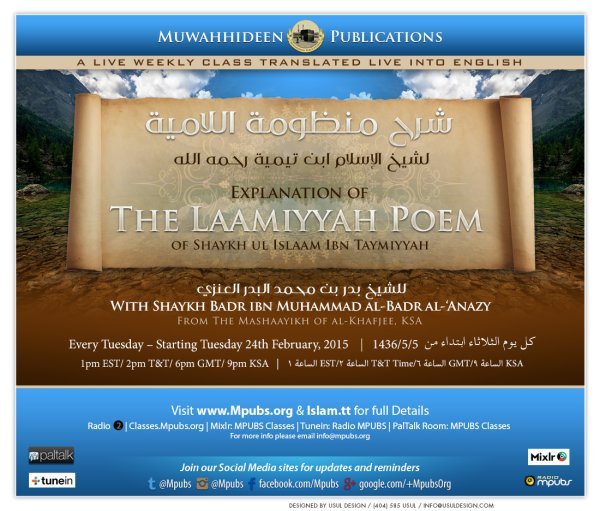
Explanation of The Laamiyyah Poem of Shaykh-ul-Islaam Ibn Taymiyyah – Shaykh Badr al-Badr al-Anazy [Audio|Ar-En]

Explanation of The Laamiyyah Poem of Shaykh-ul-Islaam Ibn Taymiyyah - Shaykh Badr al-Badr al-Anazy

Explanation of The Laamiyyah Poem of Shaykh-ul-Islaam Ibn Taymiyyah

دروس أسبوعي – شرح منظومة اللامية لشيخ الإسلام ابن تيمية رحمه الله مع فضيلة الشيخ بدر بن محمد البدر العنزي

Speaker: Shaykh Badr Ibn Muhammad al-Badr al-‘Anazy الشيخ بدر بن محمد البدر العنزي
Country of Speaker: Saudi Arabia المملكة العربية السعودية
Category: ‘Aqeedah عقيدة

Class # 01 – 24.02.15  Download / Listen تحميل / استماع

[audio https://salafiaudio.files.wordpress.com/2015/04/expl-of-the-laamiyyah-poem-01-shaykh-badr-al-badr-al-anazy.mp3]

Class # 02 – 02.03.15 – Download / Listen تحميل / استماع

[audio https://salafiaudio.files.wordpress.com/2015/04/expl-of-the-laamiyyah-poem-02-shaykh-badr-al-badr-al-anazy.mp3]

Class # 03 – 10.03.15  Download / Listen تحميل / استماع

[audio https://salafiaudio.files.wordpress.com/2015/04/expl-of-the-laamiyyah-poem-03-shaykh-badr-al-badr-al-anazy.mp3]

Class # 04 – 17.03.15  Download / Listen تحميل / استماع

[audio https://salafiaudio.files.wordpress.com/2015/04/expl-of-the-laamiyyah-poem-04-shaykh-badr-al-badr-al-anazy.mp3]

Class # 05 – 31.03.15  Download / Listen تحميل / استماع
[audio https://salafiaudio.files.wordpress.com/2015/04/expl-of-the-laamiyyah-poem-05-shaykh-badr-al-badr-al-anazy.mp3]

Posted from : http://store.mpubs.org

Further Book Study : http://salaf-us-saalih.com/islamic-book-study

Maintaining Pure Hearts And Tongues Towards The Companions Of Allaah’s Messenger (صلى الله عليه و سلم) – Ibn Taymiyyah

Shaikh-ul-lslaam Ibn Taimiyyah said in his book AI-‘Aqeedat-ul-Waasitiyyah:

“Among the Principles of Ahl-us-Sunnah wal-Jamaa’ah is maintaining pure hearts and tongues towards the Companions of Allaah’s Messenger (صلى الله عليه و سلم), as Allaah has described them in His saying: ‘And those who come after them say: ‘Our Lord! Forgive us and our brothers who preceded us in Faith. And put not in our hearts any hatred against those who have believed. Our Lord, You are indeed full of kindness, most Merciful.’ [Surah Al-Hashr: 10]

And (from their principles is) obedience to the Prophet with regard to his (صلى الله عليه و سلم) saying: ‘Do not revile my Companions! For by the One whose Hand my soul is in, if one of you were to give away the size of mount Uhud in gold for charity, it would not equal a mudd of one of them nor even half of it.’

They accept what is stated in the Qur’aan, the Sunnah and the Consensus concerning their (the Companion’s) virtues and high status. And they give preference to those who spent their wealth and fought (in the Way of Allaah) before the Victory, which refers to the Treaty of al-Hudaibiyah, over those who gave their wealth and fought after it. They give precedence to the Muhaajireen over the Ansaar. And they believe that Allaah said to the people who fought in (the Battle of) Badr – who numbered over three hundred people: ‘Do whatever you wish, for I have already forgiven you.’

And they believe that no one who pledged their allegiance to the Prophet (صلى الله عليه و سلم) under the tree will enter the Hellfire, as the Prophet (صلى الله عليه و سلم) informed us. In fact, Allaah was pleased with them and they were pleased with Him. And they were more than one thousand four hundred people.

They designate to Paradise whoever the Messenger of Allaah testified will be in Paradise, such as the Ten (Companions), Thaabit bin Qays bin Shammas and others.

They confirm what has been reported in tawaatur form on the Commander of the Believers, ‘Alee Ibn Abee Taalib and others that: The best of this ummah after its Prophet are Abu Bakr; then ‘Umar. Then they place ‘Uthmaan third and ‘Alee fourth, may Allaah be pleased with all of them. This is as is indicated in the athaar (reports from the Sahaabah) and as was unanimously agreed upon that ‘Uthmaan had precedence (over ‘Alee) for being pledged allegiance to (for the Khilaafah).

In spite of this, after unanimously agreeing to the precedence of Abu Bakr and ‘Umar, some of Ahl-us-Sunnah have disagreed with regard to ‘Uthmaan and ‘Alee as to which of them is better. So a group of them gave precedence to ‘Uthmaan and then remained silent, and placed ‘Alee as the fourth. And another group gave precedence to ‘Alee. And yet another group remained neutral. But the affair of Al-us-Sunnah settled upon giving precedence to ‘Uthmaan and then ‘Alee.

Regardless, this issue of ‘Uthmaan and ‘Alee is not from the principles by which the one who disagrees concerning it becomes misguided (and deviant), according to the majority of the (scholars of) Ahl-us-Sunnah. Rather, the issue in which the one who opposes becomes misguided is the issue of the Khilaafah – and it is that they (must) believe that the Khaleefah after Allaah’s Messenger was Abu Bakr, then ‘Umar, then ‘Uthmaan, then ‘Alee. And whoever attacks the Khilaafah of any one of them, then he is more astray than the donkey of his people.”

Then he mentioned that they have love and affection for the Members of the Household of Allaah’s Messenger and that they preserve the Will (final requests) of Allaah’s Messenger concerning them. And that they have affection for the Wives of Allaah’s Messenger, the Mothers of the Believers and believe that they will be his wives in the Hereafter.

Then he said:

“They absolve themselves from the way of the Rawaafid – those who hate the Companions and revile them – and from the way of the Nawaasib – those who abuse the Members of the (Prophet’s) Household – through speech or action. And they refrain from (delving into) the disputes that occurred between the Companions. And they say: These narrations that have been reported concerning their faults have in them some that are false, some that have had things added to them, some that have had parts omitted from them, and some that have been changed from their original state. As for those narrations that are authentic (concerning their faults), then they (the Companions) are excused (and forgiven) – either they made Ijtihaad and were correct or they made Ijtihaad and were wrong.

Furthermore, they do not believe that each of the Companions is infallible and free from committing major or minor sins. Rather, they are capable of committing sins in general, however, they possess from precedence and virtues that which necessitates that they be forgiven for whatever (sins) they commit – if they did commit any. This is even to the point that they will be forgiven for evil deeds the likes of which those who come after them will not be forgiven for. This is because they possess good deeds that wipe out the evil deeds, the likes of which will not be for those after them.

It is established from the saying of Allaah’s Messenger (صلى الله عليه و سلم) that they are the best of generations and that if one of them were to give a mudd (of gold) in charity it would be better than if someone who came after them were to give the whole of Mount Uhud in gold. And if it was the case that one of them committed a sin, then either he repented from it or he performed some good deed that wiped it out. Or he will be forgiven for it due to the virtue of his precedence or because of the intercession of Muhammad H, of which the Companions have the most right among people of receiving. Or perhaps he was tested by some affliction in this world, by which it was expiated from him. So if this is with respect to the sins that were actualized (by them), then what about the matters in which they did Ijtihaad? If they were correct they will have two rewards and if they were incorrect they will have just one reward and their error will be forgiven.

Furthermore, the amount of (bad) deeds committed by some of them, that is forsaken yet forgiven, is tiny in comparison to their virtues and good qualities, such as their belief in Allaah and His Messenger, their Jihaad for His Cause, their performance of Hijrah, their support (of the Religion), as well as their beneficial knowledge and good deeds. And whoever studies the history of the ‘people’ (i.e. the Sahaabah) with knowledge and insight, and studies the merits that Allaah bestowed unto them, he will come to know with full certainty that they are the best of creation after the prophets. There was not nor will there be anyone like them. They are the safwah (chosen elite) from all the generations of this nation (of Muslims), which is itself the best and most honorable of all nations with Allaah.”

[End of Ibn Taimiyyah’s words]

Posted from : The Creed of Ahlus-Sunnah wal-Jamaa’ah concerning the Companions – Shaikh ‘Abdul-Muhsin bin Hamad Al-‘Abbaad (al-ibaanah e-Book)

The madh-hab of Ahl-us-Sunnah wal-Jamaa’ah concerning the Companions is that of moderateness between the two ends of extremism and heedlessness – Shaykh Abdul-Muhsin al-Abbad

The madh-hab of Ahl-us-Sunnah wal-Jamaa’ah concerning the Companions is that of moderateness between the two ends of extremism and heedlessnessThe madh-hab of Ahl-us-Sunnah wal-Jamaa’ah concerning the Companions is that of moderateness between the two ends of extremism and heedlessness. It is moderateness amidst the extremist fanatics who elevate the esteemed ones amongst them to a level that is only befitting for Allaah or for His messengers and moderateness amidst the heedless and harsh ones who belittle and revile them. So they are in the middle between those who are excessive and those who fall short – they love all of them and put each one of them in the due place that they deserve, with fairness and justice. So they do not elevate them to a level they don’t deserve, nor do they belittle them, taking away what they are worthy of. Their tongues are moist with mentioning them only in good, according to what is befitting for them. And their hearts are filled with love for them.

And whatever disputes and differences that occurred between (some of) them, that can be authentically confirmed, we hold that they were Mujtahideen in that regard – either they were correct and will receive one reward for their Ijtihaad and one reward for being correct, or they were wrong and will receive just one reward for their Ijtihaad while their error will be forgiven. They were not infallible since they were human beings. At times they were correct and at times they erred. But how much more were they correct as compared to others being correct, and how fewer were their errors as compared to the errors of others? And on top of this, they will receive Allaah’s forgiveness and contentment.

The books of Ahl-us-Sunnah are filled with a clarification of this pure and radiant Creed concerning these elite people, who were chosen amongst mankind to accompany the best of mankind (صلى الله عليه و سلم). May Allaah be pleased with them all.

An example of this is the statement of At-Tahaawee in his (book on the) Creed of Ahl- us-Sunnah:

“We love the Companions of Allaah’s Messenger. But we do not go to extremes in our love for anyone amongst them, nor do we absolve ourselves from any of them. And we hate anyone that hates them or anyone that talks about them in a bad way. And we do not mention them except with good. Loving them is Deen (Religion), Eemaan (Faith) and Ihsaan (Goodness) and hating them is Kufr (Disbelief), Nifaaq (hypocrisy) and Tughyaan (transgression).”

Imaam Ahmad bin Hanbal said in his book as-Sunnah:

“And from the Sunnah is mentioning the good qualities of the Companions of Allaah’s Messenger – all of them – and to refrain from (speaking about) what disputes occurred between them. So whoever reviles the Companions of Allaah’s Messenger or (just) one of them, then he is an innovator, a Raafidee.

Loving them is a Sunnah and making du’aa (supplication) for them is a means of getting close to Allaah (taqarrub). Following them is a means and taking from their example is a virtue…

Posted from : The Creed of Ahlus-Sunnah wal-Jamaa’ah concerning the Companions – Shaikh ‘Abdul-Muhsin bin Hamad Al-‘Abbaad, al-ibaanah eBook

Benefit : All of the Companions (Sahabah) of Allaah’s Messenger are Trustworthy – Shaikh Abdul-Muhsin al-Abbad

All of the Companions of Allaah’s Messenger are trustworthy based on Allaah’s testifying that for them and because of His praise for them and the praise of His Messenger (صلى الله عليه و سلم) for them.

An-Nawawee said in at-Taqreeb, which As-Suyootee explained in his Tadreeb-ur-Raawee:

“All of the Companions are trustworthy – those who were involved in the afflictions (fitan) and other than them – according to the consensus of the scholars.”

Al-Haafidh Ibn Hajr said in al-lsaabah:

“Ahl-us-Sunnah have unanimously agreed that all of them (the Sahaabah) are trustworthy and no one opposed this except some deviants amongst the innovators.”

This is why there is no harm in not knowing a Companion in a chain of narration. So if a Taabi’ee says: “On the authority of a man who accompanied the Prophet…” this does not affect the report. This is because not knowing the Companions (in the chain) causes no harm since they are all trustworthy.

Al-Khateeb Al-Baghdaadee said in his book al-Kifaayah:

“Every hadeeth that has a chain of narration that is connected between the one who reported it and the Prophet is not to be acted upon until first having affirmed the trustworthiness and reliability of all the narrators (in the chain). It is an obligation to investigate all of their conditions, except for the Sahaabee (Companion) who raises it (or attributes the hadeeth) to the Prophet. This is because the trustworthiness of the Companions is established and well known based on Allaah’s affirming that for them, His informing us of their pure state and His preference of them in the texts of the Qur’aan…”

Then he (rahimahullaah) went on to list some ayaat and ahaadeeth concerning their virtues and said:

“And even if Allaah or His Messenger had not mentioned anything about them from what we just stated now (of their virtues), the condition they were upon of having made Hijrah, fought in Jihaad, of having offered their support, sacrificed their lives and wealth, experienced the killings of their parents and children, of mutually advising for the Religion and having strong Faith and unshakeable certainty, (all of this) would be enough to prove their trustworthiness and enough for one to have firm faith in their honesty and integrity. And it would necessitate the understanding that they are the best from those who receive testimony and approval as to their trustworthiness and reliability from all of the people that will come after them forever and ever.”

Posted from : The Creed of Ahlus-Sunnah wal-Jamaa’ah concerning the Companions – Shaikh ‘Abdul-Muhsin bin Hamad Al-‘Abbaad, al-ibaanah eBook

Shaykh Hasan al Banna Visit To Masjid Tawheed – Abu Muhammad al Maghribee [Audio|En]

Lectures from Shaykh Hasan ibn Abdul Wahhab Marzooq al-Banna Visit to Masjid Tawheed

  • 01 – 12-29-11 Sh Hasan Opening Talk
    [audio https://salafiaudio.files.wordpress.com/2015/03/sh-hasan-al-banna-visit-to-masjid-tawheed-01-12-29-11-sh-hasan-opening-talk-abu-muhammad-al-maghribee.mp3]
  • 02 – 12-30-11 Sh Hasan Tafsir Surat Al-Iklaas
    [audio https://salafiaudio.files.wordpress.com/2015/03/sh-hasan-al-banna-visit-to-masjid-tawheed-02-12-30-11-sh-hasan-tafsir-surat-al-iklaas-abu-muhammad-al-maghribee.mp3]
  • 03 – 12-30-11 Sh Hasan Usoolus-Sunnah
    [audio https://salafiaudio.files.wordpress.com/2015/03/sh-hasan-al-banna-visit-to-masjid-tawheed-03-12-30-11-sh-hasan-usoolus-sunnah-abu-muhammad-al-maghribee.mp3]
  • 04 – 12-30-11 Sheikh Hasan Friday Khutbah
    [audio https://salafiaudio.files.wordpress.com/2015/03/sh-hasan-al-banna-visit-to-masjid-tawheed-04-12-30-11-sheikh-hasan-friday-khutbah-abu-muhammad-al-maghribee.mp3]
  • 05 – 12-30-11 Talk #5 Sh Hasan
    [audio https://salafiaudio.files.wordpress.com/2015/03/sh-hasan-al-banna-visit-to-masjid-tawheed-05-12-30-11-talk-5-sh-hasan-abu-muhammad-al-maghribee.mp3]
  • 06 – 12-31-11 Sh Hasan Tafsir Surat An-Noor & Usoolus-Sunnah
    [audio https://salafiaudio.files.wordpress.com/2015/03/sh-hasan-al-banna-visit-to-masjid-tawheed-06-12-31-11-sh-hasan-tafsir-surat-an-noor-usoolus-sunnah-abu-muhammad-al-maghribee.mp3]
  • 07 – 12-31-11 Sh Hasan Tafsir Surat An-Noor
    [audio https://salafiaudio.files.wordpress.com/2015/03/sh-hasan-al-banna-visit-to-masjid-tawheed-07-12-31-11-sh-hasan-tafsir-surat-an-noor-abu-muhammad-al-maghribee.mp3]
  • 08 – 1-1-12 Sh Hasan Tafsir Surat An-Noor & Usoolus-Sunnah
    [audio https://salafiaudio.files.wordpress.com/2015/03/sh-hasan-al-banna-visit-to-masjid-tawheed-08-1-1-12-sh-hasan-tafsir-surat-an-noor-usoolus-sunnah-abu-muhammad-al-maghribee.mp3]
  • 09 – 1-1-12 Sh Hasan Tafsir Surat An-Noor
    [audio https://salafiaudio.files.wordpress.com/2015/03/sh-hasan-al-banna-visit-to-masjid-tawheed-09-1-1-12-sh-hasan-tafsir-surat-an-noor-abu-muhammad-al-maghribee.mp3]
  • 10 – 1-2-12 Sh Hasan Talk #1
    [audio https://salafiaudio.files.wordpress.com/2015/03/sh-hasan-al-banna-visit-to-masjid-tawheed-10-1-2-12-sh-hasan-talk-1-abu-muhammad-al-maghribee.mp3]
  • 11 – 1-2-12 Sh Hasan Talk #2
    [audio https://salafiaudio.files.wordpress.com/2015/03/sh-hasan-al-banna-visit-to-masjid-tawheed-11-1-2-12-sh-hasan-talk-2-abu-muhammad-al-maghribee.mp3]

Audio Posted from Abu Muhamamd’s (hafidhahullaah) 4-Shared account. Visit his website followthesalaf.com to listen to more lectures.

Learning Aqeedah from Hajj – Shaykh Muhammad Al Aqeel [Audio|Ar-En]

Title: Learning Aqeedah from Hajj – Lesson 1, 2 & 3 (3 Mp3 Lectures)
By: Shaykh Muhammad Al Aqeel
Translated by: Abbas Abu Yahya
Copyright: miraath.net

Visit the below link to Listen or Download Mp3 Lectures

http://www.miraathpublications.net/learning-aqeedah-from-hajj/

Learning the Creed (Aqeedah) – Shaykh Saalih al-Fawzaan

[Q]: There are some people here, who keep away from [attending] lessons on ‘aqeedah (creed/beliefs), and they say: ‘We are Muslims, we are not unbelievers or idol-worshippers such that we have to learn ‘aqeedah or attend lectures about it’ So, O noble Shaykh, what is your view regarding this!

[A]: Teaching the Muslims [the correct] ‘aqeedah does not mean that we have judged them to be unbelievers. Rather, we teach the Muslims about ‘aqeedah in order for them to know about it thoroughly, and know what matters nullify it and what matters are contrary to it. Hudhayfah ibn al-Yamaan, one of the distinguished Companions – radiallaahu ‘anhu – said: “People used to ask the Messenger about the good, but I used to ask him about the evil, for fear of falling into it.” [2]

Likewise ‘Umar ibn al-Khattaab radiallaahu ‘anhu said: “Soon the bonds of Islaam will be loosened bit by bit, because people will enter into Islaam but will be unaware of Jaahiliyyah (ignorant practices that Islaam opposes).” [3] Thus, when we teach ‘aqeedoh, this does not imply that we have judged those whom we are teaching to be non-Muslims. Rather, what it means is that we desire that they should be thoroughly aware of the correct Islaamic ‘aqeedah; so as to cling to it, and to be aware of what opposes it; so as to keep far away from it. Allaah – the Most High – said, whilst addressing His Prophet sallallaahu ‘alayhi wa sallam: “So have knowledge about Laa ilaaha illallaah (i.e, have knowledge that none has the right to be worshipped except Allaah), and seek forgiveness for your sins, and for the believing men and women.” [Soorah Muhammad 47:19].

So it is essential that a person learns and that he does not content himself with merely saying: ‘I am a Muslim.’ Yes indeed, you are a Muslim – and ail praise is for Allaah! However, if one of you were asked as to what Islaam means, or you were asked to explain what Islaam is, then many of you would not be able to correctly explain this. If one of you were to be asked to explain what are those factors which nullify Islaam, then many of you would not be able to explain this. Thus, if a person is ignorant [of such fundamentals], it is possible that he may fall into falsehood without realising it. If one of you were asked to explain the pillars of Islaam or eemaan (faith) that the Messenger sallallaahu ‘alayhi wa sallam explained and taught, we would find that most people would be unable to do so. So how is it that a person [suffices with] saying: ‘l am a Muslim,’ yet does not know these [basic] matters!

Unfortunately, many of the daa’ees (callers to Islaam) are themselves unaware of [basic matters such as] what are the conditions for Prayer, or unaware of the rules and regulations concerning wudhoo (ablution) and those matters which

invalidate wudhoo. Some of them do not even know what matters form the arkaan (pillars) of the Prayer, or form its waajibaat (obligations), or those matters which invalidate the Prayer. So what Islaam are they calling to! Islaam is not merely a call, rather it is a reality to be learnt and practiced. So it is essential to acquire sound knowledge and understanding of the Religion. This is because a person who does not have sound knowledge, may fall into dangers without even realizing it; just like a person who walks down a path, but is ignorant of the fact that along this path there is a ditch, or a hole, or even an ambush. Yet [due to his ignorance] he ends up falling into the hole, or the ambush, without even realizing it.

Thus it is essential to learn about tawheed, since it is tawheed that is the basic foundation [of both the Religion and the correct Islaamic ‘aqeedah]. Indeed, no one abstains from learning about tawheed [and those matters it necessitates, as well as its limits, conditions, fundamentals, clear proofs, fruits and consequences, and those matters which increase and strengthen it, and those that decrease and weaken it, etc.] except one of two people: [i] an ignorant person – and the ignorant person’s [view] is not to be given any weight; or [ii] a bigoted deviant – one who desires to avert people from the ‘aqeedah of pure tawheed, and who wishes to conceal from the people his own false beliefs, and those other deviant beliefs that are [falsely] ascribed to Islaam. And this is possibly the Ease of many of those who abstain from learning about tawheed.

Allaah – the Most High – said:

“And it is not proper for all the Believers to go out together and fight. From every troop of them only a party of them should go forth, so that those who remain behind may gain understanding of the Religion so that they may [instruct and] warn their people when they return to them, in order that they may beware.” [Soorah at-Tawbaa 9:122].

Also, the Messenger sallallaahu ‘alayhi wa sallam said: “Whoever Allaah desires to show goodness to, He gives him the understanding of the Religion.” [4]

The meaning of this hadeeth is that whenever Allaah does not want to show goodness to a person, He does not give him the understanding of the Religion. So the one who says: ‘l do not need to learn ‘aqeedah.’ It is as if he is saying: ‘l do not need to gain understanding of the Religion!’ And this is said by either an ignorant person, or one who is misguided!

Al-Muntaqaa min Fataawa (1/303-306).

[2]. Related by al-Bukhaaree (no.3606) and Muslim (no.1847).
[3]. Related by Ibn Taymiyyah in his Majmoo’ Fataawaa (10/301).
[4]. Related by al-Bukhaaree (1/25), from Mu’aawiyah radiallaahu ‘anhu.

Source:  Al-Istiqaamah Magazine, Issue No.8 – Shawwal 1418H / February 1998

The Glorious Qur’aan – It Is a Proof For You or Against You – Dr. Saleh As-Saleh [Audio|En]

The Glorious Qur’aan – It Is a Proof For You or Against You
Dr. Saleh As-Saleh (rahimahullah)
https://www.youtube.com/watch?v=Hv-DmU8U3wM [19 min)

Listen / Download Mp3 (Time 19:10)

Based upon lecture of Shaykh Ibn Baaz  rahimahullaah

This sermon discusses the significance of the Qur’an as a decisive proof for or against an individual on the Day of Judgment. The speaker elaborates on the concept of giving “advice” (Nasiha) to the Book of Allah, which includes defending it, believing in it, pondering its meanings, obeying its commands, and avoiding its prohibitions. A major portion is dedicated to the five types of “abandonment” (Hajr) of the Qur’an, as detailed by Imam ibn al-Qayyim. These range from abandoning its recitation and contemplation to neglecting its rulings and seeking cures elsewhere. The sermon reinforces these points with verses from the Qur’an and sayings from the early generations of Muslims (Salaf), such as Ibn Mas’ud and Abu Musa al-Ash’ari, emphasizing that a person’s engagement with the Qur’an determines whether they will be led to Paradise or driven to Hellfire. The speaker concludes with practical advice on how to connect with the Qur’an by reciting, understanding, memorizing, and applying its teachings.

بسم الله الرحمن الرحيم. الحمد لله رب العالمين وصلى الله على محمد وعلى آله وصحبه وسلم.
In the name of Allah, the Most Beneficent, the Most Merciful. I testify that there is no true God worthy of worship except Allah and that Muhammad sallallahu alaihi wasallam is Allah’s true slave and messenger.

This will conclude the subject on the Noble Quran, and this is only really a brief discussion on the glorious Noble Quran. This last part will deal with the topic that the Quran is a proof for you or against you.

This statement is of the Prophet Muhammad sallallahu alaihi wasallam’s words and which is reported in the Hadith in Sahih Muslim. The Quran is a proof for the believer who establishes what is required from him regarding this noble book. The requirement is stated in the great Hadith in which the Prophet sallallahu alaihi wasallam declared that religion is advice.

الدين النصيحة
The religion is advice.

Then he sallallahu alaihi wasallam clarified that part of this advice is the advice to Allah’s book. Such advice has many aspects to it, including the following, and which I benefited from our Sheikh’s durus on this subject, and they are summarized as follows.

Number one: defending the Quran against all kinds of تحريف tahreef (alteration). This is advice to Allah’s book, which takes form in the defending, in defending the Quran against all kinds of tahreef (alteration).

Secondly, believing all of its reports without any kind of doubt. And this is نصيحة nasiha to Allah’s book, is believing all of its reports without any kind of doubt.

Thirdly, from the nasiha to Allah’s book is pondering on its meanings, and complying with its commands.

Fourthly, from the advice to Allah’s book is keeping away from its prohibitions.

Fifthly, from the advice to Allah’s book is believing that its legislations are the best and most perfected laws.

And sixthly, from the advice to Allah’s book is believing that this Quran, letters and meanings, is of the speech of Allah and that He ‘azza wa jall, Most Mighty and Most Magnificent, spoke it to Jibril alaihi assalam, to Gabriel, and that Jibril alaihi assalam brought it down to the Prophet Muhammad sallallahu alaihi wasallam.

Accordingly, the Quran is a proof against the one who does not establish the advice it demands. And that’s why the one who knows, ponders, and abides by the Quran, profits and his life is in constant attachment with the Quran. While the one who does not, fall in debt and his chest is in a state of confinement because they have abandoned the Quran in one way or another. This is in comparison.

The types of الهجر al-hajr, abandonment or desertation or desertion of the Quran were summarized by Imam ibn al-Qayyim رحمه الله (rahimahullah) as:

Number one: Hajr of listening to its recitation, believing in it, or giving attention to it.

Hajr, secondly: abandonment or desertion, hajr, of acting by it and abiding by what it prescribes as halal or haram, even though the one who does so believes in it or recites it. Meaning it is not sufficient to believe in it and recite it and then abandon acting by it and abiding by what it prescribes as halal or haram. Rather, therefore, from the hajr, from the abandonment, is abandonment of acting by it and abiding by what it prescribes as halal or haram, even though the one reading it believes in it or recites it.

The third type: Hajr (abandonment) of ruling by it or taking it as a judge in all matters of religion, believing that it does not warrant certainty of conviction, and that its evidences are merely literal in the sense that it does not result in knowledge. This is a type of abandonment.

Number four: hajr of reflecting upon its meanings, understanding them, and knowing what Allah, the one who spoke it, desires from the one who recites it. This is the fourth type of hajr.

The fifth type of hajr is Hajr of using the Quran as a cure and healing for all the diseases and ailments of the heart. So he seeks the cure of his ailment in other than the Quran and thus abandons its use as a medicine. So the person seeks the cure of his or her ailment in other than the Quran and thus abandons its use as a medicine.

All of this is signified in the saying of Allah in Surah al-Furqan, in chapter 25, verse 30.

قال الله تعالى Allah the Exalted said:

وَقَالَ الرَّسُولُ يَا رَبِّ إِنَّ قَوْمِي اتَّخَذُوا هَٰذَا الْقُرْآنَ مَهْجُورًا

And the Messenger (Muhammad صلى الله عليه وسلم) will say: “O my Lord! Verily, my people deserted this Qur’an (25:30)

Even though some kinds of hajr are lesser in magnitude than others. One of the Salaf رحمهم الله (rahimahumullah) stated that no one ever sits with the Quran and leaves safe. He will either win or lose. And he will, he will never leave kind of neutral. He will either win or lose. And then he recited the following verse in Surah al-Isra, 17, 82.

وَنُنَزِّلُ مِنَ الْقُرْآنِ مَا هُوَ شِفَاءٌ وَرَحْمَةٌ لِّلْمُؤْمِنِينَ ۙ وَلَا يَزِيدُ الظَّالِمِينَ إِلَّا خَسَارًا

And we send down from the Quran that which is a healing and a mercy to those who believe in tawhid and act upon it. And it increases the الظالمين dhalimin, the polytheists and the wrongdoers, nothing but loss. (17:82)

Ibn Mas’ud may Allah be pleased with him, said, quote, “The Quran is an intercessor of which intercession will be accepted and a disputant and credible adversary. So, whoever places it as his leader, it will lead him to الجنة al-Jannah, to Paradise. And whoever places it behind his back, it will lead him to the fire of hell.” End of quote. And this is reported by Abdul Razzaq in his Musannaf and al-Tabarani in al-Kabir, through the same chain of narration, and it is, or its isnad is declared as sahih by the checker of Jami’ al-‘Ulum wal-Hikam.

It is also reported that Abu Musa al-Ash’ari may Allah be pleased with him, said, quote, “Verily, this Quran is either a reward for you or a burden upon you. Thus, follow the Quran and let not the Quran follow you. Verily, whoever follows the Quran, it will make him to alight upon the gardens of Paradise. And whomsoever the Quran follows, it will push or thrust him from behind until it shall cast him into the fire of Hell.” End of quote.

Imam ibn al-Qayyim rahimahullah pointed out that Imam al-Bukhari rahimahullah statement, “Nobody enjoys it and benefit by it except the one who believes in it,” meaning the Quran. He stressed that nobody will enjoy the Quran and its recitation and understanding except the one who testifies that it is the words of Allah, that He really spoke and revealed to His Messenger sallallahu alaihi wasallam. Anyone who does not believe that the Quran is a true book from Allah, which He truly spoke to Jibril and revealed to Muhammad sallallahu alaihi wasallam and that it is not part of his creation, then his heart is constrained by difficulty therefrom.

And anyone who says that it has a باطن batin, an inward meaning that opposes its ظاهر dhahir, its outward meaning, or that it has a figurative interpretation that opposes its apparently understood meaning, then his heart is striated by difficulty therefrom. Anyone who says that the Quran has a meaning which we cannot understand or apply, rather we worship Allah by the mere recitation of its, then indeed his heart is confined by difficulty therefrom.

Nobody subjects the Quran to the rhyme of baseless opinions, the irrationality of the people of scholastic theology, the sophistry of the sufists, and the superstitions of the Sufis, except that his heart is constrained by difficulty therefrom.

Anyone who makes the Quran subservient to his sect or madhhab or to the far-stretched ideas of whom he blindly follows, then his heart is confined by difficulty therefrom.

Anyone who does not take the Quran as a judge in the open or in secret and all matters, in all matters of deen, and does not submit to its rules, no matter what it could be, then his heart is striated by difficulty therefrom.

And anyone who does not comply with its commands and is not forbidden by its restraining statements, and does not believe in all of its reports, then his heart is restricted by difficulty therefrom.

All of those people, their hearts are not affected by the meanings of the Noble Quran, nor do they understand it as it should be understood, and they find not the joy of its sweetness and taste and which the companions and their successors found.

رحم الله Rahim Allah Imam Ibn al-Qayyim and the scholars of Islam, and may Allah subhanahu wa ta’ala make from this discussion a benefit for myself and a proof for me and not against me, and the same for you.

والحمد لله رب العالمين وصلى الله على محمد وعلى آله وصحبه وسلم
Walhamdulillahi rabbil ‘alameen wa salla Allahu ‘ala Muhammadin wa ‘ala aalihi wa sahbihi wa sallam.

This concludes the subject on the glorious Quran, and there is a reminder at the end, is that we should exert the effort to try to begin the process of reciting the Quran, understanding, even if we take five verses at a time, recite them properly, correctly, understand what they mean, commit them to memory and go on. And act upon what we learn. This is my advice. This is the advice for myself first and for all of you.

Walhamdulillahi rabbil ‘alameen wa salla Allahu ‘ala Muhammadin wa ‘ala aalihi wa sahbihi wa sallam.

The Glorious Qur’aan – It Is Blessed, In Its Influence, Its Results, Its Rewards – Imam Ibn Baaz | Dr. Saleh As-Saleh [Audio|En]

Listen / Download Mp3 (Time 52:38)

Based upon lecture of Shaykh Ibn Baaz  rahimahullaah

The Glorious Qur’aan – It Is Uncreated and It Is the Speech of Allaah – Dr. Saleh As-Saleh [Audio|En]

Listen / Download Mp3 (Time 47:14)
[audio https://salafiaudio.files.wordpress.com/2014/09/the-glorious-quraan-01-it-is-uncreated-and-it-is-the-speech-of-allaah-saleh-as-saleh.mp3]

Based upon lecture of Shaykh Ibn Baaz  rahimahullaah

The Creed of the Salaf (Righteous Predecessors) regarding the Noble Qur’aan – Shaykh ibn Uthaymeen

Bismillaah

Question 60:

What is the creed of the Righteous Predecessors regarding the Noble Qur’aan?

The Answer:

The creed of the as-Salaf pertaining to the Noble Qur’aan is like their creed with regard to the rest of the Attributes and Names of Allaah, and it is based upon what is proven by the Book of Allaah and the Sunnah of His Messenger (صلى الله عليه و سلم). And we all know that Allaah, The One free of all imperfection, The Most High, described the Qur’aan as being His Words, and that it is sent down from Him. So, He, Most Magnificent and Most High, Says:

وَإِنْ أَحَدٌ مِّنَ الْمُشْرِكِينَ اسْتَجَارَكَ فَأَجِرْهُ حَتَّىٰ يَسْمَعَ كَلَامَ اللَّهِ ثُمَّ أَبْلِغْهُ مَأْمَنَهُ

“And if anyone of the Mushriks seeks your protection, then grant him protection so that they may hear the Word of Allaah [the Qur’aan], and then escort him to where he can be secure” [Qur’aan, soorat at-Tawbah (9): 6].

And the intended by the “Word of Allaah” here, without any doubt, is the Noble Qur’aan. And furthermore, He, the Most High, Says:

إِنَّ هَٰذَا الْقُرْآنَ يَقُصُّ عَلَىٰ بَنِي إِسْرَائِيلَ أَكْثَرَ الَّذِي هُمْ فِيهِ يَخْتَلِفُونَ

“Verily, this Qur’aan narrates to the Children of Israel most of that in which they differ” [Qur’aan, soorat an-Naml (27): 76].

So, the Qur’aan is the Word of Allaah, The Most High, letter and meaning. He really Spoke it and bestowed it upon Jibreel, the trustworthy, who then brought it down upon the heart of Muhammad (صلى الله عليه و سلم) so that he may be one of those who warn, in the plain Arabic language.

The Salaf also believe that the Qur’aan is a Revelation, brought down by Allaah (عزّ وجلّ) upon Muhammad (صلى الله عليه و سلم) in parts over a period of twenty three years as necessitated by Allaah’s Wisdom. In addition, its revelation is either original or occasional, meaning that some of it is brought down in response to a certain occasion that necessitated its revelation, and some of it is revealed without being due to a certain reason. Also some of it is revealed as a narration of a past condition that occurred to the Prophet (صلى الله عليه و سلم) and his companions, whilst some of it comes down as original legislations, revealed for the first time. This is according to what has been mentioned by the people of knowledge pertaining to this matter.

Furthermore, the Salaf say: The Qur’aan is in the beginning from Allaah (عزّ وجلّ), and to Him it shall return at the end of time.” This constitutes the saying of the Salaf regarding the Noble Qur’aan.

And it is something well known to us all that Allaah, The Most High, described the Qur’aan with great qualities. He described it as hakeem (wise), kareem (an honourable reciter: Noble), ‘atheem (great), and majeed (glorious). And these qualities with which Allaah has described His Words applies to the one who holds to this Book and works according to it openly and inwardly. So Allaah, The Most High, grants him from the glory, greatness, wisdom, might, and authority, something that it would not be given to the one who does not cling to the Book of Allaah (عزّ وجلّ). That is why I call upon, from this pulpit, all of the Muslims, rulers and ruled, scholars and common people, to cling hold to the Book of Allaah (عزّ وجلّ), openly and inwardly, so that they attain the might, happiness, glory, and prevalence in the East and West.

SourceFiqhul ‘Ibaadaat – Understanding Worship, By Shaykh Muhammad bin Saalih Al-‘Uthaimeen (rahimahullah), Translated by Dr. Saleh as Saleh (rahimahullaah)

The Blemishes of Aqidah and the means to avoid them – Ibn Baz

Click the below link to read or download PDF

The Blemishes of ‘Aqidah and the means to avoid them – Ibn Baaz – alifta [PDF]

Understanding Worship (Fiqh ul-‘Ibadah) – Shaykh Uthaymeen | Dr Saleh as Saleh

Click the Below Link to Read or Download the PDF

Audio

Contents of this e-Book

Introduction by Dr. Saleh as-Saleh rahimahullaah

Questions & Answers

The Tawheed and Belief
The Purpose Behind The Creation Of Mankind

Question 1: What is the purpose of creating mankind?

Question 2: Is there a meaning for ‘Ibaadah (worship) such that it is possible for us to know of? Does it have a general and a specific meaning?

Question 3: Would those specifically choosing al-’Ibaadah al-Kawniyyah and excluding al-’Ibaadah ash-Shar’iyya, be rewarded?

The First Obligation upon the Slaves [of Allaah]

Question 4: What is the first obligation upon the creation?

The Relation of the Shaadah with the Types of Tawheed.

Question 5: But does the Shahaadah Comprise the Types of Tawheed?

The Meaning of Tawheed.

Question 6: What is the Meaning Tawheed?
Question 7: In General, What are the Types of Tawheed ?
Question 8: What are the Types of Tawheed? Please Clarify and Give Examples.

The Importance of Tawheed Al-Asmaa’ was Sifaat

Question 9: We would like some more details about this type of Tawheed i.e. Tawheed al-Asmaa’ was Sifaat.

The obligations Towards Each Type Tawheed

Question 10: What is obligatory upon us towards each of the types alone?

The Danger in Worshipping other than Allaah

Question 11: What is the ruling on directing any kind of worship to other than Allaah, The One free of all imperfections?

The Meaning of Ash-Shahaadataan

Question 12: What is the meaning of Ash-Shahaadataan: La Ilaaha Illallaah and Muhammad Rasoolulaah.

The Meaning of The Shahaadah: Muhammad is the Messenger of Allaah.

Question 13: You explained the meaning of the Shahaadah: La Ilaaha Illallaah. So, what is the meaning of the Shahaadha: Muhammad Rasoolullaah

The Difference Between the Profession with the Tongue and the Profession with the Heart

Question 14: However, what is the difference between the profession of the testimony of faith with the tongue and its profession with the heart? Is it obligatory to profess both?

A Doubt and its Rebuttle
Question 15: What lead to this question is that nowadays there is a group of people when they are called to worship Allaah they say: “Allaah is the Rabb of the hearts.” We would like also that you comment on this response?

The Meaning of Eemaan
Question 16: Briefly, what is the meaning of Eemaan [faith] and its pillars.

The Relation of Eemaan to the Hadeeth of Jibreel (alaihissalam)
Question 17: Is the aforementioned meaning the same as that which came in Prophet’s (alaihissalam) answer to Jibreel’s question about Eemaan?

Question 18: If a person is asked about Eemaan, should he say that it means the attestation that obligates acceptance and submission, or should he say that it means to believe in Allaah, His Angels, His Books, and His Messengers as the Messenger صَلَّى اللّٰهُ عَلَيْهِ وَسَلَّم explained?

The Meaning of Eemaan And Its Pillars
Question 19: We would like to expound on the meaning of Eemaan and also know of its pillars?

How to Respond to the Dahrees
Question 20: We know that the Dahrees, who are many nowadays and who are considered from the intellect because they think and infer, are agreed upon the belief in the non-existence of Allaah, The Mighty and Majestic. So, how to respond to people like this?

The Eemaan (Belief) and its Pillars
Question 21: What are the Pillars of Eemaan?

The Belief in the Angels
Question 22: Are there other things related to the belief in the angels?

The Belief in the Books
Question 23: What about the Third Pillar of Eemaan?

The Belief in the Messengers
Question 24: What do you say regarding the Fourth Pillar of Eemaan–Belief in the Messengers?

The Belief in the Last Day
Question 25: How can the belief in the Last Day be?

The Belief in al-Qadar
Question 26: What about the pillar of belief in al-Qadar.

The Increase and Decrease of Eemaan (Faith)

Question 27: Does Eemaan increase or decrease? What are the things that make it increase or decrease?

Question 28: There are those of the opinion that Eemaan neither increases nor decreases, and that sin wipes out Eemaan entirely, and that the person who commits it becomes a Kaafir! How to respond to those people?

Denying that Eemaan Increases and Decreases

Question 29: But what is the Islamic Ruling vis-à-vis the unattestation to the increase and decrease of faith?

The Manner of Judging by other than that which Allaah has revealed

Question 30: What is the manner of judging by other than what Allaah has revealed?

The Difference Between the Thaalim (Transgressor) and Faasiq (Disobedient Sinner`)

Question 31: You mentioned, however, about the Faasiq and the Thaalim things that are close, or possibly intermixed. And it is that the Thaalim rules by that which Allaah has not sent down whilst knowing that Allaah’s Judgment is better. But that he intends to gratify his thirst for revenge from someone. So he applies a judgment on someone that Allaah has not approved of. And then the Faasiq rules while knowing the Judgment of Allaah and that it is the right Judgment, but because of his own interest or lowly desire, or due to a certain bias to fulfill the desires of someone else, he rules by that which Allaah has not sent down. So what is the difference between the two?

SOOTHSAYING (Fortune-Telling)
Question 32: What is Soothsaying?

The Ruling Regarding Those Who go to Diviners
Question 33: It would be nice if we could know of the status of people who go to fortune-tellers.

Astrology and Its Ruling
Question 34: What is astrology (At-Tanjeem) and it’s ruling?

The Relation of Astrology with Fortune-Telling
Question 36: Is there a connection between astrology and divination?

Which One is More Dangerous?
Question 37: Which one, however, is more dangerous on the Muslims?

The Reality of Magic

Question 38: You mentioned in your talk that astrology is a form of magic, so what is magic?

Question 39: What is meant by subtleness in your saying, “Magic is everything that is subtle and whose cause is hidden”?

Question 40: What is the legal judgment regarding magic and its learning?

Is There a Reality to Magic?

Question 41: Is magic a true thing, or it is just conveying doubts, and fantasies to the people?

The Relation of Divination with Magic

Question 42: You mentioned divination and you defined the fortune-teller as well as the magician. Is there, however, a connection between divination and magic?

Was the Prophet (صَلَّى اللّٰهُ عَلَيْهِ وَسَلَّم ) Bewitched?

Question 43: It was reported from the Prophet (صَلَّى اللّٰهُ عَلَيْهِ وَسَلَّم) that he was bewitched. So we would like you to talk about the means by which he (صَلَّى اللّٰهُ عَلَيْهِ وَسَلَّم) was bewitched. Furthermore, is it contradictory to the status of Prophethood that bewitchment of the Prophet (صَلَّى اللّٰهُ عَلَيْهِ وَسَلَّم) took place?

The Reality of Ilhaad?

Question 44: What is Ilhaad–concerning Allaah’s Names and Attributes?

Types of Shirk

Question 45: Shall we then change [the topic] from knowledge concerning the types of Ilhaad to that regarding knowledge of the types of Shirk?

Defining the Types of Shirk

Question 46: We knew the types of shirk, but is there a specific definition for each type of it?

Is the relinquishing of worship called Shirk?

Question 47: It was mentioned, as in the narration reported by Saheeh Muslim, the saying of the Prophet (صَلَّى اللّٰهُ عَلَيْهِ وَسَلَّم): “Verily between man and between Shirk and Kufr (unbelief) is the abandonment of prayers.” –Is the abandonment of worship considered Shirk?

The Reality of the Deen of Islaam?

Question 48: What is the Religion of Islaam?

Question 49: So should we then understand that we have a general and a particular definition of Islaam?

The Taaghut and Its Types?

Question 50: What is the meaning of at-Taaghut and its derivations?

The Creed of the Muslims Regarding ‘Eesaa (Jesus alaihissalam)?

Question 51: What is the creed of the Muslims with regard to ‘Eesaa, son of Maryam? Also what is the ruling as to the saying that he was killed and crucified.

The Division of the Ummah

Question 52: What is the extent of the split up within the Ummah after the death of its Prophet Muhammad (صَلَّى اللّٰهُ عَلَيْهِ وَسَلَّم)?

The Characteristics of the Saved Group

Question 53: What is the most distinguished qualities of the saved group?

Question 54: Is it necessary that the characteristics in the four matters: ‘Aqeedah, worship, manners and transaction be totally or completely present without diminution? And in case anything of it is gets diminished, does this take the person out of the folds of the saved group or it doesn’t ?

Question 55: Is there something you want to add concerning the qualities of the saved sect?

The Correct and False Tawassul

Question 56: What is the correct and false Tawassul ?

A Fifth Kind of Tawassul

Question 57: Are there any other types of Tawassul in addition to the four that you have mentioned?

The Incorrect and Futile Tawassul and its Types.

Question 58: Having known the Correct Tawassul and its Types, then it is inevitable for us to know the Incorrect Tawassul and its Types.

The Affirmed and Annulled Intercession.
Question 59: What is the affirmed and nullified intercession?

The Creed of The Salaf with Regard to the Noble Qur’aan

Question 60: What is the creed of the Righteous Predecessors regarding the Noble Qur’aan?

The Most Prominent Rulings Regarding The Qur’anic Recital

Question 61: What is the most distinguished ruling of Qur’anic Recital?

The Recitation of Soorat al-Faatihah For the Prophet’s (صَلَّى اللّٰهُ عَلَيْهِ وَسَلَّم)Soul

Question 62: As regard those who bequeath that the Faatihah be recited on behalf of the Prophet’s soul, or on his behalf by the Prophet’s grave?

Appendix
Definition of Taaghut
Every Kufr is Taaghut, but not every Taaghut is Kufr
Very Important to Remember


The Correct Creed – Shaykh Abdus Salaam Burjis – Dr. Saleh as Saleh [Audio Series|En]

The Correct Creed -  Shaykh Abdus Salaam Burjis
The Correct Creed That Every Muslim Should Know
Shaykh ʿAbd-al-Salām Ibn Burjiss (raḥimahullāh)
– with notes from Shaykh Muḥammad Ibn Ramzān al-Hājirī

[Buy the Printed Book Here]

Biography of Shaykh ‘Abdus-Salam Bin Barjas Ali ‘Abdil-Karim

Audio Lessons by Dr. Saleh as Saleh (rahimahullah) based on the Book of Shaykh ‘Abdus Salaam bin Burjis (rahimahullaah)

Reviewing the Creed – A’laam As-Sunnah Al-Manshoorah – Hafidh Al-Hakami – Dr. Saleh as Saleh [Audio|En]

Reviewing the Creed-Al-Hakami – Based upon the book of Shaik Al-Hakami – A’laam As-Sunnah Al-Manshoorah

Part 01 : Listen / Download Mp3 Here (Time 15:47)
[audio http://salafiaudio.files.wordpress.com/2014/09/reviewing-the-creed-alaam-as-sunnah-al-manshoorah-01-hakami-saleh-as-saleh.mp3]

Part 02 : Listen / Download Mp3 Here (Time 8:31)
[audio http://salafiaudio.files.wordpress.com/2014/09/reviewing-the-creed-alaam-as-sunnah-al-manshoorah-02-hakami-saleh-as-saleh.mp3]

Part 03 : Listen / Download Mp3 Here (Time 12:49)
[audio http://salafiaudio.files.wordpress.com/2014/09/reviewing-the-creed-alaam-as-sunnah-al-manshoorah-03-hakami-saleh-as-saleh.mp3]

Part 04 : Listen / Download Mp3 Here (Time 13:26)
[audio http://salafiaudio.files.wordpress.com/2014/09/reviewing-the-creed-alaam-as-sunnah-al-manshoorah-04-hakami-saleh-as-saleh.mp3]

Part 05 : Listen / Download Mp3 Here (Time 18:26)
[audio http://salafiaudio.files.wordpress.com/2014/09/reviewing-the-creed-alaam-as-sunnah-al-manshoorah-05-hakami-saleh-as-saleh.mp3]

Explanation of The Four Rules (Al-Qawaa’id-ul-Arba’ah) – Dr. Saleh as Saleh [Audio Series|En]

Book of Shaykh Muhammad bin AbdulWahab At-Tamimi rahimahullaah
Audio Series based on the explanation of Shaykh Uthaymeen rahimahullah

The treatise Al-Qawaa’id-ul-‘Arba’ah” [The Four Rules regarding Shirk] is well known throughout the Muslim world and needs no introduction. It is a basic discussion that provides fundamental principles regarding Shirk. Although short in size, it is an extremely valuable source of knowledge and a must–read for all students desiring to further their understanding of Islaam.

Part 01: Listen / Download Mp3 Here (Time 25:49)

In Part 01, Dr. Saleh As-Saleh explains from the Introduction of Author Shaykh Muhammad bin Abdul Wahhaab (rahimahullah): I ask Allaah, the Most Generous, Lord of the Great Throne to befriend you in this world and the Hereafter, and to make you blessed wherever you may be. And (I ask) that He make you from those who when they are given, are thankful; when they are tested, are patient; and when they sin, seek forgiveness (from Allaah). For indeed these three characteristics are the true signs of happiness.

Part 02: Listen / Download Mp3 Here (Time 40:11)

Part 02 Covers The Foundation of Al-Haneefiyyah, The Religion of Ibraaheem

Part 03: Listen / Download Mp3 Here (Time 40:58)

Part 03 Covers – Rule No. 1 and 2 of Four rules regarding Shirk

Part 04: Listen / Download Mp3 Here (Time 1:21:20)

Part 04 Covers – Rule No. 3 and 4 of Four rules regarding Shirk

The following Benefits are extracted from these audio series:

Related Links: 

Aspects of the Days of Ignorance – Imaam Muhammad bin ‘Abdil-Wahhaab (Translated Text)

AUTHOR: Imaam Muhammad bin ‘Abdil-Wahhaab [Died 1206H]
TRANSLATED: Al-Ibaanah Book Publishing
PRODUCED BY: Al-Ibaanah.com

About the Book:

This is a translation of the classical treatise of Imaam Muhammad bin ‘Abdil-Wahhaab “Masaa’il-ul-Jaahiliyyah” (Aspects of the Days of Ignorance), which is a list of 128 points – each point representing one aspect of belief or practice that the people of the Days of Ignorance were upon, which Islaam came to oppose. The source used for this translation can be found on sahab.org.

The original Arabic text of the treatise is included within this translation so as to make this e-book a comprehensive reference guide and an easily-accessible study guide. Footnotes were added by the translator in order to clarify and provide evidence for some of the points that the author mentioned but didn’t provide proof or an explanation for. In recent times, this treatise has been explained by Shaikh Saalih Al-Fawzaan in several lectures. These lectures were recorded and transcribed and put into a book.

The subject matter of this treatise is one of great importance, for the aspects of the Days of Ignorance have not ceased to be acted upon till this very day. And the people that call towards these misguided beliefs and practices of the Days of Ignorance are many, such as innovators and people of desire. So it is important for the Muslim to learn what the People of the Days of Ignorance were upon in terms of beliefs, actions and practices, so that he may avoid that, since Islaam came to oppose these aspects.

Quotes from the Book: “These are the aspects that the people of the Days of Ignorance – both the people of the Book and the non-People of the Book – were upon, which the Messenger of Allaah opposed. They are from the matters that every Muslim is required to possess knowledge of. This is since with (understanding) one side of the opposite, the goodness of the other side of the opposite can be made apparent. And it is by (making apparent the) opposite of something that matters become clarified. The most important of these aspects (of the Days of Ignorance) and most severe in terms of danger was the absence of faith (Eemaan) in the heart, for what the Messenger of Allaah came with. And if approval for what the people of the Days of Ignorance were upon is further added to this (absence of faith), then the total ruin is achieved, as Allaah says: ‘And those who believe in the falsehood while disbelieving in Allaah, it is they who are the losers.’ [Surah Al-‘Ankaboot: 52]”

[3] They held the acts of opposing the figure of authority and failing to comply with him as being something virtuous. And they saw the acts of hearing and obeying as being humiliating and degrading. So Allaah’s Messenger opposed them and commanded that patience be observed when facing the oppression of the rulers. And he commanded with hearing and obeying them, as well as advising (them). And he spoke extensively in regards to that and he constantly brought it up and repeated it.”

[5] From their greatest principles was that they were deceived by (following) the majority, using that as a proof against the correctness of a matter. And they also used as evidence for declaring the falsehood of something, the fact that it was strange and that its adherents were few. So Allaah prescribed the opposite of that and He clarified this in many places of the Qur’aan.”

[23] They were deluded by the life of this world. So they perceived Allaah’s bestowal of worldly material (on someone), as an indication of He was pleased (with that person), as He says: ‘And they say: We are abundant in wealth and in children. And (because of that) we are not going to be punished.’ [Surah Saba’: 35]”

[Download the Book Here]

This is Our Call (The Way of the Salaf) – Imaam Al-Albaanee

AUTHOR: Imaam Muhammad Naasir-ud-Deen Al-Albaanee
TRANSLATED: Al-Ibaanah Book Publishing
PRODUCED BY: Al-Ibaanah.com

About the Book:

This is a translated transcription of a lecture delivered by Imaam Al-Albaanee (rahimahullaah) that was recorded and distributed under the title “Hadhihi Da’watunaa” (This is Our Call). The present translation was translated directly from the Arabic audio.

In this lecture, Imaam Al-Albaanee explains the basis of the Salafee Manhaj, which is following the way, understanding and practical application of the Salaf, who were namely the first three generations of Muslims: The Sahaabah, Taabi’een and Atbaa’ at-Taabi’een. They are the ones referred to in the Prophet’s saying: “The best of mankind is my generation, then those that come after them, then those that come after them.”

This is the basis that distinguishes the true call to Islaam from all other false and erroneous calls, regardless if they claim to be “upon the Qur’aan and the Sunnah.” Al-Albaanee goes into depth discussing this fact, that one cannot truly understand and apply the Qur’aan and Sunnah unless he follows the understanding and application of the Salaf. We ask Allaah to accept this effort and benefit the Muslims with it.

Quotes from the Book:

“So here we have given the answer from the ayah and the two hadeeth, we just mentioned. Follow the way of the Believers! The way of those believers from present times? The answer is no, we mean the Believers from the past – the first era – the era of the Companions – the Salaf As-Saalih (pious predecessors). These are the people whom we should take as our example and as the ones whom we follow. And there is absolutely no one equal to them on the face of the earth. Therefore, the essence of our call is based on three pillars – on the (1) Qur’aan, the (2) Sunnah and (3) Following the Salaf As-Saalih (pious predecessors).”

“So everyone claims to follow the Qur’aan and the Sunnah, and how often have we heard this kind of talk from the youth who are in confusion, when they say: ‘Ya akhee, these people claim to follow the Qur’aan and the Sunnah and those people claim to follow the Qur’aan and the Sunnah.’ So what is the clear and decisive distinction? It is the Qur’aan and the Sunnah and the Methodology of the Salaf As-Saalih. So whoever follows the Qur’aan and the Sunnah without following the Salaf As-Saalih, he in fact has not followed the Qur’aan and the Sunnah, rather he has only followed his intellect, if not his desire.”

“After making clear this important condition of “upon the methodology of the Salaf As-Saalih”, I must give you some examples. In the past, the Muslims split up into many sects. You hear about the Mu’tazilah, you hear about the Murji’ah, you hear about the Khawaarij, you hear about the Zaidiyyah, not to mention the Shi’a and the Raafidah and so on. There is no one amongst these groups, no matter how deep in misguidance they are, that does not share the same saying as the rest of the Muslims, which is that: “We are on the Qur’aan and the Sunnah.” No one amongst them says: “We don’t follow the Qur’aan and the Sunnah.” And if one of them were to say that, he would completely leave the fold of Islaam. So then why did they split up so long as all of them rely on the Qur’aan and the Sunnah – and I bear witness that they do rely on the Qur’aan and the Sunnah for support. But how is this relying done? It is done without relying on the third foundation, which is what the Salaf As-Saalih were upon.”

[Download the Book Here]


Video Courtesy: adamibnzubayr

The Creed of Ahlus-Sunnah wal-Jamaa’ah concerning the Companions – Shaykh Abdul-Muhsin Al-Abbaad

AUTHOR: Shaikh ‘Abdul-Muhsin bin Hamad Al-‘Abbaad
TRANSLATED: Al-Ibaanah.Com
PRODUCED BY: Al-Ibaanah.com

About the Book:

This is a translation of a small treatise entitled ’Aqeedatu Ahlis-Sunnah wal-Jamaa’ah fis-Sahaabat-il-Kiraam (The Creed of Ahlus-Sunnah wal-Jamaa’ah concerning the Companions) written by Shaikh ‘Abdul-Muhsin Al-‘Abbaad. The source for this treatise was an article the Shaikh wrote for the Islamic University of Madeenah Newsletter (Issue 2 of their fourth year) Shawaal 1391H. This article was distributed together with a transcribed lecture from the Shaikh entitled “Sending Salaat on the Prophet” in a booklet published by the Islamic University of Madeenah.

In this brief presentation, Shaikh Al-‘Abbaad, one of the senior scholars and a Muhaddith in Saudi Arabia, may Allaah preserve him, outlines the proper belief a Muslim should have with regard to the Companions, and that is of moderateness.

So the Muslim should not go to either extreme of being fanatical towards individuals amongst the Companions or being lenient and heedless about the rights they deserve. Rather, it is upon the believer, the adherent of Ahlus-Sunnah wal-Jamaa’ah, to have love and respect for all of them, as well as to acknowledge their virtues and refrain from mentioning their errors and mishaps. The Shaikh presents the material in a concise but educational manner, quoting numerous ayaat, ahaadeeth and statements of the Salaf.

Quotes from the Book:

“The madh-hab of Ahl-us-Sunnah wal-Jamaa’ah concerning the Companions is that of moderateness between the two ends of extremism and heedlessness. It is moderateness amidst the extremist fanatics who elevate the esteemed ones amongst them to a level that is only befitting for Allaah or for His messengers and moderateness amidst the heedless and harsh ones who belittle and revile them. So they are in the middle between those who are excessive and those who fall short – they love all of them and put each one of them in the due place that they deserve, with fairness and justice. So they do not elevate them to a level they don’t deserve, nor do they belittle them, taking away what they are worthy of. Their tongues are moist with mentioning them only in good, according to what is befitting for them. And their hearts are filled with love for them.“

“And whatever disputes and differences that occurred between (some of) them, that can be authentically confirmed, we hold that they were Mujtahideen in that regard – either they were correct and will receive one reward for their Ijtihaad and one reward for being correct, or they were wrong and will receive just one reward for their Ijtihaad while their error will be forgiven. They were not infallible since they were human beings. At times they were correct and at times they erred. But how much more were they correct as compared to others being correct, and how fewer were their errors as compared to the errors of others? And on top of this, they will receive Allaah’s forgiveness and contentment.”

“These are five examples from the sayings of the Salaf As-Saalih (righteous predecessors), which demonstrate what we are obligated to believe in with respect to the best of creation after the Prophets and Messengers. One thing we must understand is that defaming these chosen and unique individuals is equal to defaming the Religion itself, since it was none other than them who passed the Religion down to those who came after them. And we already mentioned the words of Abu Zur’ah, in which he said: ‘The only ones who brought this Qur’aan and Sunan (plural of Sunnah) to us are the Companions of Allaah’s Messenger. (So) they only wish to disparage and demolish our witnesses so that they can nullify the Book and the Sunnah, whereas they are more deserving of being disparaged for they are the heretics (zanaadiqah).'”

[Download the Book Here]

Short Articles extracted from this book:

Benefit : All of the Companions (Sahabah) of Allaah’s Messenger are Trustworthy – Shaikh Abdul-Muhsin al-Abbad

The madh-hab of Ahl-us-Sunnah wal-Jamaa’ah concerning the Companions is that of moderateness between the two ends of extremism and heedlessness – Shaykh Abdul-Muhsin al-Abbad

Refraining from (speaking about) the differences that occurred between Companions – Shaikh Abdul-Muhsin Al-Abbaad

Maintaining Pure Hearts And Tongues Towards The Companions Of Allaah’s Messenger (صلى الله عليه و سلم) – Ibn Taymiyyah

Benefit: Defaming the Companions is equal to Defaming the Religion itself – Shaykh Abdul-Muhsin