How To Understand Islam – The Saved Group Follows the Way of the Companions – 32:12
—
This is the 3rd lecture in the “How to Understand Islam” Series
https://abdurrahman.org/2015/02/21/how-to-understand-islaam-dr-saleh-as-saleh/
Islamic Knowledge – Islam, Sunnah, Salafiyyah

How To Understand Islam – The Saved Group Follows the Way of the Companions – 32:12
—
This is the 3rd lecture in the “How to Understand Islam” Series
https://abdurrahman.org/2015/02/21/how-to-understand-islaam-dr-saleh-as-saleh/
Fatwas of the Permanent Committee>Group 2>Volume 2: `Aqidah>The Sects>Ahmad Deedat’s “Al-Qur’an the Miracle of Miracles”
Fatwa no. 19040
Q: Ahmad Deedat said in his book “Al-Qur’an the Miracle of Miracles” that Qur’an includes many references to the number 19 and its multiplications. He gave many examples and here are some of them:
– The word “اسم” (name) is mentioned 19 times in the Qur’an.
– The word “الله” (Allah) is mentioned 2698 (19 x 142) times in the Qur’an.
– The word “الرحيم” (The Most Merciful) is mentioned 114 (19 x 6) times in the Qur’an.
– The letter “ن” (Nun) is mentioned 133 (19 x 7) times in Surah Al-Qalam.
He also made reference to the study conducted by Dr. Rashad Khalifah in his book “Al-Qur`an Taqdim Mar’y li-Mu`jizah”. Here are some examples of the points he raised:
– The first Qur’anic revelation is composed of 19 words which include 76 (19 x 4) letters.
– The first Surah (Qur’anic chapter) revealed in the Qur’an includes 19 Ayahs (Qur’anic verses) and 285 (19 x 15) letters, etc.
Please give us your Fatwa (legal opinion issued by a qualified Muslim scholar) in this regard.
Answer:
This study is among the fabricated falsities of a sect called Al-Batiniyyah Al-Baha’iyyah. It is based on glorifying the number 19. There is no doubt that this study is false, as it involves manipulating the Glorious Qur’an and distracting people from pondering its true meanings.
So, it is the duty of Muslims to beware of falling into this evil group and of being affected by its ideas or books.
We ask Allah (Glorified and Exalted be He) to save us from their plotting and to protect Muslims from their evils, for He is All-Powerful.
May Allah grant us success. May peace and blessings be upon our Prophet Muhammad, his family, and Companions.
The Permanent Committee for Scholarly Research and Ifta’
Chairman – Imaam Abdul-`Aziz ibn `Abdullah ibn Baz
Source : http://www.alifta.net
O Brothers, know that the Muslim ummah is divided into three groups with respect to Allaah’s Pre-Decree:
The First Group:
They went overboard in their affirmation of Allaah’s Pre-Decree, denying that the human being has any ability or choice in the matter. They hold that “A person has no ability or choice – he is controlled and has no free will, just like a tree when it is blown by the wind.” They do not distinguish between a person’s action that occur as a result of his choice and an action of his that occurs without him choosing so. No doubt, these people are astray, because what is known from the Religion by necessity, and from the intellect and customs, is that a human being knows the difference between an action he chooses to do and an action he is forced into doing.
The Second Group:
They went to extremes in their affirmation of a person’s ability and choice, such that they negated Allaah having any part in Willing or Choosing or Creating what action a person does. And they claimed that a person is independently responsible for producing his action. This is such that a group amongst them went too far, saying: “Allaah does not know what actions His servants will do until after it occurs from them.” These people have also gone to extremes and shown great radicalism in affirming a human being’s ability and choice.
The Third Group:
These are the ones who truly believe, and so Allaah has guided them concerning that which is disagreed upon from the truth. They are Ahlus-Sunnah wal-Jamaa’ah. They have treaded the moderate path and the middle course, which is based on religious and logical proofs and evidences.
And they say: The actions that Allaah introduces into existence are divided into two types:
First: The actions from Allaah that He causes to occur in His Creation. No one has any choice in regard to these actions, and they are such as when rain descends, when the earth produces vegetation, when life or death occurs, when health or sickness befalls and so on and so forth – from the many things that can be observed occurring within the creation. Without doubt, no one has any part in choosing or willing for these things to transpire, but rather it is only Allaah who wills that to happen.
Second: The actions that the creation, i.e. all of the various types of creatures that possess a willingness, do. These actions occur as a result their choosing and wanting to do them, since Allaah gave them the ability to do that, as He says:
“To whoever amongst you wills to go straight.” [Surah At-Takweer: 28]
And He says:
“Among you is he who desires the worldly life and among you is he who desires the Hereafter.” [Surah Aali ‘Imraan: 152]
And He says:
“So whoever wishes, then let him believe, and whoever wishes then let him disbelieve.” [Surah Al-Kahf: 29]
A human being knows the difference between what occurs from him as a result of his own free will and what occurs from him as a result of being compelled and forced. So for example, when a human being climbs a ladder to get to the roof of a house, he ascends the ladder out of his own free will, and while knowing that he freely chose to do so. But when he trips and falls down from the roof, he knows that he did not choose to do that. So he can tell the difference between these two actions – that he freely chose to do the former, while he was compelled to do the latter. Every human being knows this.
Likewise, when a person is stricken with a sickness in which his urine constantly flows out, this urine comes out from him without his desiring or choosing that. But when he is in a healthy state and free from this sickness, the urine comes out from him when he wills and chooses. So he knows the difference between this and that. No one can deny the difference between the two.
And the same goes with everything else that occurs to a person – he can tell the difference between what occurs due to his free will and what occurs due to his being coerced and forced. As a matter of fact, due to Allaah’s Mercy there are some actions a person may do on his own free will, yet not be held accountable for any of them, as is the case with a person when he sleeps or forgets. In the story of the people of the Cave, Allaah tells us:
“And you would have thought them to be awake whereas they were asleep. And We turned them on their right and on their left sides.” [Surah Al-Kahf: 18]
They were the ones who turned around in their sleep, yet Allaah ascribes the action to Himself. This is because when a person sleeps, he has no choice or free will in his actions, and he will not be held accountable for actions done in this state, so the act is attributed to Allaah. The Prophet (sallAllaahu ‘alayhi wa sallam) said: “Whoever forgets while fasting, and eats or drinks, then he should complete his fast because it was only Allaah who fed him and gave him to drink.” [2] So he (sallAllaahu ‘alayhi wa sallam) attributed this act of feeding and quenching thirst to Allaah, because the action occurred from the individual without him being aware of it, so it is as if it happened without him choosing to do it.
All of us know the difference between when a person experiences pain or joy within himself at times without choosing so, and not knowing the reason why and between him experiencing these pains or these joys as a result of an act that he did himself. This matter, all praise be to Allaah is clear and there is no confusion over it.
O brothers: If we were to take the view of the first group (i.e. the Jabariyyah) who went to extremes in affirming the Divine Pre-Decree, the Religion would be invalidated from its very foundation. This is since the belief that a person has no choice or free will in his actions necessitates that he not be praised for a praiseworthy act or that he be blamed for a blameworthy act, since in reality they were not done by his choice or free will. So then this would mean that Allaah, may He be far removed from it, is oppressing those who sin when He punishes and recompenses them for their acts because He has punished them for something they had no free choice or free will in! This no doubt clearly contradicts the Qur’aan. Allaah says:
“And his companion (angel) will say: ‘Here is (his record) ready with me!’ (Allaah will say to the angels): ‘Both of you, throw into the Hellfire every stubborn disbeliever, hinderer of good, transgressor, doubter, he who set up another god with Allaah. So both of you cast him into the Severe Torment.’ His (devil) companion will say: ‘Our Lord! I did not push him to transgress, but rather it was he himself who was in error, far astray. Allaah will say: ‘Do not dispute in front of Me, I had already sent the threat to you in advance. The Word (Ordainment) that comes from Me cannot be changed, and I am not unjust to the slaves.’” [Surah Qaaf: 23-29]
So Allaah clarifies that this punishment is not oppression from Him, but rather that it is complete justice since He had previously given them a warning and clarified to them the various paths and explained the truth and falsehood to them, but they chose for themselves the path of falsehood. So there didn’t remain any proof for them before Allaah.
And if we were to take this false view, it would invalidate Allaah’s statement:
“Messengers, bearing glad tidings and warning in order that mankind would not have any argument (i.e. proof) against Allaah after the (coming of) Messengers.” [Surah An-Nisaa: 165]
Allaah denies that mankind should have any excuses after the sending of Messengers because the proof has been established against them with that. So if the Divine PreDecree was an excuse for them, this excuse would be infinite even after the advent of the messengers since Allaah’s Pre-Decree did not cease and will not cease to exist before and after the sending of messengers. So therefore, this view is invalidated by the religious texts, and it is invalidated by reality, as we have explained in the previous examples.
As for those who hold the second view, then the religious texts and reality also refute them since the texts clearly state that a person’s will is subject to Allaah’s Will:
“To whoever amongst you wills to go straight. However, you cannot will unless Allaah, Lord of the Universe, wills.” [Surah At-Takweer: 28-29]
“And your Lord creates whatever He wills and chooses.” [Surah Al-Qasas: 68]
“And Allaah calls (you) to the Abode of Peace, and guides whomever He wills to the Straight Path.” [Surah Yoonus: 25]
Those who hold this view (i.e. the Qadariyyah) are in reality invalidating one of the aspects of Allaah’s Lordship, and they are also claiming that there can be found in Allaah’s dominion that which Allaah did not will or create, when in fact Allaah wills everything, creates everything and has pre-decreed everything. They also contradict that which is known by necessity, which is that everything that is created belongs to Allaah, their essence as well as their attributes, there being no distinction between the attribute and the essence. Therefore, everything belongs to Allaah so it is not possible for there to be anything in His dominion that He did not desire. So what path should a person take and what is his solution if Allaah has pre-decreed that He go astray and not be guided?
We say: The answer to this is that Allaah only guides those who deserve to be guided, and He leads astray only those who deserve to be led astray. Allaah says: “So when they turned away, Allaah turned their hearts away.” [Surah As-Saff: 5] And He says:
“So because they breached their covenant, We cursed them and made their hearts grow hard. They change the words from their (right) places and have abandoned a good part of the Message that was sent to them.” [Surah AlMaa’idah: 13] So Allaah clarified that what caused the person to go astray was himself. A person, as we have explained previously, doesn’t know what Allaah has pre-decreed for him since he doesn’t know what has been pre-decreed until after it occurs. So he doesn’t know if Allaah has decreed for him to be astray or guided. So if this is the case, how can he take the path of misguidance, then use as an excuse the argument that this is what Allaah willed for him? Wouldn’t it be more befitting for him to tread the path of guidance and then say that Allah has guided me to the Straight Path?
Is it right for him to be a Jabaree, i.e. claim that he is forced, when he is misguided, and a Qadaree, i.e. that Allaah has no part in his deeds, when he obeys?! Never! II does not befit a person to claim that he was forced when he finds himself upon misguidance and sin. So when he goes astray and disobeys Allaah, he says: “This is something that has been written and pre-decreed for me, and I am not able to remove myself from what Allaah has ordained for me.” Yet when he does good deeds and Allaah grants him obedience and guidance, he claims that this came solely from himself, saying: “I attained this by myself.” So he becomes a Qadaree when it comes to guidance and a Jabaree when it comes to disobedience. This is not possible ever. So in reality, a person has ability and will. The door to guidance is not any more hidden than the door to sustenance and the door to seeking knowledge. A person, as is well known to everybody, has pre-decreed for him whatever he has from sustenance. But yet in spite of this, he strives for the means of sustenance in his country and outside of it, on the right and on the left. He doesn’t just sit at home and say: “Provision has been pre-decreed for me and it will come to me.” On the contrary, he strives for the means of sustenance.
Yet sustenance itself goes hand and hand with actions/works, as has been authentically reported on the Prophet, in the narration of Ibn Mas’ood, who said that he (sallAllaahu ‘alayhi wa sallam) said: “Verily, the creation of each of you is brought together in his mother’s womb for forty days in the form of a seed. Then he becomes a clot of blood for the same amount of time, then a morsel of flesh for the same amount of time. Then an angel is sent to him and commanded with four things: to record his sustenance, his lifespan, his actions, and whether he will be miserable or happy.” [3]
So this sustenance is written just as the good and evil actions are written. So how is it that you can go here and there, traversing land and sea, seeking the sustenance of the world and yet you don’t perform any righteous deed seeking the sustenance of the Hereafter or the success of Paradise? Indeed, these two aspects are one and the same. There is no difference between the two of them. So likewise, you strive for your sustenance and you strive for your livelihood and to prolong your lifespan.
But when you become ill with a sickness, you travel through all the regions of the world looking for a skilled doctor who will cure your sickness. This is even though whatever has been pre-decreed for you as your lifespan will come to be and it will not increase or decrease. Yet you do not rely on this and say: “I will remain sick and bedridden at home, and if Allaah has decreed that my lifespan will be prolonged, then it will be prolonged.” Rather, we will find you striving with all of your might and energy to find a doctor whom you regard will be the best one at whose hands Allaah will ordain your recovery. So why don’t you do acts for the Hereafter and righteous deeds the same way you do acts for this worldly life?
We stated previously that: The Divine Pre-Ordainment is a hidden secret, you have no way of finding out about it. So right now, you are between two paths – a path that will take you to salvation and success, and a path that will take you to destruction and regret. So right now, you are standing between these two paths with a free choice. There is no one in front of you preventing you from taking the right path or the left path. If you wish, you can go here, and if you wish, you can go there. So how can you take the left path and say: “This has been pre-decreed for me!” Isn’t it more befitting for you to take the right path and say: “This has been pre-decreed for me?!”
And if you want to go on a journey to some other country and before you lies two roads, one of which is paved, short and safe, while the other is unpaved, long and dangerous, we would find you choosing the short, paved and safe road and not the other one. So this figurative road is similar to it and doesn’t differ from it at all. However, it is the souls and desires that sometimes govern and take over the mind. The believer must take over and control his desires. And when his mind judges, the mind, according to its correct meaning, should prevent a person from what harms it and lead it to what benefits and pleases it.
With this it becomes clear that people have a free choice when it comes to their actions, and that they are not coerced. And just as he has a free choice in the acts of his worldly affairs, if he wills he will put out this product or make that his business, then likewise he has a free choice with regard to the affairs of the Hereafter. In fact, the paths of the Hereafter are clearer by far than the paths of this worldly life, because the One who clarifies the paths of the Hereafter is Allaah, in His Book and upon the tongue of His Messenger (sallAllaahu ‘alayhi wa sallam). So the paths of the Hereafter are clearer and more lucid than the paths of the worldly life. But in spite of this, people still tread the paths of the worldly life, which have no guaranteed results and abandon the paths of the Hereafter, whose results are guaranteed and known since they are affirmed by Allaah’s promise, and Allaah does not break His promises.
Having said this, we say that Ahlus-Sunnah wal-Jamaa’ah affirm all of this and make it their Creed and Belief that: A person acts on his own free will and says what he wants. However, his desire and choosing are subject to Allaah’s Will and Desire. Furthermore, Ahlus-Sunnah wal-Jamaa’ah believe that Allaah’s Will is subject to His Wisdom, and that it is not a pure and absolute Will, but rather a will that is dependent on His Wisdom. This is because one of Allaah’s Names is Al-Hakeem (The MostWise), and the Most-Wise is the One who judges matters precisely realistically and religiously.
And based on His Wisdom, He decrees guidance for the one who desires it and for the one whom He knows wants the truth and whose heart is upon steadfastness. And He decrees misguidance for the one who is not like this – the one who when Islaam is presented to him, his heart becomes constricted as if he were being forced to ascend to the sky. So Allaah’s Wisdom refuses to let this person be from among the guided, unless Allaah renews his determination for him and changes his desire to another desire. And Allaah is Able to do all things. However, Allaah’s Wisdom insists that the causes be closely linked to the effects.
[2] Saheeh Muslim: Book of Fasting (1155)
[3] Saheeh Al-Bukhaaree: Book of the Beginning of Creation (3208) and Saheeh Muslim: Book of Divine Pre-Decree (2643)
Posted from al-ibaanah eBook:
The Divine Pre-Decree and Ordainment of Allaah (Al-Qadaa wal-Qadar) – Shaykh Uthaymeen
Alhamdulillaah, new android app link for abdurrahman org feeds
(old android app no more works)
https://play.google.com/store/apps/details?id=me.dwnld.xqr116&hl=en
Author: Sheikh Abdul Aziz Bin Abdullah Bin Baz (rahimahullaah)
Translated by: Khalid A. Al-Awadh
Reviewed and Edited By: Dr. Saleh As-Saleh (rahimahullaah)
Published by : Co-Operative office for Call and Guidance, Riyadh
All Praise is due to Allah, we praise Him, and seek His help and forgiveness. We seek refuge in Allah, the Most High, from the evils of our own selves and from our wicked deeds. Whomsoever has been guided by Allah, none can misguide him, and whomsoever has been misguided by Allah, none can guide him. I bear witness that there is no true god worthy of being worshipped except Allah, alone, without partner or associate. I further bear witness that Muhammad is His true slave and Messenger. May Allah, the Exalted, bestow His peace and blessings on the final Prophet Muhammad, upon his good and pure family, and upon all of his noble companions.
“O you who believe! Fear Allah (by doing all that He ordered and abstaining from all that He has forbidden) as He should be feared, and die not except in the state of Islam (as Muslims with complete submission to Allah).” [Al-Qur’an 3:102]
“O mankind! Be dutiful to your Lord, Who created you from a single person (‘Adam) and from him He created his wife, and from them both He created many men and women; and fear Allah through Whom you demand your mutual (rights) and (do no cut the relations of) the wombs (kinship). Surely, Allah is ever an All Watcher over you.” [Al-Qur’an 4:1]
“O you who believe! Keep your duty to Allah and fear Him, and speak (always) the truth, He will direct you to do righteous good deeds and will forgive you your sins. And whosoever obeys Allah and His Messenger, he has indeed achieved a great success.” [Al-Qur’an 33:70-71]
Know that the most truthful speech is that of Allah’s Book (the Qur’an), and that the best of guidance is that of Muhammad, sallallahu ‘alayhi wa sallam. The worst of evils are innovations (foreign to the true teachings of Islam), and every innovated matter (in religion) is a bid’ah, and every bid’ah is a misguidance, and every mean of misguidance is in the Fire of Hell.
This is an introductory book for every Muslim. It is a summary of basic Islamic beliefs and acts of worship. We ask Allah by His Names and Attributes to accept this work and make it a benefit for those who read it and / or distribute it.
Khalid al-Awadh and Dr. Saleh As-Saleh
24/2/1413
8/12/1993
Contents
Memorizing the opening surah (chapter) of the Qur’an, al-Fatihah (the Opening) and some short passages and chapters from No. 99 (az-Zalzalah) to 114 (an-Nas). Every Muslim must make an effort to memorize, recite and understand passages and/or chapters from the Noble Qur’an.
Knowing the meaning and the conditions of the declaration of ash-shahadatan that, “There is no true God except Allah, and that Muhammad, sallallahu ‘alayhi wa sallam, is the Messenger of Allah”. The phrase that “there is no true God” negates anything or anyone that is being worshipped other than Allah, and the phrase, “except Allah”, confirms that all forms of worship, submission and adoration must be for Allah Alone, without setting up rivals with Him. The conditions needed to fulfill the meaning of ash-shahadatan are:
The six fundamental articles of faith are:
Tawhid (Faith in the Unity of Allah) is divided into three articles:
As for shirk (associating anything or anyone in worship with Allah), it is divided into three types:
Alternatively, shirk could be divided into two kinds – major and minor. In this case, the hiddenshirk encompasses both the major and minor kinds depending upon the act committed. It is major if it is the same as the shirk of the hypocrites who hide their false beliefs while showing off Islam out of fear. It is minor if it is the same as riya.
The five pillars of Islam are ash-shahadatan (bearing witness that there is none worthy of being worshipped except Allah and that Muhammad, sallallahu ‘alayhi wa sallam, is His Messenger), establishing prayers, paying the alms (zakah), fasting the month of Ramadhan, and performing pilgrimage (Hajj) if one can afford it.
The nine conditions of prayers are Islam, sanity, maturity, performing the ablution (wudu), cleanliness from impurities (on the body, clothes, and place of prayer), dressing properly, having the intention of prayers, facing the right direction of qiblah (direction of the Ka’bah at Makkah), and the praying at the proper time.
The fourteen basic elements (arkan) of prayers are standing (if one is able), saying allahu akbar(Allah is the Greatest), reading the opening surah of the Qur’an (al-Fatihah), lowering the head and back down at the right angle (ruku’), resuming the initial standing position, prostrating with the toes of both feet, both knees, both hands and the forehead touching the ground (sujud), rising in a sitting position, a short rest in a sitting posture between the two prostrations, tranquility in all actions, performing the basic elements of prayer in order, the last tashahud (the second part), sitting for the last tashahud, exalting the Prophet Muhammad, sallallahu ‘alayhi wa sallam, and turning the face to the right side and to the left one saying as-salamu ‘alaykum wa rahmatullah (peace and mercy of Allah be upon you) one time on each side.
(Note: Salah is invalid if any of the above is missing.)
The eight obligatory acts of the prayer are all the occasions of saying allahu akbar other thantakbirat al-ihram (which is basic); saying samiallahuliman hamidah (Allah accepts any who are thankful to Him) by the Imam as well as the one who is praying alone, and saying rabbana wa laka al-hamd (Our Lord, praise be to You) for both the Imam and the individual; saying subhana rabbi al-athim (Glory to my Lord, the Most Great) in ruku; saying subhana rabbi al-a’la (Glory to my Lord, the Most High) in sujud; saying rabighfirli (Oh my Lord, grant forgiveness to me) between the two prostrations; the first part (at-tashahud al-awwal); and sitting for it.
(Note: if any of the above is missing, the Muslim needs to make sujud al-sahw).
Knowing the contents of at-tashahud:
First Part: “At-tahiyyato lillahi was-salawatu wat-tayyibat. As-salamu alayka ayyuha an-nabi warahmatullahi wa barakatuh, as-salamu alayna wa ala ibadillahi as-salihin, ashadu an la ilaha illallah, wa ashadu anna muhammadan abduhu wa rasuluh.”
“Greetings, prayers ant the good things of life belong to Allah . Peace be upon you, O Prophet, and the Mercy of Allah and His blessings. Peace be upon us all and on the righteous servants of Allah. I bear witness that there is no true God worthy of worship but Allah alone, and I bear witness that Muhammad is His true slave and Messenger.”
Second Part: “Allahumma salli ala muhammad wa ala ali muhammad kama sallayta ala ibrahima wa ala ali ibrahim. Wa barik ala muhammad wa ala ali muhammad, kama barakta ala ibrahima wa ala ali ibrahim, innaka hamidon majid.”
“Oh Allah! Exalt Muhammad and the family of Muhammad, as you did exalt Ibrahim (Abraham) and the family of Abraham. And bless Muhammad and the family of Muhammad, as you did bless Abraham and the people of Abraham, verily You are the Most Praised, The Most Glorious.”
Following the reciting of the tashahud, the slave asks Allah’s protection from the torment of Hell, the torment of the grave, the trials in life-time and after death, and from the impostor Anti-Christ. After that he may supplicate and ask Allah whatever he wishes, especially the type of invocation said by the Prophet, sallallahu ‘alayhi wa sallam:
“O Allah help me to perform remembrance of You and to give all due thanks to You and allow me to worship you in the good way (i.e. as ordained by Allah and His Messenger). O Allah I have inflicted a great deal of wrong upon myself and there is none other than You who can offer forgiveness. Grant me forgiveness from You and grant me your Mercy. You are the All-Merciful, The Oft Forgiving.”
The sunnan (supererogatory) acts of the prayer:
Any prayer is invalid and nullified if any of the following acts are committed – Intentional talking, laughing, eating, drinking, uncovering the parts of the body of which are not allowed to be uncovered during prayer, excessive alteration in the direction towards the qiblah, excessive moving outside the regular acts and movements of prayer, without a proper reason and nullifying the ablution.
The ten conditions for performing ablution are:
The obligatory elements of ablution are:
The six nullifying acts of the ablution are:
Notice: Washing the dead does not nullify the ablution except for that the washer’s hand touches (without any barrier) the sexual organs. Kissing women with or without desire does not nullify ablution because the Prophet, sallallahu ‘alayhi wa sallam, once kissed one of his wives and prayed without performing ablution. This holds as long as there is no associated sexual excretions (e.g. semen). As for the saying of Allah, Most Glorified:
” … or you have been in contact with women (by sexual relations) … “ [Al-Qur’an 4: 43]
The contact with women is the involvement in a full sexual relation as related by Ibn Abbas (companion) and others, and it is the correct opinion.
The recommended morals for every Muslim are truthfulness, honesty, abstinence, modesty, courage, generosity, loyalty, refraining from everything that Allah had made unlawful, being a good neighbor, helping the needy, and other morals stated either in the Holy Qur’an or in the Prophet’s, sallallahu ‘alayhi wa sallam, tradition.
Islamic decencies – greeting, cheerfulness, eating and drinking with the right hand, adhering to the Islamic conduct in entering and leaving homes and mosques and while traveling, dealing kindly with parents, relatives, neighbors, the old man and the young; congratulating, lamenting, and other Islamic ethics.
Warning against shirk (association) and against other wrongdoing such as witchcraft, murdering, taking the money of the orphan, dealing with interest (riba), escaping on the day ofJihad (war), speaking evil of faithful women, disobeying parents, breaking up with one’s relatives, false witnessing, harming neighbors, committing outrage upon others, and other warnings as declared by Allah and His messenger, sallallahu ‘alayhi wa sallam.
Washing the dead body and performing the funeral prayer:
a) Washing the dead:
When a Muslim is confirmed dead his eyes must be closed and his jaws brought together.
When washing the dead body, the whole body beginning with the exposed parts of ablution must be washed. The abdomen is gently squeezed and followed by washing of the anus and the sexual organs using a wet piece of cloth. Normal ablution will then be performed. The body is washed starting with the head and beard using water mixed with the leaves ofsidr (lote tree, if available). The right side must be washed before the left side and the body must be washed three times. Each time the abdomen is squeezed as above. The mustache and the nails are clipped, and when the body is clean, it is wrapped in three white cotton sheets covering all parts of the body and perfumed with incense. If the body is still unclean, ablution must be extended to 5-7 times after which the body is dried with a clean cloth. Men’s hair should not be combed while that of a woman is to be braided into three chains and left hanging down behind her (as done to the Prophet’s daughter).
It is preferred to shroud men with three white sheets without a gown or amamah (head cover); children in one up to three sheets and women in five sheets, these sheets are:
Dir’: a loose outer garment with sleeves slit in front.
Khimar: covering head and face.
Izar: a sheet wrapped around the waist, and
Two overall wrapping sheets.
Young girls can be wrapped with a gown and two sheets.
The one who has the most right to wash the dead body of a man is his chosen guardian (if any) then his father, his grandfather, then the closest of his relatives. The woman is best washed by her chosen female then the mother, the grandmother, then the closest one of her female relatives. The husband can wash the body of his wife and vice versa because Abu Bakr, may Allah be pleased with him, was washed by his wife; and Ali ibn Abi Talib, may Allah be pleased with him, washed his wife, Fatimah, the daughter of the Prophet, may Allah be pleased with her.
b) The funeral prayer (salat ul-janazah):
Saying takbir (allahu akbar) four times. Reciting al-Fatihah after the first takbir. Following the second takbir, one prays for the Prophet, sallallahu ‘alayhi wa sallam, as he does intashahud. Then after saying allahu akbar for the third time, one recites what is usually said in other prayers like asking Allah to forgive all Muslims or any supplications he knows, preferably this:
“Allahumma ighfir li hayyina wa mayyitina, wa shahidina wa ghaibina wa sagheerina wa kabeerina wa thakarina wa unthana. Allahumma man ahyaytahu minna fa ahyihi ala al Islam, wa man tawaffaytah u minna fa tawaffahu ala al-iman. Allahmma la tahrimna ajrah, wa la taftinna badah.”
“O Allah, grant forgiveness to our living and to our dead, and to those who are present and to those who are absent, and to our young and our old folk, and to our males and our females. O Allah, whomsoever you grant to live, from among us, help him to live in Islam and whomsoever of us you cause to die, help him to die in faith. O Allah, do not deprive us of the reward for patience on his (her, their) loss and do not make us subject to trial after him.”
Or one could say:
“Allahumma ighfir lah u warhamhu wa’afihi wa’fu anhu, wa’akrim nuzulahu wa wassi’ madkhalahu, wa’ghsilhu bil mae wathalgi walbarad, wanaqihi mina al-thunoubi walkhataya kama unaqa athawbo alabiado mina addanas, wa abdilhu daran khairan min darihi, wa ahlan khairan min ahlihi, wa adkhilhu al-jannah, wa aidhu min adhabi al qabr, wa adhabi an-nar; wafsah lahu fi qabrihi, wanawir lahu fehi. Allahumma la tahrimna ajrahu, wa la tudhlilna ba’dahu.”
“O Allah forgive him (her, them) and have your Mercy upon him; protect him and pardon him, receive him with honor and make his grave spacious; wash him with water, snow and hail, and clean him from sins and wrong-doings as is cleaned a white garment from impurity; requite him with an abode more excellent than his, and with a mate better than his mate. Admit him to the Garden, and protect him from the torment of the grave and the torment of the Fire; widen his space in his grave and bring him light therein. O Allah don’t deprive us from his reward and don’t let us go astray after him.”
Then after saying allahu akbar for the fourth time one turns his head to the right (makingtaslim) and thus ending the funeral prayer.
It is best to raise one’s hand while saying allahu akbar. In the case when the dead is a child or an infant, the following du’a is made:
“Allahumma ejalhu dhiktan liwalidayehi, washafeean mujaban. Allahuma thaqil bihi mawazeenahuma wa a’dhun bihi ujorahuma wa alhiqhu bi salih al-mu’minin, waj’alhu fi kafalati ibrahim alayhi as-salam, waqihi bi rahmatika adhaba al-jahim.”
“O Allah make him a preceding reward and a reserve treasure (on the Day of Judgment) for his parents; a one whose intercession would be granted. O Allah make of him an excess in the measures and in the rewards (granted by Allah) to his parents. Let him join the company of the righteous believers and make him under the care of Abraham (may the peace of Allah be upon him), and protect him, by Your Mercy, from the torment of the blazing Fire.”
The tradition is for the Imam to stand right next to the head of the body if it is a man, and to the middle of the body if it is a woman. If the dead were many, men, women, male and female children in one funeral, the following positions are to be taken:
The men right in front of the Imam. The women further towards the qiblah. The male children are between the men and women and more towards the men while the female children follow women further down in the direction of qiblah (all of the dead bodies are to be laid parallel to those praying). The bodies are to be arranged such that the head of the male child lies next to that of a man while the middle of a woman lies next to the head of a man. The head of the female child lies next to the head of a woman.
The followers of Imam are to stand behind him just as in other prayers. It is acceptable for one to stand to the right of the Imam if he finds no place behind him.
All praise is due to Allah and His blessings and peace be upon His Prophet, his family and his companions.
(s) A lesson given by Shaykh Abdul-‘Aziz ibn ‘Abdullah ibn Baz
(t) Khalid A. al-Awadh
(e) Dr. Saleh as-Saleh
This is an unauthorized modification of the English translation of the booklet. For any comments or suggestions, please write to:
Islamic Da’wah and Guidance Center
Dammam, Postal Code 31311
Saudi Arabia
Tel: 827-4800, 826-3535
Fax: 827-2772
Audio Explanations of this Excellent Book:
Clip Source: http://urdu-islamic-audio.com/?s=what…
Transcribed and Translated by: Aboo Bilal Nahim ibn Abd al Majid
Date: 4th Jumada al-Ula 1437 (corresponding with 13th February 2016)
Transcription:
Today children are weak and behind in their education. weak and behind in their religion. due to this calamity. due to this calamity. The small amount of time they may have… Look for yourself! Look at your own situation, what can I say about the state of the children! Where is our time wasted? Generally (our time is wasted by).
just looking at the service of WhatsApp! How much time to we spend upon it?
How much spare time do we have?!
How much time do we have to seek knowledge?!
The knowledge of the fundamentals of the religion, the knowledge of ‘Aqeedah, the knowledge of Halaal and Haraam. How much time do we have?! Even that is wasted!
Look at your watch that is with you! How much time do you spend on WhatsApp, YouTube, Telegram?! Until the end of those (other) services that are available! You look at. in 24 hours how much time you spend (for the sake) of Allah and (for the sake of) this mobile phone!
Sharh Usool-ith-Thalaathah – Explanation of the Three Fundamental Principles
of Imaam Muhammad ibn ‘Abdil-Wahhaab [1115-1206 H]
Explained by Shaikh Saalih ibn Saalih al-Fawzaan haafidhahullaah
The above clip was extracted from Lesson 8
Read or Download : Transcription of the audio PDF
Posted with the permission of Dawud Burbank rahimahullaah
Sharh Usool-ith-Thalaathah – Shaykh Fawzan | Dawud Burbank [Audio|En]
THE BALANCED APPROACH
Shaykhul Islaam Ibn Taymiyyah – rahimahullaah – said:
“When dealing with the people of sin, one must not exceed the limits prescribed by the Sharee’ah – neither in hating, censuring, preventing, abandoning or chastising them. Rather, the one who does so should be told: Worry about your own self. No harm will come to you from those who are misled, if you are truly guided, as Allaah – the Mort High – said: “And do not let your hatred of others swerve you away from doing justice. But be just! That is closer to taqwaa (piety).” [Soorah al-Maa’idah 5:8]. And Allaah said: “And fight in the way of Allaah those who fight you, but do not transgress the limits.” [Soorah al-Baqarah 2:190]. Indeed, many of those who command and forbid overstep the limits set by Allaah, either through jahl (ignorance) or dhulm (injustice). Thus, this issue (of justice) must be firmly maintained, whether it is in regards to censuring the unbelievers, the hypocrites, the sinners or the disobedient ones.” [3]
He further said: “The one commanding the good or forbidding the evil should do so in the way prescribed by the Sharee’ah; with knowledge, gentleness and patience, and with good intentions, and by following a balanced approach. All of this enters into Allaah’s saying: “O you who believe! Beware of your own selves. No harm will come to you from those who are misled, if you are truly guided.” [Soorah al-Maa’idah 5:105) … There is in this Aayah (Verse) another meaning as well, which is that a person must turn towards that which will be of benefit to him, both in knowledge and action, and he must avoid what does not concern him – as the conveyer of the Sharee’ah (i.e. the Prophet sallallaahu ‘alayhi wa sallam) said: “From the perfection of a person’s Islaam is to leave alone that which doer not concern him.” [4] This especially applies to a person delving into that which doer not concern him regarding someone’s religious or worldly affairs. Thus, such a person may speak out of envy or desire for position; or act either with deliberate oppression, or foolish scorn and sarcasm. How often does Shaytaan make such an act appear to be an art of commanding the good or prohibiting the evil, or jihaad in the path of Allaah, whereas it is actually an act of injustice and transgression!” [5]
Footnotes:
[3]. Majmoo’ul-Fataawaa (14/381).
[4]. Saheeh: Related by at-Tirmidhee (no.23 18) and others, from Abu Hurayrahradiallaahu ‘anhu. It was authenticated by Shaykh al-Albaanee in Saheeh Sunan Ibn Maajah (no.3976).
[5]. Majmoo’ul-Fataawaa (14/382).
Posted from: https://abdurrahman.org/2014/01/29/being-balanced – Al-Istiqaamah , Issue No.5
28- Important Lessons – Ch 09 – Salaah – At-Tashahud – Its Meaning
—
Source: Important Lessons for the Ummah – Ibn Baaz
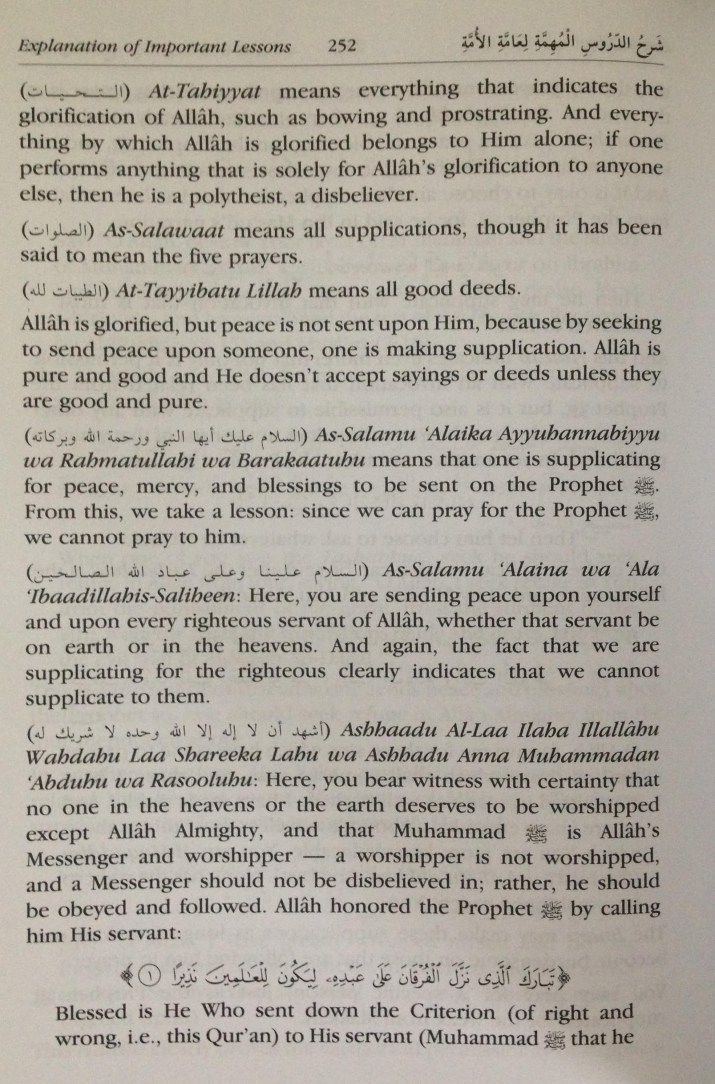
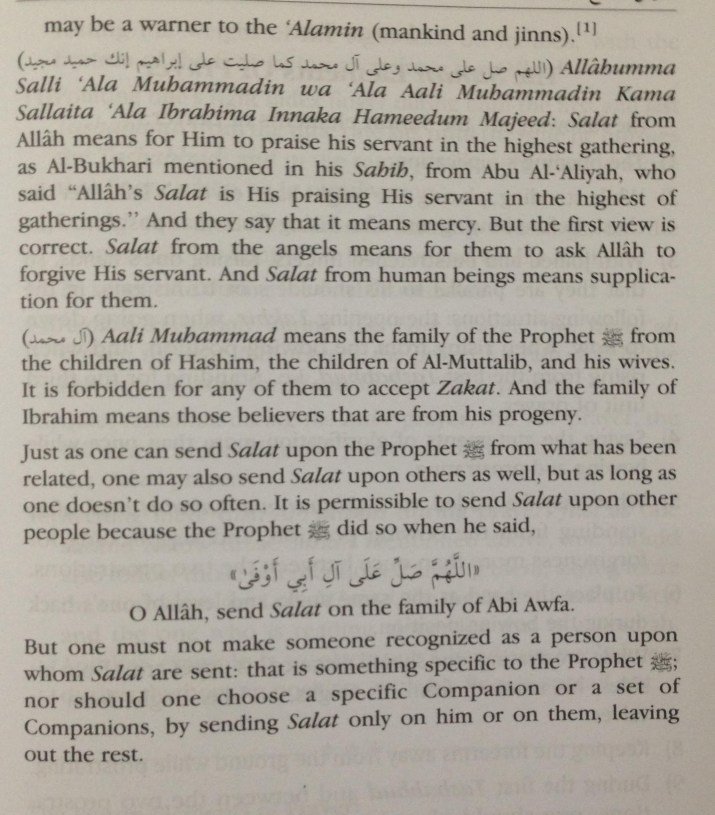
[1] Al-Furqan 25:1
(Images Source: from the Book “Explanation of Important Lessons for every Muslim – Ibn Baz, darussalam publications, pg 252-253, You are encouraged to buy this excellent Book)
Al-Fudail (rahimahullaah) said: “The believer conceals (the sin of his brother) and advises (him), while the evildoer disgraces and condemns (him).”
This is what Al-Fudail has mentioned as being from the signs of advising and condemning – and it is that advising is linked to secrecy while condemning is linked to publicizing.
It used to be said: “Whosoever commands his brother (towards doing good) at the head of a gathering, then he has condemned him.” Or it is something with this meaning.
The Salaf used to hate that commanding good and forbidding evil be done in this manner. Instead, they loved that it be done privately between the one commanding and the one being commanded, for indeed, this is from the signs of sincere advice.
This is since it is not the goal of the one who is advising to spread and publicize the faults of the person he is advising, rather his goal is only to put an end to the evil that he has fallen into.
As for spreading and exposing someone’s faults, then that is from the things that Allaah and His Messenger صلى الله عليه وسلم have forbidden. Allaah, may He be Exalted, says:
“Verily, those who love that the evil and indecent actions of those who believe should be propagated (and spread), they will have a painful torment in this world and the Hereafter. And Allaah knows and you know not. And had it not been for the grace of Allaah and His mercy on you, (Allaah would have hastened the punishment on you) and that Allaah is full of kindness, Most Merciful.” [Surah An-Noor: 19-20]
The ahaadeeth concerning the virtue of keeping the faults of others secret are many.[27] Some of the scholars would say to those who were commanding towards good:
“Strive hard to conceal the faults of the sinners, for indeed, exposing their faults shows a weakness in Islaam. The thing that deserves the most to be concealed is one’s faults.”
It is for this reason that spreading someone’s evil and indecent actions is linked to condemning. And they are both from the affairs of the evildoer, since it is not the goal of the evildoer to put an end to the fault nor that the believer avoids that fault or defect. Rather his only goal is to spread and publicize the defects found in his believing brother, and to destroy his honor. So he initiates that and repeats it. And his intention is to belittle his believing brother by exposing his defects and bad qualities to the people so that some harm can fall upon him in this world.
But as for the person that is sincerely advising, his aim in doing that (advising) is to eradicate the faults found in his believing brother and to help him avoid it. This is what Allaah the Most High, has described His Messenger صلى الله عليه وسلم with, saying:
“Verily, there has come unto you a Messenger from amongst yourselves. It grieves him that you should receive any harm or difficulty. He is anxious over you (to rid you of faults and sin), for the believers he is full of pity, kind and merciful.” [Surah At-Tawbah: 128]
And He described his صلى الله عليه وسلم Companions with that, saying:
“Muhammad is the Messenger of Allaah. And those who are with him (i.e. his Companions) are severe with the disbelievers and merciful towards one another.” [Surah Al-Fath: 29]
And He described the believers with the characteristics of patience and mutual advising of one another towards mercy and compassion. [28]
But what drives the evildoer to propagate (his brother’s) evil and to disgrace him is force and harshness, his love for abusing his believing brother, and (his desire) to inflict some harm upon him. These are the characteristics of the Devil – the one who beautifies disbelief, sin and disobedience to the children of Aadam so that due to it they may become amongst the dwellers of the Hellfire, as Allaah says:
“Verily, the Devil is an enemy for you, so take him as an enemy. Verily, he only calls his party (of followers) to be from amongst the dwellers of the Hellfire.” [Surah Faatir: 6]
And He says, after telling us the story of Iblees (the Devil) when he was with the prophet of Allaah, Aadam, and the evil plot that he unleashed on him, such that it brought him to be cast out from Paradise:
“O Children of Aadam! Let not the Devil deceive you, as he got your parents out of Paradise, stripping them of their garments, to show them their private parts.” [Surah Al-A’araaf: 27]
So what a difference there is between one whose intention it is to advise (naseehah) and one whose intention it is to disgrace (fadeehah)! And no one confuses one of these with the other, except someone who does not possess sound intellect.
Footnotes:
[27] See Fath-ul-Baaree (5/97) and Saheeh Muslim (4/1996)
[28] As is found in Allaah’s saying: “Then he became from among those who believed and recommended one another towards patience and recommended one another towards compassion.” [Surah Al-Balad. 17]
Source: From the al-ibaanah eBook :
The Difference between Advising and Condemning – Imaam Ibn Rajab
Lesson Eleven
Actions That Nullify One’s Prayer
There are eight actions that nullify one’s prayer:
(Source: from the Book “Explanation of Important Lessons for every Muslim – Ibn Baz, darussalam publications, pg 273)
Important Lessons – Ch 11 – Salaah – Invalidators of Salaah
–
Source: Important Lessons for the Ummah – Ibn Baaz
–
Posted from: Salah (Prayer) – Points of Benefit – Dr. Saleh as Saleh rahimahullaah
https://abdurrahman.org/audio-saleh-as-saleh
Based on the Answer by Shaykh ibn Uthaymeen rahimahullaah
Question:
Why is it that Allaah burdens the believers (with with trials, illnesses) who worship Him abundantly , while those disobedient enjoy all the goods of life?
–
–
Source: Fitan and Deviations :Contemporary Issues
Reference: AbdurRahman.Org
Question:
Would it be disbelief to study at a kaafir school (i.e. public school system in Canada), knowing that we live in a kaafir country, and that we also need an education? This is in addition to the fact that these schools have free-mixing environments where the women do not cover properly. And if studying at these schools is not permissible, is there any exception for those who wish to study at these schools so as to attain some certificate or degree so as to facilitate their plans for hijrah?
Ans: First of all, any of the schools which contain free mixing environments and intermingling of the genders, then attendance in these schools and studying in them is not allowable for whatever reason. And if the schools are free of free mixing and intermingling, then it is allowable to study in this schools if what is being taught does not contain ideology of kufr or systems of kufr. And if it does not contain what promotes kufr, nor does it call to it. So if a Muslim was to study for example engineering, be that of planes or cars or computers (or other than them), and all these being from the inventions of mankind, in order that he may benefit himself and benefit the Muslims, then this is allowable and it is desired that the Muslims may benefit from this type of knowledge.
And it is upon the Muslims to cooperate upon righteousness and fearing of Allaah (subhaana wa ta’laa). Allaah’s statement:
“Help you one another in Al Birr and AtTaqwa (virtue, righteousness and piety.” (Al-Ma’idah 5:2)
So studying in schools which are free from intermingling of men and women, then this is allowable as long as it is free from those things which are muharram (not allowable) in the deen. And also with the condition that what is being studied does not contain disbelief in it.
And the shaykh mentioned the order of the Prophet (صلى الله عليه وسلم) to Zayd bin Thaabit to study the language of the Jews. And Zayd bin Thaabit (radiyAllaahu anhu) went on and mentioned that he had mastered the language of the Jews in fifteen days. And this was of benefit to the Prophet (صلى الله عليه وسلم), as Zayd bin Thaabit was able to translate the letter of the Jews for the Prophet (صلى الله عليه وسلم) and also write to them. And Shaykh Ahmed mentioned that the language was studied so that the Prophet (صلى الله عليه وسلم) and the Muslims may be safe from the planning and the plotting of the Jews.
Source: Al-Qawl-ul- Mufeed Fee Adillatit Tawheed [Beneficial Speech in Establishing the Evidences of Tawheed], Class 22 – Question and Answer Session, By Shaykh Ahmed al-Wasaabee, Translated by Shaakir al-Kanadee
Based on Ibn Qayyim al-Jawziyyah rahimahullaah
Listen / Download Mp3 Here (Time 14:51)
–
Transcription of the Audio:
Bismillaah hir Rahman nir Raheem. Alhumdulillahi Rabbil Aalameen
Wa sallallahu ala Muhammadin wa ala aalihi wa sahbihi wa sallam
The pillars of Kufr are four, they are,
–
If the pillar of false pride and haughtiness is demolished, then submission will become easy for him. If the pillar of envy is demolished, then it becomes easier for him to accept advice and to offer it. If the pillar of anger is demolished, it becomes easy for him to be just and humble. If the pillar of lust is demolished, it becomes easy for him to be patient and ready for worship.
The demolishing of mountains is much more easier than demolishing these four pillars for the one who is afflicted with it, specially if they are entrenched in him and became as a firmed attribute, because no action can be upright with the presence of these pillars and no soul can be sanctified and purified having these established in it and whenever the person wants to exert himself to do or to act, these four pillars come and corrupt his work. And all other defects originate from these four and if these four are established in the heart it will make him see falsehood in the form of the truth and truth in the form of falsehood and good in the form of wrong and wrong in the form of good and it will make this life grow nearer to him and make the hereafter far removed from him.
If you contemplate the Kufr of the nations before, you will see that the Kufr of the nations originated from these four pillars and upon these four pillars the punishment will befall. The intensity of the punishment and it’s severity will depend upon how these four and entrenched. So whoever opens for himself these four pillars is indeed has opened all the doors of evil, sooner or later and whoever has closed the doors of these then he indeed has closed all the doors of evil because these four prevents submissiveness, sincerity, repentance and longing and turning to Allah, acceptance of the truth, the advice to the Muslims, humbleness to Allah and to his creation. This is what these four pillars can do.
The origin of these four pillars is from man’s ignorance concerning his Lord and ignorance concerning himself. Had he known of his Lord qualified with the most perfect and magnificent attributes and had he known himself qualified with all forms of defects, he wouldn’t be haughty, angry, envious of others because envy in fact is one form of opposition to Allah because he dislikes the favour and blessing of Allah which he bestowed upon his slave while Allah loves that. Not only that, he likes that it to be rifted from his brother and Allah does not like that. So he is opposing Allah in his pre-decree and what Allah loves and his honour and that is why Iblees (Satan) is enemy because his sin was due to haughtiness, arrogance and envy.
How can these be removed?
These two qualities, knowing Allah and Tawheed, and content with him and pleased with him and turning to him, takes away these two qualities of haughtiness and envy and taking anger away by knowing oneself that the self does not deserve all that so that to be angry for it and to avenge for its all sake. In this case this will prompt it to be contempt once this is taken out. Otherwise then this will be preference for the self over its creator and originator. The greatest thing to repel this defect is to train the self to get angry for Allah’s sake and whatever at any time enters the self this type of anger for Allah’s sake, there will exit the anger for its self and the opposite is true. As to the lust, its cure, its healing is in the correct knowledge. Yielding to the self’s lust deprives it from the correct knowledge and putting it on a diet in that respect puts it on the linkage with the correct knowledge. The more you are open the door for lusts, the more you are trying to deprive the self from the correct knowledge and the more you close it, the more you will be linked to the correct knowledge.
Anger is like the wild animal. If its owner releases it, it starts by eating him up first. Lust is like the fire when the person ignites it it begins by burning him there in first. Al-Kibr, haughtiness, false pride, arrogance is like confronting the king regarding the king’s possession and kingdom, if he does not destroy you he will expel you. Envy is like opposing someone who is more powerful and more stronger than you.
This is based on Imam Ibn Al Qayim’s (rahimahAllah) specification of these four pillars of Kufr.
Transcribed by brother AbdulRazak bin AbdulAleem for AbdurRahman.org, May Allah reward him, ameen.
Q 5: Is it permissible for a Muslim who believes in one God to participate in the wedding ceremonies of Mushriks (those who associate others with Allah in His Divinity or worship), and help them arrange such ceremonies on account of a blood or marriage relationship, or the like? Also, is it permissible to attend their funerals, without praying for their dead, and the burial? Is it permissible to sit and commiserate with them?
Ans:
It is not permissible to share in their occasions, which involve Shirk (associating others with Allah in His Divinity or worship) or Bid`ah (innovation in Islam).
Moreover, it is not permissible to follow their funeral processions; because this is a type of forbidden association with them.
May Allah grant us success. May peace and blessings be upon our Prophet Muhammad, his family, and Companions.
The Permanent Committee for Scholarly Research and Ifta’
Member – Member – Chairman
Bakr Abu Zayd – Salih Al-Fawzan – Abdul-`Aziz ibn `Abdullah Al Al-Shaykh
Fatwas of the Permanent Committee: Browse by Volume Number > Group 2 > Volume 1: `Aqidah > Acts commensurate with Kufr > Attending Mushriks’ weddings
The fifth question of Fatwa no. 21587
Fatwa no. 17727
Q: Some Arab newspapers and magazines dedicate pages to the horoscope, talking about zodiac signs such as Aries, Taurus, Gemini and others. They claim that people born under these signs will probably be moody because the zodiac conflicts a lot during this period. There are many things written in these pages, a copy of which is attached to the message and many Muslim youth read them. Please clarify the Islamic ruling on zodiac signs and your advice to Muslims and to those responsible for the magazines.
A: This is considered the same as divination used by fortune-tellers to inform people if they will be happy or miserable and if they should be optimistic or pessimistic. This is a prohibited idea dating back to the days of Jahiliyyah (pre-Islamic time of ignorance). It is not permissible to practice, follow or spread these ideas. It is even more misleading and misguiding to Muslims to spread such ideas in newspapers, as they involve claiming to know Ghayb (the Unseen), which is the sole Right of Allah (Glorified and Exalted be He) Who says,
Say: “None in the heavens and the earth knows the Ghaib (Unseen) except Allâh, nor can they perceive when they shall be resurrected.” [Surah Al-Naml, 27: 65]
Allah also says,
“And with Him are the keys of the Ghaib (all that is hidden), none knows them but He. And He knows whatever there is in the land and in the sea; not a leaf falls, but he knows it. There is not a grain in the darkness of the earth nor anything fresh or dry, but is written in a Clear Record.” [Surah Al-An`am, 6: 59]
Allah even denied that His Messenger Muhammad (peace be upon him) knew the Ghayb. Allah says,
“Say (O Muhammad صلى الله عليه وسلم): I don’t tell you that with me are the treasures of Allâh, nor (that) I know the Unseen; nor I tell you that I am an angel. I but follow what is revealed to me.” Say: “Are the blind and the one who sees equal? Will you not then take thought?” [Surah Al-An`am, 6: 50]
He (Glorified be He) says,
“And I do not say to you that with me are the Treasures of Allâh, nor that I know the Ghaib (Unseen), nor do I say I am an angel, and I do not say of those whom your eyes look down upon that Allâh will not bestow any good on them. Allâh knows what is in their inner-selves (as regards belief, etc.). In that case, I should, indeed be one of the Zâlimûn (wrong-doers, oppressors).” [Surah Hud, 11: 31]
The Prophet (peace be upon him) said,
“Anyone who acquires a branch of the knowledge of astrology has acquired a branch of magic (of which they acquire more as long as) they continue to do so.”
There are many Ayahs (Qur’anic verses) and Hadiths in this regard. Muslim scholars unanimously agree on this well-established ruling prohibiting astrology.
Thus, it is the duty of every Muslim seeking the best for themselves and their religion to avoid this form of manipulating people’s minds and beliefs, to fear Allah regarding themselves and their nation and not to spread misleading ideas among Muslims.
On the other hand, Muslim rulers (may Allah grant them success) should prevent this practice and punish those who spread it according to the Islamic prescribed punishment.
May Allah grant us success. May peace and blessings be upon our Prophet Muhammad, his family, and Companions.
The Permanent Committee for Scholarly Research and Ifta’
Member Member Member Member Chairman
Bakr Abu Zayd `Abdul-`Aziz Al Al-Shaykh Salih Al-Fawzan `Abdullah ibn Ghudayyan `Abdul-`Aziz ibn `Abdullah ibn Baz
The Fourth Provision: The Caller must adorn himself with noble characteristics
The Caller must adorn himself with noble characteristics, such that the effect of knowledge reflects in his beliefs, his worship, his attitude, and all of his procedures, so that he can properly play the role of a Caller to Allaah. But as for him being in opposition to this, then his da’wah will fail. And if he does succeed, then his success will be minimal.
So it is upon the Caller to abide by that which he is calling to from acts of worship or daily interactions or manners or methodology, so that his da’wah may be accepted and so that he won’t be from those who will be the first to be thrown into the Hellfire.
O brothers: Indeed if we look at our conditions we will find in reality that we may call to something that we don’t implement ourselves. And this no doubt is a big defect, O Allaah, unless we deny ourselves from looking at what is better since for every place there is a saying. This is since a noble thing may be considered noble due to a number of things that make it superior. This is why the Messenger (sallAllaahu ‘alayhi wa sallam) would call to some characteristics, but at times he would preoccupy himself with things more important than them. At times he would fast to the point that it would be said that he wouldn’t stop fasting. And at times he would eat and drink to the point that it would be said that he would not fast.
O brothers! I would like every Caller to abide by the characteristics that befit the Caller, so that he can be a true Caller and so that his statements can be closer to being accepted.
Posted from al-ibaanah eBook:
Provisions for the Caller to Allaah – Imaam Muhammad bin Saalih Al-‘Uthaimeen
Reference: AbdurRahman.Org
The Sixth Provision : The Caller’s heart must be open towards the one who opposes him
The Caller’s heart must be open towards the one who opposes him, especially if he knows that his opponent has a good intention and that he only opposes him in things that require that the proof be established to him. People must be flexible in these matters and not allow these differences to incite hatred and enmity. This is except for a man that opposes and stubbornly rejects, such that the truth is explained to him but yet he continues to persist upon his falsehood Such an individual must be dealt with according to how he deserves to be treated, such as calling people away from him and warning the people from him. This is since his enmity has manifested itself, such that the truth was made clear to him, yet he did not act on it.
However, there are some subsidiary issues, which the people differ on. In reality, these are from the matters that Allaah allowed His servants to differ in. I mean issues that are not from the fundamental ones, which can cause a person that opposes in them to be considered a disbeliever. Rather, these (subsidiary) issues are from those that Allaah has permitted differing in for His servants, and for which He made the error committed in that regard to be allowable. The Prophet (sallAllaahu ‘alayhi wa sallam) said: “When the (legal) judge makes a judgement, exerting himself (Ijtihaad), and he attains the truth, then he gets two rewards. And if he errs then he gets one reward.” So the Mujtahid does not leave from the fold of being rewarded at all – either he gets two rewards for being correct or one reward for being wrong.
If you don’t like others opposing you, then likewise, those same other people don’t like for others to oppose them. So just as you want people to accept your view (on an issue), then likewise, those who oppose you want the people to take their views also.
The reference point during these times of dispute is what Allaah has explained in His statement:
“And whatever you differ in, then its final decision is with Allaah. Such is Allaah, my Lord, in whom I put my trust, and to Him I turn in repentance.” [Surah Ash-Shooraa: 10]
And He says:
“O you who believe! Obey Allaah and obey the Messenger, and those in authority amongst you. And if you differ in anything, then return it to Allaah and the Messenger, if you truly believe in Allaah and the Last Day. That is better and more suitable for final determination.” [Surah An-Nisaa: 59]
So everyone that is in disagreement and dispute with one another must return to these sources: The Book of Allaah and the Sunnah of His Messenger. And it is not lawful for anyone to turn away from the words of Allaah and His Messenger in favor of someone else’s words, regardless of who he may be. So if the truth becomes manifest to you, it is an obligation upon you to throw the view of the one who opposes it against the wall. And you must not turn towards that individual, regardless of what position he holds in knowledge and religion. This is since humans make errors, whereas the words of Allaah and His Messenger are free from errors.
It saddens me to hear that there are some people that look hard into seeking the truth and arriving at it, but in spite of this we find them divided. Each one of them has a particular name and a particular description. And this in reality is a mistake. Allaah’s religion is one and the ummah of Islaam is one.
Allaah says:
“And indeed this ummah (nation) of yours is one ummah. And I am your Lord so be dutiful to Me.” [Surah Al-Mu’minoon: 52]
And Allaah said to His Prophet Muhammad;
“Verily, those who split up their Religion and became sects, you have nothing to do with them in the least. Their affair is only with Allaah. Then He will inform them of what they used to do.” [Surah Al-An’aam: 159]
And Allaah says:
“He has ordained for you the same religion which He ordained for Nooh, and that which We have revealed to you (O Muhammad), and that which We ordained for Ibraaheem, Moosaa and ‘Eesaa saying: You should establish the religion and make no divisions in it. Intolerable to the polytheists is that which you call them to. Allaah chooses for Himself whom He wills, and guides unto Himself those who turn to Him in repentance and obedience.” [Surah Ash-Shooraa: 13]
So if these are Allaah’s instructions to us, then what is obligatory upon us is to accept these instructions, and gather together upon putting forth an issue and discussing it with one another, in order to bring about rectification not in order to criticize or take revenge. For indeed, any person that debates with someone else intending to give victory to his view and to debase his opponent’s view, or intending to critique and not to correct, then for the most part, they will come out with a result that is not pleasing to Allaah and His Messenger. So it is obligatory on us, in matters such as these, to be one ummah (nation).
I am not saying that no one errs – everyone either makes mistakes or is correct. Rather, I am talking about the way to correct this error. The way to correct this error is not by me talking about him behind his back and accusing him. Rather, the way to correct this error is to gather with him and discuss it with him. So if it becomes clear after this that this man will persist on his rejection of the truth, and that he will continue to remain upon the falsehood that he is on, then at this point I have the excuse and the right, rather I am obligated to expose his error, and to warn the people about his error. And this way, the affairs will be rectified. As for splitting up and creating parties, then no one is pleased with this except for someone that is an enemy to Islaam and the Muslims.
I ask Allaah to unite our hearts upon obedience to Him, and that He make us from those who seek judgement from Allaah and His Messenger (sallAllaahu ‘alayhi wa sallam). And we ask Allaah to make our intentions sincere and that He clarify to us what is obscure from his Sharee’ah. Verily, He is the Most Magnanimous, Most Generous.
All praise be to Allaah, Lord of the worlds, and may the peace and blessings be on our Prophet Muhammad, his family and all his Companions
Posted from al-ibaanah eBook:
Provisions for the Caller to Allaah – Imaam Muhammad bin Saalih Al-‘Uthaimeen
Reference: AbdurRahman.Org
Jābir ( رضي الله عنه) said: Three days before he died, I heard the prophet (صلّى الله عليه وسلّم ) say
[11] None of you should die except while he is having good thoughts about Allah (عزّ وجلّ)
al-Nawawī’s Explanation
The following is again from al-Nawawī’s explanation of Ṣaḥīḥ Muslim.
Regarding the statement of the prophet » None of you should die except while he is having good thoughts about Allah « scholars have said that this is a warning against losing hope and despairing (of Allah’s mercy) and an encouragement to have hope especially at the time of death.
Allah (سبحانه وتعالى) also said in the previous ḥadīth » “I am as my servant thinks of Me.” « and (considering both ḥadīth) scholars explain that » having good thoughts about Allah « means that an individual should expect Allah to have mercy on him and pardon him.
Some scholars have also said that during times of wellbeing and health, an individual should have both hope and fear in Allah and these two feelings should be equally balanced. Others say that one’s fear should be more, but when the signs of death approach, a person’s hope in Allah’s mercy should become stronger. This is because the very purpose of having fear of Allah is to prevent oneself from committing sins and ugly deeds and to increase in obedience and good deeds. And those things are most often not possible during that situation (i.e., during the last moments of one’s death).
Instead, in that situation, assuming good thoughts about Allah is preferable which would cause one to have feelings of destitution and submission and to feel oneself in total need of Allah (تعالى).
The ḥadīth mentioned by Imām Muslim right after this one also supports this understanding:
« يُبْعَثُ كُلُّ عَبْدٍ عَلَى مَا مَاتَ عَلَيْهِ »
Every servant will be resurrected according to what he died upon.[12]
Scholars explain that it means each individual will be resurrected in the same state in which he died. The next ḥadīth (in Imām Muslim’s authentic collection) also supports this:
« إِذَا أَرَادَ اللَّهُ بِقَوْمٍ عَذَابًا أَصَابَ الْعَذَابُ مَنْ كَانَ فِيهِمْ ثُمَّ بُعِثُوا عَلَى
أَعْمَالِهِمْ.»
When Allah intends to punish an entire group of people, the punishment afflicts them all, but then each is resurrected according to (his individual) deeds.[13]
And the ḥadīth:
« إِنَّمَا يُبْعَثُ النَّاسُ عَلَى نِيَّاتِهِمْ »
People will only be resurrected upon their (individual) intentions. [14]
al-Manāwī’s Explanation
The following explanation is from al-Manāwī’s, Fayḍ al-Qadīr.
His (صلّى الله عليه وسلّم) statement » None of you should die except while he is having good thoughts about Allah « means: Let none of you die under any circumstance except while in the state of thinking good about Allah (تعالى) in that He will be merciful with you and pardon you. This is because when a person’s time of passing arrives and his journey comes to an end, his fear (of Allah) has no real purpose (to prevent him from bad deeds during life). It would perhaps lead him to despair and to a feeling of restriction of (Allah’s) mercy and bounties.
Whoever at that time, even if his heart were laden with major sins, begins expecting the best (of his Lord) and increases in hope, he has then perfected his provisions for his arrival to his Lord…
al-Ṭībī said:
The prophet (صلّى الله عليه وسلّم) instructs one to ensure he does not die in any state other than expecting and assuming good about Allah. And this does not mean one can change destiny or fate. Rather, what is intended is that an individual is commanded to have good thoughts (about Allah) so that when death overcomes him, he is in such a state.
نسأل الله الغفور الرحيم لتوفيقه على حسن الظنّ به خصوصًا عند الموت
Footnotes:
[11] Collected by Muslim.
[12] Ibid.
[13] Ibid.
[14] Collected by Ibn Mājah and al-Albānī says it is authentic in Ṣaḥīḥ Sunan Ibn Mājah (no. 3407).
Source: Excerpted from the article “Thinking Good About Allah” – With Explanations by: Ibn Ḥajar al-‘Asqalānī, al-Nawawī, & al-Manāwī – authentic-translations.com


 AbdurRahman.Org
You must be logged in to post a comment.