Reaching Old Age (Book of Ar-Riqaaq – Sahih al-Bukhari) – Dr Saleh As-Saleh [Audio|En]

Sahih al-Bukhari » Book of To make the Heart Tender (Ar-Riqaq)

Chapter: If somebody reaches sixty years of age, he has no right to ask Allah for a new lease of life.

Narrated Abu Huraira ( رضي الله عنه ) : The Prophet (صلى الله عليه وسلم) said,

“Allah will not accept the excuse of any person whose instant of death is delayed till he is sixty years of age.”

Narrated Abu Huraira ( رضي الله عنه ) : I heard Allah’s Messenger (صلى الله عليه وسلم) saying,

“The heart of an old man remains young in two respects, i.e., his love for the world (its wealth, amusements and luxuries) and his incessant hope.”

Narrated Anas bin Malik ( رضي الله عنه ) : Allah’s Messenger (صلى الله عليه وسلم) said,

“The son of Adam (i.e. man) grows old and so also two (desires) grow old with him, i.e., love for wealth and (a wish for) a long life.”

Vol. 8, Book 76, Hadith 428 to 430

06- Ar-Riqaaq – Softening the Hearts – 428 – 429 – 430 – Reaching Old Age

Posted fromAl-Bukhari Book of Ar-Riqaaq – Based upon the explanation of Shaykh Ibn Al-‘Uthaymeen

Muslim ummah is divided into three groups with respect to Allaah’s Pre-Decree – Shaykh Uthaymeen

O Brothers, know that the Muslim ummah is divided into three groups with respect to Allaah’s Pre-Decree:

The First Group:

They went overboard in their affirmation of Allaah’s Pre-Decree, denying that the human being has any ability or choice in the matter. They hold that “A person has no ability or choice – he is controlled and has no free will, just like a tree when it is blown by the wind.” They do not distinguish between a person’s action that occur as a result of his choice and an action of his that occurs without him choosing so. No doubt, these people are astray, because what is known from the Religion by necessity, and from the intellect and customs, is that a human being knows the difference between an action he chooses to do and an action he is forced into doing.

The Second Group:

They went to extremes in their affirmation of a person’s ability and choice, such that they negated Allaah having any part in Willing or Choosing or Creating what action a person does. And they claimed that a person is independently responsible for producing his action. This is such that a group amongst them went too far, saying: “Allaah does not know what actions His servants will do until after it occurs from them.” These people have also gone to extremes and shown great radicalism in affirming a human being’s ability and choice.

The Third Group:

These are the ones who truly believe, and so Allaah has guided them concerning that which is disagreed upon from the truth. They are Ahlus-Sunnah wal-Jamaa’ah. They have treaded the moderate path and the middle course, which is based on religious and logical proofs and evidences.

And they say: The actions that Allaah introduces into existence are divided into two types:

First: The actions from Allaah that He causes to occur in His Creation. No one has any choice in regard to these actions, and they are such as when rain descends, when the earth produces vegetation, when life or death occurs, when health or sickness befalls and so on and so forth – from the many things that can be observed occurring within the creation. Without doubt, no one has any part in choosing or willing for these things to transpire, but rather it is only Allaah who wills that to happen.

Second: The actions that the creation, i.e. all of the various types of creatures that possess a willingness, do. These actions occur as a result their choosing and wanting to do them, since Allaah gave them the ability to do that, as He says:

“To whoever amongst you wills to go straight.” [Surah At-Takweer: 28]

And He says:

“Among you is he who desires the worldly life and among you is he who desires the Hereafter.” [Surah Aali ‘Imraan: 152]

And He says:

“So whoever wishes, then let him believe, and whoever wishes then let him disbelieve.” [Surah Al-Kahf: 29]

A human being knows the difference between what occurs from him as a result of his own free will and what occurs from him as a result of being compelled and forced. So for example, when a human being climbs a ladder to get to the roof of a house, he ascends the ladder out of his own free will, and while knowing that he freely chose to do so. But when he trips and falls down from the roof, he knows that he did not choose to do that. So he can tell the difference between these two actions – that he freely chose to do the former, while he was compelled to do the latter. Every human being knows this.

Likewise, when a person is stricken with a sickness in which his urine constantly flows out, this urine comes out from him without his desiring or choosing that. But when he is in a healthy state and free from this sickness, the urine comes out from him when he wills and chooses. So he knows the difference between this and that. No one can deny the difference between the two.

And the same goes with everything else that occurs to a person – he can tell the difference between what occurs due to his free will and what occurs due to his being coerced and forced. As a matter of fact, due to Allaah’s Mercy there are some actions a person may do on his own free will, yet not be held accountable for any of them, as is the case with a person when he sleeps or forgets. In the story of the people of the Cave, Allaah tells us:

“And you would have thought them to be awake whereas they were asleep. And We turned them on their right and on their left sides.” [Surah Al-Kahf: 18]

They were the ones who turned around in their sleep, yet Allaah ascribes the action to Himself. This is because when a person sleeps, he has no choice or free will in his actions, and he will not be held accountable for actions done in this state, so the act is attributed to Allaah. The Prophet (sallAllaahu ‘alayhi wa sallam) said: “Whoever forgets while fasting, and eats or drinks, then he should complete his fast because it was only Allaah who fed him and gave him to drink.” [2] So he (sallAllaahu ‘alayhi wa sallam) attributed this act of feeding and quenching thirst to Allaah, because the action occurred from the individual without him being aware of it, so it is as if it happened without him choosing to do it.

All of us know the difference between when a person experiences pain or joy within himself at times without choosing so, and not knowing the reason why and between him experiencing these pains or these joys as a result of an act that he did himself. This matter, all praise be to Allaah is clear and there is no confusion over it.

O brothers: If we were to take the view of the first group (i.e. the Jabariyyah) who went to extremes in affirming the Divine Pre-Decree, the Religion would be invalidated from its very foundation. This is since the belief that a person has no choice or free will in his actions necessitates that he not be praised for a praiseworthy act or that he be blamed for a blameworthy act, since in reality they were not done by his choice or free will. So then this would mean that Allaah, may He be far removed from it, is oppressing those who sin when He punishes and recompenses them for their acts because He has punished them for something they had no free choice or free will in! This no doubt clearly contradicts the Qur’aan. Allaah says:

“And his companion (angel) will say: ‘Here is (his record) ready with me!’ (Allaah will say to the angels): ‘Both of you, throw into the Hellfire every stubborn disbeliever, hinderer of good, transgressor, doubter, he who set up another god with Allaah. So both of you cast him into the Severe Torment.’ His (devil) companion will say: ‘Our Lord! I did not push him to transgress, but rather it was he himself who was in error, far astray. Allaah will say: ‘Do not dispute in front of Me, I had already sent the threat to you in advance. The Word (Ordainment) that comes from Me cannot be changed, and I am not unjust to the slaves.’” [Surah Qaaf: 23-29]

So Allaah clarifies that this punishment is not oppression from Him, but rather that it is complete justice since He had previously given them a warning and clarified to them the various paths and explained the truth and falsehood to them, but they chose for themselves the path of falsehood. So there didn’t remain any proof for them before Allaah.

And if we were to take this false view, it would invalidate Allaah’s statement:

“Messengers, bearing glad tidings and warning in order that mankind would not have any argument (i.e. proof) against Allaah after the (coming of) Messengers.” [Surah An-Nisaa: 165]

Allaah denies that mankind should have any excuses after the sending of Messengers because the proof has been established against them with that. So if the Divine PreDecree was an excuse for them, this excuse would be infinite even after the advent of the messengers since Allaah’s Pre-Decree did not cease and will not cease to exist before and after the sending of messengers. So therefore, this view is invalidated by the religious texts, and it is invalidated by reality, as we have explained in the previous examples.

As for those who hold the second view, then the religious texts and reality also refute them since the texts clearly state that a person’s will is subject to Allaah’s Will:

“To whoever amongst you wills to go straight. However, you cannot will unless Allaah, Lord of the Universe, wills.” [Surah At-Takweer: 28-29]

“And your Lord creates whatever He wills and chooses.” [Surah Al-Qasas: 68]

“And Allaah calls (you) to the Abode of Peace, and guides whomever He wills to the Straight Path.” [Surah Yoonus: 25]

Those who hold this view (i.e. the Qadariyyah) are in reality invalidating one of the aspects of Allaah’s Lordship, and they are also claiming that there can be found in Allaah’s dominion that which Allaah did not will or create, when in fact Allaah wills everything, creates everything and has pre-decreed everything. They also contradict that which is known by necessity, which is that everything that is created belongs to Allaah, their essence as well as their attributes, there being no distinction between the attribute and the essence. Therefore, everything belongs to Allaah so it is not possible for there to be anything in His dominion that He did not desire. So what path should a person take and what is his solution if Allaah has pre-decreed that He go astray and not be guided?

We say: The answer to this is that Allaah only guides those who deserve to be guided, and He leads astray only those who deserve to be led astray. Allaah says: “So when they turned away, Allaah turned their hearts away.” [Surah As-Saff: 5] And He says:

“So because they breached their covenant, We cursed them and made their hearts grow hard. They change the words from their (right) places and have abandoned a good part of the Message that was sent to them.” [Surah AlMaa’idah: 13] So Allaah clarified that what caused the person to go astray was himself. A person, as we have explained previously, doesn’t know what Allaah has pre-decreed for him since he doesn’t know what has been pre-decreed until after it occurs. So he doesn’t know if Allaah has decreed for him to be astray or guided. So if this is the case, how can he take the path of misguidance, then use as an excuse the argument that this is what Allaah willed for him? Wouldn’t it be more befitting for him to tread the path of guidance and then say that Allah has guided me to the Straight Path?

Is it right for him to be a Jabaree, i.e. claim that he is forced, when he is misguided, and a Qadaree, i.e. that Allaah has no part in his deeds, when he obeys?! Never! II does not befit a person to claim that he was forced when he finds himself upon misguidance and sin. So when he goes astray and disobeys Allaah, he says: “This is something that has been written and pre-decreed for me, and I am not able to remove myself from what Allaah has ordained for me.” Yet when he does good deeds and Allaah grants him obedience and guidance, he claims that this came solely from himself, saying: “I attained this by myself.” So he becomes a Qadaree when it comes to guidance and a Jabaree when it comes to disobedience. This is not possible ever. So in reality, a person has ability and will. The door to guidance is not any more hidden than the door to sustenance and the door to seeking knowledge. A person, as is well known to everybody, has pre-decreed for him whatever he has from sustenance. But yet in spite of this, he strives for the means of sustenance in his country and outside of it, on the right and on the left. He doesn’t just sit at home and say: “Provision has been pre-decreed for me and it will come to me.” On the contrary, he strives for the means of sustenance.

Yet sustenance itself goes hand and hand with actions/works, as has been authentically reported on the Prophet, in the narration of Ibn Mas’ood, who said that he (sallAllaahu ‘alayhi wa sallam) said: “Verily, the creation of each of you is brought together in his mother’s womb for forty days in the form of a seed. Then he becomes a clot of blood for the same amount of time, then a morsel of flesh for the same amount of time. Then an angel is sent to him and commanded with four things: to record his sustenance, his lifespan, his actions, and whether he will be miserable or happy.” [3]

So this sustenance is written just as the good and evil actions are written. So how is it that you can go here and there, traversing land and sea, seeking the sustenance of the world and yet you don’t perform any righteous deed seeking the sustenance of the Hereafter or the success of Paradise? Indeed, these two aspects are one and the same. There is no difference between the two of them. So likewise, you strive for your sustenance and you strive for your livelihood and to prolong your lifespan.

But when you become ill with a sickness, you travel through all the regions of the world looking for a skilled doctor who will cure your sickness. This is even though whatever has been pre-decreed for you as your lifespan will come to be and it will not increase or decrease. Yet you do not rely on this and say: “I will remain sick and bedridden at home, and if Allaah has decreed that my lifespan will be prolonged, then it will be prolonged.” Rather, we will find you striving with all of your might and energy to find a doctor whom you regard will be the best one at whose hands Allaah will ordain your recovery. So why don’t you do acts for the Hereafter and righteous deeds the same way you do acts for this worldly life?

We stated previously that: The Divine Pre-Ordainment is a hidden secret, you have no way of finding out about it. So right now, you are between two paths – a path that will take you to salvation and success, and a path that will take you to destruction and regret. So right now, you are standing between these two paths with a free choice. There is no one in front of you preventing you from taking the right path or the left path. If you wish, you can go here, and if you wish, you can go there. So how can you take the left path and say: “This has been pre-decreed for me!” Isn’t it more befitting for you to take the right path and say: “This has been pre-decreed for me?!”

And if you want to go on a journey to some other country and before you lies two roads, one of which is paved, short and safe, while the other is unpaved, long and dangerous, we would find you choosing the short, paved and safe road and not the other one. So this figurative road is similar to it and doesn’t differ from it at all. However, it is the souls and desires that sometimes govern and take over the mind. The believer must take over and control his desires. And when his mind judges, the mind, according to its correct meaning, should prevent a person from what harms it and lead it to what benefits and pleases it.

With this it becomes clear that people have a free choice when it comes to their actions, and that they are not coerced. And just as he has a free choice in the acts of his worldly affairs, if he wills he will put out this product or make that his business, then likewise he has a free choice with regard to the affairs of the Hereafter. In fact, the paths of the Hereafter are clearer by far than the paths of this worldly life, because the One who clarifies the paths of the Hereafter is Allaah, in His Book and upon the tongue of His Messenger (sallAllaahu ‘alayhi wa sallam). So the paths of the Hereafter are clearer and more lucid than the paths of the worldly life. But in spite of this, people still tread the paths of the worldly life, which have no guaranteed results and abandon the paths of the Hereafter, whose results are guaranteed and known since they are affirmed by Allaah’s promise, and Allaah does not break His promises.

Having said this, we say that Ahlus-Sunnah wal-Jamaa’ah affirm all of this and make it their Creed and Belief that: A person acts on his own free will and says what he wants. However, his desire and choosing are subject to Allaah’s Will and Desire. Furthermore, Ahlus-Sunnah wal-Jamaa’ah believe that Allaah’s Will is subject to His Wisdom, and that it is not a pure and absolute Will, but rather a will that is dependent on His Wisdom. This is because one of Allaah’s Names is Al-Hakeem (The MostWise), and the Most-Wise is the One who judges matters precisely realistically and religiously.

And based on His Wisdom, He decrees guidance for the one who desires it and for the one whom He knows wants the truth and whose heart is upon steadfastness. And He decrees misguidance for the one who is not like this – the one who when Islaam is presented to him, his heart becomes constricted as if he were being forced to ascend to the sky. So Allaah’s Wisdom refuses to let this person be from among the guided, unless Allaah renews his determination for him and changes his desire to another desire. And Allaah is Able to do all things. However, Allaah’s Wisdom insists that the causes be closely linked to the effects.

[2] Saheeh Muslim: Book of Fasting (1155)
[3] Saheeh Al-Bukhaaree: Book of the Beginning of Creation (3208) and Saheeh Muslim: Book of Divine Pre-Decree (2643)

Posted from al-ibaanah eBook: 

The Divine Pre-Decree and Ordainment of Allaah (Al-Qadaa wal-Qadar) – Shaykh Uthaymeen

Why is it that Allaah burdens the believers with trials while those disobedient enjoy all the goods of life? – Shaykh Uthaymeen | Dr Saleh as Saleh [Audio Benefit|English]

Based on the Answer by Shaykh ibn Uthaymeen rahimahullaah

Question:

Why is it that Allaah burdens the believers (with with trials, illnesses) who worship Him abundantly , while those disobedient enjoy all the goods of life?

SourceFitan and Deviations :Contemporary Issues

Reference: AbdurRahman.Org

The Caller must adorn himself with noble characteristics – Shaykh ibn Uthaymeen

The Fourth Provision: The Caller must adorn himself with noble characteristics

The Caller must adorn himself with noble characteristics, such that the effect of knowledge reflects in his beliefs, his worship, his attitude, and all of his procedures, so that he can properly play the role of a Caller to Allaah. But as for him being in opposition to this, then his da’wah will fail. And if he does succeed, then his success will be minimal.

So it is upon the Caller to abide by that which he is calling to from acts of worship or daily interactions or manners or methodology, so that his da’wah may be accepted and so that he won’t be from those who will be the first to be thrown into the Hellfire.

O brothers: Indeed if we look at our conditions we will find in reality that we may call to something that we don’t implement ourselves. And this no doubt is a big defect, O Allaah, unless we deny ourselves from looking at what is better since for every place there is a saying. This is since a noble thing may be considered noble due to a number of things that make it superior. This is why the Messenger (sallAllaahu ‘alayhi wa sallam) would call to some characteristics, but at times he would preoccupy himself with things more important than them. At times he would fast to the point that it would be said that he wouldn’t stop fasting. And at times he would eat and drink to the point that it would be said that he would not fast.

O brothers! I would like every Caller to abide by the characteristics that befit the Caller, so that he can be a true Caller and so that his statements can be closer to being accepted.

Posted from  al-ibaanah eBook:
Provisions for the Caller to Allaah   – Imaam Muhammad bin Saalih Al-‘Uthaimeen

Reference: AbdurRahman.Org

The Caller’s heart must be open towards the one who opposes him – Shaykh Ibn Uthaymeen

The Sixth Provision : The Caller’s heart must be open towards the one who opposes him

The Caller’s heart must be open towards the one who opposes him, especially if he knows that his opponent has a good intention and that he only opposes him in things that require that the proof be established to him. People must be flexible in these matters and not allow these differences to incite hatred and enmity. This is except for a man that opposes and stubbornly rejects, such that the truth is explained to him but yet he continues to persist upon his falsehood Such an individual must be dealt with according to how he deserves to be treated, such as calling people away from him and warning the people from him. This is since his enmity has manifested itself, such that the truth was made clear to him, yet he did not act on it.

However, there are some subsidiary issues, which the people differ on. In reality, these are from the matters that Allaah allowed His servants to differ in. I mean issues that are not from the fundamental ones, which can cause a person that opposes in them to be considered a disbeliever. Rather, these (subsidiary) issues are from those that Allaah has permitted differing in for His servants, and for which He made the error committed in that regard to be allowable. The Prophet (sallAllaahu ‘alayhi wa sallam) said: “When the (legal) judge makes a judgement, exerting himself (Ijtihaad), and he attains the truth, then he gets two rewards. And if he errs then he gets one reward.” So the Mujtahid does not leave from the fold of being rewarded at all – either he gets two rewards for being correct or one reward for being wrong.

If you don’t like others opposing you, then likewise, those same other people don’t like for others to oppose them. So just as you want people to accept your view (on an issue), then likewise, those who oppose you want the people to take their views also.

The reference point during these times of dispute is what Allaah has explained in His statement:

“And whatever you differ in, then its final decision is with Allaah. Such is Allaah, my Lord, in whom I put my trust, and to Him I turn in repentance.” [Surah Ash-Shooraa: 10]

And He says:

“O you who believe! Obey Allaah and obey the Messenger, and those in authority amongst you. And if you differ in anything, then return it to Allaah and the Messenger, if you truly believe in Allaah and the Last Day. That is better and more suitable for final determination.” [Surah An-Nisaa: 59]

So everyone that is in disagreement and dispute with one another must return to these sources: The Book of Allaah and the Sunnah of His Messenger. And it is not lawful for anyone to turn away from the words of Allaah and His Messenger in favor of someone else’s words, regardless of who he may be. So if the truth becomes manifest to you, it is an obligation upon you to throw the view of the one who opposes it against the wall. And you must not turn towards that individual, regardless of what position he holds in knowledge and religion. This is since humans make errors, whereas the words of Allaah and His Messenger are free from errors.

It saddens me to hear that there are some people that look hard into seeking the truth and arriving at it, but in spite of this we find them divided. Each one of them has a particular name and a particular description. And this in reality is a mistake. Allaah’s religion is one and the ummah of Islaam is one.

Allaah says:

“And indeed this ummah (nation) of yours is one ummah. And I am your Lord so be dutiful to Me.” [Surah Al-Mu’minoon: 52]

And Allaah said to His Prophet Muhammad;

“Verily, those who split up their Religion and became sects, you have nothing to do with them in the least. Their affair is only with Allaah. Then He will inform them of what they used to do.” [Surah Al-An’aam: 159]

And Allaah says:

“He has ordained for you the same religion which He ordained for Nooh, and that which We have revealed to you (O Muhammad), and that which We ordained for Ibraaheem, Moosaa and ‘Eesaa saying: You should establish the religion and make no divisions in it. Intolerable to the polytheists is that which you call them to. Allaah chooses for Himself whom He wills, and guides unto Himself those who turn to Him in repentance and obedience.” [Surah Ash-Shooraa: 13]

So if these are Allaah’s instructions to us, then what is obligatory upon us is to accept these instructions, and gather together upon putting forth an issue and discussing it with one another, in order to bring about rectification not in order to criticize or take revenge. For indeed, any person that debates with someone else intending to give victory to his view and to debase his opponent’s view, or intending to critique and not to correct, then for the most part, they will come out with a result that is not pleasing to Allaah and His Messenger. So it is obligatory on us, in matters such as these, to be one ummah (nation).

I am not saying that no one errs – everyone either makes mistakes or is correct. Rather, I am talking about the way to correct this error. The way to correct this error is not by me talking about him behind his back and accusing him. Rather, the way to correct this error is to gather with him and discuss it with him. So if it becomes clear after this that this man will persist on his rejection of the truth, and that he will continue to remain upon the falsehood that he is on, then at this point I have the excuse and the right, rather I am obligated to expose his error, and to warn the people about his error. And this way, the affairs will be rectified. As for splitting up and creating parties, then no one is pleased with this except for someone that is an enemy to Islaam and the Muslims.

I ask Allaah to unite our hearts upon obedience to Him, and that He make us from those who seek judgement from Allaah and His Messenger (sallAllaahu ‘alayhi wa sallam). And we ask Allaah to make our intentions sincere and that He clarify to us what is obscure from his Sharee’ah. Verily, He is the Most Magnanimous, Most Generous.

All praise be to Allaah, Lord of the worlds, and may the peace and blessings be on our Prophet Muhammad, his family and all his Companions

Posted from  al-ibaanah eBook:
Provisions for the Caller to Allaah   – Imaam Muhammad bin Saalih Al-‘Uthaimeen

Reference: AbdurRahman.Org

The Caller must invite to Allaah with wisdom – Shaykh Ibn Uthaymeen

The Third Provision: Wisdom

The Caller must invite to Allaah with wisdom. And how bitter is wisdom upon the one who doesn’t have it.

Da’wah (the Call) to Allaah must occur with (1) wisdom, then with (2) fair admonition, then with (3) debating in the best of manners against someone that is not oppressive, then with (4) debating in not the best of manners against someone that is oppressive. So there are four levels.

Allaah says:

“Call to the Way of your Lord with wisdom and fair admonition. And debate them in a way that is better. Verily, your Lord knows best who has gone astray from His path and He knows best those who are guided.” [Surah An-Nahl: 125]

And Allaah says:

“And do not debate with the People of the Scripture (i.e. the Jews and the Christians) except in a manner that is best – except for those who are oppressive amongst them, and say (to them): ‘We believe in that which has been revealed to us and revealed to you. Our God and your God is One, and to Him we have submitted.’” [Surah Al-‘Ankaboot: 46]

Wisdom means: Treating affairs with accuracy and precision, rather it means placing matters in their due place. It is not from wisdom to rush things and expect people to change from the condition they are in to the condition that the Companions were upon overnight. And whoever expects this then he has a foolish mind, and he is far removed from wisdom. This is because the wisdom of Allaah is not like this.

What proves this is that Allaah sent the Qur’aan down to Muhammad, the Messenger of Allaah, in stages so that it may become firm and settled in the souls.

The prayer was made obligatory during the Mi’raaj, three years before the Hijrah. Some say it was a year and a half, and some hold that it was five. There is differing amongst the scholars about this. But in spite of this it was not made obligatory in the manner that it is performed today. When the prayer was first made obligatory, it used to be two rak’ahs for Dhuhr, ‘Asr, ‘Ishaa and Fajr. And the Maghrib prayer used to be three rak’aat, so that it could be the Witr (odd-number) for the day. But after the Hijrah and after the Prophet had spent thirteen years in Makkah, the prayer of the resident was increased, and so it became four rak’aat for Dhuhr, ‘Asr and ‘Ishaa. And Fajr remained the way it was (i.e. two rak’aat) because the recitation of the Qur’aan is prolonged in it. And Maghrib stayed the same because it was the Witr of the day.

Furthermore, Zakaat was made obligatory in the second year after Hijrah. Or (some say) it was made obligatory in Makkah, but that it was not assigned its final estimate in terms of its dividend and obligation. And the Prophet (sallAllaahu ‘alayhi wa sallam) did not send out envoys to collect the Zakaat until the ninth year after Hijrah.

Therefore, the development of Zakaat progressed in three stages:

1. In Makkah: “But pay its due (i.e. Zakaat) on the day of its harvest.” [Surah Al-An’aam: 141] However, its obligation was not clarified nor the amount that was mandated to give for that obligation. This matter was left entrusted to the people.
2. In the second year after Hijrah, Zakaat was clarified with its rightful dividends.
3. And in the ninth year after Hijrah, the Prophet started to send envoys to the people of yields and profits to collect Zakaat from them.

So look at the careful consideration that was given to the conditions of the people with regard to Allaah’s legislation. And He is the best of judges.

The same goes for fasting, as there was a stage-by-stage development with regard to its legislation. What was first made obligatory, was that a person had a choice between fasting or feeding a needy person. Then fasting was prescribed specifically, and feeding needy people was only allowed for those who weren’t able to fast for numerous consecutive days.

Therefore I say that wisdom denounces that the world change over in one night. There must be endurance and tolerance. Accept from your brother whom you are calling what he has from truth for today, and proceed with him step by step until he is able to eventually free himself from falsehood. And this is so that you may see that people are not of equal standing. So there is a difference between one is ignorant and one who stubbornly rejects.

Perhaps it is proper that I now mention some examples of the Da’wah of Allaah’s Messenger (sallAllaahu ‘alayhi wa sallam):

The First Example:

A Bedouin man once entered the masjid, while the Prophet was sitting down with his Companions. The Bedouin man then urinated in one area of the masjid, so the people reprimanded him, meaning they scolded him angrily using harsh words. However, the Prophet, who was the one whom Allaah gave wisdom, forbade them from this. So when the man had finished urinating, the Prophet (sallAllaahu ‘alayhi wa sallam) ordered that a bucket of water be thrown over his urine. So the harm was removed and Allaah’s Messenger (sallAllaahu ‘alayhi wa sallam) called the Bedouin to him, saying to him: “Indeed it is not proper to have any harmful object or filth in these masaajid. They are only for prayer and the reciting of the Qur’aan.” Or it is as he (sallAllaahu ‘alayhi wa sallam) said. So the Bedouin’s heart opened up to this kind treatment. This is why I have seen some of the scholars quote this Bedouin man as saying: “O Allaah, have mercy on me and Muhammad and do not have mercy on anyone else besides us.” This was because the Prophet (sallAllaahu ‘alayhi wa sallam) treated him in such an excellent manner. But as for the Companions, they rushed to remove this evil act, without having properly weighed the condition of this man, who was (obviously) ignorant. [2]

The Second Example:

One time Mu’awiyah bin Al-Hakam, may Allaah be pleased with him, came while the Prophet was leading the people in prayer. So one man sneezed and said: “AlHamdulillaah.” (Note:) If one of you sneezes while in prayer then he should say AlHamdulillaah, regardless of whether he is in the standing position or the bowing position or in prostration. This man (in prayer) said “Al-Hamdulillaah, so Mu’awiyah responded: “YarhamukAllaah.” But this is considered speaking and it invalidates the prayer. So the people began to stare and look at him. So Mu’awiyah said: “May my mother be bereaved of me.” This means for the mother to be lost. This is a statement that is said but for which it’s meaning is not intended. Then Mu’awiyah continued to pray. After he finished praying, the Prophet (sallAllaahu ‘alayhi wa sallam) called him. Mu’awiyah said: “By Allaah, I did not see a teacher better at instructing than him.” May Allaah send His peace and blessings on him. He said: “By Allaah, he was not harsh with me nor did he scold me, he only said: ‘Speaking to people is not correct while in the prayer. It is only for tasbeeh (saying SubhaanAllaah), takbeer (saying Allaahu Akbar) and reciting of the Qur’aan.’” Or it is as he (sallAllaahu ‘alayhi wa sallam) said.[3]

The Prophet (sallAllaahu ‘alayhi wa sallam) even said it to Mu’aadh bin Jabal when he told him: “Shall I not inform you of what controls all of that?” He (i.e. Mu’aadh) said: “Of course O Messenger of Allaah.” He (sallAllaahu ‘alayhi wa sallam) said: “Restrain this on yourself.” And he took hold of his tongue, saying: “Restrain this.” So Mu’aadh said: “Will we be held accountable for what we say with it?” He (sallAllaahu ‘alayhi wa sallam) said: “May your mother be bereaved of you O Mu’aadh. What else will cause the people to be dragged on their faces – or he said on their noses – into the Hellfire except for the harvests of their tongues.” Look at the da’wah that is beloved to the souls, which people accept and by which the hearts become open.

We derive from the Fiqh point of benefits of this hadeeth that: Whoever speaks while in prayer, while not knowing that speaking invalidates the prayer, his prayer is still valid.

The Third Example:

A man came to the Prophet (sallAllaahu ‘alayhi wa sallam) and said: “O Messenger of Allaah, I am ruined!” So he (sallAllaahu ‘alayhi wa sallam) asked: “And what caused you to be ruined?” He said: “I had intercourse with my wife during Ramadaan while I was fasting.” So the Messenger of Allaah ordered him to free a slave, but he said: “I cannot find one (i.e. unable).” Then he commanded him to fast two consecutive months, but he said; “I am not able to.” Then he commanded him to feed sixty needy people, but he said: “I am not able to.” At this the man sat down. So the Prophet (sallAllaahu ‘alayhi wa sallam) brought some dates to him saying: “Take this and give it away in charity.” But the man became desirous of the Prophet’s generosity, which was the greatness of kindness shown towards creation. This was since the Messenger of Allaah (sallAllaahu ‘alayhi wa sallam) was indeed the most generous of people.

So the man said: “Am I to give this to someone poorer than myself O Messenger of Allaah? By Allaah there is no family poorer than mine between the two lava plains of Madeenah?” At this, the Prophet (sallAllaahu ‘alayhi wa sallam) laughed to the point that his molar teeth became visible. This was because this man had come in fear, saying: “I am ruined” but yet he left successful. So the Prophet (sallAllaahu ‘alayhi wa sallam) then said: “Feed your family with it.” So the man left peaceful, prosperous

and joyful with this religion of Islaam and with this ease from the first Caller to this religion of Islaam, may the peace and blessings of Allaah be upon him. [4]

The Fourth Example:

Let us now look at how the Prophet dealt with one who had committed a sin. The Prophet (sallAllaahu ‘alayhi wa sallam) once saw a man that had a gold ring on his finger. So the Prophet (sallAllaahu ‘alayhi wa sallam) seized the ring from him with his noble hand and threw it on the ground. And he (sallAllaahu ‘alayhi wa sallam) said: “Would any of you intentionally tale a coal of fire and place it on his hand?” So the Prophet (sallAllaahu ‘alayhi wa sallam) did not treat him the way he treated the people in the first examples. Rather, he snatched it from his hand and threw it at the floor. So when the Prophet (sallAllaahu ‘alayhi wa sallam) left, it was said to the man: “Take your ring and benefit from it (i.e. by selling it).” The man said: “By Allaah, I will never take a ring that the Prophet (sallAllaahu ‘alayhi wa sallam) threw away.” [5]

Allaahu Akbar! This was the magnificent way the Companions would execute the Commandments of Allaah and His Messenger.

So what is important is that the Caller to Allaah must invite with wisdom, because the one who is ignorant is not like the one who has knowledge. And the one who rejects is not like the one who readily accepts. So for every place there is a saying and for every position there is a condition.

Footnotes:

[2] See Saheeh Muslim (Eng.: Book 2, no. 559)
[3] See Saheeh Muslim (Eng.: Book 4, no. 1094)
[4] See Saheeh Al-Bukhaaree (Eng.: vol. 3, no. 158) and Saheeh Muslim (Eng.: Book 6, no. 2457)
[5] See Saheeh Muslim (Eng.: Book 24, no. 5209)

Posted from  al-ibaanah eBook:
Provisions for the Caller to Allaah   – Imaam Muhammad bin Saalih Al-‘Uthaimeen

Reference: AbdurRahman.Org

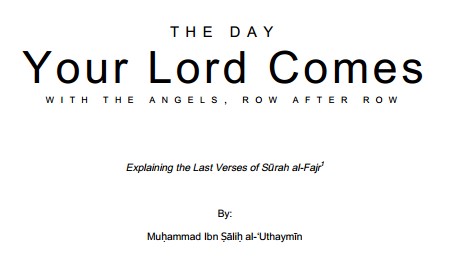
The Day Your Lord Comes with the Angels, row after row – Shaykh ibn Uthaymeen

The Day your Lord Comes

[1] This article was taken from the book Tafsīr Juz ‘Amma by Muḥammad Ibn Ṣāliḥ al-‘Uthaymīn (1423/2002, Riyadh: Dar al-Thurayya). At the time of translating, the original Arabic text could be found at: ibnothaimeen.com/all/books/article_17873.shtml.

Verses 21-30 from Surah al-Fajr

No. When the earth is leveled, pounded and crushed,
and your Lord comes with the angels, row after row,
and that day, Hell is brought near, the day man will remember, but how will the remembrance help him then?
He will say, “I wish I had sent forth (some good) for my life.”
But on that day, no one will punish as He punishes,
and no one will bind as He binds.
(But to the righteous it will be said,) “You, soul at peace,
return to your Lord well-pleased (yourself) and well pleasing (to Him).
Go and enter among My servants
and enter My paradise.”

Click the below link to Read the PDF:

The Day Your Lord Comes – Shaykh ibn Uthaymeen

Courtesy of authentic-translations.com
Translated by Abu az-Zubayr Harrison hafidhahullaah

Your share of adultery – Shaykh Ibn Uthaymeen

Muḥammad Ibn Ṣāliḥ al-‘Uthaymīn’s Explanation: [10]

[10] The selections here are from Ibn al-‘Uthaymīn’s explanation of Riyāḍ al-Ṣāliḥīn. Since the chapter in Riyāḍ al-Ṣāliḥīn where the ḥadīth under discussion appears includes preceding verses of the Quran related to lowering one’s gaze, his explanation of those verses have also been included here for the benefit it contains and its relevancy to this translated work.

The chapter in al-Nawawī’s Riyāḍ al-Ṣāliḥīn (in which the ḥadīth under discussion appears) begins with the following verses.

“Tell the believers to lower their gaze.” 

[Sūrah al-Nūr (24:30)]

Looking at non-relative women is forbidden as the author رحمه الله says and that is because Allah commanded that we lower our gaze as He says “Tell the believers to lower their gaze and preserve their private parts. That is purer for them. Allah is certainly aware of what you do.” He instructs us to lower our gaze and guard our private parts, and this indicates that when someone does not restrain his gaze, that becomes the very means by which he may fail to preserve his private parts.

When a person is liberal with his eyes, allowing them to roam freely, his heart becomes infatuated with women. He continues to look at them until he may approach a woman, speak to her, carry on a conversation with her, arrange a date with her, and then finally the immorality (of adultery) happens. We seek protection with Allah from this. This is why the look has been called “the messenger” or “delivery” of adultery; it invites to illegal sexual activity, and this is why Allah commands us to lower our gaze.

He عز وجلalso says:

“He knows the eyes’ deceit and what the breasts conceal”
[Sūrah al-Ghāfir (40:19)]

The “eyes’ deceit” is the visions a person’s sight may steal (when looking at impermissible things). In other words, a person may secretly look at something forbidden when people cannot observe him. However, Allah certainly knows what he is doing because “He knows the eyes’ deceit”.

Allah جل وعلى also knows “what the breasts conceal” of both good and bad intentions. He even knows the ideas a person’s own soul may inwardly suggest to him and what he accepts of those suggestions.

Allah تعالى also says:

“Surely the hearing, the sight, and the heart – of each of those one will be questioned”
[Sūrah al-Isrā (17:36)]

A person is accountable for his hearing and will be questioned about it. What did he listen to with his ears? Did he listen to impermissible speech or to a woman, enjoying the sound of her voice? Likewise an individual is accountable for his sight and heart so it is critical that a person safeguards himself (regarding his senses). As for a woman relative or someone to whom it would be forbidden for him to marry anyway, there is no problem with looking at her. He may see her face, her head, her hands, her arms, her legs and feet; there is no problem with any of this unless there is some sort of temptation he fears for himself. If he feels there would be some temptation for him, then he should not even look at women that are religiously considered as his female kin.

For example, if a man had a “sister” because his mother breastfed another girl in infancy who was originally unrelated to him, if such a woman was considered beautiful in his eyes, then looking at her would not be permissible even though a sister of breastfeeding is considered by the religion to be of the same status of an actual, related sister. If he feels some kind of temptation by looking at her, he must then lower his gaze when with her. She must also cover up when she is with him because the origin and purpose behind the ḥijāb (the religious covering) is to prevent temptations. So if she finds some sort of temptation, then she too must cover her face even in front of related men.

However, if there is no such temptation present and a person is chaste with a normal, sound and un-perverted heart, then he is only forbidden to look at nonrelative women not in his immediate family, for example his cousins, his sisters-inlaw, etc. In conclusion, the important point is that a man may look at women religiously considered to be his immediate relatives as long as no sort of temptation is there. As for looking at unrelated women, they are never permissible for him to look at.

The following ḥadīth, with the wording from Ṣaḥīḥ Muslim, is the one mentioned in Riyāḍ al-Ṣāliḥīn (and the same one mentioned on pg. 2-3 of this work).

Abū Hurayrah رضي الله عنه narrated that the prophet صلّى الله عليه وسلّم said:

It has been written upon the Son of Adam his share of adultery which he will indulge in; there is no escaping it. The two eyes, their adultery is looking (at what is forbidden). The two ears, their adultery is listening. The tongue, its adultery is speaking. The hand, its adultery is the touching, and the foot, its adultery is walking (toward adultery). The heart desires and hopes (for adultery) but the private parts either confirm that or deny it. » which he will indulge in; there is no escaping it « means every individual will carry out and realize his inevitable share of adultery, and there is no escape from it unless Allah protects him from doing so.

The prophet صلّى الله عليه وسلّم then mentioned some examples such as,

» The two eyes, their adultery is looking « When a man looks at unrelated women, even if it is without desire, it is a form of adultery – adultery of the eye.

» The two ears, their adultery is listening « A man may listen to a woman speaking and become moved by her voice; this is the adultery of the ear. Similarly,

» The hand, its adultery is the touching « which is anything physically done with the hand like touching or similar physical actions.

» the foot, its adultery is walking « and this includes when someone walks to any place wherein immorality and sexual activity is being committed. It could also be when a man hears a woman’s voice and he walks over to her or sees a woman whom he then approaches. These are all types of adultery – adultery of the foot.

» The heart desires « and may be inclined toward adultery, becoming infatuated with women and this is the adultery of the heart.

» but the private parts either confirm that or deny it « In other words, if a person commits adultery with his private parts—we seek protection with Allah from that—he has then actualized the adultery of all his other senses and limbs. In contrast, if he does not commit adultery with his private part, choosing instead to safeguard and preserve himself, he then denies his other senses their forms of adultery.

This ḥadīth shows the extreme caution required to prevent one’s heart from being attached to women. A man must avoid becoming obsessed with their voices, looking at them, touching them, or approaching them. He has to prevent his own heart’s infatuation with the allure of women as all of these are types of adultery, and we seek protection from Allah.

Every individual of sound intellect and chastity must beware and take precautions to ensure nothing of his senses or body parts become obsessed with women. Anytime a person senses himself being allured to any of that, he must retreat and keep far away (from actualizing any forms of adultery) because Satan courses through the Son of Adam like blood runs through him.

Also, the initial glance can be a poisonous arrow from Iblīs. For example, a man may glance at a woman while unconcerned with her at first sight. However, with the second look then the third he finds his heart becoming attached to her, Allah forbid. He may become so in love with that woman that he thinks of nothing but her. Standing, sitting, when he sleeps and when he wakes up, he thinks of her. And this is how the evil and temptation begins.

We ask Allah for wellbeing and all success is from Him.

Excerpted from PDF. You can read the full PDF article Here

Courtesy of authentic-translations.com
Translated by Abu az-Zubayr Harrison hafidhahullaah

Related Link:

Menses & Legal Sexual Intercourse – Shaykh Uthaymeen

Sixth : Menses & Legal Sexual Intercourse

It is prohibited for a husband to have sexual intercourse with his menstruating wife, and it is not allowed for her to make it possible for him. Allah (Azza wa Jal) says:

{ويسألونك عن المحيض قُل هُوَ أذًى فاعتَزِلُوا النِّساءَ في المَحيض ولا تقربوهُنَّ حتى يطْهُرن }

[Surah Al-Baqarah 2:222]

“They ask you concerning menstruation. Say: that is an Adha (a harmful thing for a husband to have a sexual intercourse with his wife while she is having her menses), therefore keep away from women during menses and go not unto them till they have been purified (from menses and have taken a bath).” (Qur’an 2: 222).

Menses here refers to the period of menstruation and the private part of the woman is the prohibited place. The Prophet (صلى الله عليه وآله وسلم) said: “Do everything except sexual intercourse.” [40]

All Muslims had Ijmaa’ prohibiting sexual intercourse with a menstruating woman. It is not permissible for anyone who believes in Allah and in the Day of Judgment to practice this act. Anyone who does this then he had disobeyed Allah and His Messenger and followed a path other than the believers path [41].

It is related that Imam Ash-Shaafiee’ had said:

Anyone who does such an act then he had committed a Great Sin“.

Other scholars of the same school said:

Anyone who sees it permissible to have sexual intercourse with a menstruating woman then a decree of his Kufr (rejection of Faith) should be made.”

In order to break the intensity of sexual desire, it is permissible (and praise is due to Allah) to kiss, hug and fondle a menstruating woman in places other than her private parts. It is important, however, that the husband does not approach the area between the knees and the navel without laying a cover sheet as ‘Aisha ( رضي الله عنها) explained:

“He (صلى الله عليه وآله وسلم) used to order me to put an Izar (dress worn below the waist) and used to fondle me (during her menses)” [42].

Footnotes:

[40] Saheeh Muslim (English) V 1. P.175, Hadeeth # 592.
[41] Allah (سبحانه و تعالى) warns saying:

{ ومن يُشاققِ الرَّسول من بَعدِ ما تبينَ لهُ الهُدى ويتَّبِعُ غيرَ سبيل المؤمنين نُوَلِّهِ ما تَولَّى ونصلِهِ جَهَنَّم وساءتْ مَصيراً }
– Surah an-Nisa 115

“And whoever contradicts and opposes the Messenger (Muhammad (صلى الله عليه وآله وسلم)) after the Right Path has been shown clearly to him, and follows other than the believers’ way, We shall keep him in the path he has chosen, and burn him in Hell;–what an evil destination.” (Qur’an 4: 115)

[42] Saheeh Al-Bukhari (Arabic-English): V. 1, P.180, Hadeeth # 298.

Posted from : [eBook] Natural Blood of Women – Shaykh Uthaymeen – Dr Saleh As-Saleh

Nifass (Post Natal Bleeding) and Its Rulings – Shaykh ibn Uthaymeen | Dr Saleh as-Saleh

Chapter Six
Nifass And Its Rulings

Nifass: is the bleeding due to delivery by a pregnant woman. It may occur with delivery, after delivery (post-natal) or before delivery (by two or three days coupled to contractions).

Shayekh Al-Islam Ibn Taymeeyah said: “The blood seen when the woman starts her contractions is Nifass and it is not limited to two or three days. These contractions are followed by delivery or otherwise the released blood is not Nifass”.

The scholars differed as to whether there is a limit on its duration. Shayekul Islam Ibn Taymeeyah said: “Nifass has no limit on the duration of its shorter or longer periods. Assuming that a woman sees a flowing of blood for more than forty, sixty, or seventy days and then the blood flow stops. This kind of bleeding is Nifass. Suppose, however, that the bleeding continues, then a limit of forty days is set as Nifass because this period is the common period encountered by most women”.

This author said: “based upon the above, if the bleeding of a woman continues beyond forty days and if there are signs that indicate that it will come to a stop (based upon previous pregnancies or some other signs), then she should wait until the blood flow stops. If none of these signs are encountered by a woman, then she cleans herself (bath) upon the completion of forty days considering it the reference period for most women. On the other hand, if upon the completion of her forty days she gets her normal menses then she should wait until it ends. If the blood continues after her regular menses ends, then she is a Mustahadah and should apply the rules of Istihadah”.

If the Nifass bleeding stops before the forty day-reference period and she becomes clean, then she should take a bath, pray, fast and she may engage in sexual intercourse with her husband. The stopping of the flow of blood for less than a day does not qualify her to be clean (as mentioned in Al-Mughnee).

Nifass is not confirmed unless the woman delivers a human being with clear features. If a small body is delivered but clearly does not show the developed features of a human being, then the associated bleeding is not Nifass and it is considered as Irq blood (blood from a blood vessel). The least period for which a human form can develop is eighty days starting from the day of conception and most often it is ninety days. Al-Mujid Ibn Taymeeyah [57] said: “If she sees blood coupled to contractions prior to the 80/90-days she should not give it any consideration (i.e., she continues to pray and fast) but if she sees blood after this period she should then refrain from praying and fasting. If, however, she delivers her load and the new born has developed human features, then her bleeding (prior the 80/90 days) should be considered as Nifass and she should correct for her missed prayers and fasting. If on the other hand the newborn does not show developed human features then her bleeding should still not to be considered as Nifass and does not have to make up for her prayers and fasting.”

The Laws of Nifass

The laws of Nifass are the same as the laws governing menses, except in the following cases:

(1) The Idda is not related to Nifass, but rather to the rules of divorce. For example: if Talaq (divorce) was declared prior to delivery, then the Idda ends upon delivery and is not related to the Nifass period. If Talaq was declared after delivery, she waits for the return of her menses and accordingly calculates her Idda as explained earlier.

(2) The period of Eelaa’. The Eelaa’ is when the husband makes an oath to indefinitely (or for more than four months) not to have sexual intercourse with his wife. If his wife demands sexual intercourse, a period of four months starting from the day he took his oath, will be set. If this period is completed he will be ordered (by a Muslim Judge) either to perform sexual intercourse with his wife or request of separation by his wife will be fulfilled. Nifass will not be counted against the Eelaa’ period. An increment equal to the period needed for the wife’s Tahara from Nifass will be added towards the Eelaa’ period. This is in contrast with menses (Haid), whereby its period is counted against the Eelaa’ period.

(3) Puberty: It is clear that Nifass is related to pregnancy. A woman cannot get pregnant before she has her own sexual secretions. Haid (and not Nifass) indicates that puberty had been reached.

(4) What if the flow of Nifass blood stops before the forty days period and then resumes on the fortyth day? In contrast with Haid blood [58], the state of this resumption is considered to be “doubtful” according to famous sayings by the Hanabilah scholars. She, according to them, must fast and pray on time . All that which is forbidden on the Haa’id is forbidden on her, except obligatory acts. She must compensate all that which the Haa’id must compensate for. This author, however, is with the opinion that: “If the blood resumes within a period that may be a Nifass period, then her blood is Nifass blood. If not, then it is a Haid blood unless it continues to flow and it will then be an Istihadah blood. This opinion is close to that reported in Al-Mughnee (V.1, P. 349) in which it is mentioned that Imam Malik have said: “If she sees blood two or three days after its flow had stopped, then it is Nifass blood or otherwise it is a Haid blood.” This is also the choice of Shayekul Islam Ibn Taymeeyah.

Realistically, there can be no “doubt” about blood. It is, however, a relative matter in which peoples’ opinions may vary depending upon their knowledge and understanding. The Book of Allah and the Sunnah of the Prophet Muhammad (صلى الله عليه وسلم) are sources of clarification for everything. Allah (سُبْحَانَهُ وَ تَعَالَى) did not make it mandatory for someone to fast twice or make Tawaff twice except when there is something done wrong during the performance of these acts for the first time and that it cannot be corrected without actually making it up. However, in the case when someone performs a certain act to the best of his/her ability then he/she is relieved from any responsibility as Allah (سُبْحَانَهُ وَ تَعَالَى) says:

( { لا يُكَلِّفُ الله نفساً إلاَّ وُسعَها } (البقرة، 286
“Allah burdens not a person beyond his scope” (Qur’an 2: 286)

( { فاتَّقوا الله ما استَطَعتُم } (التغابن، 16
“So keep your duty to Allah as much as you can” (Qur’an 64: 16)

(5) What about sexual intercourse with a woman who becomes clean prior to the forty days-reference period of Nifass? In the case of the Haa’id, sexual intercourse is permissible if she becomes clean prior to her “normal” duration of her cycle.

In the case of Nifass and in accordance with the well known opinion of the Hanbali school of thought, sexual intercourse is disliked. The right opinion, however, is that it is not disliked and this is also the saying of the majority of Muslim Scholars, because to make something disliked requires a supporting evidence from Islamic Law. In this case there is no evidence except that which Imam Ahmad related: “the wife of Uthman the son of Abi Al-‘Aass approached him before the end of the forty -day period and he told her: ‘do not!'”. This does not necessitate that he disliked what she did because it is possible that he was acting cautiously being afraid that she was not certain that she was Tahira (clean from Nifass) or that bleeding may be re-activated following intercourse with her or for some other reason- and Allah knows best.

References :

[57] Al-Mujid Ibin Taymeeyah: Is the grandfather of the famous Ibin Taymeeyah. He was also a highly respected scholar.

[58] If menses blood stops and resumes then it is certainly Haid blood. For example, a woman has her normal monthly cycle for eight days. She says that the blood stops on the fourth day for two days and then it resumes on the seventh and eighth day. This resumed blood is a certainly a Haid blood.

Posted from : [eBook] Natural Blood of Women – Shaykh Uthaymeen – Dr Saleh As-Saleh

Getting Married with the Intention of Divorce – Shaykh Ibn Uthaymeen

by Shaykh Allaama Muhammad bin Salih al-Uthaymeen (d.1421 A.H.)
Translated by Abbas Abu Yahya

Getting married with the intention of divorce is Haraam because it is cheating the wife and her family

The Esteemed Shaykh Muhammad bin Salih al-Uthaymeen may Allaah have mercy upon him was asked:

A person wanted to travel outside this country because he had been delegated to do so, and he wanted to protect himself by getting married from that country for a specific time, then after that he will divorce this wife, he would have married her without informing her that he will divorce her, so what is the verdict regarding his action?

So the Shaykh answered:

‘This marriage with the intention of divorce is of two situations: either he makes it a condition in the contract, that he marries her for a month or a year, or until he completes his studies, then this is a marriage of Muta’ (temporary marriage) and this is Haraam.

Or either, he intends that without making it a condition, so what is well-known from the Madhab of the Hanabila, that this is Haraam, and that the marriage contract is invalid because they say that the one who makes this intention is similar to the one who makes a condition (i.e. specific period of time), due to the saying of the Prophet -sallAllaahu alayhi wa sallam-:

‘Indeed actions are but by intentions and indeed every person will have what they intended.’

If a man marries a woman from someone who has pronounced a divorce from her three times, and he marries her to make her Halaal for her previous husband so he can re-marry her, and then he divorces for this reason then this type of  Nikah (Marriage contract) is invalid, even if this Nikah was without the condition of divorcing her, since the one who makes the intention of doing this is like the one who makes it a condition.

Therefore, if getting married with the intention of making the wife permissible for her previous husband invalidates the marriage contract then the intention of Muta’ also invalidates the marriage contract,  this is the opinion of the Hanabila.

The second opinion of the people of knowledge regarding this issue is: that it is correct for a man to marry a woman and he has the intention to divorce her, if he leaves that  country, like those foreigners who go abroad for education, etc.

Their reasoning is that the man has not made a condition (of a specific period of time), and the difference between this and Muta’ is, that in Muta’ if the time period finishes then a separation takes place between the husband and wife, whether the husband likes it or not, this is contradictory to the other way, since it is possible for him to want and have interest in the wife and she continues to remain with him, and this is one of the two sayings of Shaykh ul-Islaam Ibn Taymeeyah.

What I say is, that this is correct, it is not Muta’ since the definition of Muta’ (temporary marriage) cannot be applied to this, but marriage with the intention of divorce is Haraam from the angle that it is cheating the wife and her family.   Indeed the Prophet has made cheating and deception  Haraam, and if the wife came to know that this man did not want to marry her except for this period of time, she would not have married him, and her family would also not marry her to him since the man would not allow his daughter to marry a person who has the intention of divorcing her when he has finished with his need from her, so how can this man allow for himself to deal with others with that which he does not allow for them to deal with him.

This contradicts Eemaan, due to the saying of the Prophet -sallAllaahu alayhi wa sallam:

‘None of you truly believe until you love for your brother what you love for yourself.’

Since I have heard that some people have taken this verdict as a means which leads to a matter that no-one holds permissible which is that some people travel to countries only to get married (temporarily). They go to these countries so they can get married and then they stay with this wife, whom they marry with the intention of a temporary period, then they return however long Allaah wills.

This is also seriously forbidden in this issue, so it is better to close this door, due to what is there from cheating, deception and dishonesty and because this opens the door and the people are ignorant, and most people are not prevented due to following their desires, transgressing against what Allaah has made Haraam.’

[‘Fatawa for the Muslim Women’ V.2 p.757 &  Fatawa ash-Shaykh Muhammad Salih al-Uthaymeen V.2 p.789]

Posted from Abbas Abu Yahya hafidhahullaah’s blog
https://followingthesunnah.wordpress.com

Wearing Hair in a Bun at the Back of the Head Under the Hijaab – Shaykh al-Albani & Ibn Uthaymeen

Compiled & Translated by Abbas Abu Yahya

The Hadeeth

From Abu Hurairah who said the Messenger of Allaah -SallAllaahu alayhi wa Sallam- said:

صنفان من أهل النار لم أرهما قوم معهم سياط كأذناب البقر يضربون بها الناس ونساء كاسيات عاريات مميلات مائلات رءوسهن كأسنمة البخت المائلة لا يدخلن الجنة ولا يجدن ريحها وإن ريحها ليوجد من مسيرة كذا وكذا

‘There are two types of the people of the Hell-Fire who I have not seen, a people who have whips like cows’ tails with which they are hitting the people, and women who will be naked in spite of being dressed, who are seduced (to wrong paths) and seduce others, their heads will be high like a camel with humps they will not enter Paradise, nor will they find its fragrance, even though its fragrance can be found from travelling such and such distance.’

[Collected by Imam Ahmad in ‘al-Musnad’ & Muslim in ‘as-Saheeh’]

Shaykh, Allaama, Muhadith Muhammad Nasir Deen al-Albaani – May Allaah have mercy upon him.

The Questioner:

‘What is the ruling of a woman gathering her hair above her neck at the back of the head whereby it is shaped like a ball, taking into consideration that when a woman covers herself with Hijaab the shape of her hair would be apparent from her Hijaab?’

Shaykh Albaani said:

‘This is a mistake many women who wear Hijaab fall into, whereby they gather their hair at the back of the head and it bulges out from the back of their head, even though they have covered it with covering Hijaab over it.

Indeed this opposes a condition from the conditions of Hijaab, which I had gathered in my book ‘Hijaab Al-Marata Al-Muslimah min Al-Kitab wa Sunnah‘. From these conditions is that the clothing should not show the shape of the limb or anything from the woman’s body,  this is why it is not permissible for a woman to put her hair in a circular shape at the back of her head or at the side of her head whereby it bulges out, so that it appears to the one who sees her, even unintentionally that she has shaggy hair or that she has little hair.

It is obligatory that it is left hanging and not piled up/crumpled up.’

[From the cassette collection ‘Silsilah al-Huda wa Noor’ No.386, seehttp://albanyimam.com/play.php?catsmktba=13094]

The Ruling of  a Woman Winding up her Hair at the Top of her head

Shaykh Allaama Muhammad bin Salih al-Uthaymeen – May Allaah have mercy upon him.

Question:

‘Some women gather their hair in the shape of a bun at the back of the head,  does this enter into the warning mentioned in the Hadeeth: ‘Women whose  heads will be like the inclined hump of a camel they will not enter Paradise’.

Shaykh al-Uthaymeen said:

‘If a woman gathers her hair for when she is busy working away, then afterwards she lets it down,  then there is no harm in this, since she does not do this as an adornment or beautification but rather out of necessity.

As for gathering her hair and raising it up for the purpose of beautification, and it is facing upwards then it enters under the prohibition, due to the saying of the Prophet -sallAllahu alayhi wa sallam:

‘Their heads will be like the hump of a camel.’

A camel hump is at the top, and if the hair is above the neck then it does not enter under the Hadeeth. However, it is warned against doing so if a woman wants to go out to the market, since if she goes out to the market and gathers her hair on her head then it will appear from within her Abaya (outer garment), and it will cause attention, so she is prohibited from having this hair-style if she goes out to the market places.

[From ‘Liqa al-Baab al-Maftooh’ Tape 161, see: http://www.mktaba.org/vb/showthread.php?t=13165]

Abbas Abu Yahya hafidhahullaah Blog – https://followingthesunnah.wordpress.com

Don’t sully your scrolls after Hajj! – Advice from Shaykh Ibn ‘Uthaymeen [Video|Ar-En Subtitles]

Don’t sully your scrolls after Hajj! – Advice from Shaykh Ibn ‘Uthaymeen رحمه الله
http://mtws.posthaven.com/dont-sully-…
Translated by Rasheed ibn Estes Barbee حفظه الله

Video Courtesy: Brother Bilal Nahim

Shaykh Uthaymeen: 
“Returning to sins after performing the obligatory Hajj is a major 
setback”

Commands are not cancelled due to ignorance or forgetfulness, whereas prohibitions are cancelled due to ignorance and forgetfulness – Shaykh Uthaymeen

Q. 504. After completing his ‘Umrah, a man found some filth in his Ihram garments; what is the ruling on this?

A. If a person performed Tawaf and Say for ‘Umrah, and after that, he found some filth in his Ihram garments, then his Tawaf is valid, his Say is valid and his ‘Umrah is valid. This is because if a person has some filth on his garment, and he does not know about it, or he knew about it but he forgot to wash it, and then he prayed in that garment, then his prayer is valid. Similarly, if he made Tawaf in this garment, then his Tawaf is valid. The evidence for that is the Saying of Allah, the Most High:

“Our Lord! Punish us not if we forget or fall into error” [Al-Baqarah 2:286]

This evidence is general, and it is considered a great rule from among the rules of Islamic Law. There is a specific evidence in the matter, and that is that one day, the Messenger of Allah (صلى الله عليه و سلم) led his Companions, may Allah be pleased with them, in prayer and it was his practice to pray in his shoes, but he removed his shoes and the people removed their shoes too. After he had finished praying, he said to them: What was wrong with you?

They said: “We saw you removing your shoes.”

He said: “Jibril came to me and informed me that there was something harmful or some dirt on them”  [1]

That is, some impurity. The Prophet (صلى الله عليه و سلم) did not repeat the prayer, even though at the beginning of his prayer, he had worn shoes on which there was some impurity. This proves that if a person prayed in a garment in which there was impurity due to forgetfulness or ignorance, his prayer is valid.

There is a question here: If a person eats camel meat and he stands up and prays without performing ablution, believing that he had eaten mutton, should he repeat his prayer if he found out? We say: He should repeat the prayer after performing ablution. If someone asked: Why do you say that a person who prayed in a polluted garment due to ignorance should not repeat the prayer, while one who eats camel meat due to ignorance, should repeat it? We say: Because we have a useful and important rule, which is, commands are not cancelled due to ignorance or forgetfulness, whereas prohibitions are cancelled due to ignorance and forgetfulness. The evidence for this rule is the saying of the Prophet (صلى الله عليه و سلم):

“Whoever slept through a prayer or forgot it, he must offer it as soon as he remembers it.” [2]

And when he made the Taslim after performing two Rak’at in one of his afternoon prayers and he forgot the remainder of the prayer, he completed it when he remembered it. This is an evidence that those things which are commanded are not cancelled due to forgetfulness, because the Prophet ordered the one who forgot his prayer to offer it as soon as he remembers it, and the obligation to pray it was not removed due to forgetfulness. Also, he completed the prayer and he did not cancel the remainder of it due to forgetfulness. The proof that commands are not cancelled due to ignorance, is that a man came and offered a prayer in which he was not at rest, then he came to the Prophet (صلى الله عليه و سلم) and greeted him and he said to him:

“Go back and offer prayer for you have not prayed.”

He repeated it three times and the man kept praying and coming to him, but he would say:

“Go back and offer prayer, for you have not prayed.”

until the Prophet (صلى الله عليه و سلم) taught him to pray correctly. So,this man abandoned an obligatory act due to ignorance, because he said:

“By Him Who sent you with the truth, I cannot pray better than this, so teach me.” If an obligation was cancelled due to ignorance, the Prophet (صلى الله عليه و سلم) would have excused him; and this rule is important and beneficial for the seeker of knowledge.

Footnotes :

[1] Reported by Abu Dawud in the Book of Prayer (650)
[2] Reported by Al-Bukhari in the Book of the Times of the Prayers, in the Chapter: Whoever Forgot a Prayer, The He Must Pray it When he Remembers Hadith (597); and by Muslim in the Book of Masjids, in the Chapter: Making up for the Prayers Hadith 316.

Fatawa Arkanul-Islam -Islamic Verdicts on the Pillars of Islam (Volume Two)
Prayer, Zakah, Fasting, Hajj
By the Honorable Shaikh Muhammad bin Salih Al- ‘Uthaimeen
Collected and Arranged by Fahd bin Nasir bin Ibrahim As-Sulaiman

How Should a Person Pray in an Airplane? – Shaykh Uthaymeen

In the Name of Allah, the Most Gracious, the Most Merciful.

All praise and thanks are to Allah, the Lord of the worlds, and I send prayers and blessings on our Prophet, Muhammad and upon all his family and Companions.

How Should a Person Pray in an Airplane?

1 . He should offer the voluntary prayers in an airplane while he is sitting in his seat in whatever direction the airplane was facing, indicating the bowing and prostrating (by inclining his head), making the prostration lower than the bowing.

2. He should not offer the obligatory prayers in an airplane, unless he is able to face towards the Qiblah throughout the whole of the prayer and he is also able to bow, prostrate, stand and sit.

3. If he is unable to do that, he should delay the prayer until he lands at the airport and then pray on the ground. If he fears that the time for the prayer will expire before the airplane lands, he should delay it until the time of the next prayer. This is the case if it is one of those prayers that may be combined with another, such as Zuhr with ‘Asr or Maghrib with ‘Isha’. If he fears that the time for the next prayer will expire, he should pray them both in the airplane before the time ends and perform whatever conditions, pillars and obligations of the prayer he is able to. For example: If the airplane took off just before sunset and the sun set while he was in the air, then he should not offer the Maghrib prayer until the airplane lands at the airport, he disembarks, and then prays on the ground. But if he fears that the time for offering the Maghrib prayer will expire, he should delay it until the time of ‘Isha’ and offer them both together, combining them and delaying the Maghrib prayer until the time of the ‘Isha’ prayer after he descends. But if he fears that the time for the isha prayer will expire – and it expires at midnight – he should offer them before the time expires in the airplane.

4. The manner of performing the obligatory prayer in the airplane is to stand facing the Qiblah and make the Takbir. Then he recites Sural Al-Fatihah and the words which it is prescribed to recite before it, such as the opening supplication (Du’a Al- Istiftah) and some Qur’anic Verses after it. Then he should bow, then straighten up from bowing, and relax in a standing position, then prostrate, then straighten up from prostration, and relax in a sitting position, then prostrate again, then do likewise in the remainder of the prayer. If he is unable to prostrate, he should sit and indicate the prostration while sitting, and if he does not know the Qiblah, and no one reliable can inform him of it, he should use his judgement and try to ascertain it, then pray according to his judgement.

5. The prayer of the traveller in an airplane is shortened, so he performs the four Rak’ah prayer as two Rak’ahs like other travellers.

Fatawa Arkanul-Islam -Islamic Verdicts on the Pillars of Islam (Volume Two)
Prayer, Zakah, Fasting, Hajj
By the Honorable Shaikh Muhammad bin Salih Al- ‘Uthaimeen
Collected and Arranged by Fahd bin Nasir bin Ibrahim As-Sulaiman

How Should a Person Who is Traveling by Airplane Assume Ihram for Hajj and ‘Umrah? – Shaykh Uthaymeen

How Should a Person Who is Travelling by Airplane Assume Ihram for Hajj and ‘Umrah?

1 . He should perform Ghusl in his house and remain in his normal clothing, or if he wishes, he may don the garments of Ihram.

2. Once the airplane is close to passing over the starting point, he should don the garments of Ihram, if he has not done so already.

3. When the airplane passes over the starting point, he should make the intention for commencing the rites and say the Talbiyyah according to his intention either Hajj or ‘Umrah.

4. If he assumes Ihram before passing over the starting point as a precaution, being fearful of remissness or forgetfulness, then there is no objection.

Fatawa Arkanul-Islam
Islamic Verdicts on the Pillars of Islam (Volume Two)
Prayer, Zakah, Fasting, Hajj
By the Honorable Shaikh Muhammad bin Salih Al- ‘Uthaimeen
Collected and Arranged by Fahd bin Nasir bin Ibrahim As-Sulaiman

Carelessness of some Women concerning Travelling by Airplane without a Mahram – Shaykh Uthaymeen

There is a very regrettable thing with regard to this matter which is the carelessness of some women concerning travelling by airplane without a Mahram.

They are very negligent in this matter: One finds women travelling by airplane alone, and their justification for doing this is that they say that her Mahram escorted her in the airport from which the airplane took off and the other Mahram will meet her in the airport at which the airplane lands, and that in the airplane she is safe.

This justification is weak in reality, because the Mahram who accompanies her does not admit her onto the airplane, he only admits her to the departure lounge.

It may also be that the airplane is delayed in taking off and so this woman remains lost, or the airplane might take off and then be unable to land at the intended airport due to some reason or another, and so it lands at some other place, else and so this woman will be lost. Or, the airplane might land at the intended airport, but the Mahram who is supposed to meet her does not arrive due to one reason or another, such as illness, sleep or a car accident which prevents him from getting there, or something else.

Even if all of these things did not happen, and the airplane landed at the correct time of arrival and the Mahram who was supposed to meet her was present, there might be some man sitting next to her on the airplane who does not fear Allah, the Most High and does not respect the worshippers of Allah, and he might be attracted to her and she to him, which might lead to Fitnah (temptation, trial) and unlawful deeds, as is well known.

So, it is incumbent upon a woman to fear Allah, the Almighty, the All-Powerful and not to travel except with a Mahram. It is also incumbent upon women’s male guardians whom Allah has made protectors and maintainers of women to fear Allah, the Almighty, the Ail-Powerful, and to avoid being negligent to those they are Mahrim for, and losing their zeal and their religion, for a person is responsible for his family. Because Allah, the Most High has made them a trust for him; He, the Most High says:

“O you believe! Ward off yourselves and your families against a Fire (Hell) whose fuel is men and stones, over which are (appointed) angels stern (and) severe, who disobey not, (from executing) the Commands they receive from Allah, but do that which they are commanded.”

Source :
Fatawa Arkanul-Islam – Fatawa on Hajj (Pilgrimage) Q.No 458
Islamic Verdicts on t he Pillars of Islam (Volume Two) – Prayer, Zakah, Fasting, Hajj
By the Honorable haikh Muhammad bin Salih Al- ‘Uthaimeen
Collected and Arranged by : Fahd bin Nasir bin Ibrahim As-Sulaiman , Dar-us-salam Publications

The Ruling on Speaking while the Quraan is being Recited – Shaykh Ibn Uthaymeen

The Ruling on Speaking while the Quraan is being Recited from a tape/CD/recorder

Question:

What is the legislative ruling for talking during the recitation of the Qur’an in general gatherings, like if the Qur’an is recited from a tape and a group of people are talking, what is the ruling on this action?

Shaykh Muhammad ibn Saalih Al-‘Uthaymeen:

Allah the Most High states, {So when the Qur’an is recited, then listen to it and give it due attention so that you may receive mercy}. [Soorah Al-‘Araaf: 204]

Thus, if we have a recorder playing the sound of a reciter (while we are talking); either we turn off the recorder or we listen to him. However. remaining in our chatter and talking as if we only hear the sounds of humans, then this is contrary to having manners with the Quran.

So here I say, that either we turn off the recorder or listen to it. Even if one of them was listening and the others continued to chat, then that one individual lowers the sound so that no one hears it except him.

Translated by Abu Afnaan Muhammad ‘Abdullah حفظه الله
Video Courtesy: Bilal Nahim

I miss the Fajr prayer often, what should I do? – Advice from Shaykh ibn ‘Uthaymeen

Translated by Mikail ibn Mahboob Ariff حفظه الله
Video Courtesy: Bilal Nahim

Question [Reader]:

Someone with a question is saying: Esteemed Shaikh, I miss the Fajr prayer often, and I don’t pray [it] except after sunrise at the time I want to go to work. And this matter might happen again and again, so is there any [sin] upon me? And What should I do in order to stick to my prayer on time?

Shaykh Muhammad ibn Saalih Al-‘Uthaymeen:

Do a number of things.

The first thing is that you sleep early. That you sleep early. And it is for this reason the Prophet sallallaahu alaihi wa sallam used to hate [one’s] sleeping before Eshaa’ and enganging in discussions after it so that a person may go to sleep early in order to wake up early. This is one.

Second is that you have an intention at the time of going to sleep. a resolve, and determination that you are going to wake up for Fajr prayer. Then waking up will be easy for you.

Third is that you use an alarm clock you put by your head that sets off an alarm for you. And if you’re afraid that when it goes off, you’ll switch it off, turn off the sound, and keep sleeping, keep it away from you a bit. And someone, out of concern for the prayer, would put the alarm clock in a tin can [words unclear] and keep it at a distance from himself, so that it would have a powerful sound, so he would wake up. Do this. There’s nothing prohibiting [it].

If this weren’t easy for you, put a telephone by your head, if you have a telephone, and tell one of your brothers, “When the Adhaan for Fajr is given, give me a ring.” What’s important is that a person can do things which result in his waking up so that he can perform Fajr in its time. And one who makes laziness a habit for himself will remain upon laziness.

(voices too faint to hear requesting further clarification from the Shaikh)

As for prayer in other than its time, if one intended [that], then the prayer is not accepted. It is rejected from him, even if he were to pray it a thousand times, due to the saying of the Prophet , Whoever does an act that is not under our legislation, it will be rejected,“ meaning it is returned back to him [unaccepted].

Related Links:

If the Eid Coincides With the Day of Al-Jumu ah – Shaykh Ibn Uthaymeen

Translated by Abu Afnaan Muhammad ‘Abdullah حفظه الله
Video Courtesy: Bilal Nahim

Question:

May Allah grant you good. The questioner from Yemen, Hasan Saalih asks, ‘Regarding the day of ‘Eid, Eid al Fitr or ‘Eid al Adha, if it coincides with the day of al Jumu’ah, what are the legislative rulings concerning this?

Shaykh Muhammad bin Saalih Al-‘Uthaymeen:

If the ‘Eid coincides with al-Jumu’ah, whether it be ‘Eid al Fitr or Eid al Adha, then it is obligatory that the ‘Eid prayer is prayed and that Jumu’ah is prayed. Then it is said to whoever prayed ‘Eid prayer and was not the imam, if he wishes he may pray Jumu’ah or if he wishes he may pray Dhuhr in his home instead. This is the summary of the issue.