Whoever obeys him will enter paradise, and whoever disobeys him will enter the Fire – Shaykh Fawzan | Dawud Burbank [Audio|En]

Sharh Usool-ith-Thalaathah – Explanation of the Three Fundamental Principles
of Imaam Muhammad ibn ‘Abdil-Wahhaab [1115-1206 H]
Explained by Shaikh Saalih ibn Saalih al-Fawzaan haafidhahullaah

The above clip was extracted from Lesson 8
Read or Download : Transcription of the audio PDF

Posted with the permission of Dawud Burbank rahimahullaah
Sharh Usool-ith-Thalaathah – Shaykh Fawzan | Dawud Burbank [Audio|En]

It appears to be an art of commanding the good or prohibiting the evil, But in actuality it is an act of injustice and transgression!

THE BALANCED APPROACH

Shaykhul Islaam Ibn Taymiyyah – rahimahullaah – said:

“When dealing with the people of sin, one must not exceed the limits prescribed by the Sharee’ah – neither in hating, censuring, preventing, abandoning or chastising them. Rather, the one who does so should be told: Worry about your own self. No harm will come to you from those who are misled, if you are truly guided, as Allaah – the Mort High – said: “And do not let your hatred of others swerve you away from doing justice. But be just! That is closer to taqwaa (piety).” [Soorah al-Maa’idah 5:8]. And Allaah said: “And fight in the way of Allaah those who fight you, but do not transgress the limits.” [Soorah al-Baqarah 2:190]. Indeed, many of those who command and forbid overstep the limits set by Allaah, either through jahl (ignorance) or dhulm (injustice). Thus, this issue (of justice) must be firmly maintained, whether it is in regards to censuring the unbelievers, the hypocrites, the sinners or the disobedient ones.” [3]

He further said: “The one commanding the good or forbidding the evil should do so in the way prescribed by the Sharee’ah; with knowledge, gentleness and patience, and with good intentions, and by following a balanced approach. All of this enters into Allaah’s saying: “O you who believe! Beware of your own selves. No harm will come to you from those who are misled, if you are truly guided.” [Soorah al-Maa’idah 5:105) … There is in this Aayah (Verse) another meaning as well, which is that a person must turn towards that which will be of benefit to him, both in knowledge and action, and he must avoid what does not concern him – as the conveyer of the Sharee’ah (i.e. the Prophet sallallaahu ‘alayhi wa sallam) said: “From the perfection of a person’s Islaam is to leave alone that which doer not concern him.” [4] This especially applies to a person delving into that which doer not concern him regarding someone’s religious or worldly affairs. Thus, such a person may speak out of envy or desire for position; or act either with deliberate oppression, or foolish scorn and sarcasm. How often does Shaytaan make such an act appear to be an art of commanding the good or prohibiting the evil, or jihaad in the path of Allaah, whereas it is actually an act of injustice and transgression!” [5]

Footnotes:

[3]. Majmoo’ul-Fataawaa (14/381).
[4]. Saheeh: Related by at-Tirmidhee (no.23 18) and others, from Abu Hurayrahradiallaahu ‘anhu. It was authenticated by Shaykh al-Albaanee in Saheeh Sunan Ibn Maajah (no.3976).
[5]. Majmoo’ul-Fataawaa (14/382).

Posted from: https://abdurrahman.org/2014/01/29/being-balanced – Al-Istiqaamah , Issue No.5

Meaning and Explanation of At-Tashahud in Salaah – Ibn Baz | Dr Saleh as Saleh [Audio|En]

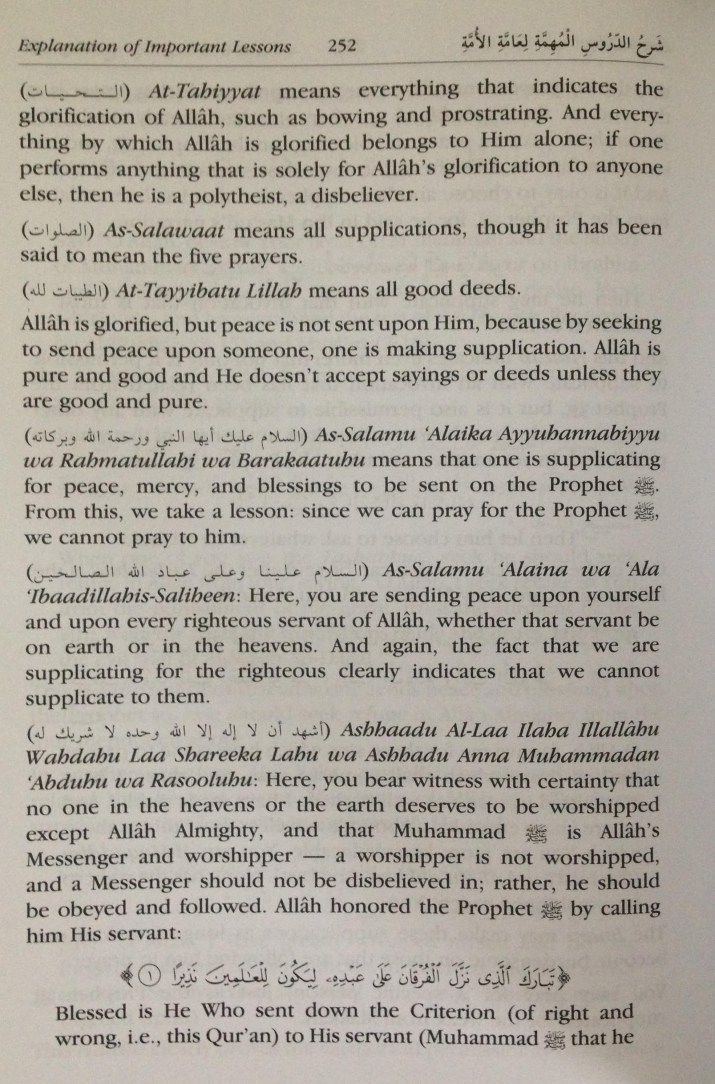
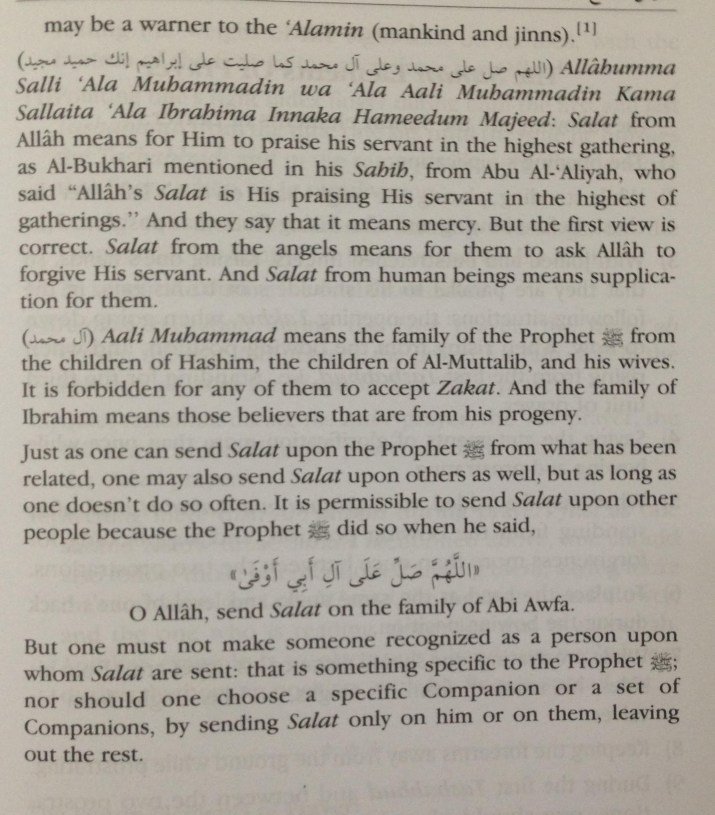
28- Important Lessons – Ch 09 – Salaah – At-Tashahud – Its Meaning

SourceImportant Lessons for the Ummah – Ibn Baaz

Tashahud-1

Tashahud-2

[1] Al-Furqan 25:1

(Images Source:  from the Book “Explanation of Important Lessons for every Muslim – Ibn Baz, darussalam publications, pg 252-253, You are encouraged to buy this excellent Book)

Advising is Linked to Secrecy while Condemning is linked to Publicizing – Imam Ibn Rajab

Al-Fudail (rahimahullaah) said: “The believer conceals (the sin of his brother) and advises (him), while the evildoer disgraces and condemns (him).”

This is what Al-Fudail has mentioned as being from the signs of advising and condemning – and it is that advising is linked to secrecy while condemning is linked to publicizing.

It used to be said: “Whosoever commands his brother (towards doing good) at the head of a gathering, then he has condemned him.” Or it is something with this meaning.

The Salaf used to hate that commanding good and forbidding evil be done in this manner. Instead, they loved that it be done privately between the one commanding and the one being commanded, for indeed, this is from the signs of sincere advice.

This is since it is not the goal of the one who is advising to spread and publicize the faults of the person he is advising, rather his goal is only to put an end to the evil that he has fallen into.

As for spreading and exposing someone’s faults, then that is from the things that Allaah and His Messenger صلى الله عليه وسلم have forbidden. Allaah, may He be Exalted, says:

“Verily, those who love that the evil and indecent actions of those who believe should be propagated (and spread), they will have a painful torment in this world and the Hereafter. And Allaah knows and you know not. And had it not been for the grace of Allaah and His mercy on you, (Allaah would have hastened the punishment on you) and that Allaah is full of kindness, Most Merciful.” [Surah An-Noor: 19-20]

The ahaadeeth concerning the virtue of keeping the faults of others secret are many.[27] Some of the scholars would say to those who were commanding towards good:

“Strive hard to conceal the faults of the sinners, for indeed, exposing their faults shows a weakness in Islaam. The thing that deserves the most to be concealed is one’s faults.”

It is for this reason that spreading someone’s evil and indecent actions is linked to condemning. And they are both from the affairs of the evildoer, since it is not the goal of the evildoer to put an end to the fault nor that the believer avoids that fault or defect. Rather his only goal is to spread and publicize the defects found in his believing brother, and to destroy his honor. So he initiates that and repeats it. And his intention is to belittle his believing brother by exposing his defects and bad qualities to the people so that some harm can fall upon him in this world.

But as for the person that is sincerely advising, his aim in doing that (advising) is to eradicate the faults found in his believing brother and to help him avoid it. This is what Allaah the Most High, has described His Messenger صلى الله عليه وسلم with, saying:

“Verily, there has come unto you a Messenger from amongst yourselves. It grieves him that you should receive any harm or difficulty. He is anxious over you (to rid you of faults and sin), for the believers he is full of pity, kind and merciful.” [Surah At-Tawbah: 128]

And He described his صلى الله عليه وسلم Companions with that, saying:

“Muhammad is the Messenger of Allaah. And those who are with him (i.e. his Companions) are severe with the disbelievers and merciful towards one another.” [Surah Al-Fath: 29]

And He described the believers with the characteristics of patience and mutual advising of one another towards mercy and compassion. [28]

But what drives the evildoer to propagate (his brother’s) evil and to disgrace him is force and harshness, his love for abusing his believing brother, and (his desire) to inflict some harm upon him. These are the characteristics of the Devil – the one who beautifies disbelief, sin and disobedience to the children of Aadam so that due to it they may become amongst the dwellers of the Hellfire, as Allaah says:

“Verily, the Devil is an enemy for you, so take him as an enemy. Verily, he only calls his party (of followers) to be from amongst the dwellers of the Hellfire.” [Surah Faatir: 6]

And He says, after telling us the story of Iblees (the Devil) when he was with the prophet of Allaah, Aadam, and the evil plot that he unleashed on him, such that it brought him to be cast out from Paradise:

“O Children of Aadam! Let not the Devil deceive you, as he got your parents out of Paradise, stripping them of their garments, to show them their private parts.” [Surah Al-A’araaf: 27]

So what a difference there is between one whose intention it is to advise (naseehah) and one whose intention it is to disgrace (fadeehah)! And no one confuses one of these with the other, except someone who does not possess sound intellect.

Footnotes:

[27] See Fath-ul-Baaree (5/97) and Saheeh Muslim (4/1996)
[28] As is found in Allaah’s saying: “Then he became from among those who believed and recommended one another towards patience and recommended one another towards compassion.” [Surah Al-Balad. 17]

Source: From the al-ibaanah eBook :
The Difference between Advising and Condemning – Imaam Ibn Rajab

Invalidators of Salaah (Actions that Nullify one’s Prayer) : Ibn Baaz – Dr. Saleh as Saleh [Audio Benefit|En]

Lesson Eleven
Actions That Nullify One’s Prayer

There are eight actions that nullify one’s prayer:

  1. Speaking, but only when: (1) one is conscious that he is in Prayer, (2) one has knowledge of what he is doing, and (3) one does it on purpose. But when one speaks forgetfully or from ignorance, then his prayer is not nullified.
  2. Laughing.
  3. Eating.
  4. Drinking.
  5. Part of one’s ‘Awrah being exposed.
  6. A significant turning from the direction of the Qiblah
  7. Much and continuous frivolous movement or fiddling around.
  8. Exiting from the state of purity.

(Source:  from the Book “Explanation of Important Lessons for every Muslim – Ibn Baz, darussalam publications, pg 273)

Important Lessons – Ch 11 – Salaah – Invalidators of Salaah

SourceImportant Lessons for the Ummah – Ibn Baaz

Making Dua in Salah (Prayer) following Verses of Threat or Mercy – Dr Saleh as Saleh [Audio|En]

Posted fromSalah (Prayer) – Points of Benefit – Dr. Saleh as Saleh rahimahullaah

https://abdurrahman.org/audio-saleh-as-saleh


Why is it that Allaah burdens the believers with trials while those disobedient enjoy all the goods of life? – Shaykh Uthaymeen | Dr Saleh as Saleh [Audio Benefit|English]

Based on the Answer by Shaykh ibn Uthaymeen rahimahullaah

Question:

Why is it that Allaah burdens the believers (with with trials, illnesses) who worship Him abundantly , while those disobedient enjoy all the goods of life?

SourceFitan and Deviations :Contemporary Issues

Reference: AbdurRahman.Org

Studying at a Kaafir school in a Kaafir Country – Shaykh Ahmed al-Wasaabee

Question:

Would it be disbelief to study at a kaafir school (i.e. public school system in Canada), knowing that we live in a kaafir country, and that we also need an education? This is in addition to the fact that these schools have free-mixing environments where the women do not cover properly. And if studying at these schools is not permissible, is there any exception for those who wish to study at these schools so as to attain some certificate or degree so as to facilitate their plans for hijrah?

Ans: First of all, any of the schools which contain free mixing environments and intermingling of the genders, then attendance in these schools and studying in them is not allowable for whatever reason. And if the schools are free of free mixing and intermingling, then it is allowable to study in this schools if what is being taught does not contain ideology of kufr or systems of kufr. And if it does not contain what promotes kufr, nor does it call to it. So if a Muslim was to study for example engineering, be that of planes or cars or computers (or other than them), and all these being from the inventions of mankind, in order that he may benefit himself and benefit the Muslims, then this is allowable and it is desired that the Muslims may benefit from this type of knowledge.

And it is upon the Muslims to cooperate upon righteousness and fearing of Allaah (subhaana wa ta’laa). Allaah’s statement:

“Help you one another in Al Birr and AtTaqwa (virtue, righteousness and piety.” (Al-Ma’idah 5:2)

So studying in schools which are free from intermingling of men and women, then this is allowable as long as it is free from those things which are muharram (not allowable) in the deen. And also with the condition that what is being studied does not contain disbelief in it.

And the shaykh mentioned the order of the Prophet (صلى الله عليه وسلم) to Zayd bin Thaabit to study the language of the Jews. And Zayd bin Thaabit (radiyAllaahu anhu) went on and mentioned that he had mastered the language of the Jews in fifteen days. And this was of benefit to the Prophet (صلى الله عليه وسلم), as Zayd bin Thaabit was able to translate the letter of the Jews for the Prophet (صلى الله عليه وسلم) and also write to them. And Shaykh Ahmed mentioned that the language was studied so that the Prophet (صلى الله عليه وسلم) and the Muslims may be safe from the planning and the plotting of the Jews.

Source: Al-Qawl-ul- Mufeed Fee Adillatit Tawheed [Beneficial Speech in Establishing the Evidences of Tawheed], Class 22 – Question and Answer Session, By Shaykh Ahmed al-Wasaabee, Translated by Shaakir al-Kanadee

The Pillars of Kufr (Disbelief) – Imam Ibn al Qayyim | Dr Saleh as Saleh [Short Audio|En]

Based on Ibn Qayyim al-Jawziyyah rahimahullaah

Listen / Download Mp3 Here (Time 14:51)

Transcription of the Audio:

Bismillaah hir Rahman nir Raheem. Alhumdulillahi Rabbil Aalameen
Wa sallallahu ala Muhammadin wa ala aalihi wa sahbihi wa sallam

The pillars of Kufr are four, they are,

  • Haughtiness and disdainfullnes : This prevents the person from submission i.e. yielding.
  • Envy (Al Hasad) : This prevents him from accepting the naseehah i.e. the advice and from exerting it.
  • Anger (Al Ghadab) : This prevents him from being just.
  • Lusts : This prevents him from giving himself to worship.

If the pillar of false pride and haughtiness is demolished, then submission will become easy for him. If the pillar of envy is demolished, then it becomes easier for him to accept advice and to offer it. If the pillar of anger is demolished, it becomes easy for him to be just and humble. If the pillar of lust is demolished, it becomes easy for him to be patient and ready for worship.

The demolishing of mountains is much more easier than demolishing these four pillars for the one who is  afflicted with it, specially if they are entrenched in him and became as a firmed attribute, because no action can be upright with the presence of these pillars and no soul can be sanctified and purified having these established in it and whenever the person wants to exert himself to do or to act, these four pillars come and corrupt his work. And all other defects originate from these four and if these four are established in the heart it will make him see falsehood in the form of the truth and truth in the form of falsehood and good in the form of wrong and wrong in the form of good and it will make this life grow nearer to him and make the hereafter far removed from him.

If you contemplate the Kufr of the nations before, you will see that the Kufr of the nations originated from these four pillars and upon these four pillars the punishment will befall. The intensity of the punishment and it’s severity will depend upon how these four and entrenched. So whoever opens for himself these four pillars is indeed has opened all the doors of evil, sooner or later and whoever has closed the doors of these then he indeed has closed all the doors of evil because these four prevents submissiveness, sincerity, repentance and longing and turning to Allah, acceptance of the truth, the advice to the Muslims, humbleness to Allah and to his creation. This is what these four pillars can do.

The origin of these four pillars is from man’s ignorance concerning his Lord and ignorance concerning himself.  Had he known of his Lord qualified with the most perfect and magnificent attributes and had he known himself qualified with all forms of defects, he wouldn’t be haughty, angry, envious of others because envy in fact is one form of opposition to Allah because he dislikes the favour and blessing of Allah which he bestowed upon his slave while Allah loves that. Not only that, he likes that it to be rifted from his brother and Allah does not like that. So he is opposing Allah in his pre-decree and what Allah loves and his honour and that is why Iblees (Satan) is enemy  because his sin was due to haughtiness, arrogance and envy.

How can these be removed?

These two qualities, knowing Allah and Tawheed, and content with him and pleased with him and turning to him, takes away these two qualities of haughtiness and envy and taking anger away by knowing oneself that the self does not deserve all that so that to be angry for it and to avenge for its all sake. In this case this will prompt it to be contempt once this is taken out. Otherwise then this will be preference for the self over its creator and originator. The greatest thing to repel this defect is to train the self to get angry for Allah’s sake and whatever at any time enters the self this type of anger for Allah’s sake, there will exit the anger for its self and the opposite is true. As to the lust, its cure, its healing is in the correct knowledge. Yielding to the self’s lust deprives it from the correct knowledge and putting it on a diet in that respect puts it on the linkage with the correct knowledge. The more you are open the door for lusts, the more you are trying to deprive the self  from the correct knowledge and the more you close it, the more you will be linked to the correct knowledge.

Anger is like the wild animal. If its owner releases it, it starts by eating him up first. Lust is like the fire when the person ignites it it begins by burning him there in first. Al-Kibr, haughtiness, false pride, arrogance is like confronting the king regarding the king’s possession and kingdom, if he does not destroy you he will expel you. Envy is like opposing someone who is more powerful and more stronger than you.

This is based on Imam Ibn Al Qayim’s (rahimahAllah) specification of these four pillars of Kufr.

Transcribed by brother AbdulRazak bin AbdulAleem for AbdurRahman.org, May Allah reward him, ameen.


Attending Mushriks’ Weddings & Funerals – Fatwas of the Permanent Committee

Q 5: Is it permissible for a Muslim who believes in one God to participate in the wedding ceremonies of Mushriks (those who associate others with Allah in His Divinity or worship), and help them arrange such ceremonies on account of a blood or marriage relationship, or the like? Also, is it permissible to attend their funerals, without praying for their dead, and the burial? Is it permissible to sit and commiserate with them?

Ans:

It is not permissible to share in their occasions, which involve Shirk (associating others with Allah in His Divinity or worship) or Bid`ah (innovation in Islam).

Moreover, it is not permissible to follow their funeral processions; because this is a type of forbidden association with them.

May Allah grant us success. May peace and blessings be upon our Prophet Muhammad, his family, and Companions.

The Permanent Committee for Scholarly Research and Ifta’

Member – Member – Chairman
Bakr Abu Zayd – Salih Al-Fawzan – Abdul-`Aziz ibn `Abdullah Al Al-Shaykh

Fatwas of the Permanent Committee: Browse by Volume Number > Group 2 > Volume 1: `Aqidah > Acts commensurate with Kufr > Attending Mushriks’ weddings

The fifth question of Fatwa no. 21587

http://www.alifta.net/Fatawa/FatawaChapters.aspx?languagename=en&View=Page&PageID=10796&PageNo=1&BookID=7

Daily horoscope in newspapers – The Permanent Committee

Fatwa no. 17727

Q: Some Arab newspapers and magazines dedicate pages to the horoscope, talking about zodiac signs such as Aries, Taurus, Gemini and others. They claim that people born under these signs will probably be moody because the zodiac conflicts a lot during this period. There are many things written in these pages, a copy of which is attached to the message and many Muslim youth read them. Please clarify the Islamic ruling on zodiac signs and your advice to Muslims and to those responsible for the magazines.

A: This is considered the same as divination used by fortune-tellers to inform people if they will be happy or miserable and if they should be optimistic or pessimistic. This is a prohibited idea dating back to the days of Jahiliyyah (pre-Islamic time of ignorance). It is not permissible to practice, follow or spread these ideas. It is even more misleading and misguiding to Muslims to spread such ideas in newspapers, as they involve claiming to know Ghayb (the Unseen), which is the sole Right of Allah (Glorified and Exalted be He) Who says,

Say: “None in the heavens and the earth knows the Ghaib (Unseen) except Allâh, nor can they perceive when they shall be resurrected.” [Surah Al-Naml, 27: 65]

Allah also says,

“And with Him are the keys of the Ghaib (all that is hidden), none knows them but He. And He knows whatever there is in the land and in the sea; not a leaf falls, but he knows it. There is not a grain in the darkness of the earth nor anything fresh or dry, but is written in a Clear Record.” [Surah Al-An`am, 6: 59]

Allah even denied that His Messenger Muhammad (peace be upon him) knew the Ghayb. Allah says,

“Say (O Muhammad صلى الله عليه وسلم): I don’t tell you that with me are the treasures of Allâh, nor (that) I know the Unseen; nor I tell you that I am an angel. I but follow what is revealed to me.” Say: “Are the blind and the one who sees equal? Will you not then take thought?[Surah Al-An`am, 6: 50]

He (Glorified be He) says,

“And I do not say to you that with me are the Treasures of Allâh, nor that I know the Ghaib (Unseen), nor do I say I am an angel, and I do not say of those whom your eyes look down upon that Allâh will not bestow any good on them. Allâh knows what is in their inner-selves (as regards belief, etc.). In that case, I should, indeed be one of the Zâlimûn (wrong-doers, oppressors).” [Surah Hud, 11: 31]

The Prophet (peace be upon him) said,

“Anyone who acquires a branch of the knowledge of astrology has acquired a branch of magic (of which they acquire more as long as) they continue to do so.”

There are many Ayahs (Qur’anic verses) and Hadiths in this regard. Muslim scholars unanimously agree on this well-established ruling prohibiting astrology.

Thus, it is the duty of every Muslim seeking the best for themselves and their religion to avoid this form of manipulating people’s minds and beliefs, to fear Allah regarding themselves and their nation and not to spread misleading ideas among Muslims.

On the other hand, Muslim rulers (may Allah grant them success) should prevent this practice and punish those who spread it according to the Islamic prescribed punishment.

May Allah grant us success. May peace and blessings be upon our Prophet Muhammad, his family, and Companions.

The Permanent Committee for Scholarly Research and Ifta’

Member Member Member Member Chairman
Bakr Abu Zayd `Abdul-`Aziz Al Al-Shaykh Salih Al-Fawzan `Abdullah ibn Ghudayyan `Abdul-`Aziz ibn `Abdullah ibn Baz

http://www.alifta.net/Fatawa/FatawaChapters.aspx?languagename=en&View=Page&PageID=10631&PageNo=1&BookID=7

The Caller must adorn himself with noble characteristics – Shaykh ibn Uthaymeen

The Fourth Provision: The Caller must adorn himself with noble characteristics

The Caller must adorn himself with noble characteristics, such that the effect of knowledge reflects in his beliefs, his worship, his attitude, and all of his procedures, so that he can properly play the role of a Caller to Allaah. But as for him being in opposition to this, then his da’wah will fail. And if he does succeed, then his success will be minimal.

So it is upon the Caller to abide by that which he is calling to from acts of worship or daily interactions or manners or methodology, so that his da’wah may be accepted and so that he won’t be from those who will be the first to be thrown into the Hellfire.

O brothers: Indeed if we look at our conditions we will find in reality that we may call to something that we don’t implement ourselves. And this no doubt is a big defect, O Allaah, unless we deny ourselves from looking at what is better since for every place there is a saying. This is since a noble thing may be considered noble due to a number of things that make it superior. This is why the Messenger (sallAllaahu ‘alayhi wa sallam) would call to some characteristics, but at times he would preoccupy himself with things more important than them. At times he would fast to the point that it would be said that he wouldn’t stop fasting. And at times he would eat and drink to the point that it would be said that he would not fast.

O brothers! I would like every Caller to abide by the characteristics that befit the Caller, so that he can be a true Caller and so that his statements can be closer to being accepted.

Posted from  al-ibaanah eBook:
Provisions for the Caller to Allaah   – Imaam Muhammad bin Saalih Al-‘Uthaimeen

Reference: AbdurRahman.Org

The Caller’s heart must be open towards the one who opposes him – Shaykh Ibn Uthaymeen

The Sixth Provision : The Caller’s heart must be open towards the one who opposes him

The Caller’s heart must be open towards the one who opposes him, especially if he knows that his opponent has a good intention and that he only opposes him in things that require that the proof be established to him. People must be flexible in these matters and not allow these differences to incite hatred and enmity. This is except for a man that opposes and stubbornly rejects, such that the truth is explained to him but yet he continues to persist upon his falsehood Such an individual must be dealt with according to how he deserves to be treated, such as calling people away from him and warning the people from him. This is since his enmity has manifested itself, such that the truth was made clear to him, yet he did not act on it.

However, there are some subsidiary issues, which the people differ on. In reality, these are from the matters that Allaah allowed His servants to differ in. I mean issues that are not from the fundamental ones, which can cause a person that opposes in them to be considered a disbeliever. Rather, these (subsidiary) issues are from those that Allaah has permitted differing in for His servants, and for which He made the error committed in that regard to be allowable. The Prophet (sallAllaahu ‘alayhi wa sallam) said: “When the (legal) judge makes a judgement, exerting himself (Ijtihaad), and he attains the truth, then he gets two rewards. And if he errs then he gets one reward.” So the Mujtahid does not leave from the fold of being rewarded at all – either he gets two rewards for being correct or one reward for being wrong.

If you don’t like others opposing you, then likewise, those same other people don’t like for others to oppose them. So just as you want people to accept your view (on an issue), then likewise, those who oppose you want the people to take their views also.

The reference point during these times of dispute is what Allaah has explained in His statement:

“And whatever you differ in, then its final decision is with Allaah. Such is Allaah, my Lord, in whom I put my trust, and to Him I turn in repentance.” [Surah Ash-Shooraa: 10]

And He says:

“O you who believe! Obey Allaah and obey the Messenger, and those in authority amongst you. And if you differ in anything, then return it to Allaah and the Messenger, if you truly believe in Allaah and the Last Day. That is better and more suitable for final determination.” [Surah An-Nisaa: 59]

So everyone that is in disagreement and dispute with one another must return to these sources: The Book of Allaah and the Sunnah of His Messenger. And it is not lawful for anyone to turn away from the words of Allaah and His Messenger in favor of someone else’s words, regardless of who he may be. So if the truth becomes manifest to you, it is an obligation upon you to throw the view of the one who opposes it against the wall. And you must not turn towards that individual, regardless of what position he holds in knowledge and religion. This is since humans make errors, whereas the words of Allaah and His Messenger are free from errors.

It saddens me to hear that there are some people that look hard into seeking the truth and arriving at it, but in spite of this we find them divided. Each one of them has a particular name and a particular description. And this in reality is a mistake. Allaah’s religion is one and the ummah of Islaam is one.

Allaah says:

“And indeed this ummah (nation) of yours is one ummah. And I am your Lord so be dutiful to Me.” [Surah Al-Mu’minoon: 52]

And Allaah said to His Prophet Muhammad;

“Verily, those who split up their Religion and became sects, you have nothing to do with them in the least. Their affair is only with Allaah. Then He will inform them of what they used to do.” [Surah Al-An’aam: 159]

And Allaah says:

“He has ordained for you the same religion which He ordained for Nooh, and that which We have revealed to you (O Muhammad), and that which We ordained for Ibraaheem, Moosaa and ‘Eesaa saying: You should establish the religion and make no divisions in it. Intolerable to the polytheists is that which you call them to. Allaah chooses for Himself whom He wills, and guides unto Himself those who turn to Him in repentance and obedience.” [Surah Ash-Shooraa: 13]

So if these are Allaah’s instructions to us, then what is obligatory upon us is to accept these instructions, and gather together upon putting forth an issue and discussing it with one another, in order to bring about rectification not in order to criticize or take revenge. For indeed, any person that debates with someone else intending to give victory to his view and to debase his opponent’s view, or intending to critique and not to correct, then for the most part, they will come out with a result that is not pleasing to Allaah and His Messenger. So it is obligatory on us, in matters such as these, to be one ummah (nation).

I am not saying that no one errs – everyone either makes mistakes or is correct. Rather, I am talking about the way to correct this error. The way to correct this error is not by me talking about him behind his back and accusing him. Rather, the way to correct this error is to gather with him and discuss it with him. So if it becomes clear after this that this man will persist on his rejection of the truth, and that he will continue to remain upon the falsehood that he is on, then at this point I have the excuse and the right, rather I am obligated to expose his error, and to warn the people about his error. And this way, the affairs will be rectified. As for splitting up and creating parties, then no one is pleased with this except for someone that is an enemy to Islaam and the Muslims.

I ask Allaah to unite our hearts upon obedience to Him, and that He make us from those who seek judgement from Allaah and His Messenger (sallAllaahu ‘alayhi wa sallam). And we ask Allaah to make our intentions sincere and that He clarify to us what is obscure from his Sharee’ah. Verily, He is the Most Magnanimous, Most Generous.

All praise be to Allaah, Lord of the worlds, and may the peace and blessings be on our Prophet Muhammad, his family and all his Companions

Posted from  al-ibaanah eBook:
Provisions for the Caller to Allaah   – Imaam Muhammad bin Saalih Al-‘Uthaimeen

Reference: AbdurRahman.Org

None of you should die Except while he is having good thoughts about Allah – Imam Nawawī’s & al-Manāwī

Jābir ( رضي الله عنه) said: Three days before he died, I heard the prophet (صلّى الله عليه وسلّم ) say

« لاَ يَمُوتَنَّ أَحَدُكُمْ إِلاَّ وَهُوَ يُحْسِنُ الظَّنَّ بِاللَّهِ عَزَّ وَجَلَّ »

[11] None of you should die except while he is having good thoughts about Allah (عزّ وجلّ)

al-Nawawī’s Explanation

The following is again from al-Nawawī’s explanation of Ṣaḥīḥ Muslim.

Regarding the statement of the prophet » None of you should die except while he is having good thoughts about Allah « scholars have said that this is a warning against losing hope and despairing (of Allah’s mercy) and an encouragement to have hope especially at the time of death.

Allah (سبحانه وتعالى) also said in the previous ḥadīth » “I am as my servant thinks of Me.” « and (considering both ḥadīth) scholars explain that » having good thoughts about Allah « means that an individual should expect Allah to have mercy on him and pardon him.

Some scholars have also said that during times of wellbeing and health, an individual should have both hope and fear in Allah and these two feelings should be equally balanced. Others say that one’s fear should be more, but when the signs of death approach, a person’s hope in Allah’s mercy should become stronger. This is because the very purpose of having fear of Allah is to prevent oneself from committing sins and ugly deeds and to increase in obedience and good deeds. And those things are most often not possible during that situation (i.e., during the last moments of one’s death).

Instead, in that situation, assuming good thoughts about Allah is preferable which would cause one to have feelings of destitution and submission and to feel oneself in total need of Allah (تعالى).

The ḥadīth mentioned by Imām Muslim right after this one also supports this understanding:

« يُبْعَثُ كُلُّ عَبْدٍ عَلَى مَا مَاتَ عَلَيْهِ »

Every servant will be resurrected according to what he died upon.[12]

Scholars explain that it means each individual will be resurrected in the same state in which he died. The next ḥadīth (in Imām Muslim’s authentic collection) also supports this:

« إِذَا أَرَادَ اللَّهُ بِقَوْمٍ عَذَابًا أَصَابَ الْعَذَابُ مَنْ كَانَ فِيهِمْ ثُمَّ بُعِثُوا عَلَى
أَعْمَالِهِمْ.»

When Allah intends to punish an entire group of people, the punishment afflicts them all, but then each is resurrected according to (his individual) deeds.[13]

And the ḥadīth:

« إِنَّمَا يُبْعَثُ النَّاسُ عَلَى نِيَّاتِهِمْ »

People will only be resurrected upon their (individual) intentions. [14]

al-Manāwī’s Explanation

The following explanation is from al-Manāwī’s, Fayḍ al-Qadīr.

His (صلّى الله عليه وسلّم) statement » None of you should die except while he is having good thoughts about Allah « means: Let none of you die under any circumstance except while in the state of thinking good about Allah (تعالى) in that He will be merciful with you and pardon you. This is because when a person’s time of passing arrives and his journey comes to an end, his fear (of Allah) has no real purpose (to prevent him from bad deeds during life). It would perhaps lead him to despair and to a feeling of restriction of (Allah’s) mercy and bounties.

Whoever at that time, even if his heart were laden with major sins, begins expecting the best (of his Lord) and increases in hope, he has then perfected his provisions for his arrival to his Lord…

al-Ṭībī said:

The prophet (صلّى الله عليه وسلّم) instructs one to ensure he does not die in any state other than expecting and assuming good about Allah. And this does not mean one can change destiny or fate. Rather, what is intended is that an individual is commanded to have good thoughts (about Allah) so that when death overcomes him, he is in such a state.

نسأل الله الغفور الرحيم لتوفيقه على حسن الظنّ به خصوصًا عند الموت

Footnotes:

[11] Collected by Muslim.
[12] Ibid.
[13] Ibid.
[14] Collected by Ibn Mājah and al-Albānī says it is authentic in Ṣaḥīḥ Sunan Ibn Mājah (no. 3407).

Source: Excerpted from the article “Thinking Good About Allah” – With Explanations by: Ibn Ḥajar al-‘Asqalānī, al-Nawawī, & al-Manāwī – authentic-translations.com

The Caller must invite to Allaah with wisdom – Shaykh Ibn Uthaymeen

The Third Provision: Wisdom

The Caller must invite to Allaah with wisdom. And how bitter is wisdom upon the one who doesn’t have it.

Da’wah (the Call) to Allaah must occur with (1) wisdom, then with (2) fair admonition, then with (3) debating in the best of manners against someone that is not oppressive, then with (4) debating in not the best of manners against someone that is oppressive. So there are four levels.

Allaah says:

“Call to the Way of your Lord with wisdom and fair admonition. And debate them in a way that is better. Verily, your Lord knows best who has gone astray from His path and He knows best those who are guided.” [Surah An-Nahl: 125]

And Allaah says:

“And do not debate with the People of the Scripture (i.e. the Jews and the Christians) except in a manner that is best – except for those who are oppressive amongst them, and say (to them): ‘We believe in that which has been revealed to us and revealed to you. Our God and your God is One, and to Him we have submitted.’” [Surah Al-‘Ankaboot: 46]

Wisdom means: Treating affairs with accuracy and precision, rather it means placing matters in their due place. It is not from wisdom to rush things and expect people to change from the condition they are in to the condition that the Companions were upon overnight. And whoever expects this then he has a foolish mind, and he is far removed from wisdom. This is because the wisdom of Allaah is not like this.

What proves this is that Allaah sent the Qur’aan down to Muhammad, the Messenger of Allaah, in stages so that it may become firm and settled in the souls.

The prayer was made obligatory during the Mi’raaj, three years before the Hijrah. Some say it was a year and a half, and some hold that it was five. There is differing amongst the scholars about this. But in spite of this it was not made obligatory in the manner that it is performed today. When the prayer was first made obligatory, it used to be two rak’ahs for Dhuhr, ‘Asr, ‘Ishaa and Fajr. And the Maghrib prayer used to be three rak’aat, so that it could be the Witr (odd-number) for the day. But after the Hijrah and after the Prophet had spent thirteen years in Makkah, the prayer of the resident was increased, and so it became four rak’aat for Dhuhr, ‘Asr and ‘Ishaa. And Fajr remained the way it was (i.e. two rak’aat) because the recitation of the Qur’aan is prolonged in it. And Maghrib stayed the same because it was the Witr of the day.

Furthermore, Zakaat was made obligatory in the second year after Hijrah. Or (some say) it was made obligatory in Makkah, but that it was not assigned its final estimate in terms of its dividend and obligation. And the Prophet (sallAllaahu ‘alayhi wa sallam) did not send out envoys to collect the Zakaat until the ninth year after Hijrah.

Therefore, the development of Zakaat progressed in three stages:

1. In Makkah: “But pay its due (i.e. Zakaat) on the day of its harvest.” [Surah Al-An’aam: 141] However, its obligation was not clarified nor the amount that was mandated to give for that obligation. This matter was left entrusted to the people.
2. In the second year after Hijrah, Zakaat was clarified with its rightful dividends.
3. And in the ninth year after Hijrah, the Prophet started to send envoys to the people of yields and profits to collect Zakaat from them.

So look at the careful consideration that was given to the conditions of the people with regard to Allaah’s legislation. And He is the best of judges.

The same goes for fasting, as there was a stage-by-stage development with regard to its legislation. What was first made obligatory, was that a person had a choice between fasting or feeding a needy person. Then fasting was prescribed specifically, and feeding needy people was only allowed for those who weren’t able to fast for numerous consecutive days.

Therefore I say that wisdom denounces that the world change over in one night. There must be endurance and tolerance. Accept from your brother whom you are calling what he has from truth for today, and proceed with him step by step until he is able to eventually free himself from falsehood. And this is so that you may see that people are not of equal standing. So there is a difference between one is ignorant and one who stubbornly rejects.

Perhaps it is proper that I now mention some examples of the Da’wah of Allaah’s Messenger (sallAllaahu ‘alayhi wa sallam):

The First Example:

A Bedouin man once entered the masjid, while the Prophet was sitting down with his Companions. The Bedouin man then urinated in one area of the masjid, so the people reprimanded him, meaning they scolded him angrily using harsh words. However, the Prophet, who was the one whom Allaah gave wisdom, forbade them from this. So when the man had finished urinating, the Prophet (sallAllaahu ‘alayhi wa sallam) ordered that a bucket of water be thrown over his urine. So the harm was removed and Allaah’s Messenger (sallAllaahu ‘alayhi wa sallam) called the Bedouin to him, saying to him: “Indeed it is not proper to have any harmful object or filth in these masaajid. They are only for prayer and the reciting of the Qur’aan.” Or it is as he (sallAllaahu ‘alayhi wa sallam) said. So the Bedouin’s heart opened up to this kind treatment. This is why I have seen some of the scholars quote this Bedouin man as saying: “O Allaah, have mercy on me and Muhammad and do not have mercy on anyone else besides us.” This was because the Prophet (sallAllaahu ‘alayhi wa sallam) treated him in such an excellent manner. But as for the Companions, they rushed to remove this evil act, without having properly weighed the condition of this man, who was (obviously) ignorant. [2]

The Second Example:

One time Mu’awiyah bin Al-Hakam, may Allaah be pleased with him, came while the Prophet was leading the people in prayer. So one man sneezed and said: “AlHamdulillaah.” (Note:) If one of you sneezes while in prayer then he should say AlHamdulillaah, regardless of whether he is in the standing position or the bowing position or in prostration. This man (in prayer) said “Al-Hamdulillaah, so Mu’awiyah responded: “YarhamukAllaah.” But this is considered speaking and it invalidates the prayer. So the people began to stare and look at him. So Mu’awiyah said: “May my mother be bereaved of me.” This means for the mother to be lost. This is a statement that is said but for which it’s meaning is not intended. Then Mu’awiyah continued to pray. After he finished praying, the Prophet (sallAllaahu ‘alayhi wa sallam) called him. Mu’awiyah said: “By Allaah, I did not see a teacher better at instructing than him.” May Allaah send His peace and blessings on him. He said: “By Allaah, he was not harsh with me nor did he scold me, he only said: ‘Speaking to people is not correct while in the prayer. It is only for tasbeeh (saying SubhaanAllaah), takbeer (saying Allaahu Akbar) and reciting of the Qur’aan.’” Or it is as he (sallAllaahu ‘alayhi wa sallam) said.[3]

The Prophet (sallAllaahu ‘alayhi wa sallam) even said it to Mu’aadh bin Jabal when he told him: “Shall I not inform you of what controls all of that?” He (i.e. Mu’aadh) said: “Of course O Messenger of Allaah.” He (sallAllaahu ‘alayhi wa sallam) said: “Restrain this on yourself.” And he took hold of his tongue, saying: “Restrain this.” So Mu’aadh said: “Will we be held accountable for what we say with it?” He (sallAllaahu ‘alayhi wa sallam) said: “May your mother be bereaved of you O Mu’aadh. What else will cause the people to be dragged on their faces – or he said on their noses – into the Hellfire except for the harvests of their tongues.” Look at the da’wah that is beloved to the souls, which people accept and by which the hearts become open.

We derive from the Fiqh point of benefits of this hadeeth that: Whoever speaks while in prayer, while not knowing that speaking invalidates the prayer, his prayer is still valid.

The Third Example:

A man came to the Prophet (sallAllaahu ‘alayhi wa sallam) and said: “O Messenger of Allaah, I am ruined!” So he (sallAllaahu ‘alayhi wa sallam) asked: “And what caused you to be ruined?” He said: “I had intercourse with my wife during Ramadaan while I was fasting.” So the Messenger of Allaah ordered him to free a slave, but he said: “I cannot find one (i.e. unable).” Then he commanded him to fast two consecutive months, but he said; “I am not able to.” Then he commanded him to feed sixty needy people, but he said: “I am not able to.” At this the man sat down. So the Prophet (sallAllaahu ‘alayhi wa sallam) brought some dates to him saying: “Take this and give it away in charity.” But the man became desirous of the Prophet’s generosity, which was the greatness of kindness shown towards creation. This was since the Messenger of Allaah (sallAllaahu ‘alayhi wa sallam) was indeed the most generous of people.

So the man said: “Am I to give this to someone poorer than myself O Messenger of Allaah? By Allaah there is no family poorer than mine between the two lava plains of Madeenah?” At this, the Prophet (sallAllaahu ‘alayhi wa sallam) laughed to the point that his molar teeth became visible. This was because this man had come in fear, saying: “I am ruined” but yet he left successful. So the Prophet (sallAllaahu ‘alayhi wa sallam) then said: “Feed your family with it.” So the man left peaceful, prosperous

and joyful with this religion of Islaam and with this ease from the first Caller to this religion of Islaam, may the peace and blessings of Allaah be upon him. [4]

The Fourth Example:

Let us now look at how the Prophet dealt with one who had committed a sin. The Prophet (sallAllaahu ‘alayhi wa sallam) once saw a man that had a gold ring on his finger. So the Prophet (sallAllaahu ‘alayhi wa sallam) seized the ring from him with his noble hand and threw it on the ground. And he (sallAllaahu ‘alayhi wa sallam) said: “Would any of you intentionally tale a coal of fire and place it on his hand?” So the Prophet (sallAllaahu ‘alayhi wa sallam) did not treat him the way he treated the people in the first examples. Rather, he snatched it from his hand and threw it at the floor. So when the Prophet (sallAllaahu ‘alayhi wa sallam) left, it was said to the man: “Take your ring and benefit from it (i.e. by selling it).” The man said: “By Allaah, I will never take a ring that the Prophet (sallAllaahu ‘alayhi wa sallam) threw away.” [5]

Allaahu Akbar! This was the magnificent way the Companions would execute the Commandments of Allaah and His Messenger.

So what is important is that the Caller to Allaah must invite with wisdom, because the one who is ignorant is not like the one who has knowledge. And the one who rejects is not like the one who readily accepts. So for every place there is a saying and for every position there is a condition.

Footnotes:

[2] See Saheeh Muslim (Eng.: Book 2, no. 559)
[3] See Saheeh Muslim (Eng.: Book 4, no. 1094)
[4] See Saheeh Al-Bukhaaree (Eng.: vol. 3, no. 158) and Saheeh Muslim (Eng.: Book 6, no. 2457)
[5] See Saheeh Muslim (Eng.: Book 24, no. 5209)

Posted from  al-ibaanah eBook:
Provisions for the Caller to Allaah   – Imaam Muhammad bin Saalih Al-‘Uthaimeen

Reference: AbdurRahman.Org

Benefit: Defaming the Companions is equal to Defaming the Religion itself – Shaykh Abdul-Muhsin

One thing we must understand is that defaming these chosen and unique individuals is equal to defaming the Religion itself, since it was none other than them who passed the Religion down to those who came after them.

And we already mentioned the words of Abu Zur’ah, in which he said:

“The only ones who brought this Qur’aan and Sunan (plural of Sunnah) to us are the Companions of Allaah’s Messenger. (So) they only wish to disparage and demolish our witnesses so that they can nullify the Book and the Sunnah, whereas they are more deserving of being disparaged for they are the heretics (zanaadiqah).”

This refers to those who seek to belittle any of the Companions. It implies that the one who defames them does not harm them in the least but rather he only benefits them, based on afore-mentioned hadeeth of the “bankrupt person.” The one who defames them only causes harm to himself. So whoever finds in his heart love for them and a lack of hatred for them, and withholds his tongue from mentioning anything but good about them, then he should praise Allaah for this blessing. And He should ask Allaah to keep him firm upon this guidance. And whoever holds any hatred for them in his heart and his tongue is loose in mentioning them with that which does not befit them, then he must fear Allaah and desist from these crimes. And he must repent to Allaah while the door of repentance remains open in front of him, before he regrets it at a time when regrets will be of no benefit.

Our Lord do not cause our hearts to go astray after having guided us and grant us mercy from Yourself, indeed You are the One who grants all requests.

“Our Lord! Forgive us and our brothers who preceded us in Faith. And put not in our hearts any hatred against those who have believed. Our Lord, You are indeed full of kindness, most Merciful.”

Posted from : The Creed of Ahlus-Sunnah wal-Jamaa’ah concerning the Companions – Shaikh ‘Abdul-Muhsin bin Hamad Al-‘Abbaad, al-ibaanah eBook

Reference: AbdurRahman.Org

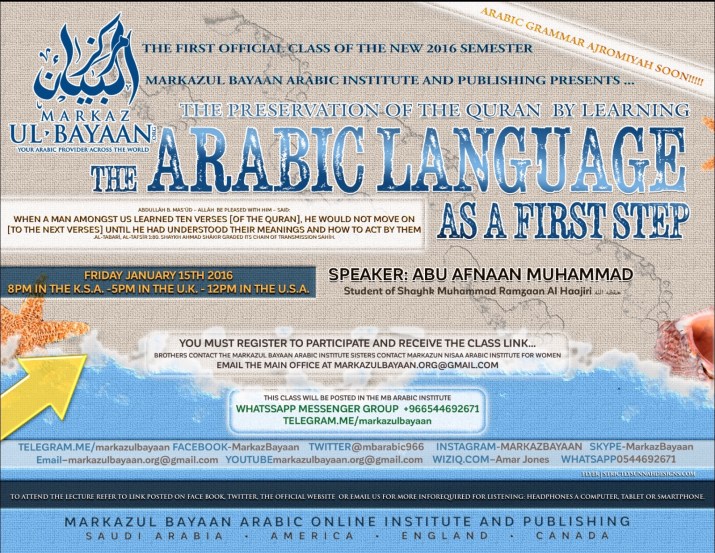
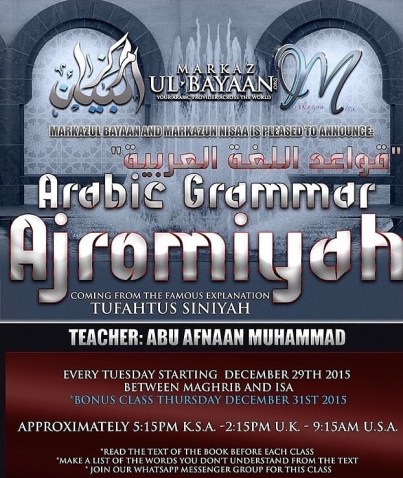
The Preservation the Qur’an by learning the Arabic Language as a First Step – Abu Afnan Muhammad [Audio|En]

markaz ul bayaan online arabic learning

Speaker: Abu Afnaan Muhammad حفظه الله
Student of Shayhk Muhammad Ramzaan Al Haajiri حفظه الله

Exiting from the Fire for those who Worshipped Allaah Alone – Silsilah Ahadeeth As-Saheehah

20 – Exiting from the Fire for those who Worshipped Allaah Alone

225 – When the believers will have finished from the fire on the Day of Judgment and become secure. Then one of you arguing for the truth, in the Duniya for his companion will not be more intense than the debating of the believers with their Lord, regarding their brothers whom had been entered into the fire.

He said: they will say: Our Lord! These are our brothers they used to pray along with us, and fast along with us, and perform the Hajj along with us, and you have entered them into the fire.

He said: that Allaah will say: “go and take out those whom you know.”

So they will come to them, and they will know them by their faces. The fire would not have eaten their faces. From amongst them there will be, he whom the fire has reached half way up his shins, and he whom the fire has reached to his ankles, and they will take them out.

The believers will say: “We took out those whom You have commanded to take out.”

Then Allaah will say: “Take out he who has the weight of a dirham of Emaan in his heart. Then the one who has the weight of half a dirham,’ until He says: He who has an atom’s weight in his heart.

Abu Sa’eed said: whoever does not believe this, then let him read this Ayaah : << Surely! Allaah wrongs not even of the weight of an atom, but if there is any good (done), He doubles it, and gives from him a great reward. >>

He said: The Believers will say: “O our Lord! Indeed we have taken out those whom You have commanded to take out.’ Then there will not remain anyone in the fire who has good in himself.”

He said: Then Allaah will say: the Angels have interceded, and the Prophets have interceded, and the believers have interceded and The Most Merciful of those who shows mercy remains.

He said : Then Allaah will grab a handful from the fire – or He said : two handfuls – of people who never did any good for Allaah at all, indeed they will be burnt so much that they will have become charcoal.

He said: they will be brought to water, which is said to be called the water of life. It will be poured on them they will sprout out like the seed sprouts after what is left over by the torrential floods, they will come out of their bodies like pearls, and they will have a stamp on their necks, saying: those freed by Allaah.

He said: it will be said to them: Enter into Paradise, whatever you wish for or anything you see then it is for you, and I have something with Me which is better than that. He said: They will say: Our Lord! What can be better than this?

He said: Allaah will say: My being pleased with you, I will never be angry with you.”

1661- “Indeed Allaah Azza wa Jal will take out a people from the fire after nothing remains of them except for their faces and Allaah will enter them into Paradise.” The hadeeth is in saheeh al-Bukhari (4/463-464) by a different narration on the authority of Abu Sa’eed in a narration ascribed to the Prophet -sallAllaahu alayhi wa sallam, and he mentions the whole of the hadeeth of the intercession; and in it, is stated: “Allaah Ta’aala will say:

Go to those whom you find in their hearts the equivalent to a dinar of Emaan and take them out of the fire, Allaah prohibits the fire from their faces…

1450 – “Take out of the fire whoever has in his heart the equivalent of an atom worth of Emaan.”

1451- “Some people from the people of Tawheed will be punished in the fire, until they will be like charcoal, then mercy will reach them. They will be taken out and thrown at the doors of Paradise. He said: then the people of Paradise will sprinkle water upon them, they will sprout like seeds left over, sprouts after the torrential floods, then they will enter paradise.”

Posted from: The Ahadeeth of Tawheed, Part 05, Explained By the Muhaaddith, the Allaamah, Shaykh Naasirud-Deen al-Albaanee (rahimullaah), Source: Silsilah Ahadeeth As-Saheehah of Shaykh Al-Albaani (rahimahullaah), Translated by: Abbas Abu Yahya (hafidhahullaah)

Reference: AbdurRahman.org

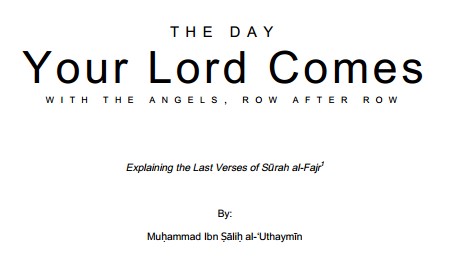
The Day Your Lord Comes with the Angels, row after row – Shaykh ibn Uthaymeen

The Day your Lord Comes

[1] This article was taken from the book Tafsīr Juz ‘Amma by Muḥammad Ibn Ṣāliḥ al-‘Uthaymīn (1423/2002, Riyadh: Dar al-Thurayya). At the time of translating, the original Arabic text could be found at: ibnothaimeen.com/all/books/article_17873.shtml.

Verses 21-30 from Surah al-Fajr

No. When the earth is leveled, pounded and crushed,
and your Lord comes with the angels, row after row,
and that day, Hell is brought near, the day man will remember, but how will the remembrance help him then?
He will say, “I wish I had sent forth (some good) for my life.”
But on that day, no one will punish as He punishes,
and no one will bind as He binds.
(But to the righteous it will be said,) “You, soul at peace,
return to your Lord well-pleased (yourself) and well pleasing (to Him).
Go and enter among My servants
and enter My paradise.”

Click the below link to Read the PDF:

The Day Your Lord Comes – Shaykh ibn Uthaymeen

Courtesy of authentic-translations.com
Translated by Abu az-Zubayr Harrison hafidhahullaah

Arabic Grammar Ajromiyah – Abu Afnaan Muhammad [Audio|Arabic]

Speaker: Abu Afnaan Muhammad حفظه الله
Student of Shayhk Muhammad Ramzaan Al Haajiri حفظه الله

Arabic Grammar Ajromiyah

Further parts will be added as available, insha Allaah.  To download, visit the sound cloud URL of the audio.

https://soundcloud.com/abdurrahmanorg/sets/arabic-grammar-ajromiyah-abu-afnaan-muhammad-arabic