The Excellence and Obligation of the Payment of Zakat – Explanation of Riyad-us-Saliheen – Dawud Burbank [Audio|En]

Allah, the Exalted, says:

“And perform Salat (Iqamat-as-Salat), and give Zakat.” (2:43)

“And they were commanded not, but that they should worship Allah, and worship none but Him Alone (abstaining from ascribing partners to Him), and perform As-Salat (Iqamat-as-Salat) and give Zakat, and that is the right religion.” (98:5)

“Take Sadaqah (alms) from their wealth in order to purify them and sanctify them with it.” (9:103)

1206.  Ibn `Umar (May Allah be pleased with them) reported: The Messenger of Allah (sallallaahu ’alayhi wa sallam) said, “(The structure of) Islam is built on five (pillars): Testification of `La ilaha illallah’ (none has the right to be worshipped but Allah), that Muhammad (sallallaahu ’alayhi wa sallam) is his slave and Messenger, the establishment of Salat, the payment of Zakat, the pilgrimage to the House of Allah (Ka`bah), and Saum during the month of Ramadan.” [Al-Bukhari and Muslim].

Part 01: Listen / Download Mp3 Here (Time 47:08)

1207.  Talhah bin `Ubaidullah (May Allah be pleased with him) reported: A person with dishevelled hair, one of the people of Najd, came to the Messenger of Allah (sallallaahu ’alayhi wa sallam). We heard the humming of his voice but could not fully understand what he was saying, till he approached close to the Messenger of Allah (sallallaahu ’alayhi wa sallam). Then I came to know that he was asking about Islam. The Messenger of Allah (sallallaahu ’alayhi wa sallam) said: “There are five (obligatory) Salat during the day and the night.” He said: “Am I obliged to perform any other (Salat) besides these?” The Messenger of Allah (sallallaahu ’alayhi wa sallam) said, “No, but whatever you observe voluntarily.” He (sallallaahu ’alayhi wa sallam) added, “There is the Saum of Ramadan.” The inquirer asked: “Am I obliged to do anything besides this?” The Messenger of Allah (sallallaahu ’alayhi wa sallam) said, “No, but whatever you do out of your own free will. You may observe voluntary fasting.” And the Messenger of Allah (sallallaahu ’alayhi wa sallam) told him about the Zakat (obligatory charity). The inquirer asked: “Am I obliged to pay anything besides this?” The Messenger of Allah (sallallaahu ’alayhi wa sallam) said, “No, but whatever you pay voluntarily out of your own free will.” That man turned back saying: “By Allah! I will neither make any addition to this nor will I decrease anything from it.” (Upon hearing this) the Messenger of Allah (sallallaahu ’alayhi wa sallam) remarked, “He is successful if he proves truthful (to what he is saying).” [Al-Bukhari and Muslim].

Part 02: Listen / Download Mp3 Here (Time 50:53)

1208. Ibn `Abbas (May Allah be pleased with them) reported: The Prophet (sallallaahu ’alayhi wa sallam) appointed Mu`adh (May Allah be pleased with him) as governor of Yemen, and at the time of his departure, he instructed him thus: “First of all, call the people to testify `La ilaha illallah’ (there is no true god except Allah) and that I (Muhammad) am the Messenger of Allah, and if they accept this (declaration of Faith), then tell them that Allah has enjoined upon them five Salat during the day and night; and if they obey you, tell them that Allah has made the payment of Zakat obligatory upon them. It should be collected from their rich and distributed among their poor.” [Al-Bukhari and Muslim].

Part 03: Listen / Download Mp3 Here (Time 48:20) (Muaadh Yemen)

1209. Ibn `Umar (May Allah be pleased with them) reported: The Messenger of Allah (sallallaahu ’alayhi wa sallam) said, “I have been commanded to fight people till they testify `La ilaha illallah’ (there is no true god except Allah) that Muhammad (sallallaahu ’alayhi wa sallam) is his slave and Messenger, and they establish Salat, and pay Zakat; and if they do this, their blood (life) and property are secured except when justified by law, and it is for Allah to call them to account.” [Al-Bukhari and Muslim].

Part 04: Listen / Download Mp3 Here (Time 41:59) (Commanded To Fight)

1210. Abu Hurairah (May Allah be pleased with him) reported: When the Messenger of Allah (sallallaahu ’alayhi wa sallam) passed away, Abu Bakr (May Allah be pleased with him) was appointed as his successor (caliph). Amongst the Arabs some men apostatised. Abu Bakr (May Allah be pleased with him) resolved to fight them. `Umar bin Al-Khattab (May Allah be pleased with him) said to Abu Bakr: “How can you fight them when the Messenger of Allah (sallallaahu ’alayhi wa sallam) has declared: `I have been commanded to fight people till they testify La ilaha illallah (there is no true god except Allah); and if they do it, their blood (life) and property are secured except when justified by law, and it is for Allah to call them to account.” Upon this Abu Bakr (May Allah be pleased with him) said: “By Allah, I would definitely fight him who makes distinction between Salat and the Zakat, because it is an obligation upon the rich to pay Zakat. By Allah I will fight them even to secure the piece of rope which they used to give to the Messenger of Allah (sallallaahu ’alayhi wa sallam).” `Umar (May Allah be pleased with him) said: “I realized that Allah opened the heart of Abu Bakr (May Allah be pleased with him) for fighting those who refused to pay Zakat, and I fully recognized that Abu Bakr ¨(May Allah be pleased with him) was right.” [Al-Bukhari and Muslim].

Part 05: Listen / Download Mp3 Here (Time 1:02:08) (Differentiate Between Salaah)

1211. Abu Ayyub (May Allah be pleased with him) reported: A man said to the Prophet (sallallaahu ’alayhi wa sallam): “Direct me to a deed which may admit me to Jannah.” Upon this he (the Messenger of Allah (sallallaahu ’alayhi wa sallam)) said, “Worship Allah and never associate anything with Him in worship, establish Salat, pay Zakat, and strengthen the ties of kinship.” [Al-Bukhari and Muslim].

1212. Abu Hurairah (May Allah be pleased with him) reported: A bedouin came to the Prophet (sallallaahu ’alayhi wa sallam) and said: “O Messenger of Allah! Direct me to a deed by which I may be entitled to enter Jannah.” The Prophet (sallallaahu ’alayhi wa sallam) said, “Worship Allah, and never associate anything with Him, establish Salat, pay the Zakat which has been enjoined upon you, and observe Saum of Ramadan.” He (the bedouin) said: “By Him in Whose Hand my soul is, I will never add anything to these (obligations).” When he turned his back, the Prophet (sallallaahu ’alayhi wa sallam) said, “He who wants to see a man from the dwellers of Jannah, let him look at him (bedouin).” [Al-Bukhari and Muslim].

Part 06: Listen / Download Mp3 Here (Time 45:35) (Action To Enter Paradise)

1214. Abu Hurairah (May Allah be pleased with him) reported: The Messenger of Allah (sallallaahu ’alayhi wa sallam) said, “Any person who possesses gold or silver and does not pay what is due on it (i.e., the Zakat); on the Day of Resurrection, sheets of silver and gold would be heated for him in the fire of Hell and with them his flank, forehead and back will be branded. When they cool down, they will be heated again and the same process will be repeated during the day the measure whereof will be fifty thousand years. (This would go on) until Judgement is pronounced among (Allah’s) slaves, and he will be shown his final abode, either to Jannah or to Hell.” It was asked, “How about someone who owns camels and does not pay what is due on him (i.e., their Zakat)?” He (sallallaahu ’alayhi wa sallam) replied, “In the same way the owner of camels who does not discharge what is due in respect of them (their due includes their milking on the day when they are taken to water) will be thrown on his face or on his back in a vast desert plain on the Day of Resurrection and they will trample upon him with their hoofs and bite him with their teeth. As often as the first of them passes him, the last of them will be made to return during a day the measure whereof will be fifty thousand years, until Judgement is pronounced among (Allah’s) slaves, he will be shown his final abode either to Jannah or to Hell.” It was (again) asked: “O Messenger of Allah, what about cows (cattle) and sheep?” He (sallallaahu ’alayhi wa sallam) said, “If anyone who possesses cattle and sheep and does not pay what is due on them (i.e., their Zakat); on the Day of Resurrection, he will be thrown on his face in a vast plain desert. He will find none of the animals missing with twisted horns, without horns or with a broken horn, and they will gore him with their horns and trample upon him with their hoofs. As often as the first of them passes him, the last of them will be made to return to him during a day the measure whereof will be fifty thousand years, until Judgement is pronounced among (Allah’s) slaves; and he will be shown his final abode either to Jannah or to Hell.” It was asked: “O Messenger of Allah, what about the horses?” Upon this he (sallallaahu ’alayhi wa sallam) said, “The horses are of three types. One, which is a burden for the owner; another which is a shield, and another one which makes its owner entitled to reward. The one for whom these are a burden is the person who rears them for show or for pride or for causing injury to the sentiments of the Muslims. They will be a cause of torment for their owners. The one for whom these are a shield is the person who rears them for the sake of Allah but does not forget the Right of Allah concerning their backs and their necks (i.e., he lets a needy ride on them), and so they are a shield for him. Those which bring reward to the one who rears them in pastures and gardens are the ones that are used in the Cause of Allah (Jihad) by the Muslims. Whatever they eat from the meadows and the gardens will be recorded on his behalf as good deeds so much so that their droppings and urine will be counted for an equal number of good deeds for him. Even when they break their tying rope and every height from which they climb and every hoofprint which they leave will be counted as a good deed on behalf of the owner. When their owner leads them through a stream from which they drink, though he does not intend to quench their thirst, yet Allah would record for him the quantity (of water) of what they would drink on his behalf as good deeds.” It was asked: “O Messenger of Allah, what about the donkeys?” Upon this he (sallallaahu ’alayhi wa sallam) said, “Nothing has been revealed to me in regard to the donkeys in particular except this one Verse of a comprehensive nature:So whosoever does good equal to the weight of an atom (or a small ant) shall see it. And whosoever does evil equal to the weight of an atom (or a small ant) shall see it.”’ (99: 8,9). [Al-Bukhari and Muslim].

Part 07: Listen / Download Mp3 Here (Time 54:12) (Punishment of not paying Zakah)

You can read The Excellence and Obligation of the Payment of Zakat – Riyad-us-Saliheen

Touching the Private Parts During Ghusl – Shaykh ‘Ubayd al-Jaabiree [Video|Ar-En Subtitles]

Touching the Private Parts During Ghusl – Shaykh ‘Ubayd al-Jaabiree حفظه الله
http://ar.miraath.net/fatwah/10884
Translated by Abu Afnaan Muhammad Abdullah حفظه الله
Video Courtesy: Bilal Nahim

The Third Level is al-ihsaan – Shaykh Fawzan | Dawud Burbank

The Third Level is al-Ihsaan

The Definition of Ihsaan

المرتبة الثالثة : الإحسان ، ركن واحد ، وهو ” أن تعبد الله كأنك تراه ، فإن لم تكن تراه فإنه يراك”

The third level is al-ihsaan. It is a single pillar and it is: «That you worship Allaah as if you were seeing Him, and even though you do not see Him, He certainly sees you46

[46] Al-Ihsaan in the language means to perfect something and complete it. It is derived from al-husun which means al-jamaal (beauty), the opposite of ugliness. It is divided into categories:

Firstly: Perfection of what lies between the servant and his Lord. This is what is meant.

Secondly: Perfection of what is between the servant and the rest of the people.

Thirdly: Doing well and perfecting what you do. When a person makes something or does an action, then it is obligatory upon him that he perfects it and does it completely.

The first type is ihsaan (perfection) of what lies between the servant his Lord. The Messenger sallallaahu`alaihiwasallam explained it when Jibreel asked him in the presence of the companions as will follow. He said: «Ihsaan is that you worship Allaah as if you were seeing Him, and even though you do not see Him, He certainly sees you

So ihsaan between the servant and his Lord is his perfecting the action which Allaah has made a duty upon him, that he does it correctly, purely and sincerely for the Face of Allaah, the Mighty and Majestic. So, an action in which there is ihsaan between the servant and his Lord is that which is done sincerely for Allaah, the Mighty and Majestic, and done with the following of the Messenger sallallaahu`alaihiwasallam. The Prophet sallallaahu`alaihiwasallam made clear that ihsaan is of two levels, one of them being higher than the other:

The first level is that you worship Allaah as if you were seeing Him such that your certainty and eemaan in Allaah reaches such a level that it is as if you are actually seeing Allaah with your eyes. You have no hesitancy or doubt, rather it is as if Allaah is in front of you, He the Perfect and Most High, and you are seeing Him openly. Whoever reaches this level has reached the limit of ihsaan. You worship Allaah as if you are seeing Him on account of the completeness of certainty and sincerity, which is as if you are seeing Allaah with your eyes. Allaah, the Mighty and Majestic, will not be seen in this world, rather He will only be seen in the Hereafter. However, you see Him with your heart to the extent that it is as if you are seeing Him with your eyes. Therefore, He will reward the people of ihsaan in the Hereafter that they will see Him, He the Perfect and Most High. This is since they used to worship Him as if they were seeing Him in this world. So, Allaah rewards them by giving them the opportunity to see Him with their eyes in the abode of bliss. He, the Most High, said:

«For the people of ihsaan there will be the best reward of Paradise and something extra[10:26]

Something extra is looking upon the Face of Allaah. The reason is that they perfected their deeds in this world, so Allaah gave them the best reward which is Paradise. And He will give them an increase which is seeing Allaah, the Mighty and Majestic. So therefore, you worship Allaah as if you are actually witnessing Him, upon love and longing to meet Him, He the Perfect and Most High. You feel delight in obedience to Him and you feel calm and obedience to Him, He the Perfect and Most High. You eagerly desire obedience to Him. This is the path of the people of ihsaan.

The second level: If you do not reach this tremendous level, then you worship Him upon the path of al-muraqabah (watchfulness) such that you know that Allaah sees you, knows your condition, and knows what lies within yourself. Therefore, it is not befitting that you should disobey Him and contradict His command when He sees and observes you. This is a good state, however, it is less than the first one. So, as long as you know that He sees you, then you therefore perfect your worship of Him and you do it well, because you know that Allaah is seeing you. And for Allaah is the Highest example. If you were in front of a created being who had status and he commanded you with a command, and you were carrying this matter out in front of him and he was looking at you, would it be befitting that you be negligent in the performance of this action?

So in summary, ihsaan is of two levels:

The level of witnessing with the heart: It is that you worship Allaah as if you are seeing Him from the strength of certainty and eemaan. It is as you are seeing Allaah, the Mighty and Majestic, with your eyes.

The second level: It is that you worship Allaah knowing that He sees you and observes you, therefore, you do not disobey Him and contradict His command, He the Perfect and Most High.

This is the level of al-ihsaan and it is highest of the levels of the religion. Whoever reaches it has reached the highest of the levels of the religion. Before it is the level of eemaan, and before that is the level of al-Islaam.

The deen has a number of domains:

The first domain: al-Islaam. It is wide to such an extent that the hypocrite enters within it and is called a Muslim and is treated like the Muslims, because he has submitted to Islaam outwardly. So therefore, he enters within the domain of Islaam. And the person who is weak in eemaan [enters the domain of Islaam], but he has nothing from eemaan except a mustard seed of it.

The second domain: It is more restricted and more specific – the domain of al-eemaan. The hypocrite in belief does not enter into it whatsoever. Rather, only the people of eemaan enter into it, and they are two categories: those who are complete in eemaan and those who are deficient in eemaan. So, the sinful believer and dutiful believer both enter into it.

The third domain: It is more restricted than the second one – the domain of al-ihsaan. It just as the Prophet sallallaahu`alaihiwasallam made clear. No one will enter into it except the people of complete eemaan.

The Evidence for al-Ihsaan

والدليل قوله تعالى:

And the proof is His saying, He the Most High:

«Allaah is with those who fear Him and are dutiful to Him; and He is with those who are people of ihsaan[16:128]

وقوله تعالى:

And His saying, He the Most High:

«And place your reliance upon the All-Mighty, the Bestower of Mercy. He who sees you when you stand to pray. And who sees your movements along with those who pray along with you. Indeed! He is the All-Hearing, the All-Knowing[26:217-220]

وقوله تعالى:

And His saying, He the Most High:

«And you are not (O Muhammad sallallaahu`alaihiwasallam) engaged in any matter nor do you recite the Book of Allaah, – nor do you do any action (O people), except that We are witness in your deeds when you do them. And not even that which is of the weight of the tiniest ant is hidden from your Lord on the earth or in the heavens. Nor is there anything smaller than that or greater than it except that it is written in a Clear Book[10:61][47]

[47] This is the proof for the first level of al-ihsaan:

«Allaah is with those who fear Him and are dutiful to Him, and He is with those who are people of ihsaan[16:128]

The aayah proves that Allaah is with the people of ihsaan. They are those who worship Allaah as if they were seeing Him, so Allaah is with them in a specific sense of Ma`iyyah – the Ma`iyyah with regard to aiding, helping, and tawfeeq (guiding them to and granting them attainment of correctness).

And His saying, He the Most High:

«And place your reliance upon the All-Mighty, the Bestower of Mercy. He who sees you when you stand to pray. And who sees your movements along with those who pray along with you[26:217-219]

This is a proof for the second level. This is a proof for his saying [sallallaahu`alaihiwasallam]: «Then, He certainly sees you

«And place your reliance» Meaning: trust your affairs «to the All-Mighty, the Bestower of Mercy» He is Allaah, the Perfect and Most High.

«When you stand to pray» You stand for worship and the prayer.

«And who sees your movements along with those who pray along with you» He sees you whilst you are performing your rukoo` (bowing) and whilst you are performing your sajdah (prostration). He sees you in all the states of worship; standing, bowing, and prostrating. He, the Perfect and Most High, sees you.

«Indeed! He is the All-Hearing, the All-Knowing» The One who hears your sayings. The One who knows your sayings, He the Perfect and Most High.

And His saying, He the Most High:

«And you are not (O Muhammad sallallaahu`alaihiwasallam) engaged in any matter nor do you recite the Book of Allaah, – nor do you do any action (O people), except that We are witness in your deeds when you do them[10:61]

This is a proof for the second level.

«And you are not (O Muhammad sallallaahu`alaihiwasallam) engaged in any matter» This is an address to the Messenger sallallaahu`alaihiwasallam. In any affair from your affairs, from the affairs of worship or other than it – all of your actions and your movements – you will not be engaged in any affair at all.

«Nor do you recite from it (i.e. Book of Allaah)» Meaning: from Allaah, because the Qur`aan is from Allaah, the Mighty and Majestic. Or the pronoun could refer back to the affair, so the meaning would be: From the affairs which you are engaged in is recitation of the Qur`aan.

«Nor do you do (O people)» This is [an address] for all of the nation, for the Messenger sallallaahu`alaihiwasallam and other than him.

«Any action» Meaning: Any action from the actions, whether good or bad.

«Except that We are witness [in your deeds]» We are seeing you, observing you, and witnessing you. This is a proof for his saying sallallaahu`alaihiwasallam: «Then indeed, He sees you

«When you do them» You are carrying it out and you are doing it. So, this gives a proof for the second level from the levels of ihsaan, in that He, the Majestic and Most High, witnesses the action of every doer of an action. He, the Perfect and Most High, sees him, knows him, and observes him. Nothing is hidden from him.

«Nothing whatsoever in the earth or in the heavens is hidden from Allaah[3:5]

As for ihsaan between the servant and in the creation, then its meaning is: doing good to them and withholding from harming them. Such that you feed the hungry person, cloth the person without clothing, assist the needy person with your position, and that you intercede for the one who needs to be interceded for. You do that which is good with all the different aspects of good. You are hospitable to the guest and you are generous towards the neighbor. Nothing but good emanates from you towards the neighbor, and you withhold harming him. So, no harm comes from you towards him or towards anyone else. For from the people, there are who are such that nothing but harm comes from them, and from the people, there are those whom harm and good comes. And from the people, there are those whom nothing but good comes from them. This is the highest of the levels.

Doing good towards the people and withholding harm from them is ihsaan (good and fine treatment) towards the people:

«Do good. Allaah loves al-Muhsineen (the doers of good)[2:195]

Even towards the animals, it is obligatory that you treat them well and make available for them whatever they need and that you withhold harming them and that you are gentle with them. This is from ihsaan towards the animals. Even a person who is going to be rightfully executed, you should not torture him, rather, you should execute him in a fine and tranquil manner. A person who is obligatory to execute, and someone it is obligatory to carry a hadd (prescribed punishment) upon, then it is carried out upon him with gentleness. There is to be no mutilation, no torture, and no beating to death.

He sallallaahu`alaihiwasallam said:

»إن الله كتب الإحسان على كل شيء ، فإذا قتلتم فأحسنوا القتلة ، وإذا ذبحتم فأحسنوا الذبح«

«Allaah has obligated ihsaan with regard to everything. So, when you kill, then kill in a fine manner. And when you slaughter an animal, then slaughter in a good manner.»[1]

So, [the principle of ihsaan applies] to execution or other than it from that which necessitates prescribed punishment.

«When you slaughter» Meaning: when you slaughter animals which are to be eaten, then slaughter in a fine manner:

»وليحد  أحدكم شفرته ، وليرح ذبيحته«

«Let one of you sharpen his knife and give relief to the animal which he is slaughtering

Therefore, you are to treat with ihsaan even the animals. Allaah forgave the prostitute woman from the People of Israaeel on account that she gave a drink of water to a dog which had its tongue hanging out from thirst. So, she gave it water to drink and Allaah thanked her for that and forgave her, her sin.[2] This is a tremendous sin and it is prostitution, meaning: zinaa (fornication). But Allaah forgave her on account of that – because she treated the thirsty animal in a fine manner.

So how about something other than a dog? If you were to treat a hungry person from the Muslims with ihsaan, or from the descendents of Aadam, even if he is a disbeliever – if you were to treat him well, then Allaah, the Majestic and Most High will thank you for that fine treatment. He, the Most High, said:

«Do good. Allaah loves al-Muhsineen (the doers of good)[2:195]

The third type: It is perfection of the action. Whatever action you do, it is obligatory that you perfect it and not so that it should be said: “So-and-so has done such-and-such very well.” There occurs in the hadeeth:

»إن الله يحب إذا عمل أحدكم عملا أن يتقنه«

«Allaah loves that one when one of you does an action that he perfects it.»[3]

[1] Reported by Muslim no. 1955 as a hadeeth of Shaddaad bin Aws, radiyallaahu `anhu.

[2] Refer to al-Bukhaaree no. 3467, Muslim no. 2245 as a hadeeth of Aboo Hurayrah, radiyallaahu `anhu.

[3] Reported by al-Bayhaqee in Shu`ab al-Eemaan 4/334 no. 5313 and no. 5314 from a hadeeth of `Aa.ishah, radiyallaahu `anha. [Declared hasan (good) by Shaikh al-Albaanee in Saheeh al-Jaami`. He spoke about it in Silsilatul-Ahaadeeth asSaheehah no. 1113].

Source : Sharh-ul-Usool-ith-Thalaathah by Shaikh Saalih al-Fawzaan | Translated by Dawud Burbank rahimahullaah.

Hisn al Muslim – Du’a – Remembrance Morning & Evening – Part 02

Listen / Download Mp3 Here (Time 4:21)

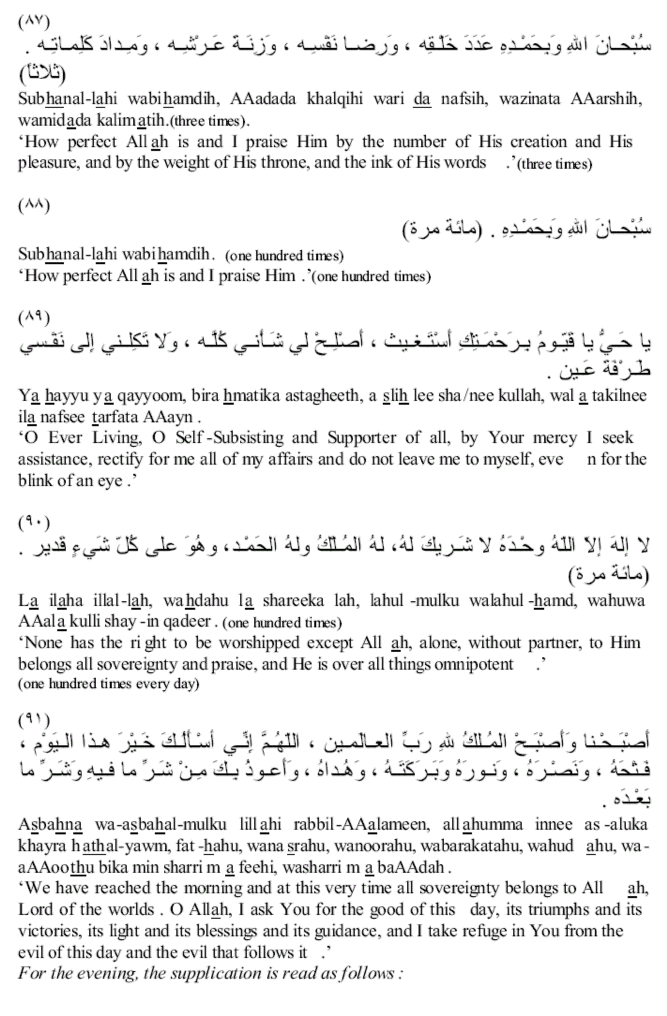
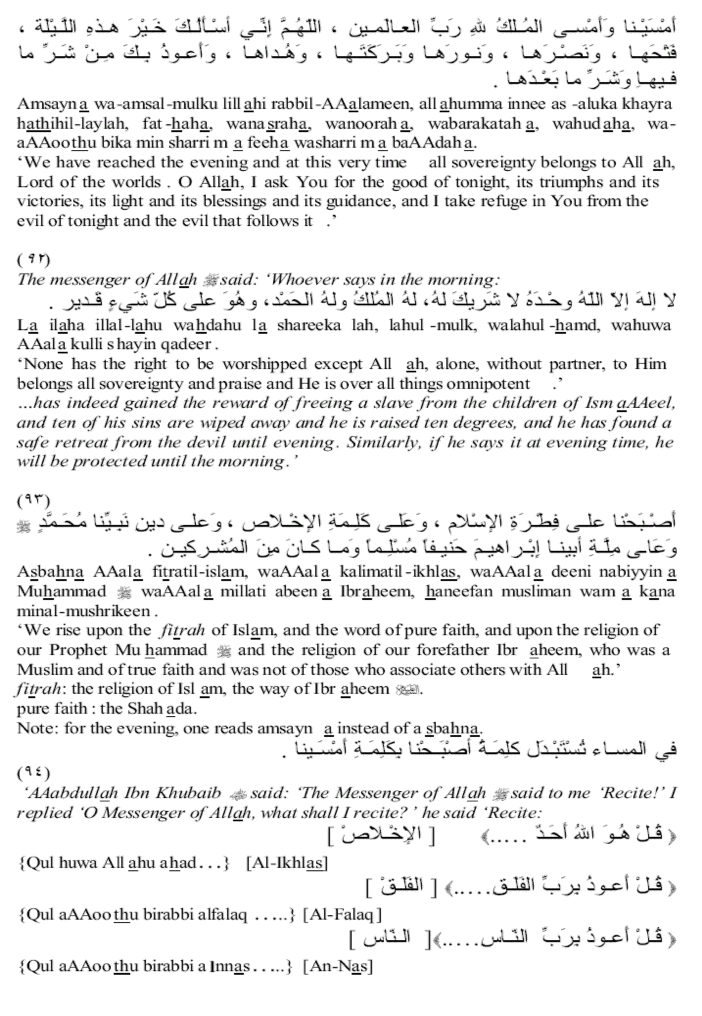
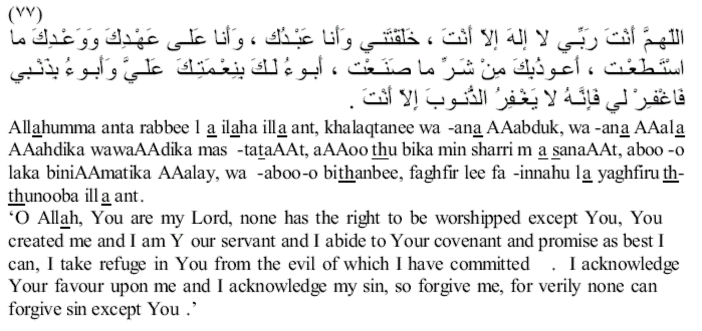
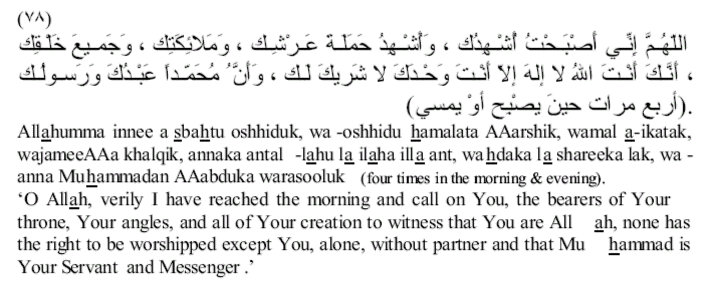
Hisn Al Muslim - Images - 27 2 RemembranceHisn Al Muslim - Images - 27 2 Remembrance 2Hisn Al Muslim - Images - 27 2 Remembrance 3Hisn Al Muslim - Images - 27 2 Remembrance 4Hisn Al Muslim - Images - 27 2 Remembrance 5


Hisn al Muslim – Du’a – Remembrance Morning & Evening – Part 01

Listen / Download Mp3 Here (Time 2:33)
[audio https://salafiaudio.files.wordpress.com/2015/02/hisn-al-muslim-remembrance-morning-evening.mp3]

Hisn Al Muslim - Images - 27 Remembrance

Hisn Al Muslim - Images - 27 Remembrance 2Hisn Al Muslim - Images - 27 Remembrance 3Hisn Al Muslim - Images - 27 Remembrance 4Hisn Al Muslim - Images - 27 Remembrance 5Hisn Al Muslim - Images - 27 Remembrance 6Hisn Al Muslim - Images - 27 Remembrance 7

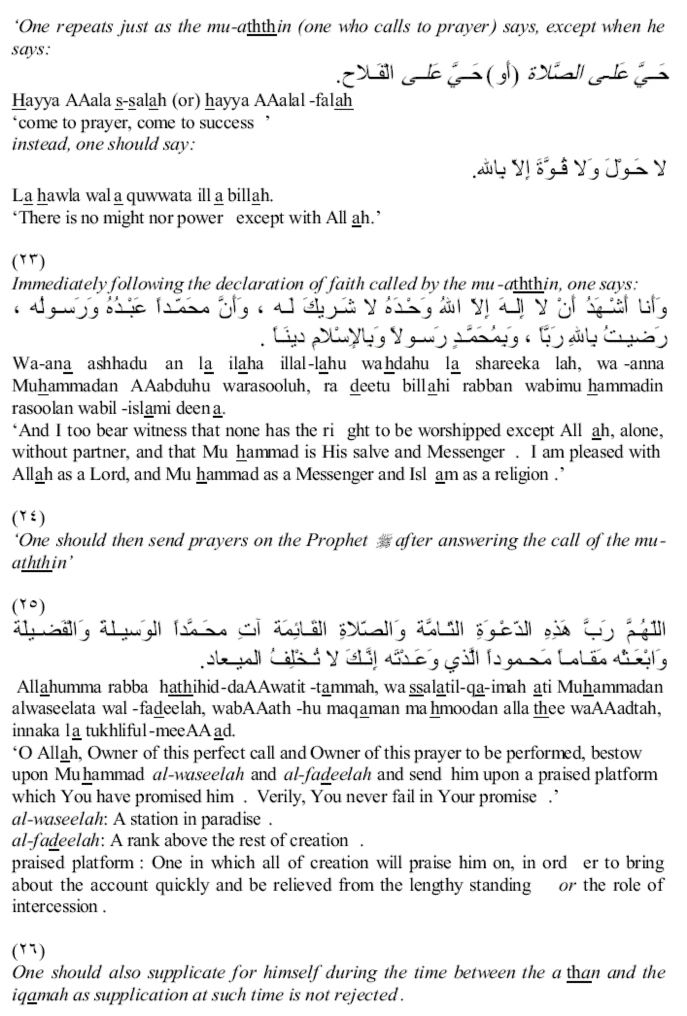
Hisn al Muslim – Du’a – Adhan

Listen / Download Mp3 Du’a Here

Hisn Al Muslim - Images - 15 AdhanHisn Al Muslim - Images - 15 Adhan 2


Authentic Adhkaar (Remembrance) after the Obligatory Salaah (Prayer) – Dawud Burbank

Dhikr #1

Dhikr After Obligatory Prayer - Dawud Burbank - 01

(1) MUSLIM reported (no. 591): “Daawood ibn Rushayd narrated to us: alWaleed narrated to us : from al-Awzaa`ee: from Aboo Ammaar-his name is Shaddaad ibn `Abdillaah: from Aboo Asmaa. : from Thawbaan who said: “When Allaah’s Messenger (صلى الله عليه و سلم) finished his Prayer he would seek forgiveness three times, and say:

اللّهُـمَّ أَنْـتَ السَّلامُ ، وَمِـنْكَ السَّلام ، تَبارَكْتَ يا ذا الجَـلالِ وَالإِكْـرام

[O Allaah You are the Flawless One, and from You comes peace and security.
Blessed are You, Possessor of Majesty and Honour].

al-Waleed said: So I said to al-Awzaa`ee: ‘How is seeking forgiveness done?’

He said: “You say : “… أَسْـتَغْفِرُ الله  أَسْـتَغْفِرُ الله ”

(I seek Allaah’s forgiveness, I seek Allaah’s forgiveness….)”.

-The wording of the four ‘Sunan’ in a hadeeth of `Aa.ishah- radiyallaahu `anhaa-(declared authentic by Shaikh al-Albaanee) is:

اللّهُـمَّ أَنْـتَ السَّلامُ ، وَمِـنْكَ السَّلام ، تَبارَكْتَ يا ذا الجَـلالِ وَالإِكْـرام

[O Allaah You are the Flawless One, and from You comes peace and security.
Exalted are You, O Possessor of Majesty and Honour].

Dhikr #2

Dhikr After Obligatory Prayer - Dawud Burbank - 02

(2) AL-BUKHAAREE reported (no.844): “Muhammad ibn Yoosuf narrated to us, saying: Sufyaan narrated to us: from `Abdul-Malik ibn `Umayr: from Warraad-the scribe of al-Mugheerah ibn Shu`bah who said: al-Mugheerah dictated to me in a letter to Mu`aawiyah that the Prophet (صلى الله عليه و سلم) used to say after every Obligatory Prayer:

La ilaha illal-lahu wahdahu la shareeka lah, lahul-mulku walahul-hamd, wahuwa ‘ala kulli shayin qadeer, allahumma la mani’a lima a’tayt, wa la mu’tiya lima mana’t, wala yanfa’u thal-jaddi minkal-jad

None has the right to be worshipped except Allaah, alone, having no partner. Sovereignty is His and all praise is for Him, and He has full power over everything. O Allaah no one can hold back what You give, and no one can give what You hold back, and no one’s riches can benefit them against You.”

Dhikr #3

Dhikr After Obligatory Prayer - Dawud Burbank - 03

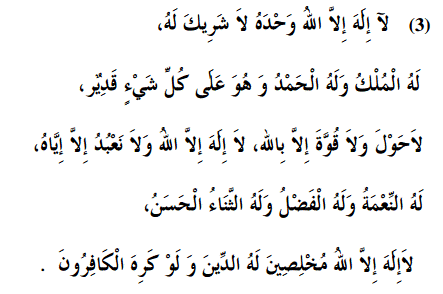
(3) MUSLIM reported (no.594): “And Muhammad ibn `Abdillaah ibn Numayr narrated to us: My father narrated to us: Hishaam narrated to us: from AbuzZubayr who said: “Ibn az-Zubayr used to say at the end of every Prayer when he had given the Salutation:

La ilaha illal-lah, wahdahu la shareeka lah, lahul-mulku walahul-hamd, wahuwa ‘ala kulli shayin qadeer. la hawla wala quwwata illa billah, la ilaha illal-lah, wala na’budu illa iyyah, lahun-niAAmatu walahul-fadl walahuth-thana-ol- hasan, la ilaha illal-lah mukhliseena lahud-deen walaw karihal-kafiroon.

[None has the right to be worshipped except Allaah, alone, having no partner. Sovereignty is His and all praise is for Him, and He has full power over everything. There is no change and no ability except with (the Aid of) Allaah. None has the right to be worshipped except Allaah, and we do not worship except Him. All blessings are from Him and all favour is from Him, and fine praise is for Him. None has the right to be worshipped except Allaah, we make the Religion purely and sincerely for Him-even though the Disbelievers detest that],

and he said: “Allaah’s Messenger (صلى الله عليه و سلم) used to repeat these words after every Prayer.”

Dhikr #4

Dhikr After Obligatory Prayer - Dawud Burbank - 04

(4) (a) Saying: ‘Subhaanallaah’, ‘al-hamdu lillaah’, and ‘Allaahu Akbar’- thirty three times each after every Prayer.
[al-Bukhaaree (no. 843) and Muslim (no. 595) from a hadeeth of Aboo Hurairah-radiyallaahu `anhu]

or (b) Saying: ‘Subhaanallaah’ -thirty-three times, ‘al-hamdu lillaah’ -thirty-three times, and ‘Allaahu akbar’ -thirty-four times-after every Prayer. [Reported by Muslim (no. 596) from a hadeeth of Ka`b ibn `Ujrah-radiyallaahu `anhu]

or (c) Saying: ‘Subhaanallaah’ -thirty-three times, ‘al-hamdu lillaah’ -thirty-three times, and ‘Allaahu akbar’ -thirty-three times- and then: لا إلهَ إلاّ اللّهُ وَحْـدَهُ لا شريكَ لهُ، لهُ الملكُ ولهُ الحَمْد، وهُوَ على كُلّ شَيءٍ قَـدير
whoever does so after every Prayer then his sins will be forgiven even if they are like the foam of the sea.
[Reported by Muslim (no.597) from a hadeeth of Aboo Hurairah-radiyallaahu `anhu]

or (d) Saying: ‘Subhaanallaah’ -twenty-five times, ‘al-hamdu lillaah’ -twenty-five times, ‘Allaahu akbar’ -twenty-five times ‘Laa ilaaha illallaah’ -twenty-five times
[Reported by an-Nasaa.ee (no. 1350) from a hadeeth of Zayd ibn Thaabit-radiyallaahu `anhu and declared ‘Saheeh’ by Shaikh al-Albaanee-rahimahullaahu.]

or (e) ) Saying: ‘Subhaanallaah’ -ten times, ‘al-hamdu lillaah’ -ten times, ‘Allaahu akbar’ -ten times.
[Reported by al-Bukhaaree (no.6329)-from a hadeeth of Aboo Hurairah-radiyallaahu `anhu]

Dhikr #5

Dhikr After Obligatory Prayer - Dawud Burbank - 05

(5) ABOO DAAWOOD reported (no. 1522): “ `Ubaydullaah ibn `Umar ibn Maysarah narrated to us: `Abullaah ibn Yazeed al-Muqri. narrated to us: Haywah ibn Shurayh narrated to us, saying: I heard `Uqbah ibn Muslim say: Aboo `Abdir-Rahmaan al-Hubulee narrated to me: from as-Sunaabihee: from Mu`aadh ibn Jabal: that Allaah’s Messenger (صلى الله عليه و سلم ) took hold of his hand and said:

<>
So he said: << I counsel you, O Mu`aadh: Do not leave off saying at the end of every Prayer:

اللّهُـمَّ أَعِـنِّي عَلـى ذِكْـرِكَ وَشُكْـرِك ، وَحُسْـنِ عِبـادَتِـك

[O Allaah help me upon remembrance of You, giving thanks to You, and worshipping You in a fine manner].>>

And Mu`aadh counselled as-Sunaabihee with that, and as-Sunaabihee counselled Aboo `Abdir-Rahmaan with it.”

[Shaikh al-Albaanee-rahimahullaah-said in ‘Saheeh Sunan Abee Daawood’ (no. 1362): “ I say: Its chain of narration is ‘Saheeh’ and it was declared ‘Saheeh’ by Ibn Khuzaymah and Ibn Hibbaan (2017)…

And the hadeeth is reported by Ahmad (5/244-245), Ibn Khuzaymah in his ‘Saheeh’ (751), and likewise Ibn Hibbaan (no. 2345), and Aboo Nu`aym in ‘al-Hilyah’ (1/241 & 5/130) through other chains from `Abdullaah ibn Yazeed al-Muqri… with it, and they add: “And Aboo `Abdir-Rahmaan counselled `Uqbah ibn Muslim.” And Aboo Nu`aym added: “And `Uqbah counselled Haywah, and Haywah counselled Aboo `Abdir-Rahmaan al-Muqri., and Aboo `Abdir-Rahmaan al-Muqri., counselled Bishr ibn Moosaa, and Bishr ibn Moosaa counselled Muhammad ibn Ahmad ibn al-Hasan, and Muhammad ibn Ahmad al-Hasan counselled me.

Aboo Nu`aym-rahimahullaah said: “And I counsel you (all) with it.” I say: This hadeeth is from the famous hadeeth reported with a serial chain, mentioning love, and I was given ijaazah to narrate it by the virtuous Shaikh Raaghib at-Tabbaakhrahimahullaah, and he narrated it to me… and he reported its isnaad in this manner mentioning love at each stage of the chain.]

Dhikr #6

Dhikr After Obligatory Prayer - Dawud Burbank - 06

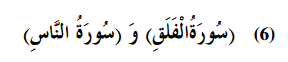
(6) AT-TIRMIDHEE reported (no.2903): “Qutaybah narrated to us, saying: Ibn Lahee`ah narrated to us: from Yazeed ibn Abee Habeeb: from `Alee ibn Rabaah: from `Uqbah ibn `Aamir who said: “Allaah’s Messenger (صلى الله عليه و سلم) commanded me to recite the two Soorahs of seeking refuge (alMu`awwidhatayn) at the end of every Prayer..” [Declared ‘saheeh’ by Shaikh al-Albaanee-rahimahullaah.]

Dhikr #7

Dhikr After Obligatory Prayer - Dawud Burbank - 07

(7) AN-NASAA.EE reported in ‘`Amalul-Yawm wal-Laylah’ (no. 100): “alHusayn ibn Bishr related to us in Tarsoos-we wrote from him, saying: Muhammad ibn Himyar narrated to us, saying: Muhammad ibn Ziyaad narrated to us: from Aboo Umaamah who said: Allaah’s Messenger (صلى الله عليه و سلم) said:<> [Shaikh al-Albaanee declared the hadeeth ‘Saheeh’ in ‘as-Saheehah’ (no. 972)].

Dhikr #8

Dhikr After Obligatory Prayer - Dawud Burbank - 08

(8) AL-BUKHAAREE reported (no. 2822): “Moosaa ibn Ismaa`eel narrated to us: Aboo `Awaanah narrated to us: `Abdul-Malik ibn `Umayr narrated to us, saying: I heard `Amr ibn Maymoon al-Awdee say: Sa`d used to teach his sons these words, just as a teacher teaches boys to write, and he used to say that Allaah’s Messenger (صلى الله عليه و سلم) would seek refuge (with Allaah) from them at the end of the Prayer:

Allahumma innee a’oothu bika minal-jubn, wa-a’oothu bika min an oradda ila arthalil- ‘umur, wa-a’oothu bika min fitnatid-dunya wa wa-a’oothu bika min ‘athabil-qabr.

[O Allaah! I seek Your refuge from cowardice, and I seek Your refuge from being brought back to senile old age, and I seek Your refuge from the trials of the world, and I seek your refuge from the punishment of the grave]

So I narrated it to Mus`ab and he affirmed it.”

Dhikr #9

Dhikr After Obligatory Prayer - Dawud Burbank - 09

(9) AN-NASAA.EE reported (no. 1347): `Amr ibn `Alee related to us, saying: Yahyaa narrated to us: from `Uthmaan ash-Shahhaam: from Muslim ibn Abee Bakrah who said: My father used to say at the end of the Prayer:

[O Allaah! I seek Your refuge from Unbelief, and poverty, and the punishment of the grave].

So I used to say it, so my father said: “Who did you take this from?” So I said: “From you!” He said: “Allaah’s Messenger (صلى الله عليه و سلم ) used to say it at the end of the Prayer.”

[Shaikh al-Albaanee said: “Its isnaad is ‘Saheeh’”]

Dhikr #10

Dhikr After Obligatory Prayer - Dawud Burbank - 10

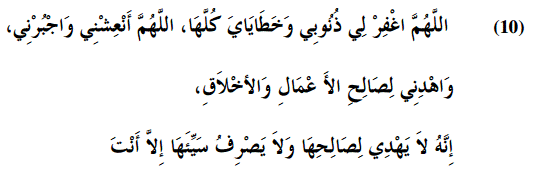
(10) IBNUS-SUNNEE reported in `Amalul-Yawm wal-Laylah’ (no. 116), and AT-TABARAANEE in ‘al-Kabeer’ (nos.7811 & 7893) (& 7982)… from Aboo Umaamah-radiyallaahu `anhu-who said:

“I never drew near to Allaah’s Messenger (صلى الله عليه و سلم ) at the end of an obligatory or optional Prayer except that I heard him saying:

[O Allaah forgive me all of my sins and shortcomings. O Allaah raise me and restore me, and guide me to righteous deeds and manners; no one can guide to that which is righteous from them, nor repel that which is bad from them besides You].”

[Declared ‘hasan’ (i.e. due to supporting narrations) by Shaikh al-Albaanee in ‘SaheehulJaami`’ (no. 1266) and Shaikh Saleem al-Hilaalee in ‘Saheeh Kitaabil-Adhkaar’ (189/154).]

Dhikr #11

Dhikr After Obligatory Prayer - Dawud Burbank - 11

(11) AN-NASAA.EE reported [Book of ‘Sahw’ (Forgetfulness)]:Chapter (87): Another type of dhikr after the Salutation (no.1344):

“Muhammad ibn Ishaaq as-Saaghaanee related to us, saying: Aboo Salamah alKhuzaa`ee-Mansoor ibn Salamah narrated to us, saying: Khallaad ibn Sulaymaan narrated to us, saying Aboo Salamah said: and he was on e of those who were fearful: From Khaalid ibn Abee `Imraan: from `Urwah: from `Aa.ishah: that when Allaah’s Messenger (صلى الله عليه و سلم) had sat in a gathering or prayer he would say some words. So `Aa.ishah asked him about the words, so he said:

<

[I declare You free of all imperfections, O Allaah, and all praise is for You. I seek Your forgiveness and turn in repentance to You.].”

[Shaikh al-Albaanee-rahimahullaah-declared it ‘Saheeh’.]

[Compiled and translated by Abu Talhah Dawud Burbank rahimahullaah]

Click the below link to read or download PDF

Authentic Adhkaar (Remembrance) after the Salaah (Prayer) – Dawud Burbank [PDF]

Sharh Usool ath-Thalaathah – Shaykh Fawzan | Dawud Burbank [Audio|En]

Sharh Usool-ith-Thalaathah – Explanation of the Three Fundamental Principles
of Imaam Muhammad ibn ‘Abdil-Wahhaab [1115-1206 H]
Explained by Shaikh Saalih ibn Saalih al-Fawzaan haafidhahullaah

Audio Lessons (MP3)

01 – 02. – 03 –  04 – 05 – 06 – 07 – 08 – 09 – 10
11 – 12 – 13 – 14 – 15 – 16 – 17 – 18 – 19 – 20
21 – 22 – 23 – 24 – 25 – 26 – 27 – 28 – 29 – 30
31 – 32 – 33 – 34 – 35 – 36 – 37 – 38 – 39 – 40
41 – 42 – 43 – 44 – 45 – 46 – 47 – 48 – 49 – 50

Transcribed Audio Lessons (PDF)

01 – 02 – 03 – 04 – 05 – 06 – 07 – 08 – 09 – 10
11 – 12 – 13 – 14 – 15 – 16 – 17 – 18 – 19 – 20
21 – 22 – 23 – 24 – 25 – 26 – 27 – 28 – 29 – 30
31 – 32 – 33 – 34 – 35 – 36 – 37 – 38 – 39 – 40
41 – 42 – 43 – 44 – 45 – 46 – 47 – 48 – 49 – 50

Posted with Permission from late Abu Talha Dawud Burbank rahimahullaah
Audio and Transcripts Courtesy: ittibaa.com

The following clips are extracted from these series:

The Fundamentals Of Belief – An abridgement of ‘The Three Fundamentals’

An abridgement of ‘The Three Fundamentals’ (‘Thalaathatul-Usool’), entitled ‘Talqeen Usoolil- ‘Aqeedah lil-‘Aammah’ (Instruction in the fundamentals of Belief for the common people)

By Shaikhul-Islaam Muhammad ibn `Abdil-Wahhaab-rahimahullaah

Click the below link to read or download the article

The Fundamentals Of Belief – An abridgement of The Three Fundamentals [PDF]

How to perform the Umrah – AbuTalha Dawood Burbank [Audio|En]

Listen / Download Mp3 Here (Time 1:34:30)

Based on the book by Sh al-Albaanee rahimahullaah


Virtues of Madina : Sahih Bukhari

Taken from Virtues of Madinah of Sahih Bukhari

  • Medina is a sanctuary from that place to that.
  • Its trees should not be cut.
  • No heresy should be innovated nor any sin should be committed in it.
  • Whoever innovates in it an heresy or commits a sin, or gives shelter to such an innovator in it will incur the curse of Allah,the angels, and all the people, none of his compulsory or optional good deeds of worship will be accepted.
  • The Prophet peace be upon him said, “I have made Medina a sanctuary between its two (Harrat) mountains.”
  • Allah’s Apostle , peace be upon him, “Verily, Belief returns and goes back to Medina as a snake returns and goes back to its hole (when in danger).”
  • “None plots against the people of Medina but that he will be dissolved (destroyed) like the salt is dissolved in water.”
  • “The terror caused by Al-Masih Ad-Dajjal will not enter Medina and at that time Medina will have seven gates and there will be two angels at each gate guarding them.”
  • “There are angels guarding the entrances (or roads) of Medina, neither plague nor Ad-Dajjal will be able to enter it.”
  • “There will be no town which Ad-Dajjal will not enter except Mecca and Medina, and there will be no entrance (road) (of both Mecca and Medina) but the angels will be standing in rows guarding it against him, and then Medina will shake with its inhabitants thrice (i.e. three earth-quakes will take place) and Allah will expel all the nonbelievers and the hypocrites from it.”
  • “Medina is like a furnace, it expels out the impurities (bad persons) and selects the good ones and makes them perfect.”
  • “Medina expels the bad persons from it, as fire expels the impurities of iron.”
  • The Prophet , peace be upon him, said, “O Allah! Bestow on Medina twice the blessings You bestowed on Mecca.”
  • The Prophet , peace be upon him, said, “There is a garden from the gardens of Paradise between my house and my pulpit, and my pulpit is on my Lake Fount (Al-Kauthar).”
  • Umar ,radhi Allaahu anhu,said, “O Allah! Grant me martyrdom in Your cause, and let my death be in the city of Your Apostle.”

Refuting Misconceptions about Kabah and Black Stone – by Dr. Saleh as-Saleh [Audio|En]

Listen / Download Mp3 Here (Time 56:37)

The Sacred Mosque in Makkah – by Dr. Saleh as-Saleh [Audio|En]

Listen / Download Mp3 Here (Time 21:30)
[audio https://salafiaudio.files.wordpress.com/2014/09/faq-clarifications-points-of-benefit-the-sacred-mosque-in-makkah-saleh-as-saleh.mp3]

Number of ‘Umrah Performed by the Prophet – Dr. Saleh-As-Saleh [Audio|En]

Listen / Download Mp3 Here (Time 3:49)
[audio https://salafiaudio.files.wordpress.com/2014/09/number-of-umrah-performed-by-the-prophet-saleh-as-saleh.mp3]

How to Perform Umrah ? – Dr Saleh As-Saleh [Audio|En]

Listen / Download Mp3 Here (Time 20:33)
[audio https://salafiaudio.files.wordpress.com/2014/09/how-to-perform-umrah-saleh-as-saleh.mp3]

The Black Stone does not Harm and does not Benefit – Shaykh Ahmed al-Wasaabee

Narrated ‘Umar ibnul-Khattaab (radiyAllaahu ‘anhu), that he came to the Black Stone and kissed it and said:

((Verily, I know that you are a stone, and that you do not harm and do not benefit, and if I did not see the Messenger of Allaah (صلّى الله عليه وسلّم ) kiss you, then I would not kiss you)).

Narrated by al-Bukhaaree, no. 1520, 1528, 1532 and Muslim, no. 1270.

Click the below link to read or download PDF

The Black Stone does not Harm and does not Benefit [PDF]

Source: ‘al-Qawl-ul- Mufeed Fee Adillatit-Tawhid’ [Beneficial Speech in Establishing the Evidences of Tawhid] – Shaykh Muhammad al-Wasabi

Clearing Misconceptions Concerning Prophet ‘Eesaa – Dr Saleh as Saleh [Audio|En]

01- Position of Islaam vs Christianity – 53:28
02- Jesus – Spirit From Allaah – 23:02
03- Jesus – His Ascent – His Return – 24:07
04- Jesus ‘alayhis salaam – 72:51

Clearing Misconceptions Concerning the Prophets – Dr Saleh as Saleh [Audio|En]

01- Are the Prophets Infallible Regarding Minor Sins – 14:27
02- Messengers – verses 2-253 and 2-136 – 8:12
03- Preferences – Prophets and Messengers – 31:00
04- Point of Benefits Regarding the Prophet Adam – 31:09
05- Point of Benefits Regarding Prophet Yusuf – 20:30
06- Knowledge of the Unseen – 9:59

Stories of The Prophets and The Messengers – Dr. Saleh as Saleh [Audio Series | En]

Bismillaah

01- Adam ‘alayhis-salaam – 59:04
02- Nuuh ‘alayhis salaam – 51:42
03- Huud ‘alayhis salaam – 33:34
04- Saalih ‘alayhis salaam – 35:14
05- Ibraaheem ‘alayhis salaam – part 1 – 72:56
06- Ibraheem ‘alayhis salaam – part 2 – 20:32
07- Luut ‘alayhis salaam – 32:06
08- Shu’ayb ‘alayhis salaam – 42:40
09- Muusaa ‘alayhis salaam – 88:43
10- Dawood and Sulayman ‘alayhumaa as-salaam – 60:00
11- Some of the Benefits from the Stories of Dawood & Sulayman ‘alayhumaa as-salaam – 20:35
12- Lessons from Stories of Prophets – 39:50

Dr. Saleh as Saleh rahimahullaah Audio Main Page:
Dr. Saleh As Saleh (Audio)

Belief in the Prophets and Messengers : One of the Pillars of Emaan
https://abdurrahman.org/?p=49905

Knowing the Prophet – Some Seerah Lessons – Dr Saleh as Saleh [Audio|En]