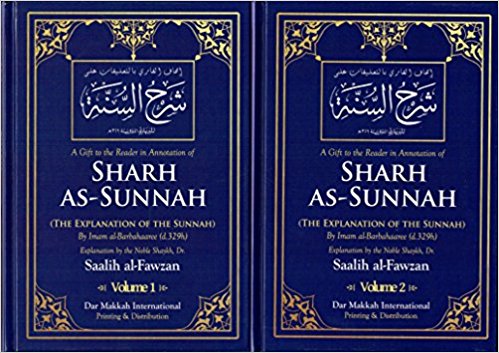
[Book Reco] The Explanation Of Imam Barbahaaree’ Sharh as-Sunnah – Shaykh Saalih Al-Fawzaan

Sharh As-sunnah, Explanation of the Sunnah By Imam Al-barbahari

This is an English translation of Imaam al-Barbahaaree’s classic work, Sharh As-Sunnah. The book consists of 170 points on different aspects of the Muslim creed

Title of the Book: A Gift To The Reader In Annotation Of Sharh As-Sunnah (The Explanation Of The Sunnah)
The Number Of Books: Pgs. 816 /2 Volumes(HB)
Publisher: Dar Makkah International
Translator: Abdus Sami’ Abdus Salaam

This is the highly beneficial two volume work in explanation of the famous works by Imam al-Barbahaaree (d.329h) by the esteemed & noble Shaykh, Dr Saalih al- Fawzan. Its importance can be seen by virtue of its being compiled in the early times; as it is one of the books of the earliest Salaf – those who lived in the same period with the great Imams, acquired knowledge from them and reported their pure Aqidah (creed).

Buy the Book Herehttp://www.authenticstatements.com/bks-0400/

Visit : Book Study Resources of Sharhu Sunnah – Imam Barbaharee

Scholars Biographies: Shaykh Abdul Muhsin al-Abbaad

1353H-Present: Shaikh ‘Abdul-Muhsin bin Hamad Al-‘Abbaad
Produced By : Al-Ibaanah.com

His Name and Lineage:

He is the great scholar and Muhaddith, Shaikh ‘Abdul-Muhsin bin Hamad bin ‘Abdil-Muhsin bin ‘Abdillaah Al-‘Abbaad Aali Badr. The family of Aali Badr comes from the family of Jalaas, which originates from the ancient tribe of ‘Anazah, one of the descendent tribes of ‘Adnan (descendent of Prophet Isma’eel). His great-grandfather’s nickname was ‘Abbaad and so as a result some of his offspring inherited it from him, such as Shaikh ‘Abdul-Muhsin and his mother, the daughter of Sulaymaan bin ‘Abdillaah Aali Badr.

The Shaikh was born on a Tuesday night after ‘Ishaa prayer in the month of Ramadaan, 1353H in the city of Zulfi, Saudi Arabia. This is the city where he grew up and learned the basics of reading and writing.

His Early Studies:

While in Zulfi, he studied under Shaikh ‘Abdullaah bin Ahmad Al-Manee’, Shaikh Zaid bin Muhammad Al-Munaifee, Shaikh ‘Abdullaah bin ‘Abdir-Rahmaan Al-Ghaith with whom he completed the noble Qur’aan, and Shaikh Faalih bin Muhammad Ar-Roomee.

When the first elementary school opened in Zulfi in 1368H, he joined it in its third year and obtained his primary degree there in 1371H.

After completing his primary studies, he moved to Riyadh and signed up with the Educational Institute there. This was the same year (1372H) that Imaam ‘Abdul-‘Azeez bin Baaz moved to Riyadh from Kharj, where he had served as judge since 1357H, and the first year he taught in this Institute. Amongst the colleagues that he studied with at that time was Shaikh Muhammad Amaan Al-Jaamee, may Allaah have mercy on him.

After graduating from this institute, the Shaikh enrolled with the College of Sharee’ah in the Imaam Muhammad bin Su’ood Islamic University of Riyadh. During his last year at the college, he was appointed a teacher in the Educational Institute of Buraidah in 5/13/1379H. Then towards the end of that final school year, he returned back to Riyadh to take his final examination for the college. Allaah blessed him by granting him the ability to finish first amongst his whole class which consisted of over 80 graduates. They represented the fourth class of graduates from the College of Sharee’ah of the Imaam Muhammad bin Su’ood University. He also finished in the first rank amongst his class during his first three years at the college and when receiving his secondary degree from the Educational Institute of Riyadh.

While in Riyadh, he was able to study under scholars the likes of Shaikh Muhammad bin Ibraaheem Aali Shaikh, Shaikh ‘Abdul-‘Azeez bin Baaz, Shaikh Muhammad Al-Ameen Ash-Shanqeetee, Shaikh ‘Abdur-Rahmaan Al-Afreeqee and Shaikh ‘Abdur-Razzaaq ‘Afeefee both in the University and in local masaajid.

He studied specifically under Shaikh ‘Abdur-Rahmaan Al-Afreeqee in Riyadh in the year 1372H and then studied Hadeeth and its Terminology the following year under him. He would say about him: “He was a sincere teacher and a great scholar, as well as a counselor, guide and good example, may Allaah have mercy on him.”

He also had a special relationship with Shaikh ‘Abdul-‘Azeez bin Baaz ever since the first time they met in 1372H. He studied formally under him in the fourth year of the College of Sharee’ah. Shaikh ‘Abdul-Muhsin mentioned: “Most of the contact I had with him would occur in between classes and in the masjid. I would also visit him in his home.”

In 1380H, he transferred to teach in the Educational Institute of Riyadh. But when the Islamic University of Madeenah opened and the first college to be established there was the College of Sharee’ah, Shaikh Muhammad bin Ibraaheem Aali Shaikh selected him to work there as a teacher. Prior to this, towards the end of 1379H, Shaikh ‘Abdul-Muhsin had requested Shaikh Muhammad bin Ibraaheem, may Allaah have mercy on him, to put him in the teaching profession program, to which he agreed on the condition that when he completed the program he would teach at the Islamic University when it opened. Shaikh ‘Abdul-Muhsin replied that he was fully prepared for the task.

His Role in the Islamic University:

So he began teaching at the Islamic University of Madeenah in 1381H and he was the first to deliver a class there. He accompanied his teacher, Shaikh ‘Abdul-‘Azeez bin Baaz, who taught at the University for the next fifteen years.

He served as a member of the University’s committee from the time of its inception to 1393H. Then in 7/30/1393H, he was appointed vice-president of the Islamic University behind Shaikh ‘Abdul-‘Azeez bin Baaz, the president at that time, who nominated him amongst three candidates for the position, upon which King Faisal, may Allaah have mercy on him, selected him for the job.

Shaikh ‘Abdul-Muhsin stayed in this position up to 10/26/1399H when he was relieved of it at his own request. In the first two of these six years, he was the second-in-charge. Then when Shaikh ‘Abdul-‘Azeez bin Baaz, may Allaah have mercy on him, transferred to become president of the Educational Research and Religious Verdict Administration, he became first-in-charge. During these six years, the Shaikh did not stop giving two weekly classes for fourth-year students at the College of Sharee’ah.

Shaikh ‘Abdul-Muhsin says about this: “I would go to him, i.e. Shaikh Ibn Baaz, before going to the University and sit with him for a little while. Shaikh Ibraaheem Al-Husayyin would also be with him and would read the (chapters on) Mu’aamalaat (business and social dealing between Muslims) to him from after Fajr till the sun rose. On one of these days, he said to me: ‘I had a dream last night where I saw a beautiful camel, which I was pulling and you were riding. And I led it to the Islamic University.’ And all praise be to Allaah, this dream came true for I served as vice-president under him for two years, then assumed his role as interim president after him for four years.”

During the time that he served as president of the University, about five-thousand manuscripts were added to its library. This was the same time that Shaikh Hammaad Al-Ansaaree was hired to bring books from libraries around the world. Shaikh Hammaad said: “A majority of the classical works of the Salaf that were photocopied for the Islamic University were done at the time when Shaikh ‘Abdul-Muhsin served as president there.”

He also said: “I brought five-thousand manuscripts for the Islamic University during my travels. Most of the journeys I took for the purpose of obtaining manuscripts and photocopying them were done during the time that Shaikh ‘Abdul-Muhsin Al-‘Abbaad was president of the University.”

Most of these manuscripts were books of Hadeeth and books on the Creed of the Salaf. To get a clearer picture of the great service that Shaikh ‘Abdul-Muhsin did while president of the Islamic University, look at the following statement of Shaikh Hammaad Al-Ansaaree:

“A historical account should be written about Shaikh ‘Abdul-Muhsin Al-‘Abbaad. He did certain jobs in the University that I wish I could have recorded or taped. There were two times in the day that he would insist on working at his job even though it wasn’t required of him – in the morning and in the afternoon after ‘Asr. I went to visit him one time in his office after ‘Asr when he was president of the University and sat with him. I then asked: ‘Where is the coffee, Shaikh?’ He answered: ‘Its ‘Asr now and there is no one here to make it.’ One time I was determined to get to the University before him so I got in the car and went. When I arrived at the University, there was Shaikh ‘Abdul-Muhsin opening the door to the University before everyone else!”

He would also say: “Relate Shaikh ‘Abdul-Muhsin’s diligence at work to the people for there is no harm in this.”

Shaikh ‘Abdul-Muhsin Al-‘Abbaad was also the reason why Shaikh Hammaad Al-Ansaaree wrote his famous book on Tawassul, which served as a refutation of a book written by ‘Abdullaah Al-Ghumaaree, which Shaikh ‘Abdul-Muhsin had brought back with him from his trip to Morocco.

Amongst the other milestones reached by the University under Shaikh ‘Abdul-Muhsin’s presidency was that it transferred from being a government facility to a private institution, the advanced studies department for the Master’s and Doctorate’s programs were formed, the faculties of Qur’aan and Islamic studies, Hadeeth, and Arabic language were created, the size of the University’s land increased to accommodate a proposed 20,000 students, and the University’s printing department was also established.

Shaikh ‘Abdul-Muhsin continues to teach at the University until this very day even though he is past the compulsory age of retirement. No one has taught longer at the Islamic University than him since he taught from its very first day until now. In addition to this, he also continues to hold lessons in the Prophet’s Masjid.

Sufficient as testimony of the great role Shaikh ‘Adul-Muhsin Al-‘Abbaad has had on the Islamic University of Madeenah is what Shaikh Hammaad Al-Ansaaree said as recorded by his son, ‘Abdul-Awwal, in his biography of his father (2/597): “The Islamic University (of Madeenah) is the university of Al-‘Abbaad, Az-Zayid and Shaikh Ibn Baaz.” And then he began praising the days they spent together.

His Travels:

The first trip that the Shaikh took outside of his hometown of Zulfi was when he went to Makkah for Hajj in 1370H. Then in 1371, he traveled to Riyadh to seek knowledge. He also traveled to Morocco. It is said that Shaikh ‘Abdul-Muhsin Al-‘Abbaad obtained his Master’s Degree from Egypt.

Some of the Shaikh’s profound Sayings:

“I have in my possession notes from the various grades of school beginning from the third year of primary school, which are from the dearest and most precious of what I saved.”

“From the most beloved of deeds to me and the most hoped for by me in the sight of my Lord is my immense love for the Companions of Allaah’s Messenger and my extreme hatred for those who hate them. And Allaah has indeed blessed me with boys and girls as children. I named four of my sons after the four rightly-guided Khaleefahs after first naming one with the name of the chief of Messengers, i.e. Muhammad. And I named some of my daughters after some of the Mothers of the Believers after naming one with the name of the leader of the believing women, i.e. Faatimah. I ask Allaah and seek a way to Him through my love for them and my hatred for those who hate them. And I ask Him to gather me in their company and to increase them in virtue and reward.”

His Students:

Many of today’s scholars and well-known students of knowledge have studied under the Shaikh either through his classes in the University or the lessons he delivers in the Prophet’s Masjid. Amongst the most famous of them are:

1. Shaikh Ihsaan Ilaahee Dhaheer, may Allaah have mercy on him;
2. Dr. ‘Alee Naasir Al-Faqeehee
3. Dr. Saalih As-Suhaymee
4. Dr. Wasee’ullaah ‘Abbaas
5. Dr. Baasim Al-Jawaabirah
6. Dr. ‘Aasim bin ‘Abdillaah Al-Qaryootee
7. Dr. ‘Abdur-Razzaaq Al-‘Abbaad, his son
8. Dr. Rabee’ bin Haadee Al-Madkhalee

His Connection with the Scholars:

He had a special relationship with many people of knowledge, especially those who would teach in the Islamic University, and not to mention those about whom he heard were people of virtue and good standing, As an example, he had a special relationship with Shaikh ‘Umar Fullaata, may Allaah have mercy on him, which can be seen in a lecture he delivered about him after his death, which was later transcribed and published.

His Writings:

Shaikh ‘Abdul-Muhsin Al-‘Abbaad has authored numerous books, some of which were either originally lectures or lessons he gave throughout the course of his life. Below are some of his well-known published books and treatises:

1. ‘Ishroona Hadeethan min Saheeh-il-Bukhaaree [20 Hadeeth from the Narrations of Al-Bukhaaree]

2. ‘Ishroona Hadeethan min Saheeh-il-Imaam Muslim [20 Hadeeth from the Narrations of Imaam Muslim]

3. Min Akhlaaq-ir-Rasool-il-Kareem [From the Manners of the Noble Messenger]

4. ‘Aqeedatu Ahlis-Sunnah wal-Jamaa’ah fis-Sahaabat-il-Kiraam [The Creed of Ahlus-Sunnah wal-Jamaa’ah concerning the Noble Companions] This book is available on Al-Ibaanah.Com as a free downloadable e-book.

5. Fadlu Ahlil-Bait wa ‘Uloo Makaanatihim ‘inda Ahlis-Sunnati wal-Jamaa’ah [The Virtue of the Members of the Prophet’s Household and their High Status amongst Ahlus-Sunnah]

6. ‘Aqeedatu Ahlis-Sunnah wal-Athar fil-Mahdee-il-Muntadhar [The Creed of Ahlus-Sunnah wal-Athar concerning the Awaited Mahdee] This book was originally a lecture the Shaikh gave, which Shaikh ‘Abdul-‘Azeez bin Baaz, was present for and praised, and announced he would publish before it was completed.

7. Ar-Radd ‘alaar-Rifaa’ee wal-Bootee [A Refutation of Ar-Rifaa’ee and Al-Bootee]

8. Al-Intisaar Lis-Sahaabat-il-Akhyaar [Supporting the Excellent Companions – A Refutation of the False Allegations of Hasan Al-Maalikee]

9. Fadlul-Madeenah wa Adaab Suknaahaa wa Ziyaaratihaa [The Virtue of Madeenah and the Etiquettes of Living in it and Visiting it]

10. Sharh ‘Aqeedah Ibn Abee Zaid Al-Qayrawaanee [An Explanation of the Creed of Ibn Abee Zaid Al-Qayrawaanee] This explanation is based on various lesson he would give in the masjid. Shaikh ‘Abdul-Muhsin was one of the first Salafee scholars, if not the first, to explain this book. Shaikh Hammaad Al-Ansaaree, who died in the middle of 1418H said: “No Salafee scholar explained the Creed of Ibn Abee Zaid Al-Qayrawaanee. Only the Asha’rees have explained it.”

11. Min Aqwaal-il-Munsifeen fis-Sahaabee al-Khaleefah Mu’aawiyah [From the Statements of the Impartial on the Companion, the Caliph Mu’aawiyah] This book has been translated and is available in the English language.

12. Rifqan Ahlus-Sunnah bi-Ahlis-Sunnah [Ahlus-Sunnah, be gentle with one another] This book has been published on-line and in book format.

13. Fat’h-ul-Qawee-il-Mateen bi-Sharh-il-Arba’een [Allaah’s Aid in Explaining An-Nawawee’s 40 Hadeeth] An excellent book in which the Shaikh explains An-Nawawee’s 42 hadeeth and Ibn Rajab’s additional 8 hadeeth – 50 in total.

14. Sharh Shuroot as-Salaat [An Explanation of the Conditions, Pillars and Requirements of Prayer] This is a brief explanation of the classical work of Imaam Muhammad bin ‘Abdil-Wahhaab, which is pending publication by Al-Ibaanah Book Publishing.

Shaikh ‘Abdul-Muhsin has many more books and treatises attributed to him, whether from his writings or a transcription of his lectures and lessons, which have not been mentioned here.

The Scholars’ Praise for him:

The great scholar, Hammaad Al-Ansaaree, may Allaah have mercy on him, said about him:

“Verily, my eyes did not see the likes of Shaikh ‘Abdul-Muhsin Al-‘Abbaad in terms of piety.” [Tarjamah Hammad Al-Ansaaree (2/621)]

It is important to note that Shaikh Hammaad said this even though he had met and accompanied great scholars the likes of Muhammad bin Ibraaheem Aali Shaikh, Al-Mu’allimee, Ibn Baaz and Al-Albaanee. So this is a significant testimony.

Since Shaikh ‘Abdul-Muhsin Al-‘Abbaad was well-versed in the field of Hadeeth, the great scholar, Imaam Al-Albaanee, would rely on some of his verifications, as can be seen in his as-Saheehah (5/276). While authenticating a hadeeth about the Mahdee and quoting Ibn Al-Qayyim as saying it was good, he said: “Shaikh Al-‘Abbaad concurred with it in his treatise on the Mahdee.”

He had a very strong relationship with his teacher, Shaikh ‘Abdul-‘Azeez bin Baaz. Whever someone would come from Madeenah (to Riyadh), he would ask them about Shaikh ‘Abdul-Muhsin Al-‘Abbaad, Shaikh Hammaad Al-Ansaaree and Shaikh ‘Umar Fullaata. [Jawaanib min Seerah Ibn Baaz (pg. 261)]

Shaikh Al-Albaanee, may Allaah have mercy on him, said:

“I do not know of anyone equal to him in this era with devotion to the Hadeeth and vast research of it. I cannot do without nor do I see that anyone else can do without his books and benefiting from them.”

Examples of his Piety:

When the Shaikh served as president of the Islamic University of Madeenah, he didn’t abuse his position and take it as an opportunity to oppress the workers and employees. Shaikh Hammaad Al-Ansaaree relates: “I went to the University at the time of ‘Asr when Shaikh ‘Abdul-Muhsin served as its president. And there would be no one in the University except for him and me. So I said to him: ‘Why don’t you bring someone who will open the University for you before you come?’ He replied: ‘I will not make anybody work at this time because it is a time of rest.’ This was at the time of ‘Asr.”

One graduate from the University related that when the Shaikh was president there he would not like to stop the university car on the road to buy things for the house. Meaning: Since the car was just to take him to and from work, he would not like to abuse this by using it for personal reasons.

On another occasion, when his term of presidency ended, his driver saw him standing on the street waiting, so he passed by him as usual and offered to take him home, but he replied: “I wouldn’t think of it. My term as president has ended and I called my son to come and get me.”

Examples of his Humor and Joking:

In his lecture on Shaikh ‘Umar Fullaata’s biography, Shaikh ‘Abdul-Muhsin said:

“From the funny incidents between us is that I would always joke with Shaikh ‘Umar about his age and how old he was even though he did not look it. One year while we were on Hajj, we went inside one of the tents in ‘Arafaat where we saw a man whose hair had become completely white – even his eyebrows. So I told Shaikh ‘Umar: ‘This man is from your peers’ – meaning he is old. After we sat down, the man looked at me and said: ‘I am your student. You taught me during the night courses of the primary school in Riyadh.’ This was around 1374H. While I was studying in Riyadh, I would teach voluntary courses in the evening at that school where most of the students worked during the day. So Shaikh ‘Umar, may Allaah have mercy on him, saw that as an opportunity to turn the tables around on me. Thereafter, he kept asking that man over and over again: ‘You are Shaikh ‘Abdul-Muhsin’s student?’”

His Lessons:

As mentioned before, Shaikh ‘Abdul-Muhsin holds regular lessons at the Prophet’s Masjid in addition to teaching in the University. He also holds some classes in his masjid. From the classical works that he would explain in the Haram during his lessons there and which can be found in the tape library at the Haram:

1. An explanation of the abridgement of al-Alfiyyah of As-Suyootee (57 tapes)
2. An explanation of the Creed of Ibn Abee Zayd Al-Qayrawaanee (14 tapes)
3. An explanation of Saheeh Al-Bukhaaree, which he did not complete (623 tapes)
4. An explanation of Sunan An-Nasaa’ee (414 tapes)
5. An explanation of Sunan Abee Dawood (272 tapes) and still ongoing
6. An explanation of the Book of Fasting from al-Lul’lu wal-Marjaan (7 tapes)
7. An explanation of Adaab-ul-Mashee ilaas-Salaat (14 tapes)

May Allaah reward the Shaikh for his great efforts in educating the Muslims and spreading the truth and may He preserve him. The telephone number of the Shaikh in Madeenah is 04/8475207.

Sources for his Biography:

This biography was taken from various postings on sahab.net.

Published on: September 6, 2007

PS: Slight updates to the above post by AbdurRahman.org

Related Linkhttps://abdurrahman.org/scholars-biographies


Types of Impurities (An-Najaasaat) and How to Purify them : Abdul-Azeem ibn Badawee al-Khalafee | Dawood Burbank

THE CHAPTER OF IMPURITIES (AN-NAJAASAAT):

Najaasaat (impurities) is the plural of najaasah (impurity), and it is everything which the people of sound nature hold to be dirty, and which they guard themselves from, and which they wash their clothes from if it fall upon them, such as urine and excrement.[1]

And the basic principle for all things is permissibility (ibaahah) and that they are pure (at-Tahaarah). So whoever claims that a particular thing is impure must bring evidence. So if he produces it then that is the case; but if he is unable to do so, or he comes with something that does not establish proof, then what is obligatory upon us is to remain upon what is necessitated by the basic principle and the basic natural state.[2]

This is because passing a judgement that something is impure is a ruling which will bring about general duty and responsibility, so it is not permissible except after proof has been established. [3]

So from that which has been proven to be impure are:

1 & 2: Human urine and excrement:

As for excrement (al-ghaa.it), then because of the hadeeth of Aboo Hurayrah that Allaah’s Messenger (صلّى الله عليه وسلّم ) said:

<<If one of you steps with his shoe upon something harmful (al-Adhaa), then the earth will be purification for it.>> [4]

And ‘al-Adhaa’ is everything which harms/offends, from impurities, filth, rocks, thorns, and other then that. [5]

And what is meant by it in the hadeeth is impurity (najaasah), as is clear. As for urine, then because of the hadeeth of Anas: that a bedouin man urinated in the mosque, so some people stood up to restrain him. So Allaah’s Messenger (صلّى الله عليه وسلّم ) said: <<Leave him, and do not interrupt him.>>

He said: “When he finished he (صلّى الله عليه وسلّم ) called for a bucket of water, and poured it upon it.” [6]

3 & 4 Pre-seminal fluid (al-madhee) and ‘al-wadee’:

As for pre-seminal fluid, then it is clear, thin, slippery fluid which discharges when there is (sexual) desire. Its discharge does not itself give a feeling of delight, nor does it shoot out all at once, nor is it followed by slackness. The person may not notice its discharge, and this happens to men and women. [7]

And it is impure (najas), and therefore the Prophet (صلّى الله عليه وسلّم ) ordered that the penis be washed from it.

From `Alee who said: “ I was a man who had profuse pre-seminal discharge, and I felt shy to ask the Prophet (صلّى الله عليه وسلّم ) because of my position with respect to his daughter. So I told al-Miqdaad ibn al-Aswad, and he asked him. So he said:

<<He should wash his penis and perform wudoo..>> ” [8]

As for ‘al-wadee’, then it is a thick white fluid which may come out after urination, [9] and it is impure.

From Ibn `Abbaas who said: “Semen, and ‘al-wadee’, and pre-seminal fluid (al madhee). As for semen, then it is what necessitates a bath (ghusl); and as for ‘alwadee’and ‘al-madhee’, then he said: “Wash your penis, or: the parts of your penis, and perform wudoo. in the manner in which you perform wudoo· for the Prayer.” [10]

5. The dung of animals whose meat may not be eaten:

From `Abdullaah who said: the Prophet (صلّى الله عليه وسلّم ) wanted to go out to the toilet, so he said: <<Bring me three stones.>> So I found two stones for him and a piece of dung from a donkey. So he took hold of the two stones, and he threw the piece of dung away, and he said: <<It is something impure.>> [11]

6. Menstrual blood:

From Asmaa· bint Abee Bakr who said: “A woman came to the Prophet (صلّى الله عليه وسلّم ) and said: ‘If menstrual blood falls on the garment of one of us, what should she do?’ So he said: <<She should scrape it off, then she should rub it with water, then she should wash it (all). Then she can pray whilst wearing it.>> [12]

7. The saliva of a dog:

From Aboo Hurayrah who said, Allaah’s Messenger (صلّى الله عليه وسلّم ) said:

<<The purification for the vessel of one of you if a dog licks from it is that he washes it seven times, the first of them being with earth.>> [13]

8. Animal carcasses:

Referring to animals which die without having been slaughtered in the legislated manner, because of his (صلّى الله عليه وسلّم ) saying:

<<When an animal skin is tanned then it has become pure.>> [14]

And an ‘animal skin’ (ihaab) is the hide of an animal which has died.

And exceptions to that [15] are:

(i) Dead fish and locusts, because of the hadeeth of Ibn `Umar- radiyallaahu `anhu)maa- who said: Allaah’s Messenger (صلّى الله عليه وسلّم ) said:

<<Two dead animals and forms of blood have been made lawful for us. As for the two dead animals, then they are fish and locusts; and as for the two forms of blood it is the liver and the spleen.>> [16]

(ii) Dead animals which do not have blood which flows, such as flies, ants, bees, and their like.

From Aboo Hurayrah -radiyallaahu `anhu- that Allaah’s Messenger (صلّى الله عليه وسلّم ) said:

<<If a fly falls into the vessel of one of you then let him immerse it in it, totally. Then let him throw it out, for indeed in one of its wings there is a poison and in the other there is a remedy.>> [17]

(iii) The bones of a dead animal, and its horn, claws, hair, and feathers.

All of that is pure, in keeping with the basic principle, which is that things are pure; and because of what al-Bukhaaree reported in disconnected form,[18] saying, ‘az-Zuhree said about the bones of a dead animal, such as the elephant and its like, “I met people from the Salaf of the scholars using it as combs, and as pots for oil. They did not see any harm in that.” And Hammaad said: “There is no harm in (using) the feathers of dead birds.”

HOW IMPURITY IS TO BE PURIFIED.

You should know that the bringer of the legislation, who made us aware that a thing is impure, or causes other things to become impure, has also made us aware of how we are able to purify it. So what is obligatory upon us is to follow his saying and to comply with his command. So whatever it is reported about that it must be washed until no colour, smell, or taste remains from it, then that is its purification; and whatever it is reported about that water must be poured upon it, or sprinkled upon it, or that it should be scraped, or wiped upon the earth, or merely walking upon pure earth, then that is its purification. Furthermore you should know that water is the basic substance for purifying impurities, since the bringer of the Legislation described it with his saying: <<Allaah created water as being pure and purifying>> [19], so nothing else besides it is turned to, unless that is established from the bringer of the legislation; otherwise not, since it would be a case of turning aside from something known to be a purifier towards something which is not known to be a purifier, and this would be a departure from what the legislated manner of proceeding demands.

So when you know this, then here is what occurs in the legislation regarding the manner of purifying substances which are impure or which cause impurity:

1. Purifying the animal through tanning:

From Ibn `Abbaas -radiyallaahu `anhumaa- who said: I heard Allaah’s Messenger (صلّى الله عليه وسلّم ) say:

<<Whichever animal skin is tanned, then it becomes pure.>> [20]

2. Purifying the vessel which a dog has licked:

From Aboo Hurayrah- radiyallaahu `anhu- that Allaah’s Messenger (صلّى الله عليه وسلّم ) said: <<The purification of the vessel of one of you when a dog has licked it is that he washes it seven times, the first of them being with the earth.>> [21]

3. Purifying a garment which menstrual blood has fallen onto:

From Asmaa· bint Abee Bakr -radiyallaahu `anhaa- who said: A woman came to the Prophet (صلّى الله عليه وسلّم ) and said: “If menstrual blood falls onto the garment of one of us, what should she do?” So he said:

<<She should scrape it off, then she should rub it with water, then she should wash it (all). Then she can pray whilst wearing it.>> [22]

If a trace still remains after that, then there is no harm: From Aboo Hurayrah -radiyallaahu `anhu- that Khawlah bint Yasaar said, “O Messenger of Allaah! I have only a single garment, and I menstruate whilst wearing it.” He said:

<<When you become clean wash the place of the blood, then pray whilst wearing it.>>

She said: “O Messenger of Allaah! If its trace is not removed?” He said:
<<The water will suffice you, and its trace will not harm you.>> [23]

4. Purifying the trailing hem of the woman’s garment:

From a slave-girl who gave birth to a child of Ibraaheem ibn `Abdir-Rahmaan ibn `Awf, that she asked Umm Salamah -the wife of the Prophet (صلّى الله عليه وسلّم ) I am a woman who makes the hem of my garment long, then what if I walk upon a filthy place?” So Umm Salamah said: “The Prophet (صلّى الله عليه وسلّم ) said: <<What comes after it will purify it.>> [24]

5. Purifying the garment from the urine of a suckling baby: [25]

From Abus-Samh, the servant of the Prophet (صلّى الله عليه وسلّم ) who said: “The Prophet (صلّى الله عليه وسلّم ) said:

<<It should be washed from the urine of a girl, and sprinkled with water from the urine of a boy.>>[26]

6. Purifying the garment from pre-seminal fluid (madhee):

From Sahl ibn Hunayf who said: I used to experience difficulty and trouble on account of pre-seminal fluid, and I used to frequently take a bath from it. So I mentioned that to Allaah’s Messenger (صلّى الله عليه وسلّم ) and he said:

<<The wudoo· would suffice you for that.”>>

I said: “What about that which fall upon my garment from it?” He said:
<<It will suffice you to take a handful of water, and to rub your garment with it wherever you see it has fallen upon it.>> [27]

7. Purifying the underneath of the shoe:

From Aboo Sa`eed -radiyallaahu `anhu- that the Prophet (صلّى الله عليه وسلّم ) said: <<When one of you comes to the mosque, then let him turn his shoes over and examine them. So if he sees some filth, then let him wipe it upon the earth, then let him pray whilst wearing them.>> [28]

8. Purifying the earth:

From Aboo Hurayrah -radiyallaahu `anhu- who said: “A Bedouin stood and urinated in the mosque. So the people began raising their voices against him. So the Prophet (صلّى الله عليه وسلّم ) said to them:

<<Leave him, and pour a bucket of water upon his urine; for you were sent as people who make things easy, and you were not sent as people who make things difficult.>> [29]

And the Prophet (صلّى الله عليه وسلّم ) commanded that in order to quickly purify the earth. So if it had been left until it became dry, and then the trace of the impurity departed, then it would have become pure, because of the hadeeth of Ibn `Umar -radiyallaahu `anhumaa- who said:

“Dogs used to urinate in the mosque, and come and go, in the time of Allaah’s Messenger (صلّى الله عليه وسلّم ) and they had not used to sprinkle anything upon it.” [30]

Footnotes:

[1] ar-Rawdatun-Nadiyyah (1/12) .
[2] as-Saylul-Jarraar (1/31) of ash-Shawkaanee.
[3] ar-Rawdatun-Nadiyyah (1/15) of Siddeeq Hasan Khaan.
[4] Saheeh: Saheeh Abee Daawood (no. 834); Aboo Daawood (2/47/381).
[5] `Awnul-Ma`bood (Sharh Abee Daawood) (2/44).
[6] Agreed upon. Muslim (1/236/284), and the wording is his; and al-Bukhaaree (10/449/6025).
[7] Sharh Saheeh Muslim: (3/213).
[8]Agreed upon: Muslim (1/247/303), and the wording is his; al-Bukhaaree (1/230/132) in abridged form.
[9]‘Fiqhus-Sunnah’ (1/24).
[10] Saheeh…al-Bayhaqee (1/115).
[11] Saheeh: Saheehul-Jaami`: (253); Ibn Khuzaymah (1/39/70), and it is reported by others without the words ‘from a donkey’. It was reported by al-Bukhaaree (1/256/156), an-Nasaa·ee (1/39), at-Tirmidhee (1/13/17), and Ibn Maajah (1/114/314).
[12] Agreed upon: Muslim (1/240/291), and the wording is his; al-Bukhaaree (1/410/307).
[13] Saheeh: Saheehul-Jaami` (3933); Muslim (1/234/91/279).
[14] Saheeh: Saheehul-Jaami` (511); Muslim (1/277/366), Aboo Daawood (11/181/4105).
[15] i.e. to the condition of being impure (transl.)
[16] Saheeh: Saheehul-Jaami` (210); Ahmad (1/255/96), al-Bayhaqee (1/254)
[17] Saheeh: Saheehul-Jaami` (837); al-Bukhaaree (10/250/5782), Ibn Maajah (2/1159/3505)
[18] (1/342)
[19] as-Saylul-Jarraar (1/42, 48) -with some paraphrasing. And you should know that regarding his saying “Allaah created water as being pure and purifying” al-Haafiz (Ibn Hajr) said in ‘at-Talkhees’ (1/14): “I have not found it in this form, and it has preceded as a hadeeth of Aboo Sa`eed with the wording: “Water is pure and purifying, nothing causes it to become impure.””
[20] Saheeh: Saheehul-Jaami` (2907); Ahmad (1/230/49), at-Tirmidhee (3/135/1728), Ibn Maajah (2/1193/3609), an-Nasaa·ee (7/173).
[21] Saheeh: Saheehul-Jaami` (3933), Muslim (1/234/91/279)
[22] Agreed upon: Muslim (1/240/291), and the wording is his; al-Bukhaaree (1/410/307).
[23] Saheeh: Saheeh Abee Daawood (351); Aboo Daawood (2/26/361), al-Bayhaqee (2/408)
[24] Saheeh:Saheeh Ibn Maajah (430), Muwatta· Imaam Maalik (27/44), Aboo Daawood (2/44/379), atTirmidhee (1/95/143), Ibn Maajah (1/177/531).
[25] i.e. the baby who is still breast-fed and has not been weaned onto solid food (transl.).
[26] Saheeh: Saheeh an-Nasaa·ee (293), Aboo Daawood (2/36/372), an Nasaa·ee (1/158).
[27] Hasan: Saheeh Ibn Maajah (409), Aboo Daawood (1/357/207), at-Tirmidhee (1/76/115), Ibn Maajah (1/169/506).
[28] Saheeh: Saheeh Abee Daawood (605); Aboo Daawood (2/353/636).
[29] Agreed upon: al-Irwaa. (171); al-Bukhaaree (1/323/220), an-Nasaa·ee (1/48 & 49); and it is reported in longer form by Aboo Daawood (2/39/376) & at-Tirmidhee (1/99/147).
[30] Saheeh: Saheeh Abee Daawood (368); al-Bukhaaree in disconnected form (1/278/174), Aboo Daawood (2/42/378).

Source : Al-Wajeez, The Book Of Purification  –  Abdul-`Azeem ibn Badawee al-Khalafee, Translated by Abu Talhah Dawood Burbank . An excellent book on the rules and regulations of various acts of worship, with evidences from the Book and Sunnah. This chapter deals with water and aspects of purification, wudhoo, ghusl, the toilet etc

Related Linkhttps://abdurrahman.org/tahara-purification/

Scholars Biographies: Shaykh ‘Abdur-Rahmaan ibn Naasir as-Sa’dee

BIOGRAPHY OF THE SHAIKH `ABDUR-RAHMAAN IBN NAASIR AS-SA`DEE -rahimahullaahu ta`aalaa

[Abridged from the book ‘ash-Shaikh `Abdur-Rahmaan ibn Naasir as-Sa`dee wa juhooduhu fee tawdeehil-`Aqeedah’ of Shaikh `Abdur-Razzaaq `Abdil-Muhsin al-`Abbaad]

Firstly: His lineage.

He is the great scholar, the pious person, the Zaahid (one who abstained from the unnecessary things of this world), the jurist, the scholar of the principles of Fiqh. The great scholar of al-Qaseem, and our Shaikh, Aboo `Abdillaah `Abdur-Rahmaan ibn Naasir ibn `Abdillaah ibn Naasir ibn Hamd Aal Sa`dee, from the tribe of Banoo Tameem.

Secondly: His birth.

He was born in `Unayzah, in al-Qaseem, on the twelfth of Muharram 1307H, and he lived as an orphan, without either of his parents.

Thirdly: His upbringing.

His father gave importance to his cultivation, and before his death he instructed his eldest son to look after him, and he took on the task of caring for him in the best manner. So he was equipped with a righteous environment, and with a great desire to seek knowledge, and he exerted in it day and night, day after day.

Fourthly: His characteristics.

(a) His physical characteristics: He was of medium height, his hair was dense; and he had a full, round face, and a dense beard. He was whitish in colour, with a reddish tinge. He had a handsome face, with light upon it, and a pure complexion.

(b) His manners: He was good-humoured, and beloved to the people on account of his good nature.

Anger would not be seen upon his face.

He had a great degree of humility and modesty, and he was amiable, to an extent that is rarely found. He was humble with the young and the old, the rich and the poor.

He had a high level of manners, decency, uprightness, and firm resolve in all his affairs. He abstained from the unnecessary things of this world, and was one who witheld (from asking). He had selfrespect, despite his possessing very little. He felt compassion towards the poor, the needy, and the strangers. He would give money to the poor and needy students, so that they could free themselves from preoccupation with seeking a livelihood.

He loved to bring about peace and rectification between the people. His clothing was moderate in fineness, and avoided conspicuousness.

Fifthly: His life in the field of knowledge.

His overriding concern in his life was to derive the benefit of knowledge, and to utilize his time for that. So he began with memorization of the Qur·aan at an early age, and he had memorized it proficiently by the age of eleven. Then he began acquiring the rest of the branches of Islamic knowledge.

He did not restrict himself whilst seeking knowledge to a single field of knowledge; rather he studied many fields: so he studied Tafseer, Hadeeth, Creed and Belief, Fiqh, Usool, Science of Hadeeth, the sciences of the language, and other than this.

The Shaikh gave a great deal of attention to the books of the two Shaikhs of Islaam: Ibn Taimiyyah and Ibnul-Qayyim; he devoted himself to reading and revising them, and to memorising and understanding them, and to writing and abridging them..

He first sat to teach at the age of twenty three, and he used to divide his time between learning and teaching. He would spend some time in reading to the scholars, and some time in sitting to teach the students. He would also spend some time in referring to the books, and in researching within them. He would not allow any of his time to be lost without his utilising it, to such an extent that teaching in his city fell to him, and all of the students relied upon him with regard to their education.

Sixthly: His Shaikhs.

(1) Shaikh Ibraaheem ibn Hamd ibn Jaasir (1241-1338 H). He was the first Shaikh whom he read to. He learned from him Tafseer and Hadeeth, and the Principles (Usool) of both of them.
(2) Shaikh Muhammad ibn `Abdil-Kareem ash-Shibl (1257-1343 H). He learned from him Fiqh, and its Principles, and the sciences of the Arabic Language.
(3) Shaikh Muhammad ibn ash-Shaikh `Abdil-`Azeez al-Muhammad al-Maani` (1300-1385 H). He learned from him the sciences of the Arabic Language.
(4) Shaikh Muhammad al-Ameen ash-Shanqeetee (1289-1351 H). He learned from him Tafseer, Hadeeth, Science of Hadeeth, and the sciences of the Language.

Seventhly: His students:

(1) Shaikh Muhammad ibn Saaalih al-`Uthaymeen. He took over from his Shaikh in the duty of Imaam of the Congregational Mosque of `Unayzah, and in teaching, admonishing, and delivering the khutbah.
(2) Shaikh `Abdullaah ibn `Abdir-Rahmaan al-Bassaam. Member of the Discretionary Committee in the Western Region.
(3) Shaikh `Abdul-`Azeez ibn Muhammad as-Salmaan. He studied in the Imaamud-Da`wah Institute in ar-Riyaad, and he followed the path of his shaikh in authorship.

Eighthly: His writings:

Shaikh Ibn Sa`dee -rahimahullaah- gave great attention to writing works. He produced many works in the different fields of Islamic knowledge. Some have been printed, while others are, as yet, unprinted. So from the printed works are:

1- ‘al-Adillatul-Qawaati` wal-Baraaheen fee Ibtaal Usoolil-Mulhideen’;
2- ‘al-Irshaad ilaa Ma`rifatil-Ahkaam’;
3- ‘Bahjatu Quloobil-Abraar wa Qurratu `Uyoonil-Akhyaar fee Sharh Jawaami`il-Akhbaar’, and it is presently being prepared and attended to;
4- ‘Tawdeehul-Kaafiyatish-Shaafiyah’;
5- ‘at-Tawdeeh wal-Bayaan lishajaratil-Eemaan’;
6- ‘at-Tanbeehaatul-Lateefah feemahtawat `alaihil-Waasitiyyah minal-Mabaahithil-Muneefah’;
7- ‘Tayseerul-Kareemir-Rahmaan fee Tafseer Kalaamil-Mannaan’;
8- ‘ad-Durratul-Mukhtasarah fee Mahaasin Deenil-Islaam’;
9- ‘Risaalah fil-Qawaa`idil-Fiqhiyyah’;
10- ‘Risaalah Lateefah Jaami`ah fee Usoolil-Fiqhil-Muhimmah’; and it is before your eyes, along with annotations upon it;
11- ‘Tareequl-Wusool ilal-`Ilmil-Ma·mool bima`rifatil-Qawaa`id wad-Dawaabit wal-Usool’;
12- ‘al-Fataawas-Sa`diyyah’.They were gathered after his death -rahimahullaahu ta`aalaa.
13- ‘al-Qawaa`idul-Hisaan li-Tafseeril-Qur·aan’;
14- ‘al-Qawlus-Sadeed fee Maqaasidit-Tawheed’;
15- ‘Manhajus-Saalikeen wa Tawdeehul-Fiqh fid-Deen’;
16- ‘al-Wasaa·ilul-Mufeedah lil-Hayaatis-Sa`eedah’.

Ninthly: His illness and death:

He fell ill in the year 1371 H, i.e. five years before his death, with the illness of high blood pressure and arteriosclerosis, and it would strike him time after time, and he bore it patiently, until he moved on to his Lord, at the time of Fajr, on Thursday the 22nd of Jumaadal-Aakhirah 1376 H – may Allaah forgive him, and his parents, and our parents, and all of the Muslims.

[Compiled by Aboo Talhah Daawood ibn Ronald Burbank]

Source: www.alitisaambissunnah.wordpress.com

A Brief discussion of some points from the Creed of Ahlus-Sunnah – Imam al-Sa’di | Dawud Burbank [Audio|En]

[Souncloud Audio Link]

This short audio clip has been extracted from the Class#01 of audio series:
Kitaab-ut-Tawheed – Expl of Imam al-Sa’di – Dawud Burbank [Audio Series|En]

The Paradise and the Fire are both already created and they will never finish or pass away – Dawud Burbank [Audio|En]

Aqeedah Tahaawiyyah: Lesson 48 : Point [173-174]
Dawud Burbank [Audio|English]

173. And the Paradise and the Fire are both already created; they will never finish or pass away.
174. And that Allaah- the Most High- created Paradise and the Fire before the rest of creation, and He created inhabitants for both of them.

[Souncloud Audio Link]

At-Ta`leeqaat Al-Mukhtasarah `alaa Matn Al-`Aqeedah AtTahaawiyyah. By Shaykh Saalih ibn Fawzaan al-Fawzaan hafizahullaah. Translated by Aboo Talhah Daawood Burbank, rahimahullaah, in 1426AH

Posted with kind permission from Dawud Burbank rahimahullaah

Listen to the Full Audio Series of Aqeedah Tahaawiyyah:
Explanation of Aqeedah at-Tahaawiyyah – Dawud Burbank [Audio|En]

Book Study Resource : Aqeedah at-Tahaawiyyah – Imam at-Tahaawi

Related Linksabdurrahman.org/finaljourney

We have Eemaan in the Resurrection, the Reckoning, the Bridge and the Balance – Dawud Burbank [Audio|En]

Aqeedah Tahaawiyyah: Lesson 47 : Point [172]
Dawud Burbank [Audio|English]

172. And we have Eemaan in the Resurrection (al-Ba’th), and in the recompensing for deeds on the Day of Resurrection; and in the presentation of deeds and in the Reckoning, and in the reading of the records; and in the reward and punishment; and in theBridge (as-Siraat) and in the Balance (al-Meezaan)

[Souncloud Audio Link]

At-Ta`leeqaat Al-Mukhtasarah `alaa Matn Al-`Aqeedah AtTahaawiyyah. By Shaykh Saalih ibn Fawzaan al-Fawzaan hafizahullaah. Translated by Aboo Talhah Daawood Burbank, rahimahullaah, in 1426AH

Posted with kind permission from Dawud Burbank rahimahullaah

Listen to the Full Audio Series of Aqeedah Tahaawiyyah:
Explanation of Aqeedah at-Tahaawiyyah – Dawud Burbank [Audio|En]

Book Study Resource : Aqeedah at-Tahaawiyyah – Imam at-Tahaawi

Related Linksabdurrahman.org/finaljourney

Scholars Biographies: Imam Ibn Baz

1330H-1420H: Imaam ‘Abdul-‘Azeez bin ‘Abdillaah bin Baaz

Author : BinBaz.Org.sa
Source: BinBaz.Org.Sa [Abridged and with Additions]
Produced By: Al-Ibaanah.com

His Name and Lineage:

He was the noble and exemplary scholar, ‘Abdul-‘Azeez bin ‘Abdillaah bin ‘Abdir-Rahmaan bin Muhammad bin ‘Abdillaah Aali Baaz, may Allaah have mercy on him. Baaz was a family that had deep roots in knowledge. business, and agriculture. They were known for their virtues and character. Shaikh Sulaymaan bin Hamdaan, may Allaah have mercy on him, said in his book on the biographies of the Hanbalee scholars: “Their origin was in Madeenah, then one of their ancestors moved to Dur’eeyah.”

His Birth and Early Youth:

He was born in Riyadh, the capital city of Najd on the 12th of Dhul-Hijjah, 1330H. This is where he spent his childhood, adolescence and early adult years.

Imaam Ibn Baaz was raised in an environment engrossed in knowledge, since Riyadh at that time was filled with scholars and people of guidance. It was also a place of security and peace since King ‘Abdul-‘Azeez had re-conquered it and established justice there based on the laws of Islaam. This was after Riyadh had been a place of endless turmoil and instability.

Imaam Ibn Baaz first started by learning the Qur’aan as was the custom of the Salaf, who would memorize and master the Qur’aan before moving on to other subjects. So he memorized the entire Qur’aan by heart before reaching the age of puberty. He then went on to study at the hands of the scholars in his area.

It is also important to note that his mother, may Allaah have mercy on her, played a large role in his path towards knowledge, since she would be the one who would constantly encourage and incite him towards acquiring knowledge, as he stated towards the end of one of his lectures, “My journey with the writers”, in which he discussed some examples of his life.

Imaam Ibn Baaz had sight for the first part of his life. Then due to Allaah’s infinite wisdom, He willed that the Imaam’s sight weaken due to an eye disease in 1346H, which eventually lead to him completely losing his eyesight in 1350H when he was close to twenty years of age. However, this did not prevent him from his perseverance and diligence in seeking knowledge, which he continued to do and excel in.

Remarkably, losing his eyesight was a means of benefit for Imaam Ibn Baaz, since he was able to achieve several advantages of which we will mention four, as an example and not to limit:

1. Reward from Allaah: Imaam Al-Bukhaaree reported in his Saheeh a hadeeth qudsee, in which Allaah said: “If my servant is tested with losing his two beloved (eyes), I will substitute them with Paradise.”[Saheeh Al-Bukhaaree: no. 5653]

2. Strong Memorization: Imaam Ibn Baaz was the Haafidh (Memorizer) of this era when it came to Knowledge of Hadeeth. If you were to ask him on a hadeeth found in the Six Collections of Hadeeth or other collections such as the Musnad of Imaam Ahmad, you would find him well versed in the hadeeth’s chain of narration, textual wording, the scholars who spoke on it, its narrators and its explanation.

3. Lack of Interest in Worldly Splendors: Imaam Ibn Baaz refrained from chasing after the pleasures of the worldly life, living an abstentious and humble lifestyle.

4. High Determination: Losing sight, only made Imaam Ibn Baaz more determined and perseverant in his quest for seeking and acquiring knowledge, to the point that he became one of the senior scholars, known throughout the world. Allaah indeed replaced the light in his eyes with light in his heart, love for knowledge, and following of the Prophet’s Sunnah.

His Teachers:

After memorizing the Qur’aan, Imaam Ibn Baaz, may Allaah have mercy on him, went on to study the other Islaamic sciences under many of the scholars of Riyadh, the most prominent of whom were:

1. Shaikh Muhammad bin ‘Abdil-Lateef Aali Shaikh, the great-great grandson of Imaam Muhammad bin ‘Abdil-Wahhaab,
2. Shaikh Saalih bin ‘Abdil-‘Azeez Aali Shaikh, the great-great grandson of Imaam Muhammad bin ‘Abdil-Wahhaab and the Chief Judge of Riyadh,
3. Shaikh Sa’ad bin Hamad Al-‘Ateeq, Judge of Riyadh,
4. Shaikh Hamad bin Faaris, Vice-Chancellor of the Treasury of Riyadh,
5. Shaikh Sa’ad Waqqaas Al-Bukhaaree, from the scholars of Makkah whom he learned the science of Tajweed from in 1355H,
6. Shaikh Muhammad bin Ibraaheem Aali Shaikh, former Chief Muftee of the Kingdom of Saudi Arabia. He attended his study circles for about ten years, learning all of the Islamic sciences from him, from 1347H to 1357H, when his teacher nominated him to be a judge. May Allah have mercy on all of them.

His Educational Life:

When Imaam Ibn Baaz was selected for being the Judge of the Kharj district, he accepted it unwillingly since he had no desire or love for position. But it was due to the encouragement of his teacher, Shaikh Muhammad bin Ibraaheem Aali Shaikh, and the order of King ‘Abdul-‘Azeez that he took up the position. So he went to ad-Dalam, the capital city of the Kharj district at that time, and the people greeted him warmly. As soon as he got out of the car that transported him there, he ascended the Central Mosque and prayed two rak’at, in accordance with the Sunnah. Then he rested for a while in the presence of the Ameer of ad-Dalam at that time, Naasir bin Sulaymaan al-Huqbaanee, may Allaah have mercy on him. Thereafter the people gathered around him and so he gave them a profound admonition. From the things he told them was that he had no desire to be the Judge of their district but that he was ordered and so he must obey the leader.

As soon as he commenced working at his position, Allaah brought much good through his hands and he judged the people with justice and kindness. He served in this position for a little over fourteen years. During this time, the Kharj district became a place of good and uprightness. Imaam Ibn Baaz would attribute this success to the good hearts of the people and their high esteem for virtue and justice. Because the courts were in ad-Dalam, he lived there in the Judge’s Residence given to him by Imaam ‘Abdullaah bin Faysal bin Turkee.

Imaam Ibn Baaz was well known throughout the Muslim world for his religious verdicts (fataawaa) and his beneficial books. He would preside over committees for educational seminars in Saudi Arabia, and give various lectures over the telephone to Muslims outside of the Kingdom. He would also answer the questions of the people over the radio and during the blessed times of Hajj and Ramadaan. And his words would appear in Muslim newspapers, magazines, and articles throughout the world.

His Books and Treatises:

Even though the Imaam was pressed for time as a result of his duties and role in giving da’wah and educating, he still made time to write books and treatises that addressed important issues, which the Muslims were in need of knowledge of. Amongst his most famous works were:

1. The Obligation of Following the Sunnah
2. The Ideological Attack
3. The Life and Call of Imaam Muhammad bin ‘Abdil-Wahhaab
4. Three Treatises on the Prayer
5. The Correct Belief and what Opposes It
6. Important Lessons for the Muslim Ummah
7. A Criticism of Arab Nationalism
8. The Dangers of Tabarruj
9. Two Essays on Fasting and Zakaat
10. The Ruling on Pictures
11. The Ruling on Celebrating the Prophet’s Birthday
12. A Warning against Innovations

And there are many more books, which can be read and printed at the Imaam’s official web site binbaz.org.sa. This was in addition to his many fataawaa (religious verdicts) that were collected, compiled and published, which range in numerous volumes.

His Educational and Religious Positions:
1. He served as a Judge in the Kharj District of Saudi Arabia for fourteen years from 1357H to 1371H.

2. He taught at the Educational Institute of Riyadh in 1372H and in the College of Sharee’ah after its inception in 1373H, covering the subjects of Fiqh, Tawheed and Hadeeth. He remained in this teaching position for nine years until 1380H.

3. In 1381H, he was appointed Vice-Chancellor of the Islamic University of Madeenah, where he served until 1390H.

4. He was then appointed as the Chancellor of the Islamic University of Madeenah in 1390H, after its former Chancellor, Shaikh Muhammad bin Ibraaheem Aali Shaikh died in Ramadaan of 1389H. He remained in this position until 1395H.

5. In 10/14/1395H, the King ordered that Imaam Ibn Baaz be appointed as Head of the Council for Islamic Research, Verdicts, Da’wah and Guidance. He held this position until 1414H.

6. In 1/20/1414H, the King appointed Imaam Ibn Baaz as the Chief Muftee of the Kingdom of Saudi Arabia. He held this position along with being the Head of the Council of Senior Scholars and the Head of the Committee for Islamic Research and Verdicts.

He also held the following positions:

1. Head of the Permanent Committee for Islamic Research and Verdicts,

2. President and Member of the Founding Committee for the Muslim World League,

3. President of the higher World League Council,

4. President of the World Supreme Council for Mosques,

5. President of the Islamic Fiqh Assembly in Makkah, which is under the Muslim World League,

6. Member of the Higher Council of the Islamic University of Madeenah,

7. Member of the Supreme Committee for Islamic Propagation.

His Students:

Imaam Ibn Baaz, may Allaah have mercy on him, had numerous students that would attend his classes and study circles. The most famous and distinguished among them were:

1. Muhammad bin Saalih Al-‘Uthaimeen, former member of the Council of Senior Scholars, may Allaah have mercy on him,
2. ‘Abdullaah bin Hasan Al-Qu’ood, current member of the Permanent Committee for Islamic Research and Fataawaa and of the Council of Senior Scholars,
3. ‘Abdullaah bin ‘Abdir-Rahmaan Al-Ghudayyaan, current member of the Permanent Committee for Islamic Research and Fataawaa and of the Council of Senior Scholars,
4. ‘Abdul-Muhsin Al-‘Abbaad, former Chancellor and Vice-Chancellor of the Islamic University of Madeenah,
5. Saalih bin Fawzaan Al-Fawzaan, current member of the Permanent Committee for Islamic Research and Fataawaa and of the Council of Senior Scholars,
6. Rabee’ bin Haadee Al-Madkhalee,
7. ‘Abdul-‘Azeez bin ‘Abdillaah Ar-Raajihee

His Physical Attributes and Appearance:

The Shaikh, may Allaah have mercy on him, was of medium build, and neither tall nor short. He had a round face and was of a golden-brown color. He had a curved nose and a beard that was short on the cheeks but thick below the chin. His beard used to be black, but when too many white hairs started showing, he dyed it with henna. Indeed, his description resembled that of many of the scholars before him.

He had a beautiful appearance. He would always try to wear white garments, and would love wide clothes, and thawbs that would reach the middle of his shin.

His Humility and Piety:

The Imaam knew his own worth and so he would be very humble before Allaah. So he would treat the people in a kind manner, with gentleness and mercy. He would not transgress over anyone or show arrogance to anyone. He would not give a false impression of grandness nor would he get up to the leave when in the company of the poor and needy, or refrain from walking and intermingling with them. He would also never turn away from listening to the advice of those who were below him.

What also showed his humbleness was that he would answer the invitation of his students and close friends to come to their wedding gatherings. He would always arrive early and ask one of the brothers to recite some ayaat from the Qur’aan, which he would then go on to explain to everyone present.

His Death:

Imaam Ibn Baaz passed away on Thursday, the 27th of Muharram, 1420H (5/13/1999), due to heart failure. He was 89 years old at the time. Millions of people throughout the Kingdom of Saudi Arabia gathered to witness his funeral prayer and he was buried in the ‘Adl Cemetery in Makkah. Muslims throughout the world mourned his loss and it was only a few months later that the Muslim world would lose another great scholar, Imaam Al-Albaanee, may Allaah have mercy on them both.

The Bath (al-Ghusl) : Abdul-Azeem ibn Badawee al-Khalafee | Dawood Burbank

THE BATH (al-Ghusl):

Those things which make it obligatory:

1) Semen coming out whilst awake or during sleep:

Because of his (صلّى الله عليه وسلّم ) saying:

“Taking a bath is binding if semen comes out.”[1]

And from Umm Salamah that Umm Sulaym said: “O Messenger of Allaah, Allaah is not shy of the truth, so is the bath binding upon the woman if she has a sexual dream.” He said: “Yes if she sees semen.” [2]

And having desire is a condition if a person is awake but not during sleep. Because of his (صلّى الله عليه وسلّم ) saying:

“If you ejaculate semen then take a bath from janaabah, but if you do not ejaculate it with force then do not take a bath.” [3]

ash-Shawkaanee [4] said: ‘al-hadhf means firing out, and it does not occur in this manner except as a result of desire and it contains a point of note that that which comes out without desire, either because of illness or severe cold, does not necessitate taking a bath.’

And whoever has a sexual dream and does not find semen, then there is no bath due upon him. And whoever finds semen but does not remember any sexual dream then taking a bath is upon him.

From `Aa·ishah-radiyallaahu `anhaa- that she said:

“Allaah’s Messenger (صلّى الله عليه وسلّم ) was asked about the man who finds liquid but does not remember any sexual dream, so he said: “He should take a bath.” And he was asked about a man who sees that he had intercourse in a dream but he does not find any liquid. So he (صلّى الله عليه وسلّم ) said:”There is no bath due upon him.” [5]

2) Sexual intercourse, even if he does not ejaculate:

From the hadeeth of Aboo Hurayrah -radiyallaahu `anhu- from the Prophet (صلّى الله عليه وسلّم ) that he said: “If he sits between her four limbs, and he has intercourse with her, then the bath has become obligatory, even if he did not ejaculate.” [6]

3) An Unbeliever accepting Islaam:

From Qays ibn `Aasim that he accepted Islaam, so the Prophet (صلّى الله عليه وسلّم ) ordered him to take a bath with water and lote-tree leaves. [7]

4) The cessation of the menstrual period and after-birth bleeding:

Because of the hadeeth of `Aa·ishah -radiyallaahu `anhaa- that the Prophet (صلّى الله عليه وسلّم ) said to Faatimah bint Abee Hubaysh:

“When the menstrual period comes then leave off the Prayer; and when it departs, then take a bath and pray.” [8]

And after-birth bleeding is just like the menstruation period by consensus.

5) The day of Jumu`ah:

From the hadeeth of Aboo Sa`eed al-Khudree that the Prophet (صلّى الله عليه وسلّم ) said: “Taking the bath for the Jumu`ah is obligatory upon every adult.” [9]

Its Pillars:

1) Intention: Because of the hadeeth:”Actions are but by intentions…” [10]
2) Covering the whole body with water.

Its recommended form:

From `Aa·ishah -radiyallaahu `anhaa- that she said:

‘When Allaah’s Messenger (صلّى الله عليه وسلّم ) took a bath from janaabah he would begin and wash his hands, then he would pour water with his right hand over his left hand and wash his genitals. Then he would perform the wudoo· in the manner in which he performed the wudoo· for the Prayer. Then he would take the water and enter his fingers into the roots of his hair until he saw that he had caused the water to reach all parts of it. Then he would take three handfuls of water and put it upon his head. Then he washed his feet.’[11]

Point of note:

It is not obligatory upon the woman to undo her hair when taking a bath from janaabah, but it is obligatory upon her to do that in the bath for the menstrual period.

From Umm Salamah -radiyallaahu `anhaa- that she said: ‘I said: “O Messenger of Allaah! I am a woman who ties my hair into plaits. Shall I undo it for the bath of janaabah?” He said: “No, it would suffice you to pour three handfuls of water upon your head, then make the water flow upon yourself, and you will be clean.” [12]

From `Aa·ishah -radiyallaahu `anhaa- that Asmaa· asked the Prophet (صلّى الله عليه وسلّم ) about the bath from menstruation. So he said:

“One of you should take her water and her lote-tree leaves, so she should purify herself and purify herself in a good manner then she should pour it upon her head and strongly rub it in until she reaches the roots upon her hair. Then she should pour the water upon herself, then she should take a piece of cloth with musk upon it and clean herself with it.” So Asmaa· said: ‘How should she clean herself with it? so he said “Subhaanallaah! (How perfect is Allaah!) She should clean herself with it.”

So `Aa·ishah said to her, and it is as if she said it secretly to her: ‘You should wipe away the trace of blood with it.’

And she asked him about the bath of janaabah. So he said:

“She should take some water and purify herself, and clean herself in a good manner, or perform the purification fully. Then she should pour it upon her head, and rub it in until she reaches the roots of (the hair) upon her head. Then she should pour the water upon herself.” [13]

So this hadeeth clearly shows a difference between the bath which a woman takes from her menses, and her bath from the state of janaabah, since he emphasised upon the menstruating woman that she should exert in rubbing strongly, and in purifying, in a way in which he did not emphasis regarding her bath from janaabah. Just as the hadeeth of Umm Salamah is a proof that it is not obligatory to undo the hair in her bath from janaabah. [14]

And the basic rule is to undo the hair to make certain that the water reaches whatever is underneath it. Except that it has been pardoned in the bath of janaabah because of the fact that it happens repeatedly, and that it would create severe difficulty to have to undo it for that. Contrary to the bath after the menses because it happens only once a month. [15]

A point of note:

It is permissible for the two spouses to take a bath together in a single place, each of them looking at the private part of the other; because of the saying of `Aa·ishah – radiyallaahu `anhaa: ‘I used to take a bath, I and Allaah’s Messenger (صلّى الله عليه وسلّم ) from a single vessel, when we were in a state of janaabah.’ [16]

The recommended baths:

1-Taking a bath at each act of sexual intercourse:

Because of the hadeeth of Aboo Raafi` that one night the Prophet (صلّى الله عليه وسلّم ) had relations with all of his wives in succession, taking a bath with this one, and with this one. He said: “O Messenger of Allaah! Why don’t you make it a single bath?” So he (صلّى الله عليه وسلّم ) said:

“This is purer, and better, and cleaner.” [17]

2- The woman who has continual bleeding taking a bath for every Prayer, or one bath for the Zuhr Prayer and `Asr Prayer together, and one bath for the Maghrib and the `Ishaa· Prayer together, and one bath for the Fajr Prayer.

Because of the hadeeth of `Aa·ishah -radiyallaahu `anhaa- that she said: “Umm Habeebah had continual bleeding in the time of Allaah’s Messenger (صلّى الله عليه وسلّم ) so he commanded her to take a bath for every Prayer….the hadeeth.” [18]

And in a narration from her a woman had continual bleeding in the time of Allaah’s Messenger (صلّى الله عليه وسلّم ) so she was commanded that she should bring the `Asr Prayer forward and delay the Dhur Prayer, and that she should take a single bath for both of them; and that she should delay the Maghrib Prayer and bring forward the `Ishaa· Prayer, and take a bath for the two of them, and that she should take a bath for the Dawn Prayer. [19]

3- Taking a bath after becoming unconscious:

Because of the hadeeth of `Aa·ishah -radiyallaahu `anhaa- that she said Allaah’s Messenger (صلّى الله عليه وسلّم ) became very ill. So he said: “Have the people prayed?” So we said: ‘No, they are waiting for you O Messenger of Allaah’. So he said: “Put some water in the tub for me.” She said so we did so. So he took a bath and then he tried to stand but he fell unconscious. Then he came around and he said: “Have the people prayed?” So we said: ‘No, they are waiting for you O Messenger of Allaah’. He said put some water for me in the tub. She said so we did so. So he took a bath then he tried to stand up and he fainted. Then he came around and he said:” Have the people prayed?” So we said: ‘No, they are waiting for you O Messenger of Allaah’. And she mentioned his sending a message to Aboo Bakr, and the completion of the hadeeth. [20]

4- Taking a bath after burying a Mushrik:

Because of the hadeeth of `Alee ibn Abee Taalib -radiyallaahu `anhu- that he came to the Prophet (صلّى الله عليه وسلّم ) and he said: “Aboo Taalib has died.” So he (صلّى الله عليه وسلّم ) said: “Go and bury him.” So when I had buried him I came back to him, and he said to me: “Take a bath.” [21]

5- Taking a bath for the two `Eeds and for the Day of `Arafah:

Because of what al-Bayhaqee reported, by way of ash-Shaafi`ee: from Zaadhaan, who said: “A man asked `Alee -radiyallaahu `anhu- about the bath.” So he said: “Take a bath every day if you want to.” So he said: “No, the bath which is the bath.” He said: “The Day of Jumu`ah, and the Day of `Arafah, and the Day of Sacrifice, and the Day of Fitr.” [22]

6- Taking a bath after washing the dead:

Because of his (صلّى الله عليه وسلّم ) saying: “Whoever washes a dead person then let him take a bath.” [23]

7- Taking a bath for the state of Ihraam for `Umrah or Hajj:

Because of the hadeeth of Zayd ibn Thaabit that he saw the Prophet (صلّى الله عليه وسلّم ) remove his (usual) clothes for entering the state of Ihraam, and he took a bath. [24]

8- Taking a bath to enter Makkah:

Because of the hadeeth of Ibn `Umar -radiyallaahu `anhu(maa)- that he had not used to come to Makkah except that he would spend the night at Dhee Tuwaa, and then enter the morning. So he would take a bath and then enter Makkah in the day time; and he mentioned from the Prophet (صلّى الله عليه وسلّم ) that he did it. [25]

Footnotes:

[1] Saheeh: [Mukhtasar Muslim (151), Muslim (1/269/343), Aboo Daawood (1/366/214)

[2] Agreed upon: al-Bukhaaree (1/228/130), Muslim (1/251/313), at-Tirmidhee (1/80/122)

[3] Its chain of narration is hasan saheeh: [Irwaa.ul-Ghaleel (1/162), Ahmad (1/247/82).

[4]  Naylul Awtaar (1/275)

[5] Saheeh: Saheeh Sunan Abee Daawood (216), at-Tirmidhee (1/74/113), Aboo Daawood (1/399/233)

[6] Saheeh: [Mukhtasar Muslim (152)], Muslim (1/271/348)

[7] Saheeh: [Irwaa.ul-Ghaleel (128), an-Nasaa.ee(1/109), at-Tirmidhee (2/58/602), Aboo Daawood (2/19/351)

[8] Agreed upon: al-Bukhaaree (1/42/320), Muslim (1/262/333), Aboo Daawood (1/466/279), at-Tirmidhee (1/82/125), an-Nasaa.ee (1/186), and their wordings except for al-Bukhaaree is: ‘wash the blood away from yourself.’

[9]Agreed upon: al-Bukhaaree (357/2/879), Muslim (2/580/846), Aboo Daawood (2/4 & 5 /337), an-Nasaa.ee (3/93), Ibn Maajah (1/346/1089)

[10]Agreed upon: al-Bukhaaree, Muslim (1/204/226)

[11]Agreed upon.

[12]Saheeh: [Irwaa·ul-Ghaleel (136), Muslim (1/259/330), Aboo Daawood (1/426/248), an-Nasaa·ee (1/131), atTirmidhee (1/71/105), Ibn Maajah (1/198/603).

[13]Saheeh: [Mukhtasar Muslim (172)], Muslim (1/261/-61-332)

[14]Tahdheeb Sunan Abee Daawood of Ibnul Qayyim.

[15]Tahdheeb Sunan Abee Daawood of Ibnul Qayyim.

[16]Hasan: Saheeh Sunan Ibn Maajah (480), Aboo Daawood (1/370/216), Ibn Maajah (1/194/590).

[17]Hasan: [Saheeh Sunan Ibn Maajah (480)], Aboo Daawood (1/370/216), Ibn Maajah (1/194/590)

[18]Saheeh: [Saheeh Sunan Abee Daawood (269)] Aboo Daawood (1/483/289)

[19]Saheeh:[Saheeh Sunan Abee Daawood (273)] Aboo Daawood (1/487/291)

[20]Agreed upon: Muslim (1/311/418), al-Bukhaaree (1/172/687).

[21]Its chain of narration is Saheeh.

[22][[Saheeh:al-Irwaa·:146]].

[23]Saheeh:[Saheeh Sunan Ibn Maajah (1195), Ibn Maajah (1/470/1463).

[24]Hasan: [Irwaa·ul-Ghaleel (149), at-Tirmidhee (2/163/831).

[25]Agreed upon: Muslim (2/919-227-1259)-and this is his wording, al-Bukhaaree (3/435/1573), Aboo Daawood (5/318/1848), at-Tirmidhee (2/172/854).

Source : Al-Wajeez, The Book Of Purification  –  Abdul-`Azeem ibn Badawee al-Khalafee, Translated by Abu Talhah Dawood Burbank . An excellent book on the rules and regulations of various acts of worship, with evidences from the Book and Sunnah. This chapter deals with water and aspects of purification, wudhoo, ghusl, the toilet etc

Related Linkhttps://abdurrahman.org/tahara-purification/

Punishment of the Grave : The Hadeeth of al-Baraa bin Aazib – Dawud Burbank [Audio|En]

Aqeedah Tahaawiyyah: Lesson 46 : Point [171 – Additional Benefit]
Dawud Burbank [Audio|English]

[Souncloud Audio Link]

From “Aḥkām al-Janāiz” by Muḥammad Nāṣir al-Dīn al-Albānī

This article is comprised of a single ḥadīth that, when presented with the various wordings and additions, illustrate with clear descriptions the distinction between a believer and a disbeliever at the time of death. This ḥadīth, though recorded in earlier ḥadīth collections, was translated from “Aḥkām al-Janāiz wa Bidau’hā” (no. 105, pp. 198-202) by Muḥammad Nāṣir al-Dīn al-Albānī with the scholar’s accompanying notes included.

Click the below link to read or download the full PDF document

The Believer and Disbeliever at the Time of Death – Shaykh al Albanee –  Translated by: Abu az-Zubayr Harrison

The grave will either be a garden from the gardens of Paradise, or a pit from the pits of the Fire – Dawud Burbank [Audio|En]

Aqeedah Tahaawiyyah: Lesson 46 : Point [171]
Dawud Burbank [Audio|English]

171. And the grave will either be a garden from the gardens of Paradise, or a pit from the pits of the Fire.

[Souncloud Audio Link]

At-Ta`leeqaat Al-Mukhtasarah `alaa Matn Al-`Aqeedah AtTahaawiyyah. By Shaykh Saalih ibn Fawzaan al-Fawzaan hafizahullaah. Translated by Aboo Talhah Daawood Burbank, rahimahullaah, in 1426AH

Posted with kind permission from Dawud Burbank rahimahullaah

Listen to the Full Audio Series of Aqeedah Tahaawiyyah:
Explanation of Aqeedah at-Tahaawiyyah – Dawud Burbank [Audio|En]

Book Study Resource : Aqeedah at-Tahaawiyyah – Imam at-Tahaawi

Related Linksabdurrahman.org/finaljourney


We have Eemaan in the punishment of the grave for those who are deserving of it & Questioning of each person in the Grave – Dawud Burbank [Audio|En]

Aqeedah Tahaawiyyah: Lesson 45 : Point [170]
Dawud Burbank [Audio|English]

170. And (We have Eemaan) in the punishment of the grave for those who are deserving of it; and in Munkar and Nakeer questioning each person in his grave about his Lord, his Religion, and his Prophet – as occurs in the narrations from Allaah’s Messenger صَلَّى اللّٰهُ عَلَيْهِ وَسَلَّم and from the Companions – may Allaah be pleased with them.

[Souncloud Audio Link]

At-Ta`leeqaat Al-Mukhtasarah `alaa Matn Al-`Aqeedah AtTahaawiyyah. By Shaykh Saalih ibn Fawzaan al-Fawzaan hafizahullaah. Translated by Aboo Talhah Daawood Burbank, rahimahullaah, in 1426AH

Posted with kind permission from Dawud Burbank rahimahullaah

Listen to the Full Audio Series of Aqeedah Tahaawiyyah:
Explanation of Aqeedah at-Tahaawiyyah – Dawud Burbank [Audio|En]

Book Study Resource : Aqeedah at-Tahaawiyyah – Imam at-Tahaawi

Related Links:

The wisdom behind saying, “Laa Hawla Wa-Laa Quwwata illa Billah” when the Mu’adhin says, “Hayya `Ala Al-Salah” and “Hayya `Ala Al-Falah” – Imam Ibn Baz

From `Abdul-`Aziz ibn `Abdullah ibn Baz to the honorable brother H. M. Th., may Allah grant him safety! May Allah’s Peace, Mercy, and Blessings be upon you. In respect of your request for Fatwa registered in the Department of the Scholarly Research and Ifta’ (no. 1513), dated (21/4/1407 A.H.), it contains three questions. Here are the answers:

 Q3: What is the wisdom behind saying,  لا حَوْلَ وَلا قُوَّةَ إِلا بِاللهLa Hawla Wala Quwwata Illla Billah”  (There is no might nor power except with Allah) when the Mu`adh-dhin says,  حي على الصلاةHayya `Ala Al-Salah (Come to Salah)” and  حي على الفلاح “Hayya `Ala Al-Falah (Come to Success)” taking into consideration that they imply a call to Salah? Is there a Hadith that refers to that?

A: The wisdom behind that saying is that man is weak by nature. He has no ability to move from a condition to another except with the help of Allah. Even his going to Salah in congregation needs the help and power of Allah. A servant of Allah has no might or power except with Allah. He realizes that he is weak, powerless, and unable to answer this call unless Allah helps him Alone. Therefore, upon hearing that call, he says: “La Hawla Wala Quwwata Illa Billah”.

This is authentically reported from `Umar (may Allah be pleased with him) as related by Muslim in his Sahih. May Allah grant us all success! May Allah’s Peace, Mercy, and Blessings be upon you!

Issued by the office of His Eminence and was read to His Eminence again on 4/4/1415 A.H.

Source: Fatwas of Ibn Baz > Volume 10 > Book of Salah > Chapter on Adhan and Iqamah > 

http://alifta.net/Fatawa/FatawaChapters.aspx?languagename=en&View=Page&PageID=1628&PageNo=1&BookID=14

We have Eemaan in the Angel of death (Malakul Mawt), who is entrusted with taking the souls of the people – Dawud Burbank [Audio|En]

Aqeedah Tahaawiyyah: Lesson 45 : Point [169]
Dawud Burbank [Audio|English]

169. And we have Eemaan in the Angel of death (Malakul Mawt), who is entrusted with taking the souls of the people.

[Souncloud Audio Link]

At-Ta`leeqaat Al-Mukhtasarah `alaa Matn Al-`Aqeedah AtTahaawiyyah. By Shaykh Saalih ibn Fawzaan al-Fawzaan hafizahullaah. Translated by Aboo Talhah Daawood Burbank, rahimahullaah, in 1426AH

Posted with kind permission from Dawud Burbank rahimahullaah

Listen to the Full Audio Series of Aqeedah Tahaawiyyah:
Explanation of Aqeedah at-Tahaawiyyah – Dawud Burbank [Audio|En]

Book Study Resource : Aqeedah at-Tahaawiyyah – Imam at-Tahaawi

Related Linkabdurrahman.org/angels

We have Eemaan in the (Angels who are) noble scribes (al-Kiraamul-Kaatibeen) – Dawud Burbank [Audio|En]

Aqeedah Tahaawiyyah: Lesson 45 : Point [168]
Dawud Burbank [Audio|English]

168.And we have Eemaan in the (Angels who are) noble scribes (al-Kiraamul-Kaatibeen), since Allaah has appointed them as guardians over us.

[Souncloud Audio Link]

At-Ta`leeqaat Al-Mukhtasarah `alaa Matn Al-`Aqeedah AtTahaawiyyah. By Shaykh Saalih ibn Fawzaan al-Fawzaan hafizahullaah. Translated by Aboo Talhah Daawood Burbank, rahimahullaah, in 1426AH

Posted with kind permission from Dawud Burbank rahimahullaah

Listen to the Full Audio Series of Aqeedah Tahaawiyyah:
Explanation of Aqeedah at-Tahaawiyyah – Dawud Burbank [Audio|En]

Book Study Resource : Aqeedah at-Tahaawiyyah – Imam at-Tahaawi

Related Linkabdurrahman.org/angels


Hajj and Jihaad continue along with those in authority over the Muslims – Dawud Burbank [Audio|En]

Aqeedah Tahaawiyyah: Lesson 44 : Point [167]
Dawud Burbank [Audio|English]

Based on Shaykh Fawzan & Shaykh Albani’s Explanation

167. And the Hajj and Jihaad continue along with those in authority over the Muslims: those (leaders) who are righteous and those who are sinners, until the establishment of the Hour; nothing abolishes it or cancels it.

[Souncloud Audio Link]

At-Ta`leeqaat Al-Mukhtasarah `alaa Matn Al-`Aqeedah AtTahaawiyyah. By Shaykh Saalih ibn Fawzaan al-Fawzaan hafizahullaah. Translated by Aboo Talhah Daawood Burbank, rahimahullaah, in 1426AH

Posted with kind permission from Dawud Burbank rahimahullaah

Listen to the Full Audio Series of Aqeedah Tahaawiyyah:
Explanation of Aqeedah at-Tahaawiyyah – Dawud Burbank [Audio|En]

Book Study Resource : Aqeedah at-Tahaawiyyah – Imam at-Tahaawi

Related Links :

Praying behind every righteous or sinful Rulers from the people of the Qiblah, and upon whoever dies from them – Aqeedah Tahawiyyah [Audio|En]

Muslim Rulers :  abdurrahman.org/rulers

Scholars Biographies: The Scholars’ Praise for Shaikh Rabee’ Ibn Haadee Al-Madkhalee

The Scholars’ Praise for Shaikh Rabee’ Carrier of the Flag of Al-Jarh wat-a’deel

Compiled by Maktabah Al-Idreesee As-Salafiyyah In San’aa, Yemen. Translated by abu maryam isma’eel alarcon

TABLE OF CONTENTS

Foreword
Introduction
A Brief Biography of Shaikh Rabee’ Ibn Haadee Al-Madkhalee
The Scholars’ Praise for Shaikh Rabee
The Praise of Imaam Al-Albaanee
The Praise of Imaam Ibn Baaz
The Praise of Shaikh Muqbil Ibn Haadee Al-Waadi’ee
The Praise of Imaam Ibn Al-‘Uthaimeen
The Praise of Shaikh Saalih Al-Fawzaan
The Praise of Shaikh Muhammad Al-Bannaa
The Praise of Shaikh Muhammad Ibn ‘Abdillaah As-Subayyal
The Praise of Shaikh Ahmad An-Najmee
The Praise of Shaikh ‘Ubaid Al-Jaabiree
Closing Remarks

FOREWORD

All praise be to Allaah and may the peace and blessings of Allaah be on His Messenger. This book you have before you is a translation of a small pamphlet that was prepared, printed and distributed by Maktabah Al-Idreesee from San’aa, Yemen concerning “The Scholars’ Praise for Shaikh Rabee’ Ibn Haadee Al-Madkhalee.

This treatise was also made available over the Internet as a downloadable file in such sites as rabee.net and alsalafia.com. This is where we obtained our source for this current translation. So we encourage all readers who wish to access the Arabic source for this book to go to the above mentioned web sites and download the file called “Shifaa-ul-‘Aleel fee Thanaa-il-‘Ulamaa ‘alaa Ash-Shaikh Rabee‘”

There were many reasons for selecting this current book for translation and publishing. The first and most important of them was to allow the Muslims to become acquainted with who the scholars of our time are and to get a first hand look at how the scholars of Ahl-us-Sunnah praise and commend one another. Secondly, in recent times there have been big debates amongst the Muslims, especially those of them who adhere to the way of the Salaf, on certain issues concerning this noble Shaikh. We felt that this is largely due to their being unaware of who Shaikh Rabee’ is and what the scholars have said about him. Shaikh Rabee’, as indicated by Shaikh AlAlbaanee, is in our current times, the leading personality in the field of Al-Jarh wat-Ta’deel (i.e. declaring who is reliable, trustworthy and upon the correct way from those who are unreliable and on a deviant way). At times, this field requires those specialized in it to speak about certain popular and renowned figures in order to clarify their mistakes or expose their deviations. So no doubt, Shaikh Rabee’ has spoken against some callers and teachers in the Muslim world that are esteemed by many. But this was only part of his sincere advice, as he was fulfilling his duty of clarifying to the ummah the mistakes of certain people so that the Muslims will not follow them in that. But unfortunately the result of this at times is that the Muslims do not readily accept from him and question his authority, and even go further and ridicule and belittle him. So we felt that it was important, especially amidst the rumors and lies being spread about this noble scholar, to present our Muslim readers with the present treatise.

Furthermore, we ask Allaah to reward all those brothers in charge of putting the book together in its Arabic form, namely the brothers in Yemen. They have also included several footnotes, which add clarification to certain issues and they have categorized the treatise into easy to read and access sections. So may Allaah reward them with the best of rewards and may He make this treatise a source for strengthening and putting light to this blessed da’wah of the Way of the Salaf.

Written by abu maryam isma’eel alarcon

INTRODUCTION

Verily, all praise is due to Allaah, we praise Him, we seek His assistance and we ask for His forgiveness. We seek refuge in Him from the evils of our souls and the evils of our actions. Whoever Allaah guides, no one can lead him astray and whoever is caused to go astray, there is no one that can guide him. I bear witness that there is no deity worthy of worship except Allaah – alone with no partners. And I bear witness that Muhammad is His slave and Messenger.

“O you who believe, fear Allaah as He ought to be feared and do not die except while you are Muslims.” [Surah Aali ‘Imraan: 102]

“O mankind, fear Allaah who created you from a single soul (Adam) and from that, He created its mate (Eve). And from them He brought forth many men and women. And fear Allaah to whom you demand your mutual rights. Verily, Allaah is an ever AllWatcher over you.” [Surah An-Nisaa: 1]

“O you who believe, fear Allaah and speak a word that is truthful (and to the point) – He will rectify your deeds and forgive you your sins. And whoever obeys Allaah and His Messenger has achieved a great success.” [Surah Al-Ahzaab: 70-71]

Indeed, the best of speech is the Book of Allaah, and the best guidance is the guidance of Muhammad, sallAllaahu ‘alayhi wa sallam. And the worst of matters are those that are newly invented, for every newly invented matter is an innovation, and every innovation is a misguidance and every misguidance is in the Hellfire. To Proceed:

Allaah had indeed promised us that He would protect His Religion and that He would preserve His Book and His Prophet’s Sunnah, as He says:

“Verily, We have revealed the Dhikr (Qur’aan and Sunnah) and surely We will preserve it.” [Surah Al-Hijr: 9]

From Allaah’s way of preserving His Religion – as well as His mercy for His servants – is that He has prepared for it men who will continue to pass it down to those that come after them, in its pure and unadulterated form, free from any defects. These are the individuals who recorded the Knowledge and the Religion in books while preserving that in their hearts – not growing weak or tired of doing that until they reached their graves.

These people are the scholars – the adherents to the Qur’aan and the Hadeeth and the inheritors of the Prophets, who defend Allaah’s Religion and fight to clarify His Prophet’s Sunnah.

Allaah has given the scholars a high and lofty position in Islaam, as well as an honorable rank amongst mankind, as He says:

“Allaah will raise those who believe amongst you and who have been given knowledge, many levels.”

And He says:

“Say: Are those who have knowledge equal to those who do not have knowledge?” [Surah Al-Mujaadilah: 11]

Allaah has commanded us to refer our questions to them and to turn back to their sayings. And He made that like a certification on their part, as He says:

“And We have not sent before you except men whom We gave revelation to. So ask the people of dhikr (remembrance, i.e. knowledge) if you don’t know.” [Surah An-Nahl: 43]

The people of dhikr are the scholars – those who have knowledge of what Allaah revealed to His prophets.

Abu Ad-Dardaa, radyAllaahu ‘anhu, reported:

“I heard the Messenger of Allaah, sallAllaahu ‘alayhi wa sallam, say: ‘Whoever treads a path, by which he seeks knowledge, Allaah will pave a way for him to Paradise because of it. Verily, the angels lower their wings out of contentment for the seeker of knowledge. And indeed, everything in the heavens and in the earth – even the fish in the sea – asks forgiveness (from Allaah) for the scholar. The virtue of the scholar over the worshipper is like the virtue of the moon over all the stars. Truly, the scholars are the inheritors of the prophets. And indeed the prophets do not leave behind any deenar or dirham (currency) for inheritance, but rather they only leave behind knowledge as inheritance. So whoever takes hold of it, then he has taken hold of an abundant share (of inheritance).'” [1]

The ayaat, ahaadeeth and athaar (narrations from the Salaf) concerning their high virtue are many. So they have the greatest share and the loftiest portion in terms of virtue and status. [2]

O Brother, listen to the great words of the Imaam of Ahl-us-Sunnah wal-Jamaa’ah, Imaam Ahmad Ibn Hanbal, when he spoke on the characteristics of the scholars and their effect on the people and the people’s effect on them:

“All praise be to Allaah who placed in every era, after the period of the messengers, remnants from the people of knowledge, who call those who deviated to guidance and who have patience with their harm. And with the Book of Allaah, they revive the dead and with the light of Allaah, they cause the blind to see. So how many people, whom the Devil has killed, have they revived? And how many people, who were lost and astray have they guided? So what a great effect do they have upon the people! And what an ugly effect do the people have on them! They (i.e. the scholars) take away from the Book of Allaah, the distortions of the extremists, the false claims of the liars and the wrong interpretations of the ignorant – those who hold high the banners of innovation and unleash the outbreaks of mischief (fitnah). So they are in disagreement with the Qur’aan, they are in opposition to the Qur’aan and they unanimously agree with one another to withdraw themselves from the Qur’aan. They say things about Allaah and about the Book of Allaah without knowledge. They talk about the ambiguous matters in speech and they deceive the ignorant people on matters that are obscure to them. We seek refuge in Allaah from the fitan (trials) of the misguided ones.” [3]

So look at the biographies of the noble and distinguished Scholars and Muhadditheen throughout the history and generations, from the time of the righteous Sahaabah and their Successors (Taabi’een), then those that came after them from the eminent Imaams, to this current day of ours. You will find that they sacrificed their lives, their wealth and their time for the sake of being sincere to Allaah, His Book, His Messenger, the Muslim leaders and their common folk.

So the right that these scholars possess over others is that they (the people) do not mention them except with goodness. And whoever mentions them in an evil way, then he is on other than the Correct Path.

And it is from the principles of Ahl-us-Sunnah and from the requirements of their beliefs, that it is an obligation to love the People of the Sunnah, to praise and speak highly of them and to not criticize them. This is such that the Salaf, may Allaah have mercy on them, considered the criticizing of Ahl-us-Sunnah and those who defend the Sunnah to be from the signs of the people of innovation and misguidance. In fact, they would consider a person to be from the people of innovation by just him criticizing the scholars (alone).

Imaam Ahmad Ibn Hanbal, rahimahullaah, said: “If you see a man slander Hamaad Ibn Salamah then have doubt about his Islaam, for indeed he (Hamaad) was harsh against the innovators.” [AsSiyar (7/447)]

Abu Zur’ah, rahimahullaah, said:

“If you see a man from Koofah speak vilely about Sufyaan Ath-Thawree and Zaa’idah, then no doubt he is a Raafidee. And if you see a person from Shaam speak vilely about Mak-hool and AlAwzaa’ee, then no doubt he is a Naasibee. And if you see a person from Khurasaan speak vilely about ‘Abdullaah Ibn Al-Mubaraak, then no doubt he is a Murji’ee. And know that all of these groups are united in their hatred for Ahmad Ibn Hanbal, because there is no one amongst them except that he has in his heart an arrow (ready) for him, which cannot be recovered from.” [Tabaqaat-ul-Hanaabilah (1/199-200)]

Na’eem Ibn Hamaad, rahimahullaah, said:

“If you see a man from Iraq speak (badly) about Ahmad Ibn Hanbal, then have doubt about his Religion. And if you see a person from Basrah speak (badly) about Wahb Ibn Jareer, then have doubt about his Religion. And if you see a man from Khurasaan speak (badly) about Ishaaq Ibn Raahawaih, then have doubt about his Religion.” [Taareekh Baghdad (6/438) and Taareekh Dimashq (8/132)]

Abu Ja’far Ibn Muhammad Ibn Haaroon Al-Mukhramee, rahimahullaah, said:

“If you see a man attacking Ahmad Ibn Hanbal, then know that he is an innovator, a deviant.” [Taqdimah Al-Jarh wat-Ta’deel (pg. 308-309) and Taareekh Dimashq (5/294)]

Abu Haatim Ar-Raazee, rahimahullaah, said:

“If you see a person from Rayy or anyone else hating Abu Zur’ah, then know that he is an innovator.” [Taareekh Baghdad (10/329) and Taareekh Dimashq (38/31)]

And Abu Haatim, rahimahullaah, also said:

A sign of the people of innovation is their battling against the people of Narrations.” [As-Sunnah of Al-Laalikaa’ee (1/179)]

Imaam Abu ‘Uthmaan As-Saaboonee, rahimahullaah, said:

“The signs of the people of innovation are clear and obvious. The most apparent of their signs is their severe enmity for those who carry the reports of the Prophet.” [‘Aqeedat-us-Salaf (pg. 101)]

As-Safaareenee, rahimahullaah, said:

“And we are not focusing on mentioning the virtues of the people of Hadeeth, for indeed their virtues are well known and their merits are many. So whoever belittles them, then he is despicable and lowly. And whoever hates them, then he is from the backward party of the Devil.” [Lawaa’ih-ul-Anwaar (2/355)]

Among these distinguished scholars and eminent Mujaahideen is the Shaikh, the ‘Allaamah, Abu Muhammad Rabee’ Ibn Haadee ‘Umair Al-Madkhalee, may Allaah continue to let him remain in defense of His Religion and cause us to benefit from this prolonging of his life.

The Shaikh, may Allaah preserve him, has truly worked hard to clarify the Sunnah, and he has struggled intensely to explain what the Correct Way is. All of this is from his sincerity to Allaah, His Book, His Messenger, the Muslims leaders and their common folk. So how many confused people did he cause to see, and how many people who went astray did he direct to the way of guidance? So we ask Allaah to grant him the best reward for what he has done on behalf of Islaam and the Muslims. And we ask Allaah to place him, as well as us, in the company of the prophets, the siddeeqeen (those who believed in the prophets), the martyrs, and the righteous – and what a great company they are.

However, there is no doubt that for every good blessing that exists (for someone) there is someone envious of it, and for every truth, there is someone who rejects or denies it.

Shaikh ‘Abdul-Lateef Aali Shaikh, rahimahullaah, said:

“From the natural habit of the people of innovation is that when they are broke of possessing any proofs and the avenues (of arguing) have become constricted for them, they cast faults and blemishes on the Ahl-us-Sunnah and criticize them, while praising themselves.”

So the Raafidah (group) met their ruin at the hands of the Prophet’s Companions, and so did the people of the Great Slander (against ‘Aa’ishah). And likewise, Ahmad Ibn Abee Duwaad and others from the Mu’tazilah met their destruction with Ahmad Ibn Hanbal. And Ibn Makhloof AlMaalikee met his ruin at the hands of Shaikh-ul-Islaam Ibn Taimiyyah. As-Subkee met his ruin at the hands of Al-Haafidh Adh-Dhahabee and so did Ibn Dihlaan and his followers from the Sufis at the hands of Shaikh-ul-Islaam Muhammad Ibn ‘Abdil-Wahhaab, as well as all the other followers of the Shaytaan who met their fate at the hands of the followers of Ar-Rahmaan.

All of this was due to Allaah testing His servants from Ahl-us-Sunnah to know who the truthful and believing ones were from the lying and hypocritical. And it was so Allaah could increase the reward of these servants of His, due to the criticism they receive from those who are astray and lead others astray.

In order to clarify the truth and to advise the ummah, we decided to distribute and spread these words and recommendations that the noble scholars have given to Shaikh Rabee’ Ibn Haadee AlMadkhalee. This is so that one who is unaware (of the Shaikh) could know his status and so that the hearts of the believers could be at rest and tranquility and so that someone who is ruined at his hands does not fall into such a circumstance without first being informed.

And all praise be to the One, through whose grace, all good deeds are completed. And may the peace and blessings of Allaah be on Muhammad and on his family and Companions. [4]

A BIOGRAPHY OF SHAIKH RABEE’ IBN HAADEE AL-MADKHALEE [5]

His Name and Lineage:

He is the Shaikh, the ‘Allaamah , the Muhaddith, Rabee’ Ibn Haadee Ibn Muhammad ‘Umair AlMadkhalee from the tribe of Mudaakhala, a well-known tribe in the Jaazaan district in the southern part of the Kingdom of Saudi Arabia. This is one of the tribes of Banoo Shabeel. Shabeel was Ibn Yashjab Ibn Qahtaan.

His Birth:

He was born in the village of Jaraadiyah, which is a small village to the west of the town of Saamitah, close to three kilometers away from it. Now, the village is connected to that town. He was born in the year 1351H, towards the last part of the year. His father passed away almost a year and a half after his birth, so he was raised and brought up in the house of his mother, may Allaah have mercy on her. She supervised him and took charge of raising him in the best possible manner, and she taught him good characteristics, such as honesty and trustworthiness and to be motivated about making the prayers. She would make him go pray, while under the supervision of his paternal uncle.

His Educational Upbringing:

When the Shaikh reached the age of eight, he joined the study circles of the village. There, he learned proper handwriting and recitation (of the Qur’aan). From those who taught him handwriting, were Shaikh Shaibaan Al-‘Areeshee and Al-Qaadee Ahmad Ibn Muhammad Jaabir Al-Madkhalee. He also learned under a third person, called Muhammad Ibn Husain Makkee from the town of Sibyaa’. He studied the Qur’aan under Shaikh Muhammad Ibn Muhammad Jaabir Al-Madkhalee, as well as the subjects of Tawheed and Tajweed.

Afterwards he studied in the Salafee School of Saamitah. From the teachers whom he studied under in this school, were: the knowledgeable, Shaikh Naasir Khaloofah At-Tiyaash Mubaarakee, rahimahullaah, who was a famous scholar from the major students of Shaikh Al-Qar’aawee, rahimahullaah. He studied the books Buloogh Al-Maraam and Nuzhat-un-Nadhr of Al-Haafidh Ibn Hajr under him.

Then he joined the educational institute in Saamitah after that, and there he studied under a number of noble Mashaayikh, the most famous of whom, generally speaking, were: Shaikh Haafidh Ibn Ahmad Al-Hakamee – the well-known great scholar, rahimahullaah, and his brother, Shaikh Muhammad Ibn Ahmad Al-Hakamee. He also studied under the great scholar, the Muhaddith, Ahmad Ibn Yahyaa An-Najmee, may Allaah preserve him, and the Shaikh, the ‘Allaamah, Dr. Muhammad Amaan Ibn ‘Alee Al-Jaamee, rahimahullaah. He also studied under the Shaikh, the Faqeeh Muhammad Sagheer Khameesee the book Zaad Al-Mustaqni’ with regard to the subject of Fiqh. And there are many others whom the Shaikh studied under, such as in the subjects of Arabic Language, Literature, Eloquent Speech (Balaagha), etc. In the year 1380H, upon finishing his allotted time, the Shaikh graduated from the educational institute of Saamitah. In the beginning of the year 1381H, he joined the Faculty of Sharee’ah in Riyadh and stayed there for a period of one or two months. Then the Islaamic University of Madeenah opened, so he moved to Madeenah and joined the Islaamic University’s Faculty of Sharee’ah. He studied there for the length of four years and graduated in the year 1384H with a grade of Mumtaz (Excellent).

The teachers whom the Shaikh studied under while in the Islaamic University:

1. The Shaikh, the ‘Allaamah, the former Chief Muftee of the Kingdom of Saudi Arabia, ‘Abdul- ‘Azeez Ibn ‘Abdillaah Ibn Baaz, rahimahullaah, under whom he studied Al-‘Aqeedah AtTahaawiyyah.
2. The ‘Allaamah, the Muhaddith, Shaikh Muhammad Naasir-ud-Deen Al-Albaanee, rahimahullaah, under whom he studied the subject of Hadeeth and its chains of narration.
3. The Shaikh, the ‘Allaamah, ‘Adul-Muhsin Al-‘Abbaad, under whom he studied the subject of Fiqh for three years, with the book Bidaayat-ul-Mujtahid.
4. The Shaikh, the ‘Allaamah, the Haafidh and Mufassir, Muhammad Al-Ameen Ash-Shanqeetee, author of the book Adwaa-ul-Bayaan, under whom he studied the subjects of Tafseer and the Principles of Fiqh for four years.
5. Shaikh Saalih Al-‘Iraaqee, under whom he studied ‘Aqeedah (Creed).
6. The Shaikh, the Muhaddith, ‘Abdul-Ghaffaar Hasan Al-Hindee, under whom he studied the Science of Hadeeth and its terms.

After graduating from the Islaamic University of Madeenah, he worked as a teacher in one of the learning institutes of the Islaamic University for a while. Then he joined the Department for Higher Studies at Umm Al-Qurraa University, where he continued his studies, obtaining his Masters Degree in the subject of Hadeeth in 1397H, by having completed his dissertation, which is well known as “Between the two Imaams, Muslim and Ad-Daaraqutnee.”

Then in the year 1400H, he obtained his Doctorate Degree from Umm Al-Qurraa also, with the grade of Mumtaz (Excellent). And this was because of his checking of the book “An-Nukat ‘alaa Kitaab Ibn As-Salaah” of Al-Haafidh Ibn Hajr, rahimahullaah.

After that, he went back to working as a teacher in the Islaamic University (of Madeenah) in the Faculty of Hadeeth, where he taught Hadeeth and its Sciences. He became head of the Dept. of Sunnah in the Department for Higher Studies several times. Now, he currently holds the position of chair-holding professor.

His Attributes and Characteristics:

The Shaikh, may Allaah preserve him, is distinguished by his great humbleness in front of his (Muslim) brothers, students, questioners and visitors. He is humble with regard to his household, his clothes and his means of transportation – not liking to have luxury in any of these things. He is also always joyful and with a cheerful countenance. He doesn’t fatigue his students with too much talk. And his gatherings are always filled with readings in Hadeeth and the Sunnah and warnings against innovation and its people, to the extent that a person that doesn’t know him well or mix with him, may think to himself that the Shaikh doesn’t preoccupy himself except with doing this! He loves the Salafee Students of Knowledge and he is polite to them and treats them nicely. And he strives to assist them with their needs as much as he is able to, both physically and financially. His home is always open to the students of knowledge, to the point that not one day passes that he is able to eat his breakfast or lunch or dinner by himself. And he inquires about his students and assists them and shares with them.

He is among the persistent and enthusiastic callers to the Qur’aan and the Sunnah and the Creed of the Salaf. Many in these times cannot equal his great zeal and passion for the Sunnah and the Creed of the Salaf. And in our time, he is from those who are defending this methodology of the Salaf As-Saalih, day and night, in hidden and in open, without letting the accusations of critics censure him, for the sake of Allaah.

His Books:

His books are many, all praise be to Allaah. The Shaikh has written on many important and required topics, especially that of refuting the people of innovation and desires in these times, in which the rectifiers are few and the troublemakers are many. His books include:[6]

1. “Between the two Imaams, Muslim and Ad-Daaraqutnee” – It is a large volume, which was his Master’s Dissertation)
2. “An-Nukat ‘alaa Kitaab Ibn As-Salaah” – This was printed in two volumes and was his Doctorate’s Dissertation.
3. A Verification of the book “Al-Madkhal Ilaa As-Saheeh” of Al-Haakim – The first volume of this book was printed.
4. A Verification (checking) of the book “At-Tawassul wal-Waseelah” of Ibn Taimiyyah – In one volume.
5. “Methodology of the Prophets in Calling to Allaah” (Translated and printed in English)
6. “Methodology of Ahl-us-Sunnah wal-Jamaa’ah in Criticizing Men, Books and Groups”
7. “The Categorization of the Hadeeth into Saheeh, Hasan and Da’eef between the actuality of the Muhadditheen and the falsification of the Blind followers” – A Refutation of ‘AbdulFattaah Abu Ghuddah and Muhammad ‘Awaamah
8. “Exposing Al-Ghazaalee’s stance on the Sunnah and Its People”
9. “Preventing the Aggression of the Disbelievers and the Ruling for Seeking Assistance from Non-Muslims”
10. “The Status of Ahlul-Hadeeth”
11. “The Methodology employed by Imaam Muslim in Arranging his Saheeh”
12. “The Ahlul-Hadeeth are the Victorious and Saved Group” – A Discussion with Salmaan Al- ‘Awdah
13. “A Treatise on the Prophetic Hadeeth”
14. “Shedding Islaamic Light on the Creed and Ideology of Sayyid Qutub”
15. “The Abuses of Sayyid Qutub against the Companions of Allaah’s Messenger”
16. “Protection against the Dangers that are found in the Books of Sayyid Qutub”
17. “The Decisive Border between the Truth and Falsehood” – A Discussion with Bakr Abu Zayd
18. “Majaazafaat Al-Hidaad”
19. “The Clear Proof concerning Protecting the Sunnah”
20. One Group (Jamaa’ah) not many Groups (Jamaa’aat) and One Path not Several” – A Discussion with ‘Abdur-Rahmaan ‘Abdul-Khaaliq
21. “An-Nasr-ul-‘Azeez ‘alaa Ar-Radd-il-Wajeez”
22. “The Condemned Form of Fanaticism and its (bad) Effects”
23. “Clarifying the corruption of the standard used to measure” – A debate with a hizbee (sectarian) that conceals himself
24. “Warning of the Falsehoods in Tawdeeh Al-Maleebaari”
25. “A Refutation of the Falsehoods of Musa Ad-Duwaish”
26. “Annihilating the Fabrications of ‘Abdul-Lateef Bashmeel”
27. “The Onslaught of Salafee Blazing Meteors against the Khalafee encampments of ‘Adnaan”
28. “Advice is a Collective Responsibility in Da’wah Work” – This was printed in the magazine “At-Taw’eeyah Al-Islaamiyyah”
29. “The Qur’aan and the Sunnah – their effect, their status, and the need for them in establishing education in our schools” – Printed in the 16th Issue of the Islaamic University Magazine
30. “The Islaamic Ruling concerning the one who reviles Allaah’s Messenger or criticizes some part of His Message” – This is an article that appeared in the Kuwaiti newspaper Al-Qabs (Issue 8576) on 9/5/1977.

The Shaikh has other books that we did not mention here. We ask Allaah to assist him in completing the good and to grant him the ability to do what He loves and is pleased with. Surely, Allaah has power over that and He is Able to do it

THE SCHOLARS’ PRAISE FOR THE SHAIKH, DR. RABEE’ IBN HAADEE ‘UMAIR AL-MADKHALEE

1. The Muhaddith, the ‘Allaamah, Muhammad Naasir-ud-Deen Al-Albaanee:

In a cassette [7] the following question was presented to the Shaikh:

“Despite the stance that the two Shaikhs, Rabee’ Ibn Haadee Al-Madkhalee and Muqbil Ibn Haadee Al-Waadi’ee, have taken in fighting against innovations and the deviant opinions and sayings, some of the youth have doubts as to if the two Shaikhs are upon the Salafee way.”

So the Shaikh, rahimahullaah, answered by saying:

“Without a doubt, we praise Allaah, the Most High, for preparing for this upright Da’wah, which is based on the Qur’aan and the Sunnah according to the methodology of the Salaf As-Saalih, numerous callers throughout the various parts of the Muslim lands. They are the ones who take charge of the communal obligation (fard kifaa’ee), when there are very few who take this responsibility in the Muslim world today. So degrading and belittling these two Shaikhs (Rabee’ and Muqbil), who call to the Qur’aan and the Sunnah and what the Salaf As-Saalih were upon and who wage war against those who oppose this correct methodology. As is quite clear to everyone, it either comes from one of two types of people. Either it comes from someone who is ignorant or someone who follows his desires… If he is ignorant, then he can be taught. But if he is one who follows his desires, then we seek Allaah’s refuge from the evil of this person. And we ask Allaah, Mighty and Sublime, to either guide him or break his back.”

Then the Shaikh, rahimahullaah, said:

“And furthermore, I want to say that what I saw from the writings of the Shaikh, Dr. Rabee’, was that they were beneficial. And I do not recall seeing any error on his part (in these books) nor any deviation from the methodology, which we are in conformity with him on and he with us.”

He, rahimahullaah, also said, commenting on the conclusion of the book “Al-‘Awaasim mimmaa fee Kutub Sayyid Qutb min Al-Qawaasim” (Protection against the Dangers that are found in the Books of Sayyid Qutb):

“Everything that you have refuted Sayyid Qutb in is true and correct. From this, it will become quite clear to every Muslim, who has some sort of Islaamic education, that reads this that Sayyid Qutb was not knowledgeable about Islaam, whether about its fundamental principles (Usool) or its subsidiary issues (Furoo’).[8] So may Allaah reward you, O brother (Rabee’) for fulfilling this obligation of clarifying and exposing his ignorance and deviation from Islaam.”

2. The Imaam, the Muhaddith, the ‘Allaamah, Shaikh ‘Abd-ul-‘Azeez Ibn Baaz:

Shaikh ‘Abdul-‘Azeez Bin Baaz was asked about what he meant by his “Clarification” (a speech he gave), so he responded on (7/28/1412) in a cassette entitled “Explaining the Clarification”:

“This clarification that we spoke about – what was intended by it was the da’wah (call) of everyone – all of the callers and scholars – in a constructive criticism. And our intent was not our brothers in Madeenah from amongst the students of knowledge, teachers and callers. And our intent was not other than them from the people in Makkah or Riyadh or Jeddah. Rather, our intent was that of all the people in a general manner. And our brothers – the well-known mashaayikh in Madeenah – we have no doubt in them. They possess sound Creed and are from the Ahl-usSunnah wal-Jamaa’ah, such as Shaikh Muhammad Amaan Ibn ‘Alee (Al-Jaamee), Shaikh Rabee’ Ibn Haadee (Al-Madkhalee), Shaikh Saalih Ibn Sa’ad As-Suhaymee, Shaikh Faalih Ibn Naafi’ and Shaikh Muhammad Ibn Haadee. All of them are known to us for their perseverance, knowledge and sound Creed…However, the callers to falsehood – those who hunt in murky water (i.e. aimlessly)9 – they are the ones who confuse the people. And they talk about these matters, saying “He meant by it such and such”, and this is not good. It is an obligation to take someone’s words according to the best manner of understanding.”

Also in the tape “Sticking to the Salafee Manhaj”, which was recorded in the masjid of Shaikh ‘Abdul-‘Azeez Ibn Baaz (rahimahullaah) in Taa’if, Shaikh Rabee’ gave a lecture on Thursday (3rd of Muharram 1413) called “Sticking to the Qur’aan and the Sunnah”. In this talk, the Shaikh incited the people to follow these two sources while in the presence of Shaikh Bin Baaz. And after Shaikh Rabee’ finished with his talk, Shaikh Ibn Baaz commented on it saying:

“In the Name of Allaah, and may the peace and blessings of Allaah be on Muhammad, his family, Companions and those who follow his guidance. All of us have listened to the words of the noble Shaikh Rabee’ Ibn Haadee Al-Madkhalee on the subject of sticking to the Book and the Sunnah and warning against what opposes them and (warning against) the causes for splitting and dividing and being fanatical to one’s desires. And he has indeed done well and spoken correctly and benefited us, may Allaah reward him and multiply his reward. This is the obligation upon all of the ummah – to stick to the Book of Allaah and the Sunnah of the Messenger of Allaah and refer to them for judging affairs – whether small or big. So we ask Allaah that He grant the noble Shaikh Rabee’ every good and that He reward him for his talk…”

In the tape “Questions from Sweden”, Shaikh Ibn Baaz was asked about Shaikh Rabee’ and responded by saying:

“Indeed, Shaikh Rabee’ is from the scholars of the Sunnah – (and then he mentioned Shaikh Muhammad Amaan Al-Jaamee with him and said) – the two of them are know to me for their knowledge and virtue.”

Also refer to the book “The Methodology of Ahl-us-Sunnah wal-Jamaa’ah in Criticizing Men, Books and Groups” (of Shaikh Rabee’) to see Shaikh ‘Abdul-‘Azeez Ibn Baaz’s good words for this book.

Truly, we don’t know any man that is upon what Shaikh ‘Abdul-‘Azeez Ibn Baaz was upon – inwardly and outwardly – from love of the Sunnah and support for its people and hatred for innovation and warning against its people, like Shaikh Rabee’ Ibn Haadee is. The Shaikh did not cease to love him, praise him and recommend him – in fact, he granted him permission to something greater than all of this, and it was permission for him to teach in his masjid in Makkah. There he taught his well-known class on Fat’h-ul-Majeed – which continues until today – and this is a proof that the Shaikh died while he was pleased with him and with his manhaj (methodology). [10]

3. The Muhaddith, the ‘Allaamah, Muqbil Ibn Haadee Al-Waadi’ee:

In the cassette entitled “Questions from Hadhramaut”, Shaikh Muqbil was asked: “What is your opinion concerning those who say that Shaikh Rabee’ is mutahawwir (rash and hasty)?” So the Shaikh responded by saying:

“Shaikh Rabee’ has experience in knowing the current state of affairs because he lived with the Ikhwaan Al-Mufliseen for a long period of time. All praise be to Allaah, he is the best at rectifying these affairs and refuting the innovations of the innovators, so I ask Allaah to preserve him.”

And in the cassette “Question regarding the Sunnah posed to the great scholar of the lands of Yemen: Questions from the youth of Taa’if”, the Shaikh said:

“From those who have the most insight and knowledge of the groups (jamaa’aat) and the pollution of these groups in our time is the brother, Shaikh Rabee’ Ibn Haadee, may Allaah preserve him. Whoever Shaikh Rabee’ says about that he is a hizbee (partisan), then you will discover after a few days that he is really a hizbee.[11] You will remember that. An individual may conceal himself in the beginning – he doesn’t want that his true nature be discovered. But when he gains strength and followers and he knows that talk abut him will not harm him, he manifests and reveals what he is truly upon. So I advise that his (Shaikh Rabee’s) books be read and that benefit be derived from them, may Allaah preserve him.”

4. The Shaikh, the ‘Allaamah, Muhammad Ibn Saalih Al-‘Uthaimeen:

In the cassette “Al-‘Uthaimeen’s Meeting with Rabee’ Al-Madkhalee and Muhammad Al-Imaam”, the Shaikh, rahimahullaah, said:

“Indeed, we praise Allaah that He has enabled our brother, Doctor Rabee’ Ibn Haadee AlMadkhalee to visit this province (in Saudi Arabia) so that those who are unaware of certain matters may know that our brother is on the side of the Salafiyyah – the way of the Salaf. May Allaah grant success to him and us. And I do not mean by “salafiyyah” that it is a separate and individual party (hizb) that opposes those apart from it amongst the Muslims. Rather what I mean by “salafiyyah” is that he is following the way of the Salaf in his methodology and especially in comprehending Tawheed and denouncing those who oppose it. And we all know that Tawheed is the foundation of the Message for which reason Allaah sent his messengers… Our Brother Shaikh Rabee’ Ibn Haadee’s visit to this province and specifically to our region of ‘Unayzah, no doubt it will have an effect here. And it will become clear to many of the people what they were unaware of due to their inflaming, propagating and allowing their tongues to talk freely.12 And how many are the people that feel sorrow for what they have stated against the scholars when it becomes clarified to them that they were in fact correct.”

Then on the same tape, one of the people in the gathering said: “There is a question concerning the books of Shaikh Rabee’?”

So he, rahimahullaah, responded: “It is clear that this question is in no need of my response, for as Imaam Ahmad was once asked about Ishaaq Ibn Raahawaih – may Allaah have mercy on them all – so he said: “The likes of me is asked about Ishaaq? Rather Ishaaq should be asked about me!”13 I have already spoken at the start of my talk about what I know of Shaikh Rabee’, may Allaah gave him tawfeeq. And I still insist on what I stated then until now. And his coming here and his talk in which he informed me of what he did – no doubt – are from the things that only increases a person in his love for him and his supplicating for him.”

And in the tape “Shaikh Rabee’s meeting with Shaikh Ibn ‘Uthaimeen concerning the manhaj”, he, rahimahullaah, was asked the following question:

“We know about many of the deviations of Sayyid Qutb, but the only thing that I have not heard about him, but which I heard from one of the students of knowledge and which I am not satisfied with – is that Sayyid Qutb was from those who held the belief in wahdat-ul-wujood. Naturally, this is clear-cut disbelief. So was Sayyid Qutb from those who held the belief in wahdat-ulwujood? I hope for your response and may Allaah reward you. With good.”

So the Shaikh, rahimahullaah, responded: “My examination of the books of Sayyid Qutb is little and I do not know of the condition of this man. However, the scholars have written remarks about his book on tafseer (i.e. Fee Dhilaal-il-Qur’aan), such as the books of Shaikh ‘Abdullaah Ad-Duwaish, rahimahullaah. Also, our brother Shaikh Rabee’ Al-Madkhalee wrote some remarks about Sayyid Qutb concerning his tafseer and other aspects. So whoever wants to refer to them, then he should refer to them.”

He was also asked about Shaikh Rabee’ in the cassette “Questions from Sweden” and responded:

“With respect to Shaikh Rabee’, I do not know anything of him except good. And the man is one who possesses (knowledge and following of) the Sunnah and Hadeeth.”

In another tape entitled “Unveiling the contradictions of Ahmad Salaam”, which was a telephone link-up from Holland, the question was posed to the Shaikh:

“What is your advice to the one who prevents the tapes of Shaikh Rabee’ Ibn Haadee from being distributed claiming that they will lead to fitnah (turmoil), and that in these tapes is praise for the leaders in Saudi Arabia – and this praise of his for the leaders is hypocrisy?”

So the Shaikh answered: “Our view is that this is a mistake and a great error. Shaikh Rabee’ is from the scholars of the Sunnah and from the people of goodness. And his Creed is sound and his methodology is upright. But when he spoke out against some (popular) figures amongst the people of recent times, and he deafened them with (his exposition of) these faults…”

5. Shaikh Dr. Saalih Ibn Fawzaan Al-Fawzaan:

In his introduction to (Shaikh Rabee’s) book “Methodology of the Prophets in Calling to Allaah” (pg. 12-13), the Shaikh says:

“And this is because Islaam calls to gathering together upon the truth, as Allaah says: ‘That you should establish the Religion and not make division within it.’ [Surah Ash-Shooraa: 13]

And Allaah says: ’And hold firmly onto the Rope of Allaah – all of you together – and do not divide (into sects).’ [Surah Aali ‘Imraan: 103]

Since clarifying and explaining this matter is an obligation, a group amongst the scholars – that have protectiveness (of this Religion) and the ability to verify – took the responsibility of cautioning against the errors of these groups. And they took charge of explaining their opposition to the Call towards the Methodology of the Prophets, so that perhaps these groups may return to the truth – for indeed, arriving at the truth is the objective of the believer – and so that those who are unaware of the errors of these groups will not continue to be deceived by them. And from those scholars that have taken charge of this duty, acting on the hadeeth – (‘The Religion is sincerity. Religion is sincerity. Religion is sincerity.’ We said: ‘To who, O Messenger of Allaah?’ He said: ‘To Allaah, His Book, His Messenger, the Muslim leaders and their common folk’) – from those who clarified and advised is Shaikh Dr. Rabee’ Ibn Haadee Al-Madkhalee. In this book, which is before us, entitled “Methodology of the Prophets in Calling to Allaah”, he has explained – may Allaah grant him success and reward him with good – the methodology of the Messengers in Calling to Allaah according to what is stated in the Book of Allaah and the Sunnah of His Messenger. And he has compared this with the methodology of the opposing groups so that the difference between the methodology of the messengers and those various methodologies in opposition to the methodology of the messengers can become clear…”

In his introduction to the book (also by Shaikh Rabee’) “One Group not many groups and One Path, not several”, the Shaikh said:

“However, during recent times, there appeared groups that ascribed themselves to the Da’wah and which were guided by leaders specific to their groups. Each of these groups made a specific methodology for themselves the result of which was dividing, differing and a constant struggle between these groups – all of which the Religion forbids and which the Book and the Sunnah prohibit. So when the scholars refuted this methodology employed by these groups, which was foreign to Islaam, some brothers set out to defend them. And from the people that defended these groups was the Shaikh ‘Abdur-Rahmaaan ‘Abdul-Khaaliq, by way of his printed treatises and recorded cassettes. He did all of this in spite of being advised not to do it by his brothers. Then he added to that, his reproaching and condemnation of those scholars that didn’t agree with him in his actions. And he labeled them with descriptions that were unbefitting of them, and he did not desist from that – not even against some of the sheikhs that taught him! The noble Shaikh, Rabee’ Ibn Haadee Al-Madkhalee took the responsibility of refuting him in this book, which the reader holds before him, by the title ‘One Group not many groups and One Path, not several.’ And I have read it and found that it sufficiently fulfills its objective, all praise be to Allaah.” And in the cassette “Questions from Sweden” (recorded on Rabee’-ul-Aakhira 1417H), the Shaikh said after mentioning Shaikh Rabee’ along with a group of other scholars:

“They are from the prominent scholars that have an active role in the Da’wah (Call) and in refuting those who desire to deviate from the correct way of the Da’wah. So his tapes must be distributed for there is a huge benefit in them for the Muslims.”

6. The ‘Allaamah, Shaikh Muhammad Ibn ‘Abd-il-Wahhaab Marzooq Al-Bannaa:

In his introduction to the book “One Group not many groups and One Path, not several”, the Shaikh, may Allaah preserve him, said:

“I know Dr. Rabee’ Ibn Haadee Al-Madkhalee from the days when I was a student at the Islamic University (in Madeenah) as someone who was anxious to learn the Sunnah and the Way of the Salaf As-Saalih, as well as to follow that methodology and call others to that Straight Path. I graduated with him and the brothers ‘Abdur-Rahmaan ‘Abdul-Khaaliq, ‘Umar Sulaymaan AlAshqar and Shaikh Muhammad Amaan Al-Jaamee along with some Sudanese students that were upon the same methodology of Da’wah in Sudan during the summer recess of that year. And amongst the best of those (of us) who stood firm on this path (of the Way of the Salaf) was Shaikh Rabee’ Ibn Haadee Al-Madkhalee. We ask Allaah that He continue his firmness, for he has filled the gap by defending the Sunnah and clarifying the mistakes of some people whom we bear witness to their virtuousness, yet whom many people are deceived by. This is such as his advice to the son, Shaikh ‘Abdur-Rahmaan (‘Abdul-Khaaliq) in the book ‘One Group not many groups and One Path, not several.’ And in this book, he clarifies the truth that he holds, so may Allaah reward him with the best reward and may He grant us, the brother ‘Abdur-Rahmaan, and all of the brothers, the methodology of the Straight Path. And may He protect us all from the deviant paths. And I have come to know of the death of Shaikh Muhammad Amaan Al-Jaamee, may Allaah forgive him and grant him a spacious place in Paradise. He was indeed among those who defended the Sunnah and who called to following the Way of the Salaf. I ask Allaah that He accept his efforts and that he forgive him and us.”

7. Shaikh Muhammad Ibn ‘Abdillaah As-Subayyal, chief caretaker of the affairs of Masjid Al-Haraam and Masjid An-Nabawee and the Imaam and khateeb of Masjid Al-Haraam:

In the book “An-Nasr-ul-‘Azeez ‘alaa Ar-Radd-il-Wajeez” (pg. 11), he said:

“All praise be to Allaah, and the peace and blessings on the one whom no prophet will come after him, Muhammad, and on his family and Companions. To proceed: Indeed, the noble Shaikh Rabee’ Ibn Haadee Al-Madkhalee, who is a professor at the Islaamic University of Madeenah, is from the well-known scholars and popular callers in the scholarly and educational circles in the Kingdom of Saudi Arabia. He is known for his authority in the sciences of the Sunnah as well as other subjects from the Islaamic Sciences. The Shaikh has a big role in calling to Allaah upon the methodology of the Salaf As-Saalih, defending the correct Salafee Creed and refuting those amongst the people of innovation and desires that oppose it by what is mentioned to him, so he is well thanked for that. So we ask Allaah to continue His blessing on him and that He increase him in his ability and his focus.”

And in the cassette “Unveiling the contradictions of Ahmad Salaam” (tape 1), the following was recorded:

Question: “What is your advice to the one who prevents (the distribution of) the tapes of the well known scholars from Ahl-us-Sunnah, such as Shaikh Muhammad Amaan Al-Jaamee, rahimahullaah, and Shaikh Rabee’ Ibn Haadee Al-Madkhalee, hafidhahullaah, to the point that he says that the Shaikh’s tapes will bring about fitnah?”

The Shaikh answered: “I seek refuge in Allaah, I seek refuge in Allaah…no. Look, the tapes of these two Shaikhs are from the best of tapes. They call the people to the Sunnah and to cling tightly onto the Sunnah, but no one talks bad about them except one who follows his desires. Most of the people that talk about them are the people of sects and parties – those who affiliate themselves with one of the groups or parties. They are the ones who make such statements. As for these two Shaikhs, then they are known for sticking to the Sunnah and for possessing a Creed in accordance with the way of the Salaf. And they are from the best of people.”

8. Shaikh Ahmad An-Najmee:

In the first cassette of the tape set “The Rulings of the Scholars on the Statements of ‘Adnaan ‘Aroor”,[14] the Shaikh said:

“As for Shaikh Rabee’ – he is known for his effort in clarifying the Sunnah and refuting the innovators. May Allaah reward him with good.”

9. Shaikh ‘Ubaid Al-Jaabiree:

He was asked about Shaikh Rabee’ on the cassette “A Clarification of some of the Errors of ‘Adnaan ‘Aroor, and it was said to him: “There is a lot of talk going on about Shaikh Rabee’ – is he considered one of the scholars of the Muslims?”

So he responded: “Shaikh Rabee’, all praise be to Allaah, is well-known with the elite personalities and the scholars. And furthermore, our shaikh (teacher), Shaikh ‘Abdul-‘Azeez Bin Baaz has praised and approved of him. And I would not think that you would present this question to me.”

CLOSING REMARKS

So this is a small treatise containing some of the praises of the scholars for Dr. Shaikh Rabee’ Ibn Haadee Al-Madkhalee, may Allaah preserve him and guard him and make Paradise his and our final abode. These statements are only a small portion of the many praises that the scholars – those living and those who have passed away – have given to this noble scholar (Shaikh Rabee’ Ibn Haadee).

So the testimony of the people of knowledge is sufficient for us as testimony. And Allaah has called on their testimony in His Book concerning the greatest matter that requires one’s testimony and that is Tawheed, as Allaah says:

“Allaah bears witness that No deity has the right to be worshipped, and so do the angels and those who have been given knowledge. (He is always) maintaining His creation with justice. There is no deity worthy of worship except Him, the All-Mighty, the All-Wise.” [Surah Aali-‘Imraan: 18]

And dear brother, do not be like the one about whom Allaah says:

“And when (news of) a matter comes to them concerning (matters of) security or fear, they propagate it…”

But rather implement the saying of Allaah:

“But if they had only returned it back to the Messenger and those in authority amongst them, those amongst them who are able to derive a correct conclusion from it would have understood it (and made it known to them).” [Surah An-Nisaa: 83]

And beware O brother of being from those about whom Allaah says:

“And those who harm the believing men and believing women undeservedly, they bear (on themselves) the crime of slander and plain sin.” [Surah Al-Ahzaab: 58]

And remember the saying of the Prophet, sallAllaahu ‘alayhi wa sallam:

“Whoever says something about a believer that is not true about him will be locked away in the boiling puss of the Hellfire, until he turns back from what he said.” [15]

In these times, the false rumors and claims (against Shaikh Rabee’) have become widespread, but:

“Indeed Allaah will defend those who believe. Verily Allaah does not love every treacherous, ungrateful person.” [Surah Al-Hajj: 38]

So O servants of Allaah, do not listen to what these prejudiced and spiteful people say in their belittling and defaming of the Ahl-us-Sunnah. Rather act on the saying of Allaah:

“O you who believe, if an evildoer comes to you with some news, then verify it, lest some people be afflicted by you due to ignorance and then you will feel remorse for what you did later.” [Surah Al-Hujuraat: 6]

And take heed of the saying of the Prophet: “It is enough of a lie for a person that he narrate everything he hears.”

This is our conclusion and may Allaah send His peace and blessings on our sayyid, Muhammad, his family and Companions.

Footnotes:

[1] Abu Dawood (3641), At-Tirmidhee (2683) and Ibn Maajah (223)

[2] Refer to the book Miftaah Daar As-Sa’aadah of Imaam Ibn Al-Qayyim

[3] See the Introduction to his book “Ar-Radd ‘Alaal-Jahmiyyah waz-Zanaadiqah”

[4]The source of this treatise was originally compiled by Al-Idreesee Salafi Bookstore of San’aa, Yemen under the supervision of the brother, Shaikh ‘Alee Hamood Al-Idreesee, may Allaah preserve him. Then some noble brothers placed additions to it, so may Allaah reward all of them with the best of rewards.

[5] This biography was taken from the book of Shaikh Rabee’ “At-Ta’assub Adh-Dhameem wa Aathaaruhu” (The condemned form of fanaticism and its Effects), with some additions made to it.

[6] Translator’s Note: The titles of the Shaikh’s books have been translated into English, however, this does not mean that they are available in the English language. From the list, we only know of one that has been translated and printed in English and it is “The Methodology of the Prophets in Calling to Allaah.”

[7]Translator’s Note: All cassette titles were translated from Arabic to English. This does not mean that the tape is available in the English language unless otherwise specified.

[8] How can the Qutubi Surroris make this man – Sayyid Qutb – a mujaddid and an Imaam when he was ignorant of the fundamental aspects of Islaam before the subsidiary aspects!! By Allaah, this is something very strange! So abandon your lies O you whom Allaah has tested by means of this man and defending of him. Can someone who is ignorant of the fundamental aspects of Islaam be considered a mujaddid (reviver)?! What will he revive? Rather, this kind of person can only be a mujaddid (reviver) of innovations and a reviver of diseases that are deadly to Islaam and to the Muslims. And this is known from his books, for he has revived the views of the Jahmiyyah and the Mu’tazilah and the views of the Rawaafid and the Khawaarij and the views of the Sufis, such as that of wahdat-ul-wujood (Allaah and the creation are all one existence). This is what Sayyid Qutb has revived, so how can someone who has this condition be considered an Imaam? – unless he is an Imaam of misguidance! And that is what he is, may Allaah protect us from his fitnah and his evil. Many of the scholars have refuted Sayyid Qutb, including Shaikh ‘Abdullaah Ad-Duwaish, Shaikh Rabee’ Ibn Haadee Al-Madkhalee (in four separate books) and Shaikh Mahmood Shaakir. The latter has refuted Sayyid Qutb in the issue of his reviling of the Companions of Allaah’s Messenger. But Sayyid Qutb did not pay heed to the refutation of Shaikh Mahmood Shaakir and instead was proud and stubborn and persisted in his reviling and belittling of the Companions as is quite clear in the Introduction of the book “Mataa’in Sayyid Qutb fee Ashaabi Rasoolillaah” (The Abuses of Sayyid Qutub against the Companions of Allaah’s Messenger) of Shaikh Rabee’ [Second Printing]

[9] The ones whom Shaikh Ibn Baaz, rahimahullaah, is referring to here are: Salmaan Al-‘Awdah, Safar AlHawaali and Muhammad Sa’eed Al-Qahtaanee, as well as all others that stand in need of clarification. And the Shaikh has called them “callers to falsehood” and “those who hunt in murky water (i.e. aimlessly)”, wa laa Hawla wa laa Quwata illaa Billaah!

[10] How can he not be pleased with him and his methodology when it is the methodology of the Salaf AsSaalih (Righteous Predecessors) in protecting the Tawheed and the Sunnah from the distortions and lies of the people of innovations and misguidance?

[11]By Allaah, he has spoken the truth, for Shaikh Rabee’ has informed us of (the condition of) many people and after a while, that which the Shaikh said about them began to manifest itself, may Allaah preserve him.

[12] These are the Hizbees (partisans) from the Ikhwaan Al-Muslimeen and the Suroori Qutubis!

[13] This is an assertion from the great scholar, Ibn ‘Uthaimeen, to the fact that Shaikh Rabee’ is the Carrier of the Flag of Al-Jarh wat-Ta’deel. And also, this is a sign of the Shaikh’s humbleness, may Allaah have mercy on him.

[14] This ‘Aroor has invented false and corrupt principles by which he tries to defend the people of innovation and misguidance. And he is from the extremists with regard to promoting Sayyid Qutb, to the point that he said: “I do not know of any person on the face of this earth that has spoken about the minhaaj (methodology) in the manner that Sayyid Qutb has spoken about it”!!! And he has many statements in which he praises Sayyid Qutb and commends and exalts his books. And ‘Aroor is well known for lying and falsifying information about him (i.e. in favor of Sayyid Qutb), may Allaah protect us from the evil of the Qutubis. And we ask Allaah that He expose them day after day. Many of the scholars have refuted ‘Aroor and have clarified his falsifications, deceptions and lies on the Salafees – not to mention Shaikh Rabee’ from one perspective and ‘Aroor’s excessiveness with regard to Sayyid Qutb from another perspective. So O brothers, strive to find out about ‘Aroor and every misguided innovator so that you can beware of them, especially in these times in which the people of innovations, desires and calamities are many.

[15] See Silsilat Al-Ahaadeeth As-Saheehah (no. 437)

PS: Slighly edited and removed some references by AbdurRahman.Org

We say: ‘Allaah knows best’ regarding whatever is unclear to us -Shaykh Fawzan | Dawud Burbank [Audio|En]

Aqeedah Tahaawiyyah: Lesson 43 : Point [165]
Dawud Burbank [Audio|English]

165. And we say: ‘Allaah knows best’ regarding whatever is unclear to us.

[Souncloud Audio Link]

Quote from Shaykh Fawzan:

A man came to Imam Malik rahimahullaah, “Imaam Dar al-Hijrah”, and asked him about forty issues. He answered four of them and said in respect to the rest: “I do not know.” So, the man said: “I have come to you from such and such place on my camel, and you say, ‘I do not know’?” Imam Malik told him: ‘Ride your camel, and go back to the land you came from and say, ‘I asked Malik and he said, I do not know’!

At-Ta`leeqaat Al-Mukhtasarah `alaa Matn Al-`Aqeedah AtTahaawiyyah. By Shaykh Saalih ibn Fawzaan al-Fawzaan hafizahullaah. Translated by Aboo Talhah Daawood Burbank, rahimahullaah, in 1426AH

Posted with kind permission from Dawud Burbank rahimahullaah

Listen to the Full Audio Series of Aqeedah Tahaawiyyah:
Explanation of Aqeedah at-Tahaawiyyah – Dawud Burbank [Audio|En]

Book Study Resource : Aqeedah at-Tahaawiyyah – Imam at-Tahaawi

The types of hijrah and their rulings – Shaykh ‘Abdur Rahmaan al-‘Adanee

Question 3: The types of hijrah and their rulings

“What are the types of hijrah, and what is the ruling of each one?”

The Answer:

There are numerous divisions for the types of hijrah which the people of knowledge have mentioned. From these divisions is that which Ibn Hajar has mentioned in ‘Al-Fath’ (his explanation of Saheeh al-Bukhaaree) under the hadeeth: “The Muhaajir is he who leaves that which Allaah has prohibited” He said, “…and this hijrah is of two types, outer and inner. The inner is to leave that which the soul which commands evil and the Shaytaan call to, and the outer is to flee with the deen from tribulations.” Some of them phrase this as hijrah of the place and hijrah of the deeds.

The hijrah of the place, its proofs have preceded. As for hijrah of the deeds, it is that the Muslim leave, that which Allaah has prohibited from disobedient acts and the different types of sins and transgressions. This type is as Ibnul-Mulaqqin (Rahimahullaahu Ta’ala) has said, “Some of the later Maalikee scholars have said it is the greatest hijrah in which all of the divisions fall under.” This division of hijrah, hijrah of deeds or hijrah of sins, its proof is what the two Shaykhs have transmitted on ‘Abdullaah Ibn ‘Amr Ibn al-‘Aas on the Prophet (Sallallaahu ‘Alayhi Wa Sallam) that he said, “The Muslim is he who the Muslims are safe from his tongue and his hand, and the Muhaajir is he who leaves that which Allaah has prohibited.”

Also, An-Nasaa’ee has transmitted with a chain that is saheeh on ‘Abdullaah Ibn ‘Amr Ibn al-‘Aas that he said, “A man said, ‘O Messenger of Allaah. What hijrah is best?’” He said, “That you leave that which your Lord (‘Azza Wa Jall) dislikes.”

Also, Ibn Maajah has transmitted with a chain that is hasan on Fudaalah Ibn ‘Ubayd on the Prophet (Sallallaahu ‘Alayhi Wa Sallam) that he said, “The believer is he who the people trust him with their wealth and their own selves, and the Muhaajir is he who leaves off crimes and sins.”

Ibn Hajar (Rahimahullaahu Ta’ala) has said under the previous passage, under the hadeeth: “The Muhaajir is he who leaves that which Allaah has prohibited,” he said, “It is as if the Muhaajiroon were addressed with that in order that they don’t rely solely upon the migration from their land, and in order that they act according to the commands and prohibitions of the legislation, or it is possible that was said after the hijrah had ceased, when Makkah was conquered, to soothe the hearts of those who did not attain that, however, the essence of hijrah is obtained by he who leaves that which Allaah has prohibited.”

Ibn Hajar (Rahimahullaahu Ta’ala) derived and summarized this from the statement of Ibnul-Mulaqqin in his explanation of the book ‘Al-‘Umdah’.

There is also another division of Al-Hijrah, that Al-Hijrah is divided into general and specific. The specific hijrah being the hijrah from Makkah to Madeenah, and it is well known that hijrah to Madeenah before the conquest of Makkah was obligatory upon the Muslims, and that it was obligatory upon the Muslims in Makkah and elsewhere to reside in Madeenah in order to help the Prophet (Sallallaahu ‘Alayhi Wa Sallam) and assist him with person and wealth and other than that.

Allaah (Subhaanahu Wa Ta’ala) emphasized that before the conquest of Makkah in numerous verses to the point where He cut the ties of guardianship between whoever made hijrah and whoever did not make hijrah. Allaah (‘Azza Wa Jall) said:

And as to those who believed but did not emigrate (to you O Muhammad), you owe no duty of protection to them until they emigrate…” – Al-Anfaal (8):72

So this specific hijrah is the one which its ruling of being obligatory was abolished by his (Sallallaahu ‘Alayhi Wa ‘Alaa Aalihi Wa Sallam) statement: “There is no hijrah after the conquest, rather Jihaad and intention.” So when Makkah was conquered and it became a land of Islaam, the ruling of making hijrah to it (Madeenah) was abolished. (Imaam) alBukhaaree (Rahimahullaahu Ta’ala) has transmitted in his Saheeh from the chain of Ataa Ibn Abee Rabaah that he said, “I along with ‘Ubayd Ibn Umar al-Laithee visited ‘Aishah and we asked her about Al-Hijrah, so she said, ‘There is no hijrah today.

It used to be that the believers, one of them would flee with his deen to Allaah (Ta’ala) and His Messenger (Sallallaahu ‘Alayhi Wa ‘Alaa Aalihi Wa Sallam) out of fear of being tortured because of it (his deen). As for today, Allaah has made Islaam victorious, and today the person can worship his Lord wherever he pleases, however, there is Jihaad and intention.’” What ‘Aishah means by her statement “today” is after the conquest of Makkah. So this is the specific hijrah for which its ruling of being obligatory has been abolished.

As for the general hijrah, which is the migration from the land of shirk to the land of Islaam, this remains until the Final Hour as the Prophet (Sallallaahu ‘Alayhi Wa Sallam) has stated for he who is not able to perform his deen and openly perform its rituals in the land which is not the land of Islaam. How long has there continued to exist, lands of disbelief and enemies that fight the people of the Religion of Islaam, so hijrah continues to be a prescribed practice.

There is also another division of hijrah, that hijrah is of two types: The hijrah from the land of shirk to the land of Islaam which has previously been discussed and its ruling – when is it obligatory and when is it mustahab (highly recommended) – has also preceded, and Allaah (Ta’ala) willing, the discussion about the rule defining the land of shirk will come in the answer to the fifth question. The second type is to leave and make hijrah from the land in which innovations and sins have become widespread to the land where that is few and less intense.

So with regards to leaving and making hijrah from the land in which misguiding innovations are many and widespread, and the man on the Sunnah is not able to openly perform the Sunnah and defend it and wage war against those innovations, this type of hijrah has been mentioned by a group of Scholars, among them is Ibnul-‘Arabee (Rahimahullaah) in his book ‘Ahkaam AlQur’aan’. He said, “Ibnul-Qaasim said, ‘I heard Maalik say, ‘It is not permissible for anyone to reside in a land where the Salaf are reviled therein.’’” (Imaam) al-Qurtubee added that he also said, “and falsehood is practiced therein.” Ibnul-‘Arabee commented on this statement of Maalik saying, “This is true, for verily the munkar (abomination), if you are not able to change it then get away from it.” Allaah (Ta’ala) said:

“And when you (Muhammad) see those who engage in a false conversation about Our Verses (of the Qur’aan) by mocking at them, stay away from them till they turn to another topic. And if Shaytaan (Satan) causes you to forget, then after the remembrance sit not you in the company of those people who are the wrong-doers.” – Al-An’aam (6):68

So due to that, there are many Scholars who have mentioned this type of hijrah, leaving the land in which innovations are many, and the people of innovation are out in the open, and the Sunan are hidden. Many Scholars from the Maalikee Scholars, and the Shaafi’ee Scholars, and Scholars from some of the other madhaahib amongst them, the Hanbalee Scholars, take the position of leaving (such a land), for he has said in the book ‘AlMuntahaa’, “…or the land of the oppressors or misguiding innovations like Rafd [1] or I’tizaal [2]. It is obligatory that he leave there and go to the land of the people of the Sunnah if he is not able to openly perform the methodology of the people of the Sunnah therein.”

Also, others such as al-Baghawee in his tafseer, and al-Qurtubee, and Ibn Hajar in ‘Al-Fath’, and ashShawkaanee, may Allaah have mercy upon them all, have mentioned this type of hijrah, while (on the other hand) some Scholars remained in the lands where innovations were many and widespread thinking they would be able to confront these innovations and abominations and establish, for Allaah’s (‘Azza Wa Jall) sake, the proof against the slaves of Allaah, so they would defend (the truth) and combat and reduce the evils.

Ibnul-‘Arabee mentioned in his book ‘Ahkaam Al-Qur’aan’ that he requested from his Shaykh Abu Bakr al-Fihree that he leave the land of Misr (Egypt) and go somewhere else because of the innovation and forbidden acts that existed there. So his Shaykh gave as an excuse that there is good in him staying there, from spreading the guidance, and directing the people, and spreading Tawheed, and warning from false beliefs, and calling to Allaah.

Thereafter, the dispute between them became severe over the issue. Ibnul-‘Arabee said, “…to the point that the dispute between he and I grew extremely intense,” or a statement similar to that (Rahimahullaahu Ta’ala). Many Scholars have mentioned this type of hijrah to be obligatory, from the Maalikee Scholars, and the Shaafi’ee Scholars, and the Hanbalee Scholars.

Likewise, leaving the land in which sins and different types of crimes and disobedient acts are many, and the Muslim there is not able to enjoin the good and forbid the evil and reduce the evil, rather he is scared for himself, and for his family, and for those whom Allaah (Subhaanahu Wa Ta’ala) has made him responsible for. A group of Scholars from the Maalikee Scholars, and the Shaafi’ee Scholars, and the Hanbalee Scholars have also mentioned this, and that it is upon the Muslim to make hijrah. However, some Scholars dispute it being obligatory, they dispute it being obligatory to make the hijrah of this type. They have reported on a group of Scholars of Fiqh, from the Hanbalee Scholars of Fiqh, that hijrah from the land in which sins are many and widespread is mustahab (highly recommended) and it is not obligatory because of the statement of the Prophet (Sallallaahu ‘Alayhi Wa Sallam): “Whoever amongst you sees an evil, let him change it with his hand.” Likewise, Imaam ash-Shawkaanee (Rahimahullaahu Ta’ala) in his book ‘Nail AlAwtaar’ disputed the obligation of leaving the land of sins, rather he saw that to be highly recommended. However, in his book ‘As-Sail Al-Jarraar’ he took that back and declared it to be obligatory. A group (from the people of knowledge) has mentioned it to be highly recommended, while others see this type of hijrah to be similar to the previous type of hijrah, hijrah from the land of innovations and desires. They see leaving the land in which sins are widespread, and the Muslim therein is not able to combat that and suppress that, and he does not feel safe for himself there, they see this type to also be obligatory. Whatever the case may be, this is a division from the divisions of hijrah that the people of knowledge have mentioned. The proof the people of knowledge use for this type of hijrah, hijrah from the land of sins and hijrah from the land of innovations, is the statement of Allaah (‘Azza Wa Jall):

“Verily! As for those whom the angels take (in death) while they are wronging themselves (as they stayed among the disbelievers even though emigration was obligatory for them), they (angels) say (to them): ‘In what (condition) were you?’ They reply: ‘We were weak and oppressed on earth.’” – An-Nisaa (4):97

They have reported on Sa’eed Ibn Jubair that he extracted from this verse that it is obligatory to make hijrah from the land in which sins are many, and they similarly reported that on ‘Ataa, and similarly a group of the people of knowledge have used this as a proof. So in brief, the hijrah from the land in which sins are many and widespread, a group of Scholars of Fiqh, as you have heard, declare it to be obligatory, and some of them say it is highly recommended. As for the first type, making hijrah from the land of innovations, many people of knowledge see it to be obligatory to leave this type of land.

Footnotes:

[1] This is the belief and practice of the Raafidhah. They are more commonly known as the Shee’ah who have exceeded in their love and honor for the family of the Prophet (Salallaahu ‘Alayhi Wa Sallam).

They are called the Raafidhah because they rejected the leadership of Zayd Ibn ‘Ali Iibn alHusayn, and also when they asked him about Abu Bakr and ‘Umar and he praised them. So they said: “They are the ministers of my grandfather”, then they departed and as a result rejected (the statement and leadership of Zayd ibn ‘Ali).

[2] This is the belief and practice of the Mu’tazilah. The doctrine of i’tizal is the belief that there exists state of existence between eemaan and kufr. They also believe that the Qur’aan is created. From the main proponents of this deviant ideology was the ‘Abbasid khaleefah al-Ma’moon and his brother al-Mu’tasim. The belief of this group was strongly opposed and refuted by Imaam Ahmed Ibn Hanbal (Rahimahullaah).

The name Mu’tazilah is derived from a schism which took place in the circle of al-Hasan alBasree. After laying down their deviant ideology Wasil Ibn ‘Ataa and ‘Amr Ibn ‘Ubayd are said to have separated (i‘tazala) from al-Hasan al-Basree’s circle to establish an independent school.

Source : Transcribed from the PDF –  Questions and answers concerning al-Hijrah – By Shaykh ‘Abdur Rahmaan al-‘Adanee

Related Link: Hijrah (Migration to Muslim Lands) – abdurrahman.org/hijrah

Brief Biographies of some of the People of Knowledge

Taken from Siyaar ‘Alaam an-Nubalaa & Thahdheeb at Thahdheeb  And other works
Compiled & Translated  By Abbas Abu Yahya
FollowingTheSunnah.wordpress.com

 From the People of Knowledge

 The Khalifah Umar bin AbdulAzeez

He was the Khalifah and great Imaam Umar bin AbdulAzeez ibn Marwan bin al-Hakm bin Abee al-Aas, his kunya was Abu Hafs and he was from the Quraish. His mother was the granddaughter of Umar bin al-Khattab. He was born in 63 A.H. and passed away in the year 101A.H.

Narrated by AbdulAzeez bin Yazeed al-‘Aylee who said : Sulaiman did Hajj & Umar bin AbdulAzeez was with him, it started to thunder & lightening struck so much that their hearts nearly came out, so Sulaiman said, Abu Hafs, have you ever seen a night like this or even heard of one like this? He answered: O Ameer al-Mumneen! This is the sound of the mercy of Allaah, so how would it be if you heard the sound of the punishment of Allaah! ?

Al-‘Awza’ee said : Umar bin AbdulAzeez wrote a letter to us, no one memorized it except me and Makhool : ‘To proceed, indeed whoever remembers death a lot, then he is pleased with little in this world, and he who adds his speech in comparison to his action, then he lessens his speech except with that which will benefit him and as-salaam.’

Sufyaan bin Saeed ath-Thawree -Rahimullaah

Sufyaan bin Saeed ath-Thawree (161 A.H.) was born in Koofah in a place called Thawr, his kunya is Abu Abdullaah, he narrated many ahadeeth and many scholars say that he was the Ameer ul Mumineen of hadeeth of his time. His father was also a great Muhaddith (Scholar of hadeeth).

Abdullaah ibn Mubarak -Rahimullaah- said: ‘I wrote hadeeth from over 1,100 Shaykhs and I didn’t write from anyone better than Sufyaan.

Sufyaan ath-Thawree said: The Angels are the guardians of the heavens & the Companions of hadeeth (as-haabul hadeeth) are the guardians in the earth.

Refer to Thahdheeb at thahdheeb by Ibn Hajar 2/56 & Siyaar ‘Alaam an-Nubalaa by adh-Dhahabee 7/229.

Maalik ibn Anas -Rahimullaah

Maalik ibn Anas ibn Aamir was born in Madeenah in 93 A.H. & died in 179 A.H. His kunya was Abu Abdullaah, he had the famous title of ‘Imaam Dar ul Hijrah’ which means Madeenah.

His grandfather Aamir was from amongst the major Companions. He was a Muhadith and a Faqih.

He taught hadeeth in Madeenah for 40 years. He did not want his famous book al-Muwatta to become the only book that was relied upon.

Abdullaah bin al-Mubarak -Rahimullaah

Abdullaah bin al-Mubarak al-Hanzaalee at-Tameemee the great Imaam,

AbdulAzeez bin Abee Rizma’ said : There’s no characteristic from the good characteristics except that it was combined in Abdullaah bin al-Mubarak, shyness, hospitality, good behaviour, a good companionship, it is good to sit with him, Zuhud and piety and in everything.

He passed away -Rahimullaah- in 181 A.H.

Imaam Shaafiee -Rahimullaah

Imaam Shaafiee was born in 150 A.H. and grew up in Makkah. He was a beautiful man. Ibn Abdul Barr -Rahimullaah- mentions that he had memorised the Qur’aan by the age 7 and memorised al-Muwatta by 10 years of age, and was giving legal verdicts from 15 years of age.

His ancestry goes back to the Prophet -sallAllaahu alayhi wa sallam- (his grandfather al-Muttalib was the brother of the grandfather of the Prophet.) At the age of 20 he began studying with Imaam Maalik in Madina until Imaam Maalik -Rahimullaah-passed away.

Imaam Ahmad -Rahimullaah- was also his student. He died in 204 A.H. in old Cairo, due to injuries from being stabbed.

Yahya bin Ma’een -Rahimullaah

Abu Zakariya, Yahya bin Ma’een bin ‘Awn al-Ghatfaanee.

It is said that Yahya’s father left Yahya a million dirham in inhaeritance, and Yahya spent all of it in the field of Hadeeth until he did not have shoes to wear.

He was the elder of his peers, from the likes of ‘Alee bin Madeenee, Ahmad bin Hanbal, Ishaaq bin Rah’wayaa & Abu Bakr bin Abee Shayba -Rahimhumullaah.

A man came to Imaam Ahmad & said : O Aba Abdillaah, look at these ahaadeeth indeed there is a mistake in them. So Imaam Ahmad said: Go to Abu Zakariya, for indeed he knows the mistake.

Imaam Ahmad said about Yahya bin Ma’een: Here is a man that Allaah created for this matter, he exposes the lies of the liars.

He died in the year 233 A.H.

Abu Zura’h ar-Razee -Rahimullaah

Abu Zura’h, UbaidAllaah bin ‘AbdulKareem bin Yazeed al-Qurashee ar-Razee.

He started travelling for knowledge when he was 13 years of age, and on his second journey he was away for 14 yrs.

Imaam adh-Dahabee said: He was unique of his time, in memory power, intelligence, and in the Deen, sincerity and knowledge and action.

Yahya bin Manda said: It is said that Abu Huraira Radi Allaahu anhuhad the most powerful memory from this Ummah, then it is Abu Zura’h ar-Razee.

Abu Hatim said: If you saw ar-Razee and others hating Abu Zura’h then know that person is a mubtadi’.

He passed away to the mercy of Allaah in 264 A.H.

Abu Hatim ar-Raazee -Rahimullaah

Abu Hatim, Muhammad bin Idrees bin al-Mundhir al-Qhatfaanee ar-Raazee, who died in 277 A.H.

He first started to memorize narrations when he was 14 years old, he was so knowledgeable that by just looking at the hadeeth he could give a judgement on it, whether it was authentic or not.

Abu Hatim and Abu Zura’h were good friends.

Imaam adh-Dahabee said: If Abu Hatim says someone is thiqa’ (trustworthy), then hold onto his saying, because he does not make anyone thiqa’ (trustworthy) except a narrator who has authentic hadeeth.

an-Nisaa’ee -Rahimullaah

Abu AbdurRahmaan Ahmad bin Shuaib bin ‘Alee al-Khurasaanee an-Nisaa’ee, who died in the year 303 A.H.

It is said that the town from which an-Nisaa’ee came from, was named Nisa’ which means women, and the story behind it’s name is because when the Muslims came to conquer it during the earlier period of Islaam, the men were not present in the town, so the women came out to fight, when the Muslims saw that, they did not fight, because women are not fought against.

Ibn Katheer mentions that Imaam an-Nisaa’ee was very beautiful and his face was like a candle.

He started travelling for knowledge at a young age. Ibn ‘Adee said: I heard Mansoor the Faqhiee and Abu Jafar at-Tahawee say: Abu AbdurRahmaan is a Imaam from the Imaams of the Muslims.

Abu Ya’ala al-Khaleelee said: That his book is added to the books of al-Bukharee, Muslim and Abu Dawood, …and his opinion in Jarh wa Ta’deel (praising and criticising narrators) is relied upon.

He was very strict and firm in Jarh wa Ta’deel (praising and criticising narrators). He -Rahimullaah- died in Makkah and was buried there.

ad-Daraqutni -Rahimullaah

He is the great scholar of Hadeeth, who has collected a ‘Sunaan’ his name is Abul-Hasan, ‘Alee bin Umar bin Ahmad ad-Daraqutni, who died in the year 385 A.H. at the age of 80 years.

He had a tremendous memory, Raja’ bin Muhammad al-Mu’adl said: I said to Daraqutni: ‘Have you ever seen anyone like yourself?’ and he replied that Allaah says : ‘Do not praise your selves.’

Then al-Mu’adl said I leaned towards him and said: ‘I have not seen anyone gather what you have gathered.’

Adh-Dhahabee said: ‘This man never entered into philosophy nor debating, nor did he investigate it but rather he was a Salafee.’

Ibn Salaah -Rahimullaah

He is Ibn Taqi ud-Deen Uthmaan bin Abdurrahman Salaah ud-Deen, He died in 643 A.H. he was a great scholar of hadeeth, especially in the field of the science of hadeeth, Imaam ad-Dhahbee said: ‘He was a Salafee, he had a correct creed, not entering into the ta’weel (interpolation) of the philosophers, he believed in what was established from the texts, neither going too deep, nor over bound.’

Shaykh al-Islaam Ibn Taymeeyah -Rahimullaah

Shaykh al-Islaam Ibn Taymeeyah Taqi ud-Deen Abul-‘Abbaas Ahmad Ibn ‘Abdul-Haleem Ibn ‘Abdus-Salaam Ibn Taymeeyah al-Harraanee al-Hanbalee, was born on Monday the 10th of Rabi’ al-Awwal 66l A.H. at Harraan (northern Iraq).

His grandfather, Abu al-Barkat Majd-ud-Deen ibn Taymeeyah (d.653AH) was a reputed teacher of the Hanbalee School Damascus was the centre of Islaamic studies at that time, and Ahmad Ibn Taymeeyah followed in the footsteps of his father, who was a scholar of Islaamic studies, by studying with the great scholars of his time.

As for the religions sciences, Ibn Taymeeyah studied the Qur’aan, Hadeeth and Sharee’ah. He learnt the Hanbalee Fiqh (law) from his own father.

Ibn Taymiyyah -Rahimullaah- had great love for Tafseer (Qur’aanic exegesis). He read over a hundred commentaries of the Qur’aan.

He completed his studies when he was a teenager and at age 19 he became a professor of Islaamic studies. Who was well versed in Qur’aanic studies, Hadeeth, Fiqh, theology, Arabic grammar and scholastic theology, etc.

The Muslim scholars, like adh-Dhahabee, Ibn Katheer, Ibn al-‘Imad al-Hanbalee and many others praised Ibn Taymiyyah and considered him one of the greatest scholars of Islaam of all time.

Ibn Taymiyyah -Rahimullaah- died in jail in Damascus on the night of Sunday-Monday 20th Dhul-Qa’dah 728 A.H. at the age of 67, and is buried in Damascus.

Bin Abdul Haady al-Maqdasee -Rahimullaah

He is Muhammad bin Ahmad bin Abdul Haady al-Jama ‘alee al-Maqdasee, he died in the 744 A.H., he was born in Palestine. From his Shaykhs were Ibn Taymeeyah, ad-Dahabee & al-Mizzee, amongst others.

He -Rahimullaah- had a great amount of books that he authored; he had an illness for nearly three months before he passed away with the Kalimah (testification) on his lips.

Ibn Katheer mentions about him: he was Mustaqeem on the way of the Salaf, and in following the Book & the Sunnah.

Ibn al-Qayyim -Rahimullaah

He is Muhammad ibn Abee Bakr Ibn Qayyim Shamsud-Deen, Abu Abdullaah, the great scholar Imaam, judge, Mujahid, the famous student of Shaykh ul-Islaam Ibn Taymeeyah -Rahimullaah.

He passed away on the Adhan of ‘esha prayer at the age of 60 years. In the year 751A.H. and is buried next to his father.

He was brought up in an environment of knowledge, studied under his father and under Shaykh ul-Islaam Ibn Taymeeyah -Rahimullaah- for 17years until the death of the shaykh.

He -Rahimullaah- was a great scholar in all the sciences of Islaam, grammar, hadeeth, fiqh, Adaab and Akhlaaq. He was well known for his worship & travelling in pursuit of knowledge.

Ibn Rajab -Rahimullaah

He is Zain ud-Deen AbduRahmaan bin Ahmad, ibn Rajab -Rahimullaah. One of the great scholars of Hadeeth & Fiqh. He died in 795 A.H.

Ibn Hajr -Rahimullaah- said: ‘He perfected the knowledge of Hadeeth, and became the most knowledgeable about the inaccuracies of Hadeeth and tracing their routes from the people of his time.’

Ibn al-Emaad al-Hambalee said: ‘That his gatherings for reminding the hearts would cause shudders & he was beneficial, a blessing for the general people. The different groups would gather under him, their hearts would fill with love and would incline towards him. He has many beneficial works and has authored many books.’

Ibn Hajr al-Asqaalanee -Rahimullaah

He is Shihaab ud-Deen, Abu Fadl, Ahmad bin ‘Alee al-Asqaalanee, he died in 852 A.H.

He was a great scholar of Hadeeth, he was given the title of Ameer ul-Mumineen of Hadeeth in his time.

Ibn Fahad said: ‘Eyes have not seen one like him and he hasn’t seen anyone like himself.’

He used to follow and stick to the Sunnah very firmly in all his affairs. He used to call to the Sunnah with his speech and his writings; he used to warn against opposing it and was severe in his disapproval of Bida’.

He wrote a very famous explanation of the Saheeh of al-Bukharee, called Fath-ul-Bari.

ash-Shawkanee -Rahimullaah

He is Muhammad bin ‘Alee ash-Shawkanee who died in the year 1250 A.H. he lived in Sana’, Yemen.

He studied under his father who was a great scholar of Yemen, and he authored many books in the different sciences of Islaam, in Tafseer he wrote ‘Fathul-Qadeer’, & in the field of hadeeth he wrote ‘Nail awtaar’.

Muhammad NaasirudDeen al-Albaanee -Rahimullaah

Shaykh Muhammad NaasirudDeen al-Albaanee he was born in Albania in the year 1332 A.H. into a poor family. His father and the family made Hijrah to Damascus.

In Damascus Shaykh al-Albaanee completed his initial education and was then taught the Qur’aan, Tajweed, sciences of Arabic language, fiqh of the Hanafee madhab and further branches of the Deen by various Shaykhs and friends of his father.

He also learnt from his father the art of clock and watch repair – and became highly skilled in that and famous for it and derived his earnings through it. He began to specialise in the field of Hadeeth and its related sciences by the age of 20- being influenced by articles in ‘al-Manaar’ magazine.

Since he could not afford many of the books he required he would borrow them from the famous library of Damascus – “al-Maktabah adth Dthaahiriyyah” or sometimes from book sellers.

He became engrossed with the science of Hadeeth to the extent that he would sometimes close up his shop and remain in the library for up to twelve hours – breaking off his work only for prayer – he would not even leave to eat, but would take two light snacks with him.

Eventually the library authorities granted him a special room to himself for his study and his own key for access to the library before normal opening time. Often he would remain at work from early morning until after ‘Ishaa. During this time he produced many useful works – many of which are still waiting to be printed.

The Shaykh faced much opposition in his efforts to promote Tawheed and the Sunnah but he bore this with patient perseverance. His works – mainly in the field of Hadeeth and its sciences number over 100.

His students are many and include many Shaykhs of the present day amongst them:
Shaykh Hamdee ‘Abdul-Majeed, Shaykh Muqbil ibn Haadee al-Waadi’ee, Shaykh Muhammad Jameel Zaynoo, Shaykh ‘Abdur-Rahmaan Abdus-Samad.

The Shaykh -Rahimullaah- passed away on Saturday 22 Jumaadaa ath-Thaaniyah 1420 A.H./2 October 1999. He was 87 years of age. May Allaah -subhaanahu wa ta’aala- have Mercy upon his soul, Aameen.

Muhammad ibn Saalih ibn Uthaimeen -Rahimullaah

He is Abu Abdillaah Muhammad ibn Saalih ibn Uthaimeen al-Wahabee at-Tameemee.

Born in Unayzah, the Kingdom of Saudi Arabia 27th of Ramadan in the year 1347 hijree, he memorized the Qur’aan at a young age and he studied under the shaykh Abdur Rahmaan as-Sa’adee, he studied fiqh, grammar, hadeeth and tafseer.

He also studied under the shaykh Abdul Azeez ibn Baaz. He was also a member of the Council of Eminent Scholars of Saudi Arabia; he wrote over 40 works, he regularly delivered lectures in the masjid al-Haraam in Makka in the Rammadan and Hajj seasons.

He passed away in the year 1421A.H. and is buried in Makkah.

All Praise belongs to Allaah, may His peace and blessings be upon our final Prophet Muhammad, his family, his companions and all those who follow his guidance.

Related Links: