There is no excuse for anyone going astray, thinking that he is upon Guidance – Dawud Burbank [Audio|En]

Sharhu Sunnah : Lesson 05 : Point 3B
Dawud Burbank [Audio|English]

[Listen to  Point 3A ]

The author rahimahullaah said,

“And `Umar Ibnul-Khattaab rahimahullaah said, there is no excuse for anyone going astray, thinking that he is upon Guidance, nor for abandoning Guidance thinking it to be misguidance, since the affairs have been made clear, the proof has been established and the excuse has been cut off.” [2]

[Souncloud Audio Link

The Explanation (Transcription of above Audio):

The saying of `Umar radiyAllaahu `anhu “There is no excuse for anyone…” because Allaah has made the Truth clear and He has clarified it in detail in the Qur·aan and in the Sunnah, so there is no excuse for anyone therefore to be upon misguidance, because it is he who has fallen short since he did not seek after the Truth, and he did not ask the People of Knowledge, so the misguidance has come about on account of him himself, so he is the one who has fallen short of what is required.

His saying, “thinking that it is guidance…” – this clarifies that supposing/assuming/thinking wrongly something to be the case; this will not suffice with regard to the Truth at all. And Allaah the Majestic and Most High says:

And (the devils) hinder them from the true path and they (the people of shirk) think that they are upon right guidance. (Sooratuz-Zukhruf (43), aayah37)

So what they consider will not justify and excuse them, so they have no excuse, for they did not refer back to the Book and the Sunnah and become aware of the Truth and distinguish it from falsehood, rather they just followed their desires, and they think that they are guided even though, Allaah has judged that they are guilty of disbelief and misguidance. So a person’s merely thinking that he is upon the Truth does not become an excuse for him, unless nothing from the Divinely sent Revelation which was sent down to the Messengers reaches him. Since what is obligatory upon him is to refer back to the Book and the Sunnah and not just that he remains upon what he thinks and what he considers and upon what other people say to him that it is the Truth. This is not an excuse. And there occurs in the other aayah:

They took the devils as allies besides Allaah and they think that they are rightly guided. (Sooratul-A`raaf (7), aayah 30)

Look how they took devils from mankind and from the jinn as their allies besides Allaah and they followed them and yet they think that they are rightly guided! So do the devils wish good for them? 3] He the Most High said:

And whoever turns away from the remembrance of the Most Merciful then We will appoint for him a devil so he will be his companion. (Sooratuz-Zukhruf (43), aayah 36)

Look at his Saying:

And whoever turns away from the remembrance of the Most Merciful then We will appoint for him a devil…

This is his punishment.
…so he will be his companion. And they… meaning the devils

…block them away from the true path and yet still they think that they are rightly guided.

The followers think that they are rightly guided, so that does not benefit them (at all) and there is no excuse for them in that because the call of the Messengers reached them but they did not accept it.

Rather excuse can only be with regard to matters of ijtihaad, matters where there is room for scholars to make personal deduction, things where ijtihaad is permissible; that a person performs ijtihaad, personal scholarly striving. He strives in accordance with is ability and his capability to research to the extent that he thinks that he is then upon the Truth, then he is excused. As is shown by his saying, sallAllaahu `alayhi wa sallam,

“If a judge strives and he is correct, then he will receive two rewards and if he strives and he is in error then there is one reward for him.” [4]

This is with regard to matters of ijtihaad. As for matters which are, towqeefiyyah, dependent upon a direct text, and they are the matters of `aqeedah, creed and belief, then no one has the right to delve into them with personal deduction, rather what is obligatory is to follow the evidence. There is no scope for ijtihaad, personal deduction in them (matters of creed and belief).

His saying, “nor for abandoning guidance thinking it to be misguidance” – the matter is not left up to what the person considers himself and thinks, so that he adopts misguidance thinking it to be guidance or that he abandons the Truth thinking it to be misguidance. What he thinks and considers here will not excuse and justify him because guidance and misguidance have both been made clear by Allaah in the Qur·aan and they have been made clear by the Messenger sallAllaahu `alayhi wa sallam in the Sunnah, and the Salaf have explained these two in their lives and their creeds, so the Truth is clear and all praise is for Allaah. And from the Mercy of Allaah is that the Truth is clear in the Book and the Sunnah and the way of the Salafus-Saalih, the Pious Predecessors. There is no obscurity and confusion about it as occurred for the previous nations, when the time became prolonged for them and the Truth became confused for them and the Books became distorted and changed. But as for this nation, then the Truth remains clear and the Book and the Sunnah are both preserved from distortion and change; so therefore there is no excuse for anyone in this case.

His saying, “for the affairs have been made clear” – yes the affairs have indeed been made clear, however it needs research and study, that the person learns and acquires knowledge and takes knowledge from the People of Knowledge. He does not take knowledge from himself or from his like from the ignorant people or from those false claimants to knowledge or just from the books, rather he takes the knowledge from its people, because this knowledge should be taken from the `ulamaa·, the People of Knowledge/the scholars. So knowledge is gained by taking it correctly not just by taking it out of books. The books are indeed only tools for research but they are to be explained by the scholars. And as for reaching the Truth then it is taken from the People of Knowledge and narrated from them, the later generations from the earlier ones.

His saying, “and the proof is confirmed and the excuse has been cut off.” No-one has an excuse. So this Religion has been preserved by Allaah from distortion and from being changed and the Truth has become clear. There is no confusion about it. Contrary to the case with the earlier nations for when the time became prolonged for them, then they distorted and changed their books and they altered them, so therefore the Truth became confused and disappeared. [5]

Footnotes:

[2] It is reported by Aboo Yoosuf in the book al-Kharaaj and Ibn Shabbah in the Taareekh of alMadeenah and Ibn Battah in al-Ibaanah and, Ibn Hazm in al Ihkaam and others, through different chains of narration from `Umar radiyAllaahu `anhu with it. And it is also reported by Aboo Nu`aym in al-Hilyatul-Owliyaa· from `Umar ibn `Abdil `Azeez rahimahullaah (the famous khaleefah, as his saying).

Translator’s side point: In the checking of Shaykh Khaalid ar-Raddaadee he mentions with regard to this report that it is reported by Ibn Battah in al-Ibaanatul-Kubraa by way of al-Awzaa`ee that he said that it reached him that `Umar ibn al-Khattaab said this saying. Therefore its chain of narration is disconnected. It is also reported by al-Marwazee in (his book) as-Sunnah as a statement of `Umar ibn `Abdil-`Azeez that he said, “There is no excuse for anyone after the Sunnah to be upon misguidance thinking that it is guidance.”

[3] Translator’s note: Of course not

[4] Reported by al-Bukhaaree in his Saheeh (no. 7352) and by Muslim in his Saheeh (no. 1716) as a hadeeth of `Amr ibnul-`Aas and (also a hadeeth of) Aboo Hurayrah radiyAllaahu `anhumaa.

[5] Shaykh Ahmad an-Najmee rahimahullaah said in his explanation,

“The author rahimahullaah said `Umar ibnul-Khattaab radiyAllaahu `anhu said, “There is no excuse for anyone to be upon misguidance which he is upon thinking it to be Guidance, nor to abandon Guidance thinking it to be misguidance, because the affairs have been made clear and the proof has been established and the excuse has been cut off.” This is tremendous speech which came from a tremendous man, that man who was the second Khaleefah, `Umar ibnul-Khattaab radiyAllaahu `anhu. And this necessitates that whoever puts himself upon misguidance thinking it to be Guidance or who abandons Guidance thinking it to be misguidance, then there will be no excuse for him with Allaah, since this will not be done except by a person who has fallen short of searching for the Truth in the Book and the Sunnah; so therefore there will be no excuse for him. And therefore he said, “because the affairs have been made clear,” meaning, been made clear in the Book of Allaah and in the Sunnah of Allaah’s Messenger sallAllaahu `alayhi wa sallam and in action of the Companions and the proof has indeed been established upon the people as is shown by His Saying, He the Perfect and Most High,

So that the people should not have any argument left with Allaah after the sending of the Messengers (Sooratun-Nisaa (4), aayah 165)

“So the excuse has been cut off. So there is no excuse for a person who innovates in the Religion or who goes astray or is ignorant of the rulings after Allaah has made them clear and has made them very clear upon the tongue of His Messenger sallAllaahu `alayhi wa sallam with what He sent by Revelation to him in the Book and the Sunnah.” (Irshaadus-Saaree fee Sharhis-Sunnati lilBarbahaaree)

Points discussed by Shaykh Saalih al-Fowzaan hafizahullaah:

  • There is no excuse for being misguided for the one who did not seek after the Truth
  • The excuse can only be in matters of ijtihaad, after striving to reach the Truth
  • There is no scope of ijtihaad in matters of creed and belief
  • The Truth is clear in the Book and the Sunnah and the way of the Salafus-Saalih
  • Book and the Sunnah are both preserved from distortion and change
  • A person must learn from the People of Knowledge, the scholars

Transcribed by Umm Safiyyah Madeehah Ahmad. Download PDF of Lesson 05

Ithaaful-Qaaree bit-Ta`leeqaat `alaa Sharhis-Sunnah
by Shaykh Saalih ibn Fowzaan al-Fowzaan
hafizahullaah
Translated by Aboo Talhah Daawood Burbank, rahimahullaah

Posted with kind permission from Dawud Burbank rahimahullaah

Listen to the full Audio Series of Sharhu Sunnah
Sharh-us-Sunnah – Shaykh Saalih Fawzaan – Dawood Burbank [Audio|En]

Visit : Book Study of Sharhu Sunnah – Imam Barbaharee

The foundation which the Jamaa’ah is built upon is the Companions of Muhammad ﷺ – Dawud Burbank [Audio|En]

Sharhu Sunnah : Lesson 04 : Point 3A
Dawud Burbank [Audio|English]

Imaam al-Barbahaaree rahimahullaah said,

And the foundation which the Jamaa`ah is built upon is the Companions of Muhammad sallAllaahu `alayhi wa sallam, may Allaah have mercy upon all of them. And they are the Ahlus-Sunnah walJamaa`ah, the People of the Sunnah and the United Body upon the Truth. So whoever does not take from them then he has gone astray and innovated, and every innovation is misguidance, and misguidance and its people will be in the Fire.

[Souncloud Audio Link

The Explanation (Transcription of above Audio):

His saying, “And the foundation upon which the Jamaa`ah is built upon” – who are the Jamaa`ah who have this status? They are the Companions of Muhammad sallAllaahu `alayhi wa sallam and those who come after them from the Taabi`een (their successors) and from the successors of the Taabi`een, and the most excellent generations. They are the Jamaa`ah and whoever follows them from the later peoples, they are the Jamaa`ah; those whom it is obligatory upon the Muslims to be with, whatever harm comes upon him and whatever threats and whatever blame and whatever attacks – he should still have patience upon that and he should bear it, as long as he is upon the Truth. So he should not deviate away from the Truth, rather he should have patience upon whatever befalls him, otherwise he will just be a target for those people with evil intentions and the callers to evil and the callers to misguidance.

He the Most High said:

And the first and foremost ones from the Muhaajireen (the Muslims who emigrated from Makkah) and the Ansaar (the Muslims of Madeenah who gave them shelter) and those who followed them upon good. Allaah is pleased with them and they are pleased with Him.[1] (Sooratut-Towbah (9), aayah 100)

And He the Most High, when He mentioned the Muhaajireen and the Ansaar in Sooratul-Hashr, He said:

And those who come after them they say, O our Lord forgive us and our brothers who preceded us in Eemaan and do not place any ill feeling in our hearts towards those who truly believe. O our Lord, you are Compassionate, Merciful. (Sooratul-Hashr (59), aayah 10)

So the one who comes later he follows the earlier one from the people of the Truth and good even if there is a long period of time between him and them, he adheres to what they were upon no matter what it costs him, he should have patience.

His saying, “the Companions of Muhammad sallAllaahu `alayhi wa sallam” – from the Muhaajireen and the Ansaar because they were the ones who accompanied the Messenger sallAllaahu `alayhi wa sallam and they fought jihaad along with him and they aided him and they bore the Religion and they conveyed it to us; so they are the intermediaries between us and between Allaah’s Messenger sallAllaahu `alayhi wa sallam. So those people who abuse the Companions or belittle them, they only want to demolish Islaam; however they come with this ploy. So when they speak against the Companions and they devalue them, then what will remain at that time from the intermediary that is between us and the Messenger sallAllaahu `alayhi wa sallam? Their intent is to cut off the connection with the first and foremost ones from the Muhaajireen and the Ansaar so that the nation will go astray; otherwise what else could lead them to abusing the Companions? Did they have any dispute with the Companions with regard to money or something else? Have the Companions caused them any personal harm when there are many centuries between them and the Companions?

So what led them to this is hatred in the hearts, because the Companions they are the ones who bore this Religion. So they want to cut off the link between the Messenger sallAllaahu `alayhi wa sallam and his nation so that this Religion falls. This is their intent.[2]

His saying, “and they (the Companions of Muhammad sallAllaahu `alayhi wa sallam) are the People of the Sunnah and of the Jamaa`ah (the United Body of the Muslims upon the Truth).” The Companions of Muhammad sallAllaahu `alayhi wa sallam and those who came after them, those who followed them upon good, they are the People of the Sunnah, meaning the people of the correct path; and it is the ‘Sunnah’ which we have explained in this book (the Sunnah referring to the path that which the Prophet sallAllaahu `alayhi wa sallam and his Companions were upon).

And they are the true Jamaa`ah; but as for the uniting of others besides them, upon false and futile matters then they are not called the Jamaa`ah even if they are many in number.

You think that they are all together but their hearts are actually divided.
(Sooratul-Hashr 59, aayah 14)

So the Jamaa`ah is whoever is upon the Truth. So the person who says, “I am with such-and-such hizb (party); this group is a jamaa`ah and you people say, “Adhere to the Jamaa`ah” and they are a jamaa`ah.” So we say to them, “Who said to you that those people are the Jamaa`ah. The Jamaa`ah is those who are upon the Truth; whoever is upon the Sunnah, they are the Jamaa`ah.”

His saying, “So whoever does not take from them (the Companions radiyAllaahu `anhum) then he has gone astray and has innovated.” Whoever does not take his Religion from the Companions, those who are the conveyers of the Book and the Sunnah, then he is not upon the Truth. So if they are attacked and accused then what they convey is nullified, and Allaah’s refuge is sought. And the intent of the enemies of Allaah and His Messenger is indeed to nullify Islaam, however they came with this filthy trick in order to cause a separation between the later people and the early people from the Muslims, so that it will be easy for them to devour the later people and easy to chew them up. But as for if the people tie themselves to the first Jamaa`ah and to the Book and the Sunnah then that will never be easy for them to do, indeed it will be impossible for them to chew them up by the permission of Allaah. His saying, “then he has gone astray” – meaning he has strayed away from the Truth and become lost.

“and he has innovated”– Innovation is whatever is from the matters of worship or from matters of creed and beliefs or from sayings and it does not have a proof from the Book and the Sunnah (that is an innovation). He sallAllaahu `alayhi wa sallam said,

“Whoever does an action which our affair is not in accordance with, it is rejected.” [3]

And in a narration,

“Whoever introduces into this affair of ours that which is not from it then it is rejected.” [4]

And he said,

“And beware of newly introduced matters for every newly introduced matter is a bid`ah (an innovation) and every innovation is misguidance” [5].

So innovation is whatever has been introduced into the Religion and it is not from it. And how can it be known that it is not from it?

If it does not have a daleel, a proof, then it is not from the Religion, because Allaah the Majestic and Most High says:

This day have I completed your Religion for you [6]
(Sooratul-Maa·idah (5), aayah 3)

So the Religion is complete, and all praise is for Allaah; it does not accept any additions. So it is just upon us to come to know of the Religion which Allaah the Mighty and Majestic completed, and to cling to it and that we abandon whatever is besides it from additions and from things which people deem to be good introductions and from supplements and from other than that, because these things only take people farther away from Allaah the Majestic and Most High. And there will follow a clarification that: No people introduce an innovation except that its like (a like amount of it) will be taken away from the Sunnah.[7]

So this is the correct and straight path, adhering to the Jamaa`ah, adhering to the Sunnah and abandoning innovations.

His saying, “And every innovation is misguidance” – so there is no such thing as bid`ah hasanah, ‘good innovation’, as some people say. Rather all innovations are misguidance by the textual statement of the hadeeth of the Messenger sallAllaahu `alayhi wa sallam when he said,

“For every newly invented matter is an innovation (bid`ah) and every innovation is misguidance.” [8]

So innovations in the Religion, there is nothing good from them at all, rather all of them are misguidance and this is the speech of the Messenger sallAllaahu `alayhi wa sallam who did not speak from desires.

His saying, “And misguidance and its people will be in the Hell Fire” – Misguidance and the people of misguidance will be in the Fire, either on account of their disbelief or on account of sin. So innovations are not of one level only. Some of them are kufr, disbelief, such that its person will be forever in the Fire, such as seeking aid from the dead and making supplication to the dead and making sacrifice to other than Allaah and making vows to other than Allaah – so these are innovations which are disbelief, kufr. And likewise denying the Names of Allaah and His and Attributes as is said by the Jahmiyyah, those who deny the Names and Attributes. So this is kufr, disbelief, and Allaah’s refuge is sought, because they describe Allaah as not having names or attributes; so in that case He would be nonexistent! Because that which exists must have attributes and the one who has no attributes does not exist. And therefore the Imaams judged that the Jahmiyyah are disbelievers, those who said that the Qur·aan is a created thing. So they made the Qur·aan which is the Speech of Allaah and His Revelation and that which He sent down, they made it a created thing, such as the rest of the created things. And they said Allaah does not speak so therefore they likened Him to an inanimate object; and one who does not speak cannot be a god/one deserving of worship. He the Most High said:

And the people of Moosaa in his absence made out of the jewellery of the Copts a calf in bodily form which produced a mooing sound. Do they not then see that it could not speak to them and nor could it guide them upon the way? (Sooratul-A`raaf (7), aayah 148)

So this shows that the one who does not speak cannot be an ilaah, one deserving of worship; whereas the Jahmiyyah say Allaah does not speak, so therefore He would not be one deserving of worship, High and Exalted is Allaah above what they say. And there occurs in Soorah Taahaa:

Do they not see that it cannot respond to them with any saying and it does not possess any power to harm or benefit them. (Soorah Taahaa (20), aayah 89)

Meaning the calf – if they were to speak to it, it could not respond to them, so therefore was it befitting that it could be one deserving of worship? [9] And Ibraaheem `alayhissalaam said to the worshippers of the idols:

So ask them if they are able to speak.

So they said to him:

You already know that they (these idols) can’t speak.

So then he said to them:

Then will you worship besides Allaah that which cannot benefit you at all and cannot harm you. Uff (word of anger and disgust) to you and to that which you worship besides Allaah! Do you have no intellect which prevents you from this? (Sooratul-Anbiyaa· (21), aayahs 66-67)

Allaah, the Majestic and Most High says:

And your Lord said, call upon Me, I will respond to you.
(Soorah Ghaafir (40), aayah 60)

He described Himself that He says and He speaks. So the one who does not speak He is not one deserving of worship. So therefore many of the Imaams declared the heads of the Jahmiyyah to be disbelievers, but not their blind followers or those who were just followers, those to whom the Truth had not become clear, but rather they were just blindly following upon ignorance. Those people are a case for examination and the matter must be clarified to them, and then if they persist, then judgement that they are disbelievers will be passed.

Foot notes:

[1] Translator’s side point: In tafseer of this aayah ‘And the first and foremost ones’ the people of tafseer such as at-Tabaree and those who came after them like al-Baghawee, as-Sam`aanee, Ibn Katheer and others mention a number of different sayings with regard to who are those actually meant by ‘the first and foremost ones’ (from the Muslims). Amongst what at-Tabaree brings, he brings with an authentic chain of narration from the noble Taabi`ee Sa`eed ibnul-Musayyib that he said, “The first Muhaajireen (referred to here) they are the ones who prayed towards both qiblahs” meaning the ones who accepted Islaam before the qiblah was changed, so they prayed toward Jerusalem then when the qiblah was changed they prayed towards Makkah afterwards.

Likewise the great Salafee mufassir Aboo Muzaffar as-Sam`aanee in his tafseer, he mentioned four saying in explanation of this aayah. One of the sayings, he mentioned this same saying as Sa`eed ibnul Musayyib and he mentioned it also from Ibn Sireen and a group. Then he mentioned three further saying as well with regards to who are ‘the first and foremost ones’. The first saying he mentioned was that they are the people of Badr, meaning the people who fought at Badr; they had accepted Islaam by that time, in the second year. The second saying he quotes is that they are the people of Bay`atur-Ridwaan, the people who gave the pledge at the Treaty of Hudaybiyyah in Thul-Qa`dah in the sixth year. The third saying he quoted is that the first and foremost ones from the Muhaajireen are the ones who accepted Islaam before the Hijrah, and the first and foremost ones from the Ansaar are those who gave the pledge to Allaah’s Messenger sallAllaahu `alayhi wa sallam on the night of `Aqabah just before the Hijrah, those who accepted Islaam in Madeenah and they came for the Hajj and gave the pledge of `Aqabah to Allaah’s Messenger sallAllaahu `alayhi wa sallam. Shaykul-Islaam Ibn Taymiyyah preferred the view that they were those who accepted Islaam before the Treaty of Hudaybiyyah, and as it is known that those at the treaty of Hudaybiyyah were one thousand and four hundred and more in number. Likewise Shaykh al-Fowzaan said the same thing in his explanation of al-Waasitiyyah, that ‘the first and foremost ones’ refers to those who had accepted Islaam before the Treaty of Hudaybiyyah in the eleventh month of the sixth year. An evidence for that is an aayah from Sooratul-Hadeed (57), aayah 10:

They are not equal, those who spent in charity before the Conquest (meaning the Treaty of Hudaybiyyah) and who fought…(to the end of the aayah)

[2] Translator’s side point: Shaykh Saalih as-Suhaymee hafizahullaah said in his explanation, “The author rahimahullaah explained the importance of following and of adhering to this methodology, and that the foundation of that methodology is what we have explained a short while ago, that the foundation of the Jamaa`ah is, after Allaah’s Messenger sallAllaahu `alayhi wa sallam, the Companions ridwaanullaahi `alayhim ajma`een (may Allaah be pleased with them all). So whoever makes an attack upon the Companions then he has made an attack upon the whole of Islaam and whoever abuses the Companions then he has abused Islaam and whoever maligns and attacks the Companions, then he has spoken against and accused Islaam and whoever belittles the Companions then he has belittled Islaam. Why is this the case? Because they are the ones who conveyed Islaam to us so if it were not for them Islaam would not have reached us, if it were not for the Companions, Islaam would not have reached us, for Islaam only came to us by way of them. They are the ones who conveyed the Qur·aan to us and they are the ones who conveyed the Sunnah to us and therefore Allaah praised them for that… So whoever claims that they left Islaam, became apostates (the same as the Raafidah Shee`ah say) or that they changed and altered then he is the apostate and he is the one who is changing and altering and he is the one who is making a change in the Religion.”

[3] Reported by Muslim in his Saheeh (no. 1718) and reported by al-Bukhaaree in disconnected form in his Saheeh from a hadeeth of Aa`ishah radiyAllaahu `anhaa.

[4] Reported by al-Bukhaaree in his Saheeh (no.2 550) and by Muslim in his Saheeh (no. 1718) from Aa`ishah radiyAllaahu `anhaa.

[5] This is part of a hadeeth of al-`Irbaad ibn Saariyah radiyAllaahu `anhu, and its checking has preceded. Translator’s side point: The checking of this hadeeth is reported by Imaam Ahmad and Aboo Daawood and at-Tirmithee and Ibn Maajah and it was declared authentic by Shaykh al-Albaanee.

[6] Translator’s side point: This aayah came down on the day of `Arafah on the 10th year of the Hijrah.

(There is) a famous saying from Imaam Maalik: So whatever was not Religion on that day it will never be Religion today.

[7] Hassaan ibn `Atiyyah (from the Taabi`een) rahimahullaah said, “A people never introduce an innovation in their Religion except that Allaah takes away from their Sunnah its like and then He does not return it to them right until the Day of Resurrection.” Reported by ad-Daarimee and Aboo Nu`aym in al-Hilyah and al-Laalikaa·ee in Sharh Usool I`tiqaad Ahlis-Sunnah wal-Jamaa`ah.

Translator’s side point: With regards to this Taabi`ee, Hassaan ibn Atiyyah, Shaykh al-Albaanee said in his notes to al-Mishkaat, “He was a great and noble Taabi`ee who died in the year 130.” Shaykh alAlbaanee said with regard to this report from him, “Its chain of narration is saheeh and its like is also reported as a saying of Aboo Hurayrah radiyAllaahu `anhu reported by Abul-`Abbaas ibn al-Assam in his hadeeth.”

[8] This occurs in a number of ahaadeeth, from them the hadeeth of al-`Irbaad ibn Saariyah which has just preceded, also a hadeeth of Jaabir reported by an-Nasaa·ee (no. 1578) and also by Ibn Khuzaymah in his Saheeh; and the basis of this hadeeth occurs in Saheeh Muslim (no. 768).

[9] Translator’s note: Of course not!

Points discussed by Shaykh Saalih al-Fowzaan hafizahullaah :

  • Who are the Jam`aah whom it is obligatory for the Muslims to follow?
  • The intent of those who speak against the Companions
  • The meaning of the term Ahlus-Sunnah wal-Jamaa`ah
  • The definition of bid`ah, innovation in the Religion
  • Every (religious) innovation is misguidance
  • The people of misguidance will be in the Fire
  • Denying Allaah’s Names and Attributes is kufr, disbelief
  • A refutation of the Jahmiyyah who deny Allaah’s Speech

Transcribed by Umm Safiyyah Madeehah Ahmad. Download PDF of Lesson 04

Ithaaful-Qaaree bit-Ta`leeqaat `alaa Sharhis-Sunnah
by Shaykh Saalih ibn Fowzaan al-Fowzaan
hafizahullaah
Translated by Aboo Talhah Daawood Burbank, rahimahullaah

Posted with kind permission from Dawud Burbank rahimahullaah

Listen to the full Audio Series of Sharhu Sunnah
Sharh-us-Sunnah – Shaykh Saalih Fawzaan – Dawood Burbank [Audio|En]

Visit : Book Study of Sharhu Sunnah – Imam Barbaharee

Related Link: https://abdurrahman.org/sahaba/

From the Sunnah is adhering to the Jamaa’ah (The United Body of the Muslims upon the Truth) – Dawud Burbank [Audio|En]

Sharhu Sunnah : Lesson 03 : Point 02
Dawud Burbank [Audio|English]

The author (Imaam al-Barbahaaree) rahimahullaah said,

“So from the Sunnah is adhering to the Jamaa`ah. And whoever desires other than the Jamaa`ah and departs from it, then he has thrown off the yoke of Islaam from his neck, and he is astray leading others astray.”

[Audio Link

The Explanation (Transcription of above Audio):

His saying, “So from the Sunnah is adhering to the Jamaa`ah’ (the United Body of the Muslims upon the Truth). Since that is the case, and since Islaam is the Sunnah and the Sunnah is Islaam, then the Sunnah is of different types. So from the Sunnah is adhering to the Jamaa`ah – meaning adhering to the United Body of the Muslims, and what is meant by the Jamaa`ah here is the United Body of the Muslims who are upon the Truth [3].

As for the jama`aat, the groups which are not upon the Truth, then these are not called the true Jamaa`ah. Every jamaa`ah which gathers upon misguidance or upon a methodology contrary to Islaam or upon a way contrary to Islaam, then it is not called the true Jamaa`ah, that which is required and praiseworthy.

So the Jamaa`ah, the United Body, which is meant here, they are the people of the Truth and this does not necessitate that they must be numerous, rather even if it is a single person upon the Truth then he will be called the Jamaa`ah, the United Body.

So the Jamaa`ah is those who are upon the Truth, whether its people are few or whether they are many. So you adhere to whoever is upon the Truth and you do not contradict the Jamaa`ah which is upon the Truth, rather you should be with them upon the Truth. So whoever splits from the Jamaa`ah, the United Body, then explanation of this will follow.

And, “Adhering to the Jamaa`ah” means not departing from it and not conflicting with it. [4]

His saying, “And whoever desires other than the Jamaa`ah and splits from it then he has thrown off the yoke of Islaam from his neck’ – this is the text of a hadeeth:

Whoever separates from the Jamaa`ah by the amount of a hand span then he has thrown off the yoke of Islaam from his neck.” [5]

This is a severe threat. So if the splitting away is with regard to `aqeedah (creed and belief) such that he comes to worship other than Allaah then this is kufr (disbelief). And if the splitting away is less than that then it will be misguidance. So splitting away from the Jamaa`ah, there is no good in it. And there occurs in the hadeeth: “Adhere to the Jamaa`ah for the Hand of Allaah is upon the Jamaa`ah” [6].

And when the Prophet sallAllaahu `alayhi wa sallam informed Huthayfah ibn alYamaan of the trials and tribulations that would occur and the splitting that was going to occur, Huthayfah said to him, “What do you command me with if that reaches me?” So he said, “That you should adhere to the Jamaa`ah (United Body of the Muslims upon the Truth) and their ruler.” [7]

So the Jamaa`ah will not be except by way of two matters:

The first matter: is that the person is upon the methodology, the way, of the Book and the Sunnah. Its methodology is not the math.hab (the way) of so-and-so, nor the saying of so-and-so rather the Book and the Sunnah.

The second matter which comprises the Jamaa`ah: is that it has an imaam (a Muslim ruler) who leads it and to whom it refers back. It is not possible for a Jamaa`ah to unite without an imaam; there must be a ruler for it to turn back to, and therefore he said to Huthayfah, “Adhere to the Jamaa`ah of the Muslims and their ruler.” So then he (Huthayfah radiyAllaahu `anh) said, “What if they do not have a United Body nor a ruler?” Then he (sallAllaahu `alayhi wa sallam) said, “Then avoid all of those sects.

He ordered him to avoid all of the sects, so he should not be except with the United Body of the Muslims and he should not be with the jama`aat, the different groups, other than the Jamaa`ah of the Muslims, rather he should remain alone upon the Truth until death comes to him while he remains upon that.

So this shows that a person should not be with the jama`aat, the groups, which conflict with the true methodology and they will not be the Jamaa`ah except with two conditions; that their methodology is the Book and the Sunnah and the methodology, the way, of the Pious Predecessors and (secondly) that they have a Muslim ruler who leads them and they refer back to. So there will be no religion except with the Jamaa`ah, United Body of the Muslims, and there will be no Jamaa`ah except with the ruler and there will be no ruler except with hearing and obeying. This is the methodology of the Muslims and this is the Sunnah which he rahimahullaah explained.

So this contains a prohibition of isolated and irregular opinions and conflicting acts and that a person should adhere to the Jamaa`ah as long as they are not upon misguidance.

His saying, “then he has thrown off the yoke of Islaam from his neck” – it used to be the custom of the Arabs that they would put a cord or heavy rope upon the sheep, upon their necks so that the sheep would not become separate and become lost and become eaten by the wolves, and these ropes would be connected by a single rope which joined them together to safeguard them. So the Prophet sallAllaahu `alayhi wa sallam likened adhering to the Jamaa`ah to this matter, for the Jamaa`ah is the rope which protects from those things which bring about destruction; just like the rope, which is upon the necks of the sheep, protects them from the wolf and from being lost.

His saying, “and he is misguided, misguiding others” – meaning misguided himself away from the path, misguiding other people. So he is misguided himself and misguiding other people who take him as an example and follow him. He the Most High says:

And whoever contends with the Messenger after the guidance has been made clear to him and then he follows other than the way of the believers, then We will put him upon the path he has chosen and enter him into Hell Fire and what an evil destination. (Sooratun-Nisaa· (4),aayah 115)

So what is obligatory upon the Muslim is to follow the path of the Believers and not to be at variance with them and not to isolate himself away from them

Footnotes:

[3] Translator’s side point: Shaykh al-Albaanee rahimahullaah mentioned in his notes to Mishkaat alMasaabeeh, Volume 1, page 61, the statement of `Abdullaah ibn Mas`ood radiyAllaahu `anhu in that regard, that he said, “The Jamaa`ah is whatever conforms to the Truth even you are alone.” Shaykh alAlbaanee said this is reported by Ibn Asaakir in his Taareekh Dimashq, volume 13, page 322 part number 2, with an authentic, a saheeh chain from him.

[4] Translator’s side point: Shaykh Saalih as-Suhaymee hafizahullaah said on this same point, “He (alBarbahaaree) encouraged adherence to the Jamaa`ah, and the Jamaa`ah is al- Firqatun-Naajiyah, the Saved Sect, as proven by his sallAllaahu `alayhi wa sallam saying in the hadeeth of Mu`aawiyah radiyAllaahu `anhu when he mentioned the splitting of the Ummah that it will split into seventy-three sects, all of them being in the Fire. So they said, ‘What is it, O Messenger of Allaah?’ So he said, ‘It is the Jamaa`ah.’ This was the narration of Ibn Maajah and it is the most authentic of the narrations and it is more authentic than the narration of at-Tirmithee (when Allaah’s Messenger sallAllaahu `alayhi wa sallam was asked which one was the saved one he said) ‘That which is upon the like of what I and my Companions are upon today.’ Even though there is no difference between the two sentences with regard to the meaning, so each one of them emphasises the other one.

“So the Jamaa`ah is, to mention it in brief, the Companions and the Taabi`een and those who followed them upon good, those who are upon that which the Prophet sallAllaahu `alayhi wa sallam was upon and his Companions. This is the most precise and the most excellent and the most comprehensive and all-inclusive definition that it is possible to give to the Jamaa`ah. And there are some people who limit the Jamaa`ah to the time of the Companions, or limit it to the time of the rightly guided Khulafaa·, or the like of that. This is a restriction of something very wide, which Allaah has made wide, because Allaah the Exalted and Most High says, “And the first and foremost from the Muhaajireen and the Ansaar and those who follow them upon good, Allaah is pleased with them and they are pleased with Him.” So what is meant by the Jamaa`ah is: whoever is upon the methodology in any time and in any city, whoever is upon the methodology which the Prophet sallAllaahu `alayhi wa sallam and his Companions were upon in their sayings and actions and creed and belief, then he is from the Jamaa`ah and whoever splits from that and isolates himself from it, then he has split from the Jamaa`ah. And there occurs a severe threat upon those who split from the Jamaa`ah, that he has isolated himself, and whoever isolates himself will do so and be in the Fire, and whoever separates from the Jamaa`ah by a hand span then he has thrown off the yoke of Islaam from his neck.”

[5] Reported by Imaam Ahmad and at-Tirmithee and Ibn Khuzaymah and Ibn Hibbaan and al-Haakim and others as a hadeeth of Al-Haarith al-Ash`aree radiyAllaahu `anhu and it was declared to be saheeh by Imaam at-Tirmithee and ibn Khuzaymah and ibn Hibbaan and al-Haakim and others.

Translator’s side point: It was declared saheeh by Muhammad Naasirud-Deen al-Albaanee rahimahullaah.

[6] Reported by Imaam Ahmad and al-Humaydee and at-Tirmithee and an-Nasaa·ee in his Sunan alKubraa and Ibn Hibaan and al-Haakim and others besides them from the hadeeth of `Umar radiyAllaahu `anhu with wordings which are close to each other. At-Tirmithee said the hadeeth is ‘hasan saheeh ghareeb, (good, authentic, singular) with this chain here’. And it was declared saheeh, authentic, by Ibn Hibaan and al-Haakim and ath-Thahabee agreed.

Translator’s side point: It was declared authentic by Shaykh al-Albaanee.

[7] Reported by al-Bukhaaree in his Saheeh (no. 3411) and reported by Muslim (no. 1847) as a hadeeth of Huthayfah radiyAllaahu `anh.

Transcribed by Umm Safiyyah Madeehah Ahmad. Download PDF of Lesson 03

Ithaaful-Qaaree bit-Ta`leeqaat `alaa Sharhis-Sunnah
by Shaykh Saalih ibn Fowzaan al-Fowzaan
hafizahullaah
Translated by Aboo Talhah Daawood Burbank, rahimahullaah

Posted with kind permission from Dawud Burbank rahimahullaah

Listen to the full Audio Series of Sharhu Sunnah
Sharh-us-Sunnah – Shaykh Saalih Fawzaan – Dawood Burbank [Audio|En]

Visit : Book Study of Sharhu Sunnah – Imam Barbaharee

The Sunnah is Islaam and Islaam is the Sunnah – Dawud Burbank [Audio|En]

Sharhu Sunnah : Lesson 03 : Point 01
Dawud Burbank [Audio|English]

The author (Imaam al-Barbahaaree) rahimahullaah said,

sharhsunnah-ar-point-01

“Know that Islaam is the Sunnah and the Sunnah is Islaam and one of them cannot be established without the other. “

[Audio Link

The Explanation (Transcription of above Audio):

His saying, “Know” – this is a word used to show importance, and the meaning of ‘i`lam’, ‘know’ is ‘ta`allam’ ‘learn’. And how will you know that Islaam is the Sunnah? If you learn, then you will know that.

So ‘i`lam’ ‘know’ is a word which is brought to show the importance of that which comes after it, just as He the Most High said:

So know, that none has the right to be worshipped except Allaah and seek forgiveness for your sin. (Soorah Muhammad (47), aayah 19)

Meaning: Know the meaning of ‘laa ilaaha illAllaah’ (‘none has the right to be worshipped except Allaah’) and act upon it.

Know that Allaah is severe in punishing and that Allaah forgives extensively and shows mercy. (Sooratul- Maa·idah (5), aayah 98)

So the word ‘i’lam’ ‘know’ (a command in the singular) or i`lamoo (a command in the plural) occurs to show the importance of that which comes after it.

His saying, “Islaam is the Sunnah and the Sunnah is Islaam” – meaning Islaam is the way which the Messengers alayhimus-salaatu was-salaam came with. And every Messenger came with Islaam. So every Prophet called to Allaah and came with a sharee`ah, a revealed way, from Allaah, so that is Islaam. So Islaam is the worship of Allaah, the Mighty and Majestic, alone at every time with that which He legislated. And Allaah legislated for the Prophets ways and laws to last for appointed terms. Then He abrogated it (brought some new law and abrogated the previous one), so when that was abrogated then action came to be upon that which abrogated, that is Islaam, until all those revealed laws were abrogated by the revealed way sent to Muhammad sallAllaahu `alayhi wa sallam. Allaah the Majestic and Most High says:

There is an appointed time span for each Book sent down by Allaah. Allaah abrogates and changes whatever He wishes and He confirms. And the foundation of the Book is with Him. (Sooratur-Ra`d (13), aayah 38-39)

So Islaam is that which the Messengers came with, with regard to the call and the action at every time with what was specific to it, until the sending of Muhammad sallAllaahu `alayhi wa sallam came about; and then Islaam is whatever he came with to the exclusion of everything else. So therefore whoever remains upon the previous religious ways and does not believe in Muhammad sallAllaahu `alayhi wa sallam then he is not a Muslim, since he has not yielded or submitted to Allaah the Mighty and Majestic and he has not obeyed this Messenger sallAllaahu `alayhi wa sallam; because what he was upon has now ended and been abrogated, and remaining upon something abrogated (something replaced) is not a religion for Allaah the Mighty and Majestic, rather acting on what abrogates (what comes later and replaces) that is the religion.[1]

His saying, “and the Sunnah is Islaam” – there is no difference between these two, if we explain the Sunnah to mean ‘the way’, the ‘tareeqah’, then there is no difference between it and Islaam.

His saying, “And one of them will not be established without the other one’ – Islaam will not be established except through the Sunnah and the Sunnah will not be established except through Islaam. So the person who claims to be upon Islaam but does not act upon the Sunnah, meaning the way of the Messenger sallAllaahu `alayhi wa sallam, then he is not a Muslim; and the person who knows of the Sunnah but does not submit to Allaah, then he is not a Muslim, even if he knows about the Sunnah. So it is essential to combine both of them.[2]

Footnotes:

[1] Translator’s side point: The noble Shaykh, Saalih ibn Sa`d as-Suhaymee, hafizahullaah, (the teacher who used to be in charge of the department of `aqeedah in Madeenah) said referring to this initial part of al-Barbahaaree’s book, “He, rahimahullaah, began with the fact that the Sunnah and Islaam are inseparable. And what is meant by the Sunnah here is the Sunnah with its general meaning which is the tareeqah, the way, which the Prophet sallAllaahu `alayhi wa sallam and his Companions were upon. So this is Islaam and Islaam is the Sunnah in this sense.”

[2] Translator’s side point: The noble Shaykh, Ahmad ibn Yahyaa an-Najmee rahimahullaah said in his explanation, Irshaadus-Saaree, page 26, on this same point that Islaam is the Sunnah and the Sunnah is Islaam and one of them will not be established without the other, “Islaam is the Sunnah and the Sunnah is Islaam. How is that the case? Meaning that true Islaam is the Sunnah, so whoever is upright upon the Sunnah and establishes it then he has established Islaam, and whoever deviates away from it (from the Sunnah) and inclines away towards the right or the left, then he has fallen short with regard to true Islaam, in accordance with his deviation. However this inclining away is of two categories. Firstly turning away totally, such that the person becomes a disbeliever and judgement is passed about him that he has exited from Islaam altogether. Secondly is a partial turning away (from the Sunnah) through which a person does not become a disbeliever and he is not judged to be an apostate or to have left Islaam however he has rendered his Islaam deficient in accordance with the level of his deviation, whether it be a small deviation or a large one.”

Transcribed by Umm Safiyyah Madeehah Ahmad. Download PDF of Lesson 03

Ithaaful-Qaaree bit-Ta`leeqaat `alaa Sharhis-Sunnah
by Shaykh Saalih ibn Fowzaan al-Fowzaan
hafizahullaah
Translated by Aboo Talhah Daawood Burbank, rahimahullaah

Posted with kind permission from Dawud Burbank rahimahullaah

Listen to the full Audio Series of Sharhu Sunnah
Sharh-us-Sunnah – Shaykh Saalih Fawzaan – Dawood Burbank [Audio|En]

Visit : Book Study of Sharhu Sunnah – Imam Barbaharee
Imam Barbahari’s foreword to his Sharh as-Sunnah – Shaykh Fawzan | Dawud Burbank [Audio|En]

Sharhu Sunnah : Lesson 02 : Imam Barbahari’s foreword
Dawud Burbank [Audio|English]

Imaam al-Barbahaaree rahimahullaah said,

الحمد لله الذي هدانا للإسلام ومن علينا به وأخرجنا في خير أمة فنسأله التوفيق لما يحب ويرضى والحفظ مما يكره ويسخط

“All praise is for Allaah who guided us to Islaam and favoured us with it and who brought us out within the best nation so we ask Him for success in attaining that which He loves and is pleased with and for preservation from that which He detests and which He is angry with.”

[Audio Link

The Explanation: (Transcription of the audio) [ Download PDF]

This is the opening address of the book so he began with al-hamdulillaah (all praise is for Allaah) acting in accordance with the Sunnah. So the Prophet sallAllaahu `alayhi wa sallam used to praise Allaah and extol Him in his letters and in his addresses, and likewise the Salafus-Saalih (the Pious Predecessors) and the People of Knowledge. They would begin their books with bismillaahir-Rahmaanir-Raheem following the example of the Mighty Book (the Qur·aan), and with al-hamdulillaahi Rabbil `aalameen (all praise is for Allaah the Lord of the whole of creation) following the action of the Prophet sallAllaahu `alayhi wa sallam, since when he wanted to give an address or to speak or to draw attention to something he would praise Allaah and extol Him (repeat words of praise upon Him)1. Then he would explain whatever he wanted to explain, `alayhis-salaatu was-salaam, (may Allaah extol him and grant him peace and security). So the author (Imaam al-Barbahaaree) followed this methodology, following the example of those who came before, of the Salaf and it is beginning with al-hamdulillaah (all praise is for Allaah).

And the meaning of al-hamdulillaah, all praise is for Allaah, is that it means, all types of praise are for Allaah the Mighty and Majestic; and al-hamd (praise) means to praise and extol the one that you are praising. So Allaah, the Majestic and Most High, is praised for His Self (His Thaat) and He is to be praised for His Names and His Attributes and He, the Perfect, is praised for His Actions, so all types of praise are for Him, because all blessings are from Him, He the Perfect; and as for other than Him, then he is only praised in accordance with the level of his fine treatment. However unrestricted, complete and perfect and comprehensive (covering all types of) praise is for Allaah the Mighty and Majestic. So therefore it is not permissible for you to say, “Al-hamdu to so and so” (all praise is to such and such person) with the meaning of it being all-embracing. This is not permissible except for Allaah; just as occurs in the Qur·aan:

All praise is for Allaah the Lord of the whole of creation, the Extremely Merciful One, the Bestower of Mercy (Sooratul-Faatihah (1), aayahs 2 and 3)

All praise is for Allaah, He who created the heavens and the earth and who made the darkness and the light. (Sooratul-An`aam (6), aayah 1)

All praise is for Allaah, the One who created the heavens and the earth. (Soorah Faatir (35), aayah 1)

As for your saying, “I thank so and so,” or, “I praise so and so for such and such a thing,” meaning for that specific thing on account of which you are praising him or thanking him, then there is no harm. But as for your saying, “al-hamdu, (all praise, unrestricted praise) is for so and so,” then this is not permissible except with regard to Allaah the Perfect and Most High.

And ‘Allaah’ is a name from His names, He the Most High, and its meaning is alma·looh al-ma`bood, the One who is venerated, the One who is worshipped because uluhiyyah means `ubudiyyah (worship).

And it (Allaah) is a name that cannot be used except for Allaah and no-one besides Allaah can ever have it as his name. So even the tyrants and the disbelievers and the atheists, none of them called himself ‘Allaah’. The Pharaoh did not say, “I am Allaah,” rather he said:

I am your highest Lord (Sooratun-Naazi`aat (79), aayah 24)

So this is a name specific to Allaah the Mighty and Majestic.

And rabbil-`aalameen – Ar-Rabb means the owner who has the right to control, and al- `aalameen is the plural of `aalam and it is all of the created things; and Allaah, He is their Lord (Rabb) and their Creator and their Controller and the One whom they worship and He is their God.

His saying, “All praise is for Allaah who guided us to Islaam” – Islaam is the greatest blessing. He the Most High said:

This day have I perfected your religion for you, and completed My favour upon you, and am pleased with Islaam as your religion. (Sooratul-Maa·idah (5), aayah 3)

So through Islaam the favour was perfected upon the Muslims; and Allaah the Majestic and Most High says:

Say, Let them rejoice at the Bounty of Allaah and at His Mercy
(Soorah Yunus (10), aayah 58)

The ‘Bounty of Allaah’ (here) is Islaam and the ‘Mercy’ (referred to in the aayah) is the Qur’aan so therefore let the people rejoice at Islaam and the Qur’aan [2].

And this (‘All praise is for Allaah who guided us to Islaam and favoured us with it’) contains acknowledgement from you that the bounty/favour is from Allaah in His guiding you to Islaam and His directing you to it and making you firm upon it. This is a favour/bounty from Allaah. It has not come about through your effort, nor through your ability, rather it is success given by Allaah, the Perfect and Most High, so He is the One who guided you; and therefore the people of Paradise will say when they enter Paradise on the Day of Resurrection:

All praise is for Allaah the One who guided us to this and we would not have been guided had Allaah not guided us. (Sooratul-A`raaf (7), aayah 43)

His saying, “And He favoured us with it” – Islaam is a minnah, a favour from Allaah, the Perfect and Most High, since nothing is obligatory upon Allaah towards anyone, rather He just favours His servants with Islaam and with blessings and with well-being and with provision.

His saying, “And he brought us out in the best nation” – taken from His Saying He the Most High:

You are the best nation brought out for mankind
(Soorah Aale `Imraan (3), aayah 110)

So His saying, “kuntum” “you are” (as Imaam al-Baghawee and others explained it) this is an address to the Muslims. “The best nation” meaning the best of the nations, and al-ummah, nation, what it means is a group of people. “The best nation brought out for mankind” – consider His Saying, “for mankind”. So the best of this nation do not restrict themselves to themselves rather they transmit benefit to mankind in calling them (giving them da`wah) and in jihaad and in teaching and in guiding. It is not sufficient that a person learns himself and acts in himself and abandons the rest of the people; rather he must spread the call, propagate the knowledge and propagate the good and call to Allaah, and command the good and forbid the evil so that he is an active participant in the society of the Muslims. So His Saying, “brought out for mankind” its meaning is, ‘they were not brought out just for themselves alone, but rather Allaah brought them out for mankind’. [3]

His saying “So we ask Him for success in attaining that which He loves and is pleased with” – a person should ask Allaah for firmness even though he knows the Truth and acts upon it and holds it as his belief, then still he should not feel secure that he will not deviate or be put to trial, such that trials and tribulations come to him and overcome him so that he strays away from the path of Allaah, and therefore, he sallAllaahu `alayhi wa sallam said:

“Ya Muqallib al-quloob thabbit qalbee `alaa deenik.”
“O Turner of the hearts, make my heart firm upon your religion.” [4]

And al-Khaleel, the especially beloved one, (the Prophet Ibraaheem) alayhis-salaatu was-salaam said in his supplication:

And keep me and my sons far removed from worshipping the idols. O my Lord they have caused the misguidance of many of the people. (Soorah Ibraaheem (14), aayahs 35 and 36)

He feared for himself, and likewise the stronger a person’s eemaan in Allaah is then the more he will fear and not feel secure with regards to trials and tribulations and he will not commend himself (declare himself pure, good, fine and so forth) rather he will always and continually ask Allaah for firmness and for a fine conclusion to his life and he will fear having an evil conclusion and he will fear trials and tribulations and he will fear deviation and misguidance and the callers to evil.

His saying “And for preservation from that which He detests and is angry with” – so that He guides us and grants us that which He loves and is pleased with, with regard to actions and sayings and beliefs and that He keeps us away from whatever angers Him from sayings and actions and beliefs, since He is the One who guides, He the Perfect and Most High, and He is the One who grants success in attaining correctness and He is the One who shows the correct way and the One who guides the people to it.

Footnotes:

[1] Just as occurs in the story of the Islaam of the Dimaad al-Azdee radiyAllaahu `anhu.

Translator’s side point: This is a long hadeeth which they quote a part of here in the footnote, the story of how the noble companion Dimaad from the tribe of Azd became Muslim. It occurs in Saheeh Muslim in the book of Jumu`ah from a hadeeth of ibn `Abbaas radiyAllaahu `anhumaa.

To mention something briefly from the story then it was that whilst Allaah’s Messenger sallAllaahu `alayhi wa sallam was still in Makkah there used to be a man called Dimaad who used to perform ruqyah (recite something) upon people who had been afflicted by the jinn, so then the story reached him that Allaah’s Messengers sallAllaahu `alayhi wa sallam is such a person that he’s saying these new things and the people claim things about him, that he’s been afflicted by jinn or the like. So Dimaad said, “I will go and I will see what is with this man.” So he came to Allaah’s Messenger sallAllaahu `alayhi wa sallam and asked him to speak to him. When he came he presented that to Allaah’s Messenger sallAllaahu `alayhi wa sallam that if you have some jinn then I can recite over you and bring a remedy about for you. So Allaah’s Messenger sallAllaahu `alayhi wa sallam said to him,

“Innal-hamdalillaah nahmaduhu wa nasta`eenuhu man yahdihillaahu falaa mudilla lah, wa man yudlil falaa haadeeya lah. Ash.hadu an laa ilaaha illAllaah wahadahu laa shareeka lah, wa anna Muhammadan `abduhu wa rasooluhu amma ba`d.”

“All praise is for Allaah we praise Him and we seek His aid, whomever Allaah guides then no-one can misguide him and whomever He misguides then no-one can guide him and I bear witness that none has the right to be worshipped except Allaah alone with no partner for Him and that Muhammad is His slave and His Messenger to proceed.”

So when Dimaad heard these words he asked Allaah’s Messenger sallAllaahu `alayhi wa sallam to repeat and Allaah’s Messenger sallAllaahu `alayhi wa sallam repeated these words three times over; each time he was listening and reflecting. And then Dimaad said, “I have heard the speech of the soothsayers and I have heard the speech of the sorcerers and I have heard the speech of the poets and this is none of them, so give me your hand that I will give you the pledge upon Islaam.” So Allaah’s Messenger sallAllaahu `alayhi wa sallam asked him, “Is it just for you or is it for your people as well?” So he said, “Rather it is for my people as well.” So he accepted Islaam and the narration mentions later on that Allaah’s Messenger sallAllaahu `alayhi wa sallam sent out a detachment of an army that passed his people by, so someone in the army mentioned, “Did you take anything from those people as you passed them by?” So they said, “Yes this pot for purifying.” So they said “Return it to them because that is the people of Dimaad and he accepted Islaam on behalf of himself and his people.”

The hadeeth is reported by Muslim (no. 868).

[2]Translator’s side point: This explanation was reported by Imaam Muhammad ibn Jareer at-Tabaree in his tafseer from some of the Taabi`een, from Qataadah and from… (recording cuts off)… just the same way as Shaykh al-Fowzaan explained it here.

[3] Translator’s side point: In explanation of this aayah (aayah 110 of Soorah Aale `Imraan), Imaam atTirmithee reports in his Jaami’ in his Sunan, in the Book of Tafseer, with a chain of narration declared hasan and hadeeth declared hasan by Shaykh al-Albaanee, from Bahz ibn Hakeem from his father from his grandfather that he heard the Prophet sallAllaahu `alayhi wa sallam say with regard to His Saying, “kuntum khayra ummatin ukhrijat lin-naas” he said, “You are the completion of 70 nations; you are the best of them and the most honourable of them with Allaah.”

Al-Bukhaaree also brings a narration from Aboo Hurayrah radiyAllaahu `anhu that he said with regard to this aayah, “You are the best of the people for the people. You bring them with chains around their necks until they enter into Islaam.” (Meaning you capture them and bring them, and then they see the beauty of Islaam and then enter into Islaam). Shaykh al-Albaanee points out in his abridgement of alBukhaaree that Aboo Hurayrah also reports a similar narration directly from Allaah’s Messenger sallAllaahu `alayhi wa sallam but he doesn’t mention tafseer of the aayah, he just mentions that your Lord is amazed at people who enter Paradise in chains.

[4] Reported by Imaam Ahmad in al-Musnad and Ibn Maajah in his Sunan and an-Nasaa·ee in as-Sunan al-Kubraa and Ibn Hibaan in his Saheeh and al-Haakim in al-Mustadrak `alas-Saheehayn, and he declared it authentic to the standard of Muslim and ath-Thahabee agreed. And al-Busayree said in Misbaahuz-Zujaajah (his checking of Ibn Maajah), “Its chain of narration is saheeh.”

Translator’s side point Shaykh al-Albaanee rahimahullaah likewise declared this hadeeth saheeh.

Ithaaful-Qaaree bit-Ta`leeqaat `alaa Sharhis-Sunnah
by Shaykh Saalih ibn Fowzaan al-Fowzaan hafizahullaah
Volume 1, Pages 49-54

Translated by Aboo Talhah Daawood Burbank, rahimahullaah, on 13th July 2009. 

Points discussed by Shaykh Saalih al-Fowzaan hafizahullaah in this excerpt include:

• praising Allaah
• Allaah’s favour in guiding us to Islaam
• the meaning of ‘the best nation’
• we should not feel secure that we will not deviate
• two du`aas (supplications) made by two Messengers `alayhimas-salaatu was-salaam

Transcribed by Umm Safiyyah Madeehah Ahmad

Posted with kind permission from Dawud Burbank rahimahullaah

Listen to the full Audio Series of Sharhu Sunnah
Sharh-us-Sunnah – Shaykh Saalih Fawzaan – Dawood Burbank [Audio|En]

Visit : Book Study of Sharhu Sunnah – Imam Barbaharee

Shaykh Fawzan’s Introduction to Sharhu Sunnah of Imam al-Barbahari – Dawud Burbank [Audio|En]

Sharhu Sunnah : Lesson 01 : Shaykh Fawzan’s Intro
Dawud Burbank [Audio|English]

[Audio Link

Points Discussed:

  • Brief about Imam Barbahari rahimahullah
  • The intended meaning of Sunnah as mentioned in the title of the book
  • The early muslims used to refer to the books of Aqeedah as as-Sunnah, al-Iman, ash-Shari’ah, at-Tawheed, al-Aqeedah
  • Rebuttal of the claim that Aqeedah and Tawheed are terms that are not supported by any evidence
  • Importance of Aqeedah and Tawheed for the Unity of Muslims and Ummah
  • Explanation of the misguided saying : “We will be united upon what we agree on and excuse one another in what we differ in”
  • Many of the people following one of the four imams in Fiqh matters Only and not in Aqeedah (Creed)

Explanation of Sharhu Sunnah of Imam Barbahari.
By Shaykh Saalih ibn Fawzaan al-Fawzaan hafizahullaah.
Translated by Aboo Talhah Daawood Burbank, rahimahullaah

Posted with kind permission from Dawud Burbank rahimahullaah

Listen to the full Audio Series of Sharhu Sunnah
Sharh-us-Sunnah – Shaykh Saalih Fawzaan – Dawood Burbank [Audio|En]

Visit : Book Study of Sharhu Sunnah – Imam Barbaharee

[Book Reco] The Explanation Of Imam Barbahaaree’ Sharh as-Sunnah – Shaykh Saalih Al-Fawzaan

Sharh As-sunnah, Explanation of the Sunnah By Imam Al-barbahari

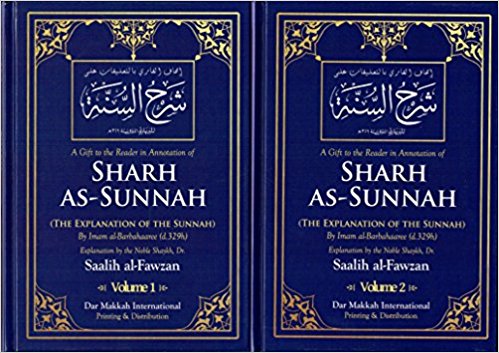
This is an English translation of Imaam al-Barbahaaree’s classic work, Sharh As-Sunnah. The book consists of 170 points on different aspects of the Muslim creed

Title of the Book: A Gift To The Reader In Annotation Of Sharh As-Sunnah (The Explanation Of The Sunnah)
The Number Of Books: Pgs. 816 /2 Volumes(HB)
Publisher: Dar Makkah International
Translator: Abdus Sami’ Abdus Salaam

This is the highly beneficial two volume work in explanation of the famous works by Imam al-Barbahaaree (d.329h) by the esteemed & noble Shaykh, Dr Saalih al- Fawzan. Its importance can be seen by virtue of its being compiled in the early times; as it is one of the books of the earliest Salaf – those who lived in the same period with the great Imams, acquired knowledge from them and reported their pure Aqidah (creed).

Buy the Book Herehttp://www.authenticstatements.com/bks-0400/

Visit : Book Study Resources of Sharhu Sunnah – Imam Barbaharee

Sharh as-Sunnah of Imaam Baarbaharee– Arabic Text & Audio

Click the Below Link to Read or Download the PDF / MS Word Doc of the Arabic Text

Sharh as-Sunnah Arabic Text (PDF) (156 Pages)

Sharh as-Sunnah Arabic Text (MS Word Doc)

Arabic Audio of the Matn (Text)

Listen / Download Mp3 Here (Time 1:07:09)

Source for abovehttp://archive.org/download/shaydzmi102/

Visit : Book Study Resources of Sharhu Sunnah – Imam Barbaharee

Sharh as-Sunnah (شرح السنة للبربهاري) of Imaam Baarbaharee– English Translation – Dawud Burbank

Explanation of the Creed  (Kitaab Sharh us-Sunnah) (شرح السنة للبربهاري)
(Abridged: 140 of 169 Points)

by Abu Muhammad Al-Hasan ibn ‘Alee ibn Khalaf Al-Barbahaaree  (d. 329H) rahimahullaah, The Imaaam of Ahlus-Sunnah wal-Jamaa’ah of his time

Translation: Abu Talhah Dawud Burbank

Click the below Link to read or download the PDF document

Sharh as-Sunnah – English Translation – Dawud Burbank [PDF]

Visit : Book Study Resources of Sharhu Sunnah – Imam Barbaharee

Imām Al-Barbahārī’s Sharh as-Sunnah شرح السنة للإمام البربهاري – Explained by Shaykh Muhammad Ramzān [Audio|Ar-En]

Imām Al-Barbahārī’s Sharh as-Sunnah شرح السنة للإمام البربهاري – Explained by Shaykh Muhammad bin Ramzān Al-Hājirī

Download the entire explanation here FREE in mp3 format:

http://ahlussunnahaudio.com/en/?p=1250

Shaykh Ahmad an-Najmi -Rahimhullah Rahmatin Waseeyah- said about Shaykh Muhammad bin Ramzaan Al-Haajiree:

“He is from the heads of Ahl AlSunnah.”

Similarly in the report of Naif Al-Mutairi – one of the Shaykh’s students- mentioned:

I narrate to you a conversation of one our brothers who telephoned Sheikh Ubaid Al-Jaabiree -may Allaah protect him- seeking a fatwa about an issue. And the Sheikh (Al-Jabiree) was busy, so he asked our brother, “Where are you from?” He said, “From Al-Jubail.” So the Shaykh (Al-Jabiree) said, “With you is Muhammad Ibn Ramzan, so call him and ask him.”

You can listen to the point by point at the below Youtube playlist

Visit : Book Study Resources of Sharhu Sunnah – Imam Barbaharee

Sharh-us-Sunnah – Shaykh Saalih Fawzaan – Dawood Burbank [Audio|En]

Explanation of the Creed (Sharh as-Sunnah)
Abu Muhammad al-Hasan ibn ‘Alee ibn Khalf al Barbahaaree [d.329 H]
Explanation by Shaikh Saalih ibn Fawzaan al-Fawzaan.
Translated by Abu Talhah Dawud ibn Ronald Burbank

This classic work consists of 170 points* on different aspects of the Muslim creed, with quotes from the the Qur.aan, the Sunnah, the Companions and later scholars. The author was an imaam who stood firm in defending this creed in the face of enmity and opposition from the people of innovation, may Allaah have mercy on him.

*In this audio series, Dawud Burbank rahimahullaah covers first 150 Points only

All lectures have been uploaded with the permission of Abu Talha rahimahullaah.

Some recordings begin with a summary of the points covered in the previous lesson.

(Please note that point numbers refer to the points in Shaykh Fawzaan’s Arabic Sharh, as against in the English translation)

Audio Lessons (mp3)

01 |02 |03 |04 |05 |06 |07 |08 |09 |10 |
11 |12 |13 |14 |15 |16 |17 |18 |19 |20 |
21 |22 |23 |24 |25 |26 |27 |28 |29 |30 |
31 |32 |33 |34 |35 |36 |37 |38 |39 |40 |
41 |42 |43 |44 |45 |46 |47 |48 |49 |50 |
51 |52 |53 |54 |55 |56 |57 |58 |59 |60 |
61 |62 |63 |64 |65 |66 |67 |68 |69 |70 |
71 |72 |73 |74 |75 |76 |77 |78 |79 |80 |
81 |82 |83 |84 |

Transcripts of Audio Lessons (PDF)

Transcripts available only for the first 30 lessons. May Allaah reward abundantly those who transcribed these lessons , ameen

01 | 02 | 03 | 04 | 05 | 06 | 07 | 08 | 09 | 10 |
11 | 12 | 13 | 14 | 15 | 16 | 17 | 18 | 19 | 20 |
21 | 22 | 23 | 24 | 25 | 26 | 27 | 28 | 29 | 30 |

Audio and Transcripts Courtesy: ittibaa.com

Visit : Book Study Resources of Sharhu Sunnah – Imam Barbaharee

The following Points are extracted from the above Lecture Series 

All the Points from the Audio Series Posted and Completed, Alhamdulillaah

All audio Clips For your Reference:

00a.Shaykh Fawzan’s Introduction to Sharhu Sunnah of Imam al-Barbahari.mp3

00b.Imam Barbahari’s foreword to his Sharh as-Sunnah.mp3

01.The Sunnah is Islaam and Islaam is the Sunnah.mp3

02.From the Sunnah is adhering to the Jamaa`ah.mp3

03A.The foundation which the Jamaa’ah is built upon is the Companions of Muhammad.mp3

03B.There is no excuse for anyone going astray, thinking that he is upon Guidance.mp3

03C.The Sunnah and the Jamaa’ah have firmly established all of the Religion, and it has become clear to the people.mp3

04A.The Religion is only what came from Allaah and it was not left to the intellects of men and to their opinions.mp3

04B.Do not follow anything based upon your desires and depart from the Religion.mp3

05.The people do not introduce an innovation, except that they lose its like from the Sunnah.mp3

06A. Small innovations grow, until they become large.mp3

06B.Examine the speech of everyone you hear from, in your time in particular.mp3

07.Know that departing from the correct path occurs in one of two ways.mp3

08.Whoever claims that there remains anything from Islaam not sufficiently explained by the Companions then he has lied against them.mp3

09.There is no qiyaas (analogy) in the matters of Aqeedah (Creed and Belief).mp3

10.Theological rhetoric, arguing, debating, disputing are all newly introduced affairs.mp3

11A.Speculative-speech-(kalaam)-about-Allaah,-the-Most-High,-is-an-innovation-and-misguidance.mp3

12.No-one-says-regarding-the-Attributes-of-the-Lord,-the-Most-High,-“How”-and-“Why”-except-for-one-who-doubts-about-Allaah.mp3

13.The-Qur’aan-is-the-Speech-of-Allaah-and-It-is-NOT-Created.mp3

14.-The-true-believers-will-see-their-Lord-on-the-Day-of-Resurrection-openly-with-their-eyes.mp3

15.Eemaan-in-the-Balance-(Meezaan)-on-the-Day-of-Resurrection.mp3

16.Eemaan-in-the-punishment-of-the-grave-and-in-Munkar-and-Nakeer.mp3

17.Eemaan-in-the-Hawd-(ReservoirLake)-of-Allaah’s-Messenger.mp3

18.Eemaan-in-the-Intercession-of-Allaah’s-Messenger-on-the-Day-of-Resurrection.mp3

19.Eemaan-in-the-Siraat-(the-Bridge)-over-the-Hellfire.mp3

20.Eemaan-in-the-Prophets-and-in-the-Angels.mp3

21.Paradise-and-Hellfire-are-true-and-are-already-Created.-They-will-never-pass-away.mp3

22.Eemaan-in-al-Maseehud-Dajjaal-(the-False-Messiah).mp3

23.Eemaan-in-the-descent-of-`Eesaa-ibn-Maryam-`alayhis-salaam.mp3

24.Eeman-is-belief-of-the-heart,-expression-upon-the-tongue-and-action-upon-the-limbs.mp3

25A.The-Best-of-this-Ummah-and-all-Umam-after-the-Prophets-is-Aboo-Bakr-then-`Umar-then-`Uthmaan.mp3

25B.The-Best-of-the-Companions-after-the-Khulafaa.mp3

25C.Refraining-from-Abusing-the-Companions.mp3

26.Hearing-and-obeying-the-Rulers-in-that-which-Allaah-loves-and-is-pleased-with.mp3

27.The-Hajj-and-fighting-Jihaad-along-with-the-ruler-continue.mp3

28.Al-Khilaafah-(the-Caliphate)-remains-within-the-Quraysh.mp3

29.Whoever-rebels-against-one-of-the-Muslim-rulers,-then-he-is-one-of-the-Khawaarij.mp3

30.It-is-not-permissible-to-fight-the-ruler,-nor-to-rebel-against-him-even-if-he-oppresses.mp3

31.It-is-permissible-to-fight-the-Khawaarij-if-they-attack-the-property,-persons-or-families-of-the-Muslims.mp3

32A.There-is-no-obedience-to-a-created-being-in-disobedience-to-the-Creator.mp3

32B.Bearing-witness-of-Paradise-or-of-the-Fire-for-a-specific-individual-without-a-proof.mp3

33.Stoning-(the-adulterer-or-adulteress)-is-True.mp3

34.Wiping-over-the-leather-socks-is-Sunnah.mp3

35.Shortening-the-prayer-whilst-upon-a-journey-is-Sunnah.mp3

36.Breaking-the-Fast-during-the-Journey-is-from-the-Concessions-of-the-Shariah.mp3

37.Praying-in-Trousers-or-Pants.mp3

38.Hypocrisy-in-Belief-(Nifaaq-I’tiqaadee)-and-Hypocrisy-in-Action-(Nifaaq-‘Amaliy).mp3

39.This-world-is-an-abode-of-Eemaan-and-Islaam.mp3

40.Funeral-Prayer-(Janaazah)-over-the-Muslims-who-committed-Major-Sins.mp3

41.No-Muslim-Exits-Islaam-Unless-He-Perpetrates-That-Which-Nullifies-It.mp3

42.The-Attributes-of-Allaah-&-The-Creed-of-Ahlus-Sunnah-wal-Jama’ah.mp3

43.Whoever-claims-that-he-saw-his-Lord-in-this-world-then-he-is-a-disbeliever-in-Allaah.mp3

44.It-is-obligatory-upon-the-Muslim-to-avoid-reflecting-upon-the-Self-of-Allaah.mp3

45.All-of-the-Existence-is-with-the-Command-of-Allaah.mp3

46.The-Knowledge-of-Allaah-Encompasses-Everything.mp3

47.There-is-no-marriage-except-with-a-guardian-&-two-just-witnesses-&-a-dower.mp3

48.If-a-man-divorces-his-wife-three-times-then-she-has-become-forbidden-for-him.mp3

49.The-blood-of-a-Muslim-cannot-lawfully-be-shed-except-on-account-of-one-of-three-cases.mp3

50.Everything-that-Allaah-has-decreed-should-pass-away-will-pass-away.mp3

51.Eemaan-in-the-Qisaas(retribution)-on-the-Day-of-Resurrection-between-all-of-the-creation.mp3

52.To-Make-one’s-Deeds-Purely-and-Sincerely-for-Allaah.mp3

53.To-be-pleased-and-satisfied-with-the-decree-of-Allaah.mp3

54-56.Glad-tidings-to-those-who-have-patience-when-they-are-struck-by-calamity.mp3

57-58.Know-that-whatever-befalls-you-was-never-going-to-miss-you.mp3

59.Four-takbeers-are-to-be-said-for-the-Funeral-Prayer.mp3

60.Along-with-Every-Raindrop-there-is-an-Angel-who-descends-from-the-sky-with-it.mp3

61.Allaah’s-Messenger-spoke-to-those-thrown-into-the-abandoned-well-on-the-day-of-Badr.mp3

62.Allaah-causes-afflictions-to-strike-the-believers-in-order-to-purify-them-or-to-multiply-their-reward.mp3

63.Allaah-rewards-the-martyr-(shaheed)-for-his-martyrdom.mp3

64.When-children-are-afflicted-by-anything-in-the-life-of-this-world-then-they-feel-pain.mp3

65.Know-that-No-One-will-enter-Paradise-except-by-the-mercy-of-Allaah.mp3

66.Do-not-Deny-or-Speak-against-the-Narrations-of-the-Messenger-of-Allaah.mp3

67.Al-Qadr-(Pre-decree)-is-Allaah’s-secret.-Don’t-Argue-or-Dispute-about-it.mp3

68.Eemaan-(True-Faith)-in-al-Israa-w’al-Mi`raaj.mp3

69.The-souls-of-the-martyrs-are-within-the-bellies-of-green-birds-in-Paradise.mp3

70-71.Eemaan-in-al-Fitnatu-fil-Qabr-(The-Trial-in-the-Grave).mp3

72.To-have-Eemaan-that-it-is-Allaah-who-spoke-to-Moosaa-on-mount-Toor.mp3

73.Know-that-Evil-and-Good-occur-by-the-Pre-Decree-and-Pre-Ordainment-of-Allaah.mp3

74.Al-Aql-(intellect)-is-not-acquired,-rather-it-is-a-fadl-(favour)-bestowed-by-Allaah.mp3

75.Allaah-has-favoured-some-of-the-servants-over-others,-He-has-done-so-justly.mp3

76.Ad-Deenu-an-Naseehah-(The-Religion-is-Sincerity).mp3

77.Affirmation-of-Attributes-of-Allaah.mp3

78.Tidings-at-the-Point-of-Death.mp3

79.Affirmation-of-Ar-Ru’yah-(Seeing-Allaah-in-the-Hereafter).mp3

80.Rhetorical-Theology-(al-kalaam)-&-Argumentation,-Disputing-&-Self-amazement.mp3

81.To-have-eemaan-that-Allaah-will-punish-the-creation-in-the-Fire-in-Shackles,-Fetters-&-Chains.mp3

82.The-Obligatory-Prayers-are-Five.-There-is-to-be-no-increase-in-them-nor-any-reduction-in-their-set-times.mp3

83.The-Obligation-of-Giving-the-Zakaat.mp3

84-86.Know-that-the-Beginning-of-Islaam-is-Ash-Shahaadataan.mp3

87.Buying-&-Selling-without-Deception,-Oppression-or-Treachery.mp3

88.The-Believer-(Mu’min)-should-combine-between-al-Khawf-(Fear)-and-ar-Rajaa-(Hope).mp3

89.Allaah-revealed-to-His-Prophet-what-will-occur-to-his-Ummah-till-the-Day-of-Resurrection.mp3

90A.My-Ummah-will-divide-into-73-sects;-all-of-them-shall-be-in-the-Fire-except-one.mp3

90B.The-Killing-of-Uthmaan-ibn-ʻAffān.mp3

90C.Differing-and-Fitan-increased-after-the-Excellent-Generations-had-Passed-Away.mp3

90D&90E.They-called-to-Sectarianism-(Furqah)-&-Sunnah-became-a-Stranger.mp3

96.Temporary-Marriage-of-Convenience-(al-Mut’ah)-is-forbidden-till-the-Day-of-Resurrection.mp3

97.Excellence-of-the-Banu-Haashim-and-the-Quraysh.mp3

98.Acknowledge-the-Virtue-of-the-Ansaar.mp3

98.Jahmiyyah-and-Ruwaybidah-(The-Lowly,-Despicable-Folk).mp3

99.Whoever-Says—-My-recital-of-the-Qur’an-is-created—then-he-is-a-Jahmi.mp3