https://youtu.be/u1LD6Yvgab0 [17 min] – Arabic | English Subtitles
Blessed Days [First 10 Days of Dhul Hijjah]
https://abdurrahman.org/hajj/blessed-days-first-10-days-of-dhul-hijjah/
Islamic Knowledge – Islam, Sunnah, Salafiyyah

Blessed Days [First 10 Days of Dhul Hijjah]
https://abdurrahman.org/hajj/blessed-days-first-10-days-of-dhul-hijjah/
Dhikr (Remembrance of Allaah) : https://abdurrahman.org/dhikr/
0:00 Introduction
2:20 The gatherings of the remembrance of Allah
6:36 Verily, in the remembrance of Allah do hearts find rest
9:39 Being heedless of the remembrance of Allah
11:59 The remembrance of Allah is the true life of the hearts
16:48 The remembrance of Allah expels the Shaytan
24:56 The dire need of the slave for the remembrance of Allah
28:01 The command to remember Allah frequently
29:20 The virtues of the remembrance of Allah In the Sunnah
31:37 The remembrance of Allah is the objective of every worship
32:17 The people who remember Allah most in their worship have the greater reward
35:20 The highest level of remembrance
36:10 Understanding the meanings of the remembrances
43:39 The most beloved to Allah are four
45:40 Conclusion
—
Dhikr (Remembrance of Allaah) – Main Page
https://abdurrahman.org/dhikr
You can buy the book here:
https://www.amazon.com/VERILY-REMEMBRANCE-ALL%C4%80H-HEARTS-FIND/dp/1640074422
Jinn & Shayateen (Devils):
https://abdurrahman.org/jinn-shayateen-devils/
Dhikr (Remembrance of Allaah):
https://abdurrahman.org/dhikr/
Tawheed:
https://abdurrahman.org/?p=29687
[Sheikh Saaleh bin Sa’d as-Suhaymee]
https://abdurrahman.org/tag/shaykh-saalih-as-suhaymee-author/
Subscribe to our Youtube channel for regular updates:
https://www.youtube.com/c/AbdurRahmanMeda?sub_confirmation=1
Du’a (Supplication to Allaah) :
https://abdurrahman.org/dua/
[Shaykh ‘Abdurrazzāq al Badr حفظه الله]
https://abdurrahman.org/tag/shaykh-abdur-razzaaq-ibn-abdul-muhsin/
Subscribe to our Youtube channel for regular updates:
https://www.youtube.com/c/AbdurRahmanMeda?sub_confirmation=1
Join our telegram channel:
https://t.me/abdurrahmanorg
[Shaykh Al-Albaani]
https://abdurrahman.org/tag/shaykh-al-albaani/
Dhikr (Remembrance of Allaah):
https://abdurrahman.org/dhikr/
Subscribe to our Youtube channel for regular updates:
https://www.youtube.com/c/AbdurRahmanMeda?sub_confirmation=1
[Dhikr (Remembrance of Allaah)]
https://AbdurRahman.org/?p=30866
[Shaykh ‘Abdurrazzāq al Badr حفظه الله]
https://abdurrahman.org/tag/shaykh-abdur-razzaaq-ibn-abdul-muhsin/
Aqeedah Tahaawiyyah: Lesson 49 : Point [182]
Dawud Burbank [Audio|English]
182. And this is the explanation of ‘Laa hawla wa laa quwwata illaa billaah’ (There is no change and no power except with Allaah’s aid). We say: there is no manoeuvring for anyone, and no movement for anyone, and no moving away from disobedience to Allaah – except with the aid of Allaah; and there is no power for anyone to establish obedience to Allaah, and to remain firm upon it,except by Allaah’s tawfeeq (His granting successful attainment of that).
At-Ta`leeqaat Al-Mukhtasarah `alaa Matn Al-`Aqeedah At–Tahaawiyyah. By Shaykh Saalih ibn Fawzaan al-Fawzaan hafizahullaah. Translated by Aboo Talhah Daawood Burbank, rahimahullaah, in 1426AH
Posted with kind permission from Dawud Burbank rahimahullaah
Listen to the Full Audio Series of Aqeedah Tahaawiyyah:
Explanation of Aqeedah at-Tahaawiyyah – Dawud Burbank [Audio|En]
Book Study Resource : Aqeedah at-Tahaawiyyah – Imam at-Tahaawi
Related Link : https://abdurrahman.org/dhikr
From `Abdul-`Aziz ibn `Abdullah ibn Baz to the honorable brother H. M. Th., may Allah grant him safety! May Allah’s Peace, Mercy, and Blessings be upon you. In respect of your request for Fatwa registered in the Department of the Scholarly Research and Ifta’ (no. 1513), dated (21/4/1407 A.H.), it contains three questions. Here are the answers:
Q3: What is the wisdom behind saying, لا حَوْلَ وَلا قُوَّةَ إِلا بِالله “La Hawla Wala Quwwata Illla Billah” (There is no might nor power except with Allah) when the Mu`adh-dhin says, حي على الصلاة “Hayya `Ala Al-Salah (Come to Salah)” and حي على الفلاح “Hayya `Ala Al-Falah (Come to Success)” taking into consideration that they imply a call to Salah? Is there a Hadith that refers to that?
A: The wisdom behind that saying is that man is weak by nature. He has no ability to move from a condition to another except with the help of Allah. Even his going to Salah in congregation needs the help and power of Allah. A servant of Allah has no might or power except with Allah. He realizes that he is weak, powerless, and unable to answer this call unless Allah helps him Alone. Therefore, upon hearing that call, he says: “La Hawla Wala Quwwata Illa Billah”.
This is authentically reported from `Umar (may Allah be pleased with him) as related by Muslim in his Sahih. May Allah grant us all success! May Allah’s Peace, Mercy, and Blessings be upon you!
Issued by the office of His Eminence and was read to His Eminence again on 4/4/1415 A.H.
Source: Fatwas of Ibn Baz > Volume 10 > Book of Salah > Chapter on Adhan and Iqamah >
Tafseer Ibn Kathir : Surah Faatir 35:11
(darussalam english publication)
Righteous Deeds ascend to Allah
(To Him ascend the good words,) means, words of remembrance, recitation of Qur’an, and supplications. This was the view of more than one of the Salaf.
Ibn Jarir recorded that Al-Mukhariq bin Sulaym said that “`Abdullah bin Mas`ud, may Allah be pleased with him, said to them, “If we tell you a Hadith, we will bring you proof of it from the Book of Allah.
When the Muslim servants says, `Glory and praise be to Allah, there is no god worthy of worship except Allah, Allah is Most Great and blessed be Allah,’ an angel takes these words and puts them under his wing, then he ascends with them to the heaven. He does not take them past any group of angels but they seek forgiveness for the one who said them, until he brings them before Allah, may He be glorified.”
Then `Abdullah, may Allah be pleased with him, recited:
(To Him ascend the good words, and the righteous deeds exalt it).”
Imam Ahmad recorded that An-Nu`man bin Bashir, may Allah be pleased with him, said, “The Messenger of Allah said:
(Those who remember Allah and glory Allah by saying, `Glory be to Allah, Allah is most Great, all praise is due to Allah and La ilaha illallah, these words go around the Throne buzzing like bees, mentioning those who said them. Would one of you not like to have something with Allah mentioning him)”
This was also recorded by Ibn Majah.
(and the righteous deeds exalt it). Ali bin Abi Talhah reported that Ibn Abbas, may Allah be pleased with him, said,
The good word is the remembrance of Allah, may He be exalted, which is taken up to Allah, and the righteous deed is the performance of obligatory duties. Whoever remembers Allah when doing an obligatory duty, his deed carries his remembrance of Allah and takes it up to Allah, may He be exalted. Whoever remembers Allah and does not perform the obligatory duties, his words will be rejected, as will his deed.
The following is based from the book Al-Wabil al-Sayyib by Ibn Qayyim al-Jawziyya
—
Posted from: http://understand-islam.net/site/index.php?option=com_content&view=article&id=126&Itemid=76
–
While prostrating (Sujood):
سُبْحَانَ رَبِّيَ الأَعْلَى
(3 times)
Subhaana Rabbiyal-A’laa
Glory is to my Lord, the Most High. (Recite three times in Arabic)
Abu Dawud, Ibn Majah, An-Nasa’i, At-Tirmithi, and Ahmad.
See also Al-Albani, Sahih At-Tirmithi 1/83.
Posted from: Salah (Prayer) Decsribed : Sujood (Prostration) – Dr. Saleh as Saleh [Audio|En]
Related Link: Dua during Sujud for worldly matters – Shaykh Abdil-‘Azeez Aali Shaikh
Reference: www.AbdurRahman.Org

Q: What is the ruling on some people who sway from right to left and backwards and forwards while reciting the Qur’an? Please advise, may Allah reward you.
A: Swaying while reciting the Qur’an is one of the habits that should be abandoned. It contradicts the etiquettes required when reciting the Qur’an. When reciting or listening to the Qur’an, a person should listen carefully and not play with things so that the listener and the reciter ponder over the meanings of the Qur’an and their hearts be submissive to Allah (Glorified and Exalted be He).
Scholars mentioned that this is one of the habits of the Jews when reciting their Book, and we are forbidden to imitate them.
May Allah grant us success. May peace and blessings be upon our Prophet Muhammad, his family, and Companions.
The Permanent Committee for Scholarly Research and Ifta’
Member – Member – Member – Deputy Chairman – Chairman
Bakr Abu Zayd Salih Al-Fawzan `Abdullah ibn Ghudayyan `Abdul-`Aziz Al Al-Shaykh `Abdul-`Aziz ibn `Abdullah ibn Baz
Related Links:
Listen / Download Mp3 Here (Time 4:16)
[audio https://salafiaudio.files.wordpress.com/2015/07/busy-your-tongue-with-dhikr-duaa-isthigfar-and-other-beneficial-speech-in-hajj-other-times-abu-muhammad-al-maghribee.mp3]
The above short clip has been extracted from the Lesson 2 of Book on Hajj (Tabseer an-Naasik fi Ahkaam al-Manaasik) – Shaykh Abdul-Muhsin al-Abbaad – Abu Muhammad al Maghribee [Audio|En]
From Anas – RadhiAllaahu anhu – who said: ‘A Bedouin came to the Prophet – sallAllaahu alayhi wa sallam – and said: ‘O Messenger of Allaah! Teach me some goodness.’
So the Prophet – sallAllaahu alayhi wa sallam – took him by the hand and said:
” قل: سبحان الله، والحمد لله، ولا إله إلا الله، والله أكبر.
‘Say: ‘Far is Allaah from imperfection, and all praise be to Allaah, and there is none worthy of worship in truth except Allaah, and Allaah is the Greatest.’
(Subhana Allaahi, wal hamdu lillaahi, wa la illaah ila Allaah, wa Allaahu Akbar.)’
The Bedouin counted them on his hand, when he finished he began to reflect then came back to the Prophet.
The Prophet – sallAllaahu alayhi wa sallam – smiled and said:
‘The desperate one has reflected.’
Then the Bedouin came and said:
‘O Messenger of Allaah! ‘Far is Allaah from imperfection, and all praise be to Allaah, and there is none worthy of worship in truth except Allaah, and Allaah is the Greatest.’ This is for Allaah, what is for me?’
The Prophet – sallAllaahu alayhi wa sallam – said:
اللهم اغفر لي وارحمني وعافني وارزقني واهدني
‘Say: O Allaah forgive me, and have mercy on me, and pardon me, and provide for me, and guide me.’
The Prophet – sallAllaahu alayhi wa sallam – said to him:
‘O Bedouin! If you say: ‘SubhanAllah’, Allaah says: ‘you have spoken the truth,
If you say: ‘Alhamdulillah’, Allaah says: ‘ you have spoken the truth,
If you say: ‘La ilaha ‘illa Allaah’, Allaah says: ‘you have spoken the truth,
If you say: Allaahu Akbar, Allaah says: ‘you have spoken the truth,
If you say: O Allaah forgive me, Allaah says: I have done so,
If you say: O Allaah have mercy on me, Allaah says: I have done so,
If you say: O Allaah give me provision, Allaah says: I have done so,
Then the Bedouin counted it seven times on his fingers, then went away.’
Shaykh al-Muhaddith al-Albaani -Rahimullaah – said :
Collected by al-Bayhaqi in ‘Shuab al-Eemaan’, and this Isnaad is Jayyid (good) its narrators are trustworthy as for al-Hasan bin Tawab; then I had become exhausted searching about him until I found who he was. So I performed a Sajdah to Allaah thankful for His success and I ask Him for an increase in His excellence.’
[Taken from : ‘Silsilah Saheehah’ No. 3336 by the Shaykh al-Muhaddith al-Albaani -Rahimullaah ]
Related Links:
Case: During Menses, it is not unlawful to celebrate Allah’s Praises (Saying Takbeer, Tasbeeh, and Tahmeed),[29] saying Bismillah before acting upon something (eating, drinking, etc..), reading Hadeeth, Islamic discussions, invocation upon Allah (Dua’), and listening to the recitation of Qur’an.
It has been confirmed by ‘Aisha (radhi Allaahu anha) that the Prophet (صلى الله عليه و سلم) used to: “lean on my lap and recite Qur’an while I was in menses” (Al-Bukhari and Muslim).[30]
Also Umm ‘Atiyya reported that she heard the Prophet (صلى الله عليه و سلم) saying: “The Unmarried young virgins and the mature girl who stay often screened or the young unmarried virgins who often stayscreened and the menstruating women should come out and participate in the good deeds as well as the religious gathering of the faithful believers but the menstruating women should keep away from the Musalla (praying place).” [31]
Case: The reciting of the Qur’an by a menstruating woman either via direct looking or silently (in her heart) without the actual uttering by the tongue is permissible.
The majority of the scholars are with the opinion that it is not prohibited for her to utter the Qur’anic recitation. Imam Bukhari, Ibn Jareer At- Tabaree and Ibn Al-Munthir, Imam Malik, and Imam Ash-Shaafi’ee (in one of his earlier sayings) are with the opinion that it is permissible for her to recite the Ayah (verse in the Qur’an).
Shayekul Islam Ibn Taymeeyah said: “Basically, there is no Sunnah to prevent her from reciting Qur’an. The “hadeeth” that: “A menstruating woman and the one who is in state of Jannabah [32] should not recite anything of the Qur’an”, is a weak hadeeth as agreed upon by the knowledgeable scholars of Hadeeth.
In fact women at the time of the Prophet (صلى الله عليه و سلم) used to have their monthly cycles of menses.Had the recitation of Qur’an been prohibited for them (as it is the case with Salat) then the Prophet (صلى الله عليه و سلم) would have made it clear to his Ummah (Islamic community) and his wives would have known about it and they would have dissipated this knowledge to the people. Because no one had related a prohibition by the Prophet (صلى الله عليه و سلم) about this issue, then it cannot be made unlawful especially when it is known that he (صلى الله عليه و سلم) did not prohibit it at the time when menses was very much present.
Accordingly, recitation by the tongue is not Haram (legally unlawful).[33] This author said: “having known the dispute between the scholars about this matter, then it is more proper for the menstruating woman not to recite Qur’an by the tongue except when it is necessary e.g. if she is a teacher or if she is preparing for an exam.”
Footnotes:
[29] Takbeer: saying Allahu Akbar (Allah is The Greatest); Tasbeeh: saying Subhana Allah (Most Glorified is Allah); Tahmeed: saying Al Hamdulil’lah: All Praise is due to Allah.
[30] Saheeh Al-Bukhari (Arabic-English) V.1, P.179, Hadeeth # 296.
[31] Agreed upon Hadeeth. In Saheeh Al-Bukhari (Arabic- English), V. 1, P. 192, Hadeeth # 321.
[32] Jannabah: Is the state in which a man (or a woman) has sexual discharge during sexual intercourse or in a dream, etc. In this state a Muslim is not allowed to pray or do other kinds of worships unless and until he (she) performs Ghusl (have a full shower) or do Tayammum if he/she cannot use water for any reason.
[33] Ibin Taymeeyah in Al-Fatawa (religious decrees) V. 26, P. 191.
Source : [eBook] Natural Blood of Women – Shaykh Uthaymeen – Translated by Dr Saleh As-Saleh
Remembering Their Cell Phones Before Remembering Allah
Shaykh Abdur Razzaq al-Badr حفظه الله
http://mtws.posthaven.com/remembering…
Translated by Rasheed ibn Estes Barbee حفظه الله
Video Courtesy: Bilal Nahim

(1) MUSLIM reported (no. 591): “Daawood ibn Rushayd narrated to us: alWaleed narrated to us : from al-Awzaa`ee: from Aboo Ammaar-his name is Shaddaad ibn `Abdillaah: from Aboo Asmaa. : from Thawbaan who said: “When Allaah’s Messenger (صلى الله عليه و سلم) finished his Prayer he would seek forgiveness three times, and say:
[O Allaah You are the Flawless One, and from You comes peace and security.
Blessed are You, Possessor of Majesty and Honour].”
al-Waleed said: So I said to al-Awzaa`ee: ‘How is seeking forgiveness done?’
He said: “You say : “… أَسْـتَغْفِرُ الله أَسْـتَغْفِرُ الله ”
(I seek Allaah’s forgiveness, I seek Allaah’s forgiveness….)”.
-The wording of the four ‘Sunan’ in a hadeeth of `Aa.ishah- radiyallaahu `anhaa-(declared authentic by Shaikh al-Albaanee) is:
[O Allaah You are the Flawless One, and from You comes peace and security.
Exalted are You, O Possessor of Majesty and Honour].

(2) AL-BUKHAAREE reported (no.844): “Muhammad ibn Yoosuf narrated to us, saying: Sufyaan narrated to us: from `Abdul-Malik ibn `Umayr: from Warraad-the scribe of al-Mugheerah ibn Shu`bah who said: al-Mugheerah dictated to me in a letter to Mu`aawiyah that the Prophet (صلى الله عليه و سلم) used to say after every Obligatory Prayer:
La ilaha illal-lahu wahdahu la shareeka lah, lahul-mulku walahul-hamd, wahuwa ‘ala kulli shayin qadeer, allahumma la mani’a lima a’tayt, wa la mu’tiya lima mana’t, wala yanfa’u thal-jaddi minkal-jad
None has the right to be worshipped except Allaah, alone, having no partner. Sovereignty is His and all praise is for Him, and He has full power over everything. O Allaah no one can hold back what You give, and no one can give what You hold back, and no one’s riches can benefit them against You.”
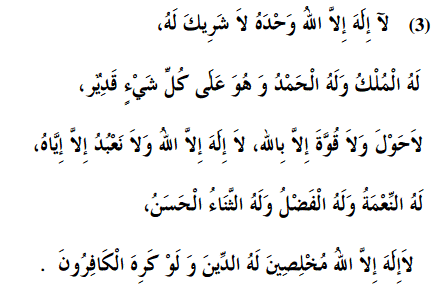
(3) MUSLIM reported (no.594): “And Muhammad ibn `Abdillaah ibn Numayr narrated to us: My father narrated to us: Hishaam narrated to us: from AbuzZubayr who said: “Ibn az-Zubayr used to say at the end of every Prayer when he had given the Salutation:
La ilaha illal-lah, wahdahu la shareeka lah, lahul-mulku walahul-hamd, wahuwa ‘ala kulli shayin qadeer. la hawla wala quwwata illa billah, la ilaha illal-lah, wala na’budu illa iyyah, lahun-niAAmatu walahul-fadl walahuth-thana-ol- hasan, la ilaha illal-lah mukhliseena lahud-deen walaw karihal-kafiroon.
[None has the right to be worshipped except Allaah, alone, having no partner. Sovereignty is His and all praise is for Him, and He has full power over everything. There is no change and no ability except with (the Aid of) Allaah. None has the right to be worshipped except Allaah, and we do not worship except Him. All blessings are from Him and all favour is from Him, and fine praise is for Him. None has the right to be worshipped except Allaah, we make the Religion purely and sincerely for Him-even though the Disbelievers detest that],
and he said: “Allaah’s Messenger (صلى الله عليه و سلم) used to repeat these words after every Prayer.”

(4) (a) Saying: ‘Subhaanallaah’, ‘al-hamdu lillaah’, and ‘Allaahu Akbar’- thirty three times each after every Prayer.
[al-Bukhaaree (no. 843) and Muslim (no. 595) from a hadeeth of Aboo Hurairah-radiyallaahu `anhu]
or (b) Saying: ‘Subhaanallaah’ -thirty-three times, ‘al-hamdu lillaah’ -thirty-three times, and ‘Allaahu akbar’ -thirty-four times-after every Prayer. [Reported by Muslim (no. 596) from a hadeeth of Ka`b ibn `Ujrah-radiyallaahu `anhu]
or (c) Saying: ‘Subhaanallaah’ -thirty-three times, ‘al-hamdu lillaah’ -thirty-three times, and ‘Allaahu akbar’ -thirty-three times- and then: لا إلهَ إلاّ اللّهُ وَحْـدَهُ لا شريكَ لهُ، لهُ الملكُ ولهُ الحَمْد، وهُوَ على كُلّ شَيءٍ قَـدير
whoever does so after every Prayer then his sins will be forgiven even if they are like the foam of the sea.
[Reported by Muslim (no.597) from a hadeeth of Aboo Hurairah-radiyallaahu `anhu]
or (d) Saying: ‘Subhaanallaah’ -twenty-five times, ‘al-hamdu lillaah’ -twenty-five times, ‘Allaahu akbar’ -twenty-five times ‘Laa ilaaha illallaah’ -twenty-five times
[Reported by an-Nasaa.ee (no. 1350) from a hadeeth of Zayd ibn Thaabit-radiyallaahu `anhu and declared ‘Saheeh’ by Shaikh al-Albaanee-rahimahullaahu.]
or (e) ) Saying: ‘Subhaanallaah’ -ten times, ‘al-hamdu lillaah’ -ten times, ‘Allaahu akbar’ -ten times.
[Reported by al-Bukhaaree (no.6329)-from a hadeeth of Aboo Hurairah-radiyallaahu `anhu]

(5) ABOO DAAWOOD reported (no. 1522): “ `Ubaydullaah ibn `Umar ibn Maysarah narrated to us: `Abullaah ibn Yazeed al-Muqri. narrated to us: Haywah ibn Shurayh narrated to us, saying: I heard `Uqbah ibn Muslim say: Aboo `Abdir-Rahmaan al-Hubulee narrated to me: from as-Sunaabihee: from Mu`aadh ibn Jabal: that Allaah’s Messenger (صلى الله عليه و سلم ) took hold of his hand and said:
<>
So he said: << I counsel you, O Mu`aadh: Do not leave off saying at the end of every Prayer:
[O Allaah help me upon remembrance of You, giving thanks to You, and worshipping You in a fine manner].>>
And Mu`aadh counselled as-Sunaabihee with that, and as-Sunaabihee counselled Aboo `Abdir-Rahmaan with it.”
[Shaikh al-Albaanee-rahimahullaah-said in ‘Saheeh Sunan Abee Daawood’ (no. 1362): “ I say: Its chain of narration is ‘Saheeh’ and it was declared ‘Saheeh’ by Ibn Khuzaymah and Ibn Hibbaan (2017)…
And the hadeeth is reported by Ahmad (5/244-245), Ibn Khuzaymah in his ‘Saheeh’ (751), and likewise Ibn Hibbaan (no. 2345), and Aboo Nu`aym in ‘al-Hilyah’ (1/241 & 5/130) through other chains from `Abdullaah ibn Yazeed al-Muqri… with it, and they add: “And Aboo `Abdir-Rahmaan counselled `Uqbah ibn Muslim.” And Aboo Nu`aym added: “And `Uqbah counselled Haywah, and Haywah counselled Aboo `Abdir-Rahmaan al-Muqri., and Aboo `Abdir-Rahmaan al-Muqri., counselled Bishr ibn Moosaa, and Bishr ibn Moosaa counselled Muhammad ibn Ahmad ibn al-Hasan, and Muhammad ibn Ahmad al-Hasan counselled me.
Aboo Nu`aym-rahimahullaah said: “And I counsel you (all) with it.” I say: This hadeeth is from the famous hadeeth reported with a serial chain, mentioning love, and I was given ijaazah to narrate it by the virtuous Shaikh Raaghib at-Tabbaakhrahimahullaah, and he narrated it to me… and he reported its isnaad in this manner mentioning love at each stage of the chain.]
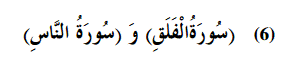
(6) AT-TIRMIDHEE reported (no.2903): “Qutaybah narrated to us, saying: Ibn Lahee`ah narrated to us: from Yazeed ibn Abee Habeeb: from `Alee ibn Rabaah: from `Uqbah ibn `Aamir who said: “Allaah’s Messenger (صلى الله عليه و سلم) commanded me to recite the two Soorahs of seeking refuge (alMu`awwidhatayn) at the end of every Prayer..” [Declared ‘saheeh’ by Shaikh al-Albaanee-rahimahullaah.]

(7) AN-NASAA.EE reported in ‘`Amalul-Yawm wal-Laylah’ (no. 100): “alHusayn ibn Bishr related to us in Tarsoos-we wrote from him, saying: Muhammad ibn Himyar narrated to us, saying: Muhammad ibn Ziyaad narrated to us: from Aboo Umaamah who said: Allaah’s Messenger (صلى الله عليه و سلم) said:<> [Shaikh al-Albaanee declared the hadeeth ‘Saheeh’ in ‘as-Saheehah’ (no. 972)].

(8) AL-BUKHAAREE reported (no. 2822): “Moosaa ibn Ismaa`eel narrated to us: Aboo `Awaanah narrated to us: `Abdul-Malik ibn `Umayr narrated to us, saying: I heard `Amr ibn Maymoon al-Awdee say: Sa`d used to teach his sons these words, just as a teacher teaches boys to write, and he used to say that Allaah’s Messenger (صلى الله عليه و سلم) would seek refuge (with Allaah) from them at the end of the Prayer:
Allahumma innee a’oothu bika minal-jubn, wa-a’oothu bika min an oradda ila arthalil- ‘umur, wa-a’oothu bika min fitnatid-dunya wa wa-a’oothu bika min ‘athabil-qabr.
[O Allaah! I seek Your refuge from cowardice, and I seek Your refuge from being brought back to senile old age, and I seek Your refuge from the trials of the world, and I seek your refuge from the punishment of the grave]
So I narrated it to Mus`ab and he affirmed it.”

(9) AN-NASAA.EE reported (no. 1347): `Amr ibn `Alee related to us, saying: Yahyaa narrated to us: from `Uthmaan ash-Shahhaam: from Muslim ibn Abee Bakrah who said: My father used to say at the end of the Prayer:
[O Allaah! I seek Your refuge from Unbelief, and poverty, and the punishment of the grave].
So I used to say it, so my father said: “Who did you take this from?” So I said: “From you!” He said: “Allaah’s Messenger (صلى الله عليه و سلم ) used to say it at the end of the Prayer.”
[Shaikh al-Albaanee said: “Its isnaad is ‘Saheeh’”]
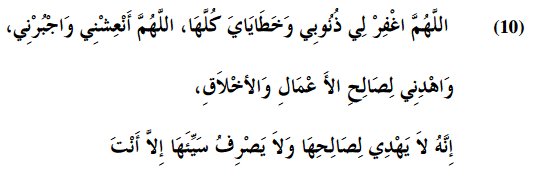
(10) IBNUS-SUNNEE reported in `Amalul-Yawm wal-Laylah’ (no. 116), and AT-TABARAANEE in ‘al-Kabeer’ (nos.7811 & 7893) (& 7982)… from Aboo Umaamah-radiyallaahu `anhu-who said:
“I never drew near to Allaah’s Messenger (صلى الله عليه و سلم ) at the end of an obligatory or optional Prayer except that I heard him saying:
[O Allaah forgive me all of my sins and shortcomings. O Allaah raise me and restore me, and guide me to righteous deeds and manners; no one can guide to that which is righteous from them, nor repel that which is bad from them besides You].”
[Declared ‘hasan’ (i.e. due to supporting narrations) by Shaikh al-Albaanee in ‘SaheehulJaami`’ (no. 1266) and Shaikh Saleem al-Hilaalee in ‘Saheeh Kitaabil-Adhkaar’ (189/154).]

(11) AN-NASAA.EE reported [Book of ‘Sahw’ (Forgetfulness)]:Chapter (87): Another type of dhikr after the Salutation (no.1344):
“Muhammad ibn Ishaaq as-Saaghaanee related to us, saying: Aboo Salamah alKhuzaa`ee-Mansoor ibn Salamah narrated to us, saying: Khallaad ibn Sulaymaan narrated to us, saying Aboo Salamah said: and he was on e of those who were fearful: From Khaalid ibn Abee `Imraan: from `Urwah: from `Aa.ishah: that when Allaah’s Messenger (صلى الله عليه و سلم) had sat in a gathering or prayer he would say some words. So `Aa.ishah asked him about the words, so he said:
<
[I declare You free of all imperfections, O Allaah, and all praise is for You. I seek Your forgiveness and turn in repentance to You.].”
[Shaikh al-Albaanee-rahimahullaah-declared it ‘Saheeh’.]
—
[Compiled and translated by Abu Talhah Dawud Burbank rahimahullaah]
Authentic Adhkaar (Remembrance) after the Salaah (Prayer) – Dawud Burbank [PDF]
—
Part 01 : Listen / Download Mp3 Here (Time 46:47)
[audio https://salafiaudio.files.wordpress.com/2014/09/make-your-houses-places-of-dhikr-of-allah-part-01-dawood-adib.mp3]
Part 02 : Listen / Download Mp3 Here (Time 39:14)
[audio https://salafiaudio.files.wordpress.com/2014/09/make-your-houses-places-of-dhikr-of-allah-part-02-dawood-adib.mp3]
Based on Ibn Taimiyyah’s The Concise Admonition ( Al Wasiyyah Al Sughrah)
Concise Admonition – Ibn Taymiyah – 21- Remembrance of Allaah – part 1 – Saleh-As-Saleh
[audio https://salafiaudio.files.wordpress.com/2014/09/concise-admonition-ibn-taymiyah-21-remembrance-of-allaah-part-1-saleh-as-saleh.mp3]
Concise Admonition – Ibn Taymiyah – 22- Remembrance of Allaah – part 2 – Saleh-As-Saleh
[audio https://salafiaudio.files.wordpress.com/2014/09/concise-admonition-ibn-taymiyah-22-remembrance-of-allaah-part-2-saleh-as-saleh.mp3]
Concise Admonition – Ibn Taymiyah – 23- Remembrance of Allaah – part 3 – Saleh-As-Saleh
[audio https://salafiaudio.files.wordpress.com/2014/09/concise-admonition-ibn-taymiyah-23-remembrance-of-allaah-part-3-saleh-as-saleh.mp3]


 AbdurRahman.Org
You must be logged in to post a comment.