Paris Attacks : The True Islamic Stance – Abu Muhammad al Maghribee [Audio|En]

The Islamic stance on terrorist attacks remains the same whether these take place in a Muslim land or a non-Muslim land.  Islam condemns all acts of terrorism, such as kidnapping, beheading, suicide bombing, etc.

Listen / Download Mp3 Here (Time 48:26)

Posted fromhttp://followthesalaf.com/home/2015/11/15/paris-attacks-the-true-islamic-stance

WatchCondemnation of Paris Attacks – Ash-Shaykh Al-ʿAllāmah Ṣāliḥ al-Luḥaydān [Video|Ar-En Subtitles]

The Menstruating Woman or the One in Her Post-Partum Period Touching the mus-haf – Shaykh Bin Baaz

Translated by Abu Abdullah Naasir Hussain حفظه الله
Source: http://www.binbaz.org.sa/node/16921

Video Courtesy: Bilal Nahim

Question:

Is a woman that is menstruating or in her post-partum period allowed to touch the mus-haf or read from it? Also, is the menstruating woman allowed to enter the masjid in order to gain religious knowledge?

Shaykh Abdulazeez bin Abdullah bin Baaz:

The menstruating woman is not allowed to sit in the masjid nor touch the mus-haf until she has become purified. However, if a need for her to touch it arose, such as in order to revise a verse (of the Qur’an) or something like that, there is no problem to do so by wearing gloves or by using some other barrier.

As for touching it without some sort of barrier, then no, she should not do that. This is because her impurity is major, like the one who is impure due to sexual relations (junub). The one who is ‘junub’ does not read or touch the mus-haf. As for the menstruating woman, she may recite [the Qur’an] during the whole period. So can the one in her post-partum period, according to the correct Opinion. She can read from her memory without touching the mus-haf unless she has to in order to revise a verse in which case it is alright if she touches it using a barrier.

This is Daesh ISIS. . . . ! – Shaykh Badr bin Muhammad al-Badr al-Anazi

Translated by Abbas Abu Yahya

Daesh (in Arabic) are the initials for ‘Dawla al-Iraq wa Shaam al-Islaami. [Islamic state of Iraq and Shaam(1) & in English termed as ISIS (2)] (3)

  • They do not know anything of Islaam except for the word ‘Islaam’, they are the most ignorant about Islaam.
  • This misguided sect came from the Khawarij [4] al-Qa’ida movement, the grandchildren of Abdurahman bin Muljam. [The evil dog who assassinated Ali RadhiAllaahu anhu]
  • The al-Qa’ida movement was the mother whilst Daesh and Jabha an-Nusrah are the children.
  • The children (ISIS) have begun making Takfeer [5] of each other and killing each other as was the condition of their forefathers , the Najdaat and the Azaariqa who made Takfeer of each other and killed each other.
  • So the children (ISIS) repeated the history of their fathers in making Takfeer, treachery and cheating. Moreover the children – meaning Daesh – have even more extreme exaggeration than their forefathers.
  • The Khawarij of old used to make Takfeer of those who committed major sins. As for Daesh and those similar to them make Takfeer of both, those who commit major and minor sins!!!
  • When they make Takfeer of one of the Muslims ➡ they ‘declare his blood, wealth and honour lawfully to be taken.’

I have been informed from the trustworthy people of Shaam:

That if Daesh make Takfeer of someone:

– they carry out capital punishment for apostasy by being shot to death.
– they take his wealth as spoils of war for the stockpile reserves for the Muslims.
– they take the women folk of Shaam as slaves and they carry out lewd acts on them, with the argument that these women are what the right hand possess.
– it has also been affirmed that they carry out pedophilia with the children of the Muslims and refuge with Allaah is sought.

they are filthier than the Jews and Christians and more defiled than the saliva of dogs.

The Khawarij swear allegiance with the Shia against the people of Sunnah:

– when the Khawarij rebelled against the rightly guided Khalifa Uthmaan bin Affan – RadhiAllaahu anhu – there was with them Abdullaah bin Saba a senior from the Shia and along with some of those people who came from the land of Yemen, they entered along with the Khawarij and killed Uthmaan -RadhiAllaahu anhu.

Today this is Daesh which takes oaths of allegiance with the Shia Nusayreeya.

– they fight against the people of Sunnah in the land of Shaam; they have no mercy upon the young, or old, or those of intellect, nor the insane, or a woman or a baby.
– they display the dead bodies of the Muslims and set fire to them.
– the Hadeeth mentions: ‘The Prophet – alayhi salat wa sallam – prohibited mutilation and displaying the dead body.’

– it is affirmed from the Messenger – alayhi salat wa sallam:
ً أوصاه بتقوى الله وقال لھم اغزوا ولا تغدروا ولا تمثلوا ولا تقتلوا امرأة )
أنھ إذا أمر أمیرا
ً
ً ولا صبیا
(…ولا شیخا

‘When he would appoint a leader, he would advise him with having Taqwa of Allaah. He would say to them go to battle, do not be treacherous, do not mutilate and display the body, do not kill a woman, old person nor a child.’

The Khawarij hate the leaders of the Muslims and they make Takfeer of them:

– the Khawarij were not pleased with the authority of the Amir al – Mumineen Ali bin Abi Talib -RadhiAllaahu anhu.
– they broke their oath of allegiance. . . and they made Takfeer of him and those who were with him. . . .
– they waged war against him and they killed him treacherously when he came out to pray the Fajr prayer.

 This is Daesh

– ‘they make Takfeer of the rulers of the Muslims.’
– ‘they make their blood lawful to take.’
– ‘rather they make Takfeer of everyone who opposes them from the Muslims.’
– ‘they wish to remove the Islaamic countries, because they do not view them as Islaamic countries, rather they view them as countries of disbelief. This was the ‘Aqeedah of the destructive Sayed Qutb, a leader of the Takfeeris (those who excommunicate Muslims) of the modern times.

  •  The Messenger of Allaah – alayhi salat wa sallam – said:
    (یقتلون أھل الإسلام ویتركون أھل الأوثان)
    ‘They kill the people of Islaam and leave off the people who worship idols.’
  • The forces of Daesh try to wipe out the Muslims in the country of Shaam whilst the Muslims say La ilaha illa Allaah.
  • Just like the forefathers of Daesh did so when they killed the Muslims in Basara; they killed Abdullaah bin Khabbab bin al-Araat [6] and threw him in a river. Then they cut open his wife’s belly and took out the baby and threw him in the river as well.
  • They would cut off the highways in Basra, kill the Muslim and let go the Christian.
  • The Messenger of Allaah – alayhi salat wa sallam – said :
    (لزوال الدنیا أھون عند الله من قتل مسلم بغیر حق)
    ‘The whole of the Dunyaa being destroyed is lesser to Allaah than unlawfully killing a Muslim.’

The Daesh forces:

○ The Daesh forces consist of a number of nationalities from different countries, from them:

– the people of Morocco, they are the extremist of the people in excessively making Takfeer.
– the people from Iraq and they are those who carry out killings, looting, plundering and crucifixion.
– those from the people of the Arabian Gulf carry out suicide operations.
– those from Chechneya are war commanders in Daesh.
– those from the people of Sham from the Baith party are spies and traitors. They inform Daesh of the homes of Syrians so they can kill them.

This is some of what I have heard about this misguided sect, dogs of the Hell fire. I ask Allaah Ta’ala to hasten their destruction.

Written by Shaykh Badr Muhammad al-Badr al-Anazi
[Taken from http://ar.miraath.net/audio/11986]

Footnotes:

[1] The regions of Syria, Jordan Palestine etc.

[4] The description of the Khawarij:

Narrated by Zaid bin Wahb al-Juhani who reported: That he was amongst the army which was with Ali -Radhi Allaahu anhu and which went out against the Khawarij. Ali -Radhi Allaahu anhu- said:

‹O people, indeed I heard the Messenger of Allaah -sallAllaahu alayhi wa sallam- say:

«There would arise from my Ummah a people who would recite the Qur’aan, and your recital would seem insignificant compared with their recital, as would your prayer as compared with their prayer, and your fast, as compared with their fast. They would recite the Qur’aan thinking that it supports them, whereas it is an evidence against them. Their prayer does not get beyond their throats..[Bukhari]

[5] Excommunicating Muslims and placing them outside the fold of Islaam.
See: http://followingthesunnah.wordpress.com/2008/02/02/warning-against-the-fitnah-of-takfeer/

Posted from: https://followingthesunnah.files.wordpress.com/2015/10/this-is-daesh-isis.pdf

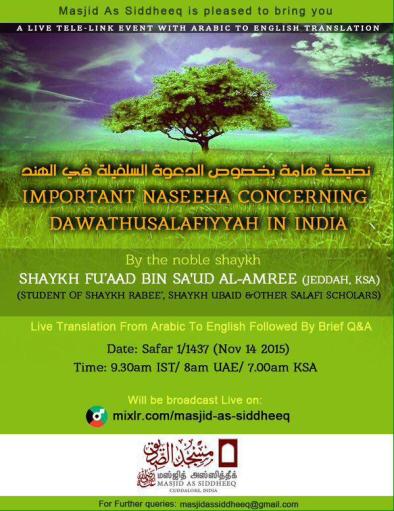
Important Naseehah concerning Dawatus-Salafiyyah in India – Shaykh Fu’ad ibn Saud al-Amree [Audio|Ar-En]

Important Naseehah concerning Dawatus-Salafiyyah in India - Shaykh Fu'ad ibn Saud al-Amree

Masjid As Siddheeq, Cuddalore Tamil Nadu, South India presents you
Important Naseehah Concerning Dawatus Salafiyyah in India
With The Noble Shaykh Fu’ād bin Sa’ud al-Amree {حفظه الله} – from the Well Known Scholars of Jeddah and Student of Shk. Rabee’, Shk. Ubayd and other Salafī Scholars

Listen / Download Mp3 Here (Time 1:49:48)
[audio https://salafiaudio.files.wordpress.com/2015/11/important-naseehah-concerning-dawatus-salafiyyah-in-india-02-01-1437-shaykh-fuad-ibn-saud-al-amree.mp3]

Delivered on  02-01-1437

Translated into English by Nadeem Ahsan Shah hafidhahullaah

Audio Courtesy: KSA_Dawah – Apply for group membership

[Alternative Download Link]

Pessimism about Safar is a characteristic of Jahiliyyah – Fatwas of Ibn Baz

Q: It is known that many people are pessimistic about the month of Safar regarding many affairs. Such people, for example, do not conclude marriage contracts during Safar. Moreover, many people believe that it is not permissible to break a stick, knot ropes, or entwine fingers when concluding a marriage contract for this leads to failure of the concerned marriage and disharmony between the spouses. Since all the foregoing are beliefs bearing on ‘Aqidah (creed), could you please advise and clarify the ruling on it? May Allah guide us all to all that He loves and is pleased with.

A: Pessimism about Safar is not permissible. It is a characteristic of Jahiliyyah (pre-Islamic time of ignorance).

Safar – just like all other months – does not bring good or evil, as good is only from Allah (Glorified be He) and evil is predestined by Him. Moreover, it is authentically reported that the Prophet (peace be upon him) annulled the concept of pessimism when he said:

There is no ‘Adwa (contagion, disease transmission naturally by itself not by the Decree of Allah), nor is there any Tiyarah (evil omen), nor is there any Hamah (pre-Islamic superstitious belief that the bones of a dead person turn into an owl), nor is there Safar (the month of Safar was believed to bring bad luck during Jahiliyyah).

(Agreed upon by Imams Al-Bukhari and Muslim)

The same applies to pessimism about entwining fingers, breaking a stick, etc., when concluding a marriage contract. Such beliefs are false, baseless, and thus they should not be adopted by a Muslim. May Allah grant us all success!

Source: Fatwas of Ibn Baz

http://alifta.net/Fatawa/FatawaChapters.aspx?languagename=en&View=Page&PageID=182&PageNo=1&BookID=10

The Muslim Woman is a Queen within Her Home – Shaykh Muhammad ibn Haadee

http://mtws.posthaven.com/the-muslim-…
Translated by Raha ibn Donald Batts حفظه الله

Video Courtesy: Bilal Nahim

The Way to Strive Against the Soul – Shaykh ‘Abdullah Al-Bukhaaree


Video Courtesy : Brother Bilal Nahim

Question:

(What is) the way to strive against the soul [Inside] that is ever commanding [One] to do Evil?

Shaykh ‘Abdullah Al-Bukhaaree:

Strive against It.

And those who strive for Our sake [from the Messenger sallallaahu alaihi wa sallam, his companions, and those who followed their way], We will most certainly show them our paths. [Al-‘Ankabut 69]

Every person is such that it is a must that he strive against himself. It is well known that the Nafs al-Ammarah bi-l-Su’ [the soul inside that is ever commanding one to do evil] takes him here and there. So it is upon him to remember that Allah, Majestic and All-High, sees him and has full knowledge of him. He knows the eyes that betray trusts and that which the chests keep hidden. And that He, Majestic and All-High [is such that] nothing at all escapes Him. So it is upon him to keep bringing to his mind at all times that Allah sees him and has full knowledge of him; that he fear Him; that he repent to Allah; that he push his soul to do good, always and ever; and that he strive his utmost against it to do acts of obedience [to Allah] and make it remain upon acts of obedience.

When he hears the call [to prayer], he gets up and aims to beat others to the mosque; and he prays, if it’s the time for performing one of known routine [Sunnah prayers] or the like of that; he prays [general] voluntary [prayers]; he recites Qur’an; he is ready in the first line [of the congregation], and in this manner, he strives against his soul. And he recites the Qur’an, memorizes from it what he is able to, and shows eagerness to gain [Islamic] knowledge- he strives his utmost against his soul. If he were to tame it just a little, the soul would get tamed: It’s over, it would give in to him. But it needs to be checked on always, on an ongoing basis. Always, and on an ongoing basis.

And let him not feel secure from Allah’s long plan [that sinners enjoy for a time but finally get the punishment they deserve]. And let him not feel secure from Allah’s long plan.

We ask Allah Al-Aiim [the Exalted], Lord of the Great Throne, that He make us and you from those who listen to a speech and follow the best of it.

Translated by Mikail ibn Mahboob Ariff حفظه الله

Related Link:

Useful Ways Of Leading A Happy Life : Forgetting The Unpleasant Things That Have Passed – Imam as Sa’di

Chapter Four: Forgetting The Unpleasant Things That Have Passed

8.Among the necessary causes of happiness and cessation of grief and worry,is striving to remove the things that bring about grief,and acquire those that bring about happiness.This is achieved by forgetting the unpleasant things that have passed and he has no power to bring them back,and knowing that occupying his mind wit them is meaningless;in fact it is stupidity,bordering and lunacy.Therefore he has to struggle with his mind not to think of them.He should also struggle with his mind not to worry over the future,not to pay attention to illusions of poverty,fear or other unpleasant things he is imagining will descend on him in the future.He should know that nobody knows what will happen in the future,whether good or evil,or pleasure or pain;this is in the Hands of Allah alone.The slave has no control over it.His only due is to struggle to accomplish what will benefit him in the future,and ward off harm from him.He should also know that when the slave turns his mind away from worrying over the future in his affairs,and relies on his Lord for its betterment,and is satisfied that his Lord will do that for him,when he does all that,his heart will be tranquil,and his condition will be good,and his worries and anxieties will vanish.

9.Among the most beneficial things to do concerning the future of one’s affair is to be saying the prayer that the Prophet,sallAllahu alaihi wa sallam,used to say:

“O Allah!Make my religion,which is my strength and invincibility,good for me;and make my world,wherein is my livelihood,good for me;and make my hereafter,which is my final abode,good for me.And make my living an increase for me in all that is good,and make my death a repose for me from every ill.[Muslim reported it]

[Note: Learn this Dua @ http://authentic-dua.com/2015/10/09/o-allaah-safeguard-my-deen-dunya-and-aakhira/]

And also his saying:

“O Allah! It is Your mercy that I have hope in,so do not leave me to myself even for the blink of an eye,and make good my affairs,all of them;there is no god worthy of being worshipped but You.”

[Abu Dawud reported it,with a sound chain of transmission]

If the slaves says this du’a,which entails seeking the betterment of his future both in terms of his religion and his worldly affairs,if he says that with a mindful and aware heart,and a true and sincere intention,coupled with an earnest struggle to achieve it,Allah will definitely materialize for him what he asked for and had hope in and struggled to achieve.As a result of this,his worry will change to happiness and delight.

Source:

Useful Ways Of Leading A Happy Life – by:Shaykh Abdur-Rahman bin Nasir As-Sa’di
Printed by:The Ministry of Islamic Affairs,Endowments,Da`wah and Guidance ; Supervised by:The Ministry’s Deputyship for Printing and Publishing Affairs.

Read or Download the Book [English Book] [PDF]

Related Links:


Prohibition of Swaying during the Salat or while reciting the Qur’an or while making dhikr – alifta

Bismillaah

Q: What is the ruling on some people who sway from right to left and backwards and forwards while reciting the Qur’an? Please advise, may Allah reward you.

A: Swaying while reciting the Qur’an is one of the habits that should be abandoned. It contradicts the etiquettes required when reciting the Qur’an. When reciting or listening to the Qur’an, a person should listen carefully and not play with things so that the listener and the reciter ponder over the meanings of the Qur’an and their hearts be submissive to Allah (Glorified and Exalted be He).

Scholars mentioned that this is one of the habits of the Jews when reciting their Book, and we are forbidden to imitate them.

May Allah grant us success. May peace and blessings be upon our Prophet Muhammad, his family, and Companions.

The Permanent Committee for Scholarly Research and Ifta’

Member – Member – Member – Deputy Chairman – Chairman
Bakr Abu Zayd Salih Al-Fawzan `Abdullah ibn Ghudayyan `Abdul-`Aziz Al Al-Shaykh `Abdul-`Aziz ibn `Abdullah ibn Baz

http://www.alifta.com/Fatawa/FatawaChapters.aspx?View=Page&BookID=7&PageID=11266&back=true&languagename=en

Related Links:

Statements Which are Better than Amassing Gold & Silver

Translated by Abbas Abu Yahya

1 – The Hadeeth

Shaddad bin Aws Radhi Allaahu anhu said that the Messenger of Allaah -sallAllaahu alayhi wa sallam-said to me:

‘O Shaddad bin Aws! If you see the people amassing gold and silver then say these statements a lot:

اللَّهُمَّ إِنِّي أَسْأَلُكَ الثَّبَاتَ فِي الْأَمْرِ، وَالْعَزِيمَةَ عَلَى الرُّشْدِ، وَأَسْأَلُكَ مُوجِبَاتِ رَحْمَتِكَ، وَعَزَائِمَ مَغْفِرَتِكَ، وَأَسْأَلُكَ شُكْرَ نِعْمَتِكَ، وَحُسْنَ عِبَادَتِكَ، وَأَسْأَلُكَ قَلْبَاً سَلِيمَاً، وَلِسَانَاً صَادِقَاً، وَأَسْأَلُكَ مِنْ خَيْرِ مَا تَعْلَمُ، وَأَعُوذُ بِكَ مِنْ شَرِّ مَا تَعْلَمُ، وَأَسْتَغْفِرُكَ لِمَا تَعْلَمُ، إِنَّكَ أنْتَ عَلاَّمُ الْغُيُوبِ

‘O Allaah verily I ask of You for strength of perseverance of obedience on the Deen[1], and determination in practicing of the Deen and goodness.  And I ask of You for that which obligates Your mercy and resolutions for Your forgiveness.

And I ask of You for the capability to be thankful for Your blessings and to worship you in a correct and good way.

And I ask of You for a heart which is purified in belief[2] and free from desires and a truthful tongue.

And ask of You for the best of what You know, and I seek refuge with You from the evil of what You know and I seek forgiveness for that which You know.

Indeed You are the One who knows the unseen.’

2 – Transliteration

‘Allaahumma innee as-alooka ath-Thabat fil Amr Wal azzeemata ala Rushd, wa as-alooka Moojeebat Rahmatik, wa Azzaim Maghfiratik, wa as-alooka Shukr Na’maatik,  Wa husn ibadaatika, wa as-alooka Qalbun Saleeeman wa Lisaanan Saddiqun, as-Alooka min khairi ma Ta’lamu wa Audhubika min Sharee ma Ta’lamu, wa astaghfiruka lima Ta’lum, Innaka Anta Alam al- Ghayoob.’

3 – Tahkreej:

Collected by Tabraani in ‘Mu’ajam al-Kabeer’ (7/335-336), Abu Na’eem in ‘al-Hileeyah’ (1/266), Ibn Aasakir in ‘Tareekh Damishk’. Albaani said this Isnaad is Jayyid, in ‘Silsilah Saheehah’ No. 3228.

Ahmad & an-Nisaee, from ‘Silsilah Saheehah’ No. 3228. Shaykh Albaani originally declared it to be weak in ‘Tammam al-Mina’ p.225, ‘Kalima Tayyib’ 105 and ‘Da’eef al-Jamia’ 1190 then he declared it to be Saheeh lighayrihi in ‘Silsilah Saheehah’ No. 3228 and ‘Taleeqat al-Hasaan’ 931,’al-Mishkat’ 955.

Shawkani mentioned it in ‘Nail Awtaar’ 92/332 and said the narrators of its chain are trustworthy.

4 – Different Wordings:

1 – In another narration the Prophet -sallAllaahu alayhi wa sallam- used to teach us to say:

اللَّهُمَّ إِنِّي أَسْأَلُكَ الثَّبَاتَ فِي الْأَمْرِ ، وَأَسْأَلُكَ عَزِيمَةَ الرُّشْدِ ، وَأَسْأَلُكَ شُكْرَ نِعْمَتِكَ ، وَحُسْنَ عِبَادَتِكَ ، وَأَسْأَلُكَ لِسَانًا صَادِقًا ، وَقَلْبًا سَلِيمًا ، وَأَعُوذُ بِكَ مِنْ شَرِّ مَا تَعْلَمُ ، وَأَسْأَلُكَ مِنْ خَيْرِ مَا تَعْلَمُ ، وَأَسْتَغْفِرُكَ مِمَّا تَعْلَمُ إِنَّكَ أَنْتَ عَلَّامُ الْغُيُوبِ

2 – As for the wording: ‘If the people gather gold and silver, then gather this Dua’. . . . . ‘ then this is from the wording of the Hadeeth collected by Imam Ahmad whereby Shaddad Radhi Allaahu anhusaid:

سمعت رسول الله صلى الله عليه وسلم يقول إذا كنز الناس الذهب والفضة فاكنزوا هؤلاء الكلمات

‘I heard the Messenger of Allaah -sallAllaahu alayhi wa sallam- say:

‘If the people gather gold and silver, then gather these words. . . . .’

[ Collected by Tabraani in ‘Mu’ajam al-Kabeer’, Abu Na’eem in ‘al-Hileeyah’ Ibn Aasakir in ‘Tareekh Damishk’. Albaani said it is Saheeh lighayrihi in ‘Silsilah Saheehah’ and  ‘Taleeqat al-Hasaan’ No. 93. ]

3 – It has also been collected with similar wordings, as for it being from the Dua’ said in the prayer then this has been collected by Nisa’ee in his ‘Sunnan’ with the wording:

(أن رسول الله صلى الله عليه وسلم كان يقول في صلاته…)

‘The Messenger of Allaah -sallAllaahu alayhi wa sallam-  used to say in his prayer. .  .’

Also narrated ibn Hibban in ‘Saheeh ibn Hibban’ Also narrated by Ahmad with extra wording:

وكان رسول الله صلى الله عليه وسلم يعلمنا كلمات ندعو بهن في صلاتنا أو قال في دبرصلاتنا.

‘The Messenger of Allaah -sallAllaahu alayhi wa sallam- used to teach us statements with which we make Dua’ in our prayer or he said at the end of the prayer.’

5 – Explanation:

Explanation by Shaykh Muhammad bin AbdurRahmaan al-Mubarakfoori (d. 1353 A.H.)  in the explanation of Tirmidhi, ‘Tufhat ul-Ahwaadhi’:

‘and determination in conduct’ – which is seriousness and determination in being correct whereby a person implements all that which is correct from his matters.

‘Conduct and being correct’: is righteousness,  success and correctness.’

In the narration of Ahmad: ‘I ask of You for strength of perseverance on the Deen and determination in conduct.’ Meaning:  having a resolve with the heart upon accomplishment of the matter.

‘And I ask of You to be able to be thankful for Your blessings’: meaning to have the ability to be thankful for Your blessings.

‘And to worship you in a correct and good way.’ meaning: for the worship to take place in a good accepted way.

‘And I ask You for a truthful tongue’ meaning: protected from lying.
‘and for a heart which is correct in Aqeedah’ meaning: secure from corrupt beliefs and secure from desires.

‘and I seek refuge with You From the evil of what You know’ meaning: that which You know and I do not know of.

‘and I seek forgiveness for that which You know’ of me, of my negligence.

‘Indeed You are the One who knows the unseen’ meaning : the hidden things which do not occur from the outset except with the knowledge of The Gentle One and the well informed.’

[From ‘Tuhfatul Ahwaathi’ ]

6 – Benefits

  • Ibn Qayyim aj-Jawzeeyah -Rahimullaah- said:

‘As for the slave of Allaah being complete then that is with adhering to the truth and being upright upon it and having a firm resolve. Therefore, whoever does not have a firm resolve then he is deficient.

Whoever has a firm resolve but does not adhere to the truth and is not upright upon it then he is deficient.

So if adhering to the truth and being upright upon it is coupled with having a firm resolve then the fruits of every noble status and perfect condition occur.

This is why in the Prophet’s Dua’ which has been narrated by Imam Ahmad and Ibn Hibban in his book ‘Saheeh’ there occurs : ‘O Allaah verily I ask of You for strength of perseverance of obedience on the Deen, and determination in practicing of the Deen and goodness. ‘ and it is known that the tree of strength of perseverance does not stand except upon the tree trunk of patience.’

[Tareeq al-Hijratayn p.400-401]

  • Shaykh Ibn Baz advised with memorizing this Dua’ and he said:

‘If you see the people amassing gold and silver then amass this Dua’.’

سُبْحَانَكَ اللَّهُمَّ وبَحَمْدكَ أشْهدُ أنْ لا إلهَ إلا أنْتَ أَسْتَغْفِرُكَ وأتُوبُ إِلَيْكَ

All Praise belongs to Allaah, may His peace and blessings be upon our final Prophet Muhammad, his family, his companions and all those who follow his guidance.

Footnotes:

[1] Similar to this is what is mentioned in the Hadeeth of Umm Salamah Radhi Allaahu anha who said: ‘The Messenger of Allaah -sallAllaahu alayhi wa sallam- used to say this Dua’ a lot : ‘O Turner of hearts, turn my heart to be upon Your obedience.’ She said: I mentioned to the Messenger of Allaah: ‘You  make a lot of supplication with this Dua, do not the hearts go back and fro?’

The Messenger said: ‘Yes, there is no heart except that it is between the two Fingers from the Fingers of Ar-Rahmaan (The Most Merciful) He turns them whichever way He wants, if He wants He makes it steadfast and if He wants He causes it to deviate.’

[Collected by Tirmidhi & authenticated by Albaani]

[2] Allaah Ta’ala said: << The Day whereon neither wealth nor sons will avail, except him who brings to Allaah a clean heart [clean from Shirk (polytheism) and Nifâq (hypocrisy)].>> [Shu’ara: 88-89]

From an-Num’an bin Basheer, who said : I heard the Messenger of Allaah -sallAllaahu alayhi wa sallam-say :

‘. . . . .Truly in the body there is a morsel of flesh which, if it be whole, all the body is whole and which, if it be diseased, all of it is diseased. Truly it is the heart.’ [ Bukhari and Muslim]

Posted from: https://followingthesunnah.wordpress.com

Travelling to disbelieving countries for football matches – Shaykh Saalih Al-Fawzaan

Translated by Owais Al-Hashimi حفظه الله
Video Courtesy: Brother Bilal Nahim

Question:

My son travels abroad to attend football (soccer) matches in the lands of the unbelievers; what is your advice for me and for him regarding this matter?

Shaykh Salih Fawzan:

[My advice] is that he is to have Taqwa of Allah and not to follow this game that has no benefit, rather it is harmful, and that he not travel for its sake to the lands of the unbelievers.

Firstly [football] is useless. and secondly, travelling to the lands of the unbelievers is not permitted except for a necessity, for medical treatment, to learn something special only they have and which we need, or for trade, this is alright.

50 Pieces of Advice For The Muslim Women – Abu Muhammad al Maghribee [Audio|En]

Part 01: Introduction Lecture :

Listen / Download Mp3 Here (Time 28:33)

Posted from: http://followthesalaf.com – [Alternative Download Link]

Further Parts will be added as they are available .. in shaa’ Allaah

The Story of Moosa (عليه السلام) and Yawm al-Aashooraa – Shaykh Saalih Fawzaan | Abu Muhammad al Maghribee [Audio|En]

Delivered on  2012-11-21

Based on the Khutbah given by Shaykh Saalih Fawzaan hafidhahullaah (Al Khutab al Minbariyya)

Listen / Download Mp3 Here (Time 48:05)


Posted from : http://followthesalaf.com

Virtues of the Month of Muharram and Fasting on Aashoora – Abu Muhammad Al Maghribee [Audio|En]

This khutbah was given at Masjid Tawheed in Stone Mountain, GA  on 2013-11-08

Listen / Download Mp3 Here (Time 32:38)


Posted from : http://followthesalaf.com/

Getting Married with the Intention of Divorce – Shaykh Ibn Uthaymeen

by Shaykh Allaama Muhammad bin Salih al-Uthaymeen (d.1421 A.H.)
Translated by Abbas Abu Yahya

Getting married with the intention of divorce is Haraam because it is cheating the wife and her family

The Esteemed Shaykh Muhammad bin Salih al-Uthaymeen may Allaah have mercy upon him was asked:

A person wanted to travel outside this country because he had been delegated to do so, and he wanted to protect himself by getting married from that country for a specific time, then after that he will divorce this wife, he would have married her without informing her that he will divorce her, so what is the verdict regarding his action?

So the Shaykh answered:

‘This marriage with the intention of divorce is of two situations: either he makes it a condition in the contract, that he marries her for a month or a year, or until he completes his studies, then this is a marriage of Muta’ (temporary marriage) and this is Haraam.

Or either, he intends that without making it a condition, so what is well-known from the Madhab of the Hanabila, that this is Haraam, and that the marriage contract is invalid because they say that the one who makes this intention is similar to the one who makes a condition (i.e. specific period of time), due to the saying of the Prophet -sallAllaahu alayhi wa sallam-:

‘Indeed actions are but by intentions and indeed every person will have what they intended.’

If a man marries a woman from someone who has pronounced a divorce from her three times, and he marries her to make her Halaal for her previous husband so he can re-marry her, and then he divorces for this reason then this type of  Nikah (Marriage contract) is invalid, even if this Nikah was without the condition of divorcing her, since the one who makes the intention of doing this is like the one who makes it a condition.

Therefore, if getting married with the intention of making the wife permissible for her previous husband invalidates the marriage contract then the intention of Muta’ also invalidates the marriage contract,  this is the opinion of the Hanabila.

The second opinion of the people of knowledge regarding this issue is: that it is correct for a man to marry a woman and he has the intention to divorce her, if he leaves that  country, like those foreigners who go abroad for education, etc.

Their reasoning is that the man has not made a condition (of a specific period of time), and the difference between this and Muta’ is, that in Muta’ if the time period finishes then a separation takes place between the husband and wife, whether the husband likes it or not, this is contradictory to the other way, since it is possible for him to want and have interest in the wife and she continues to remain with him, and this is one of the two sayings of Shaykh ul-Islaam Ibn Taymeeyah.

What I say is, that this is correct, it is not Muta’ since the definition of Muta’ (temporary marriage) cannot be applied to this, but marriage with the intention of divorce is Haraam from the angle that it is cheating the wife and her family.   Indeed the Prophet has made cheating and deception  Haraam, and if the wife came to know that this man did not want to marry her except for this period of time, she would not have married him, and her family would also not marry her to him since the man would not allow his daughter to marry a person who has the intention of divorcing her when he has finished with his need from her, so how can this man allow for himself to deal with others with that which he does not allow for them to deal with him.

This contradicts Eemaan, due to the saying of the Prophet -sallAllaahu alayhi wa sallam:

‘None of you truly believe until you love for your brother what you love for yourself.’

Since I have heard that some people have taken this verdict as a means which leads to a matter that no-one holds permissible which is that some people travel to countries only to get married (temporarily). They go to these countries so they can get married and then they stay with this wife, whom they marry with the intention of a temporary period, then they return however long Allaah wills.

This is also seriously forbidden in this issue, so it is better to close this door, due to what is there from cheating, deception and dishonesty and because this opens the door and the people are ignorant, and most people are not prevented due to following their desires, transgressing against what Allaah has made Haraam.’

[‘Fatawa for the Muslim Women’ V.2 p.757 &  Fatawa ash-Shaykh Muhammad Salih al-Uthaymeen V.2 p.789]

Posted from Abbas Abu Yahya hafidhahullaah’s blog
https://followingthesunnah.wordpress.com

The Ruling on Drinking Water in One Go – Shaykh Saalih Al-Fawzaan

Translated by Abu ‘Abdullah Naasir Hussain حفظه الله
Video Courtesy: Bilal Nahim

This questioner says: O virtuous Shaykh, l have heard that the Prophet, may the praise of Allah and peace be upon him, commanded that water should be drunk in one go. Is this correct?

Shaykh Fawzan:

This is not correct. Rather the Prophet, may the praise of I Allah and peace be upon him, prohibited drinking water in one go. This is because it is in imitation to camels. The Prophet, may the praise of Allah and peace be upon him, instructed us to drink with three breaths. To drink with three breaths. Yes.

Throwing dirt in the face of the one who praises you – Explained by Shaykh Sulaymaan Ar-Ruhaylee

http://mtws.posthaven.com/throwing-di…
Translated by Rasheed ibn Estes Barbee حفظه الله

Video Courtesy: Bilal Nahim

The Supplication of a Person Performing Hajj – From Hadith

Imaam Ibn Maajah -rahimahullaah- reported in his “Sunan” [The Book of the Rites of Hajj: chapter (5): The Virtue of the Supplication of the person performing Hajj: (no.2893)]:

“Muhammad ibn Tareef narrated to us, saying: `Imraan ibn `Uyainah narrated to us: from `Ataa· ibn as-Saa·ib: from Mujaahid: from Ibn `Umar: from the Prophet sallallaahu alayhi wa sallam, that he said:

<<The fighter in Allaah’s cause, and the person performing Hajj, and the person performing `Umrah are Allaah’s deputation: He called them, and they responded to Him; and they ask of Him, and He gives to them>>.”

Shaikh al-Albaanee -rahimahullaah- said: “Hasan”; and he said in “as-Saheehah” (no.1820), having quoted a supporting narration reported by al-Bazzaar (no.1153) as a hadeeth of Jaabir: “The hadeeth, when the two chains of narration are gathered is “Hasan”.”

And Imaam Ibn Maajah -rahimahullaah- reported (no.2895): “Aboo Bakr ibn Abee Shaybah narrated to us, saying: Yazeed ibn Haaroon narrated to us: from `Abdul-Malik ibn Abee Sulaymaan: from Abuz-Zubayr: from Safwaan ibn `Abdillaah ibn Safwaan, who said:

“I was married to a daughter of Abud-Dardaa·, so he came to her and he found Ummud-Dardaa·, but he did not find Abud-Dardaa·. So she said to him: “Do you intend to perform Hajj this year?” He said: “Yes.” She said: “Then supplicate to Allaah for good for us, since the Prophet sallallaahu alayhi wa sallam used to say:

<<The supplication which a person makes for his brother in his absence is responded to. There will be an Angel by his head saying: ‘Aameen’ [O Allaah! Grant it], to his supplication, ‘and may you receive the like of it’. >>

He said: Then I went out to the market place, and I met Abud-Dardaa·, and he narrated the like of that to me from the Prophet sallallaahu alayhi wa sallam.”

Shaikh al-Albaanee -rahimahullaah- said: “Saheeh.”

[Compiled by Aboo Talhah Daawood ibn Ronald Burbank rahimahullaah]

Posted from: www.alitisaambissunnah.wordpress.com

Wearing Hair in a Bun at the Back of the Head Under the Hijaab – Shaykh al-Albani & Ibn Uthaymeen

Compiled & Translated by Abbas Abu Yahya

The Hadeeth

From Abu Hurairah who said the Messenger of Allaah -SallAllaahu alayhi wa Sallam- said:

صنفان من أهل النار لم أرهما قوم معهم سياط كأذناب البقر يضربون بها الناس ونساء كاسيات عاريات مميلات مائلات رءوسهن كأسنمة البخت المائلة لا يدخلن الجنة ولا يجدن ريحها وإن ريحها ليوجد من مسيرة كذا وكذا

‘There are two types of the people of the Hell-Fire who I have not seen, a people who have whips like cows’ tails with which they are hitting the people, and women who will be naked in spite of being dressed, who are seduced (to wrong paths) and seduce others, their heads will be high like a camel with humps they will not enter Paradise, nor will they find its fragrance, even though its fragrance can be found from travelling such and such distance.’

[Collected by Imam Ahmad in ‘al-Musnad’ & Muslim in ‘as-Saheeh’]

Shaykh, Allaama, Muhadith Muhammad Nasir Deen al-Albaani – May Allaah have mercy upon him.

The Questioner:

‘What is the ruling of a woman gathering her hair above her neck at the back of the head whereby it is shaped like a ball, taking into consideration that when a woman covers herself with Hijaab the shape of her hair would be apparent from her Hijaab?’

Shaykh Albaani said:

‘This is a mistake many women who wear Hijaab fall into, whereby they gather their hair at the back of the head and it bulges out from the back of their head, even though they have covered it with covering Hijaab over it.

Indeed this opposes a condition from the conditions of Hijaab, which I had gathered in my book ‘Hijaab Al-Marata Al-Muslimah min Al-Kitab wa Sunnah‘. From these conditions is that the clothing should not show the shape of the limb or anything from the woman’s body,  this is why it is not permissible for a woman to put her hair in a circular shape at the back of her head or at the side of her head whereby it bulges out, so that it appears to the one who sees her, even unintentionally that she has shaggy hair or that she has little hair.

It is obligatory that it is left hanging and not piled up/crumpled up.’

[From the cassette collection ‘Silsilah al-Huda wa Noor’ No.386, seehttp://albanyimam.com/play.php?catsmktba=13094]

The Ruling of  a Woman Winding up her Hair at the Top of her head

Shaykh Allaama Muhammad bin Salih al-Uthaymeen – May Allaah have mercy upon him.

Question:

‘Some women gather their hair in the shape of a bun at the back of the head,  does this enter into the warning mentioned in the Hadeeth: ‘Women whose  heads will be like the inclined hump of a camel they will not enter Paradise’.

Shaykh al-Uthaymeen said:

‘If a woman gathers her hair for when she is busy working away, then afterwards she lets it down,  then there is no harm in this, since she does not do this as an adornment or beautification but rather out of necessity.

As for gathering her hair and raising it up for the purpose of beautification, and it is facing upwards then it enters under the prohibition, due to the saying of the Prophet -sallAllahu alayhi wa sallam:

‘Their heads will be like the hump of a camel.’

A camel hump is at the top, and if the hair is above the neck then it does not enter under the Hadeeth. However, it is warned against doing so if a woman wants to go out to the market, since if she goes out to the market and gathers her hair on her head then it will appear from within her Abaya (outer garment), and it will cause attention, so she is prohibited from having this hair-style if she goes out to the market places.

[From ‘Liqa al-Baab al-Maftooh’ Tape 161, see: http://www.mktaba.org/vb/showthread.php?t=13165]

Abbas Abu Yahya hafidhahullaah Blog – https://followingthesunnah.wordpress.com

Don’t sully your scrolls after Hajj! – Advice from Shaykh Ibn ‘Uthaymeen [Video|Ar-En Subtitles]

Don’t sully your scrolls after Hajj! – Advice from Shaykh Ibn ‘Uthaymeen رحمه الله
http://mtws.posthaven.com/dont-sully-…
Translated by Rasheed ibn Estes Barbee حفظه الله

Video Courtesy: Brother Bilal Nahim

Shaykh Uthaymeen: 
“Returning to sins after performing the obligatory Hajj is a major 
setback”