Delivered on 2015-08-15
Listen / Download Mp3 Here (Time 30:58)
[audio https://salafiaudio.files.wordpress.com/2015/08/ten-pieces-of-advice-to-muslim-teenagers-2015-08-15-abu-muhammad-al-maghribee.mp3]
Posted from : http://followthesalaf.com
Islamic Knowledge – Islam, Sunnah, Salafiyyah

Delivered on 2015-08-15
Listen / Download Mp3 Here (Time 30:58)
[audio https://salafiaudio.files.wordpress.com/2015/08/ten-pieces-of-advice-to-muslim-teenagers-2015-08-15-abu-muhammad-al-maghribee.mp3]
Posted from : http://followthesalaf.com
O brothers, use beneficial knowledge and solid proof and beneficial wisdom in your Dawa’. You should have all the noble and beautiful manners encouraged by the Book and the Messenger of guidance; indeed they are causes for victory and causes for success.
You have to believe that the Companions did not spread Islaam or enter it into the hearts except with their wisdom and their knowledge more so than with their swords. However, whoever enters into Islaam under the sword might not be firm, but whoever enters Islaam by way of knowledge, proof and evidence then this is what makes his Eemaan firm by Allaah’s permission and His assistance.
And it is upon you to have these good methods and also to be serious about knowledge. You have to be serious about Dawa’ to Allaah.
Now – O brothers – I advise you with two issues:
Firstly: Brotherhood between all of Ahl -ul-Sunnah; So O you Salafees, disseminate the soul of love and brotherhood between yourselves. Put into effect what the Messenger of Allaah – sallAllaahu alayhi wa sallam – informed us of regarding the believers: ‘Like a building, some of its parts supporting others.’[2]
And that they are: ‘Like a single body if one limb complains then the rest of the body suffers with fever and insomnia.’[3]
This is how you should be O brothers: distance yourselves from the causes of splitting, I swear by Allaah indeed it is a dangerous evil and a disastrous disease.
Secondly: distance yourselves from the causes which lead to enmity, hatred, splitting up and dissension.
Keep away from these things; because this has become predominant nowadays at the hands of people, about whom only Allaah knows their condition and intent. It has become predominant and has torn apart the youth in this country – whether in the university or other than it – or in the other parts of the Duniya.
Why?! Because those who are not from its people – neither in knowledge nor in understanding – entered into the arena of giving Dawa’ to Allaah.
It is possible that the enemies could have entered someone into the midst of theSalafeeyeen to tear them apart and split them up, and this issue is not unlikely, rather it can truly happen -BarakAllaahu Feekum.
Strive to have brotherhood. If any dissension has occurred between you, then both parties should make themselves forget what is past and start with a clean slate now.
I say to the brothers: whoever falls short it is not allowed to debase him, nor destroy the one who is deficient. Whoever makes a mistake amongst us we do not destroy him. -BarakAllaahu Feekum – but we cure him with gentleness, wisdom and face him with love and friendship and all the rest of the righteous manners, along with the correct Dawa’ until he repents. And if there remains a weakness in him then we are not hasty with him, or otherwise, I swear by Allaah no one will remain, no one will remain!
There are some people now who chase after the Salafis so much so that they reached the scholars and called them those who water things down (Mumaya’een)!! There is hardly any scholar in the arena of Dawa’ today except that he has been falsely attacked with this claim about him! Of course this is the way of the Ikhwaan al-Muslimeen and the way of Ahl-ul-Bida’ since, from the weapons of the Ahl ul-Bida’ is that they begin by overthrowing the scholars, rather it is the Jewish Masonic way: that if you wanted to discredit an idea, then discredit their scholars or their personalities.
So keep away from this rotten legacy and have respect for the scholars.
[1] Narrated by Bukhari (4855) & Muslim (177)
[2] Narrated by Bukhari (481) & by Muslim (2585) from the hadeeth of Abu Musa –radhiAllaahu anhu.
[3] Narrated by Bukhari (6011) & Muslim (2586) from the hadeeth of an-Nu’maan bin Basheer –radhiAllaahu anhu.
Excerpted from: Encouragement to have Affection and Friendliness and Warning Against Splitting up and Differing – Shaykh Rabee bin Haadee al-Madkhalee, Translated by Abbas Abu Yahya
There is a very regrettable thing with regard to this matter which is the carelessness of some women concerning travelling by airplane without a Mahram.
They are very negligent in this matter: One finds women travelling by airplane alone, and their justification for doing this is that they say that her Mahram escorted her in the airport from which the airplane took off and the other Mahram will meet her in the airport at which the airplane lands, and that in the airplane she is safe.
This justification is weak in reality, because the Mahram who accompanies her does not admit her onto the airplane, he only admits her to the departure lounge.
It may also be that the airplane is delayed in taking off and so this woman remains lost, or the airplane might take off and then be unable to land at the intended airport due to some reason or another, and so it lands at some other place, else and so this woman will be lost. Or, the airplane might land at the intended airport, but the Mahram who is supposed to meet her does not arrive due to one reason or another, such as illness, sleep or a car accident which prevents him from getting there, or something else.
Even if all of these things did not happen, and the airplane landed at the correct time of arrival and the Mahram who was supposed to meet her was present, there might be some man sitting next to her on the airplane who does not fear Allah, the Most High and does not respect the worshippers of Allah, and he might be attracted to her and she to him, which might lead to Fitnah (temptation, trial) and unlawful deeds, as is well known.
So, it is incumbent upon a woman to fear Allah, the Almighty, the All-Powerful and not to travel except with a Mahram. It is also incumbent upon women’s male guardians whom Allah has made protectors and maintainers of women to fear Allah, the Almighty, the Ail-Powerful, and to avoid being negligent to those they are Mahrim for, and losing their zeal and their religion, for a person is responsible for his family. Because Allah, the Most High has made them a trust for him; He, the Most High says:
“O you believe! Ward off yourselves and your families against a Fire (Hell) whose fuel is men and stones, over which are (appointed) angels stern (and) severe, who disobey not, (from executing) the Commands they receive from Allah, but do that which they are commanded.”
Source :
Fatawa Arkanul-Islam – Fatawa on Hajj (Pilgrimage) Q.No 458
Islamic Verdicts on t he Pillars of Islam (Volume Two) – Prayer, Zakah, Fasting, Hajj
By the Honorable haikh Muhammad bin Salih Al- ‘Uthaimeen
Collected and Arranged by : Fahd bin Nasir bin Ibrahim As-Sulaiman , Dar-us-salam Publications
The Ruling on Speaking while the Quraan is being Recited from a tape/CD/recorder
Question:
What is the legislative ruling for talking during the recitation of the Qur’an in general gatherings, like if the Qur’an is recited from a tape and a group of people are talking, what is the ruling on this action?
Shaykh Muhammad ibn Saalih Al-‘Uthaymeen:
Allah the Most High states, {So when the Qur’an is recited, then listen to it and give it due attention so that you may receive mercy}. [Soorah Al-‘Araaf: 204]
Thus, if we have a recorder playing the sound of a reciter (while we are talking); either we turn off the recorder or we listen to him. However. remaining in our chatter and talking as if we only hear the sounds of humans, then this is contrary to having manners with the Quran.
So here I say, that either we turn off the recorder or listen to it. Even if one of them was listening and the others continued to chat, then that one individual lowers the sound so that no one hears it except him.
Translated by Abu Afnaan Muhammad ‘Abdullah حفظه الله
Video Courtesy: Bilal Nahim
Question :
This questioner asks, ‘How does a person rejuvenate his heart after repeatedly sinning?
Shaykh Muhammad bin Haadee Al-Madkhali:
He rejuvenates it firstly by distancing himself from sinning. This is the first thing.
Secondly, distancing himself from the reasons for sinning like bad company or similar things, looking at prohibited things or similar actions, listening to prohibited things or travelling to do prohibited things, (he leaves) every reason which leads to this (sinning).
So he distances himself from sinning by making Towbah (repentance) and he distances himself from sins.
Also, he is to sit with righteous people, those whom we previously spoke about. From these people are those whose companionship is like air, if it is cut off, you die, you breathe with them, and thus it is upon you to sit with the righteous. Be companions with them and stick with them as you acquire an immense amount of good by sitting with them. They protect you, with the grace of Allah and His mercy, from returning to that which you were upon.
Also, it is upon you to increase your reading of the Quran and likewise it is upon you to beseech and supplicate to your Lord the Most High, the One who gives blessings, to protect you just as He gave you success to make Towbah (repentence), ask Him to protect you for as long as what remains from your life and put yourself before Allah frequently supplicating with this du’a. Ask Allah to have mercy upon you, to protect you and make you steadfast, and to make your heart firm. Increase making du’a for these things as verily Allah the Most High does not dissapoint the one who supplicates to Him.
http://ar.miraath.net/fatwah/6322
Translated by Abu Afnaan Muhammad ‘Abdullah حفظه الله
Video Courtesy: Bilal Nahim
http://mtws.posthaven.com/misyaar-mar…
Translated by Rasheed ibn Estes Barbee حفظه الله
Video Courtesy: Bilal Nahim
Translator’s Note: Misyaar marriage is where a man does an Islamic marriage contract with a woman, meeting the conditions of marriage, but the woman gives up some of her rights such as accommodation, maintenance, or the husband’s staying overnight with her
Tags: Misyaar Marriage , Misyar Marriage, Nikah al-Misyar
Translated by Mikail ibn Mahboob Ariff حفظه الله
Video Courtesy: Bilal Nahim
Question [Reader]:
Someone with a question is saying: Esteemed Shaikh, I miss the Fajr prayer often, and I don’t pray [it] except after sunrise at the time I want to go to work. And this matter might happen again and again, so is there any [sin] upon me? And What should I do in order to stick to my prayer on time?
Shaykh Muhammad ibn Saalih Al-‘Uthaymeen:
Do a number of things.
The first thing is that you sleep early. That you sleep early. And it is for this reason the Prophet sallallaahu alaihi wa sallam used to hate [one’s] sleeping before Eshaa’ and enganging in discussions after it so that a person may go to sleep early in order to wake up early. This is one.
Second is that you have an intention at the time of going to sleep. a resolve, and determination that you are going to wake up for Fajr prayer. Then waking up will be easy for you.
Third is that you use an alarm clock you put by your head that sets off an alarm for you. And if you’re afraid that when it goes off, you’ll switch it off, turn off the sound, and keep sleeping, keep it away from you a bit. And someone, out of concern for the prayer, would put the alarm clock in a tin can [words unclear] and keep it at a distance from himself, so that it would have a powerful sound, so he would wake up. Do this. There’s nothing prohibiting [it].
If this weren’t easy for you, put a telephone by your head, if you have a telephone, and tell one of your brothers, “When the Adhaan for Fajr is given, give me a ring.” What’s important is that a person can do things which result in his waking up so that he can perform Fajr in its time. And one who makes laziness a habit for himself will remain upon laziness.
(voices too faint to hear requesting further clarification from the Shaikh)
As for prayer in other than its time, if one intended [that], then the prayer is not accepted. It is rejected from him, even if he were to pray it a thousand times, due to the saying of the Prophet , Whoever does an act that is not under our legislation, it will be rejected,“ meaning it is returned back to him [unaccepted].
When the Ignorant Speak about Fitnah it Increases the Fitnah – Shaykh Saalih Al-Fawzaan حفظه الله
http://mtws.posthaven.com/when-the-ig…
Translated by Rasheed ibn Estes Barbee حفظه الله
Video Courtesy: Bilal Nahim
It is not permissible for a Muslim to love ISIS – Shaykh Sulaymaan Ar-Ruhaylee حفظه الله
http://mtws.posthaven.com/it-is-not-p…
Translated by Rasheed ibn Estes Barbee حفظه الله
Video Courtesy: Bilal Nahim
Listen / Download Mp3 Here (Time 2:52)
[audio https://salafiaudio.files.wordpress.com/2015/07/do-not-harm-the-people-by-your-smoking-in-hajj-and-other-times-abu-muhammad-al-maghribee.mp3]
The above short clip has been extracted from the Lesson 2 of Book on Hajj (Tabseer an-Naasik fi Ahkaam al-Manaasik) – Shaykh Abdul-Muhsin al-Abbaad – Abu Muhammad al Maghribee [Audio|En]
Listen / Download Mp3 Here (Time 4:16)
[audio https://salafiaudio.files.wordpress.com/2015/07/busy-your-tongue-with-dhikr-duaa-isthigfar-and-other-beneficial-speech-in-hajj-other-times-abu-muhammad-al-maghribee.mp3]
The above short clip has been extracted from the Lesson 2 of Book on Hajj (Tabseer an-Naasik fi Ahkaam al-Manaasik) – Shaykh Abdul-Muhsin al-Abbaad – Abu Muhammad al Maghribee [Audio|En]
Listen / Download Mp3 Here (Time 4:47)
The above short clip has been extracted from the Lesson 2 of Book on Hajj (Tabseer an-Naasik fi Ahkaam al-Manaasik) – Shaykh Abdul-Muhsin al-Abbaad – Abu Muhammad al Maghribee [Audio|En]
Listen / Download Mp3 Here (Time 3:06)
The above short clip has been extracted from the Lesson 2 of Book on Hajj (Tabseer an-Naasik fi Ahkaam al-Manaasik) – Shaykh Abdul-Muhsin al-Abbaad – Abu Muhammad al Maghribee [Audio|En]
Advice for those about to perform Hajj
Fourthly. And be very careful not to walk directly in front of anyone praying in the Haraam mosque, not to speak of other mosques and prying places as the Prophet said:
“If the one walking between the hands of one praying knew what were upon him then it would be better for him to stand still for forty (…) than that he should walk between his hands.
[Maalik, al-Bukhaaree, Muslim, the 4 Sunan of Abu Juhaim].
And this is a general text covering everyone walking in front, and everyone praying – and there is no authentic Hadith to make any exception for the one doing so in the Haraam Masjid – and you should pray therein like any other place towards a sutrah – according to the general nature of the Hadith regarding that – and there are also some narrations from the Companions particularly about the Masjid-ul-Haraam – which I have mentioned in ‘The Original’.
Source: Rites of Hajj and Umrah : Shaykh Al-Albaani
Listen / Download Mp3 Here (Time 5:50)
The above short clip has been extracted from the Lesson 2 of Book on Hajj (Tabseer an-Naasik fi Ahkaam al-Manaasik) – Shaykh Abdul-Muhsin al-Abbaad – Abu Muhammad al Maghribee [Audio|En]
Listen / Download this Mp3 Clip (Time 10:56)
[audio https://salafiaudio.files.wordpress.com/2015/07/ikhlaas-mutaaba-a-nice-benefit-regarding-as-shahadataan-two-shahaadah-abu-muhamamd-al-maghribee.mp3]
The above short clip has been extracted from the Lesson 1 of Book on Hajj (Tabseer an-Naasik fi Ahkaam al-Manaasik) – Shaykh Abdul-Muhsin al-Abbaad – Abu Muhammad al Maghribee [Audio|En]
Beware of Riyaa, which is doing a deed for the sake of being seen or heard.
An example of this when someone goes to Hajj so that it can be said of him “Hajji so and so.” The title Hajji (or Al-Hajj in Arabic) was not a term that was known to the righteous predecessors (Salaf as-Saalih), so we cannot hear from any of them that he said about his brother “Hajji so and so.” Rather, this is from the innovations of those in recent times. So have sincerity in your Hajj and say as Allaah’s Messenger (Sallallaahu ‘alaihi wa Sallam) said:
“O Allaah, (this is) a Hajj with no riyaa or sam’ah in it.” [2]
[2] Translator’s Note: Riyaa means doing deeds to be seen and Sam’ah means doing deeds to be heard.
Source: Advice and Guidelines for those Performing Hajj – Shaikh Muhammad Ibn Jameel Zaynoo, Translator: isma’eel alarcon – al-ibaanah.com
Listen / Download this Mp3 Clip
The above short clip has been extracted from the Lesson 1 of Book on Hajj (Tabseer an-Naasik fi Ahkaam al-Manaasik) – Shaykh Abdul-Muhsin al-Abbaad – Abu Muhammad al Maghribee [Audio|En]
Lessons of Creed Acquired From The Hajj
By ‘AbdurRazzaq bin ‘Abdul-Muhsin al-Badr
Translated by Abbas Abu Yahya

Chapter 13 : Warning Against Having Extremism in the Deen
From the great lessons of benefit for the pilgrim during his Hajj to the House of Allaah is the important lesson of taking the middle course and being just in all matters, keeping away from extremism, negligence, falling into excess or heedlessness. Allaah Ta’ala has said regarding this:
<< Thus We have made you a just and the best nation, that you be witnesses over mankind and the Messenger be a witness over you. >> [al-Baqarah: 143]
The meaning of His saying << just and the best nation >> is: trustworthy witnesses, who do not shy away from the truth, so that they exaggerate, nor that they become unmindful but are are balanced and are just.
The Hajj is full of great experiences and magnificent lessons which show the great importance of the straight path and of being balanced. From the most important circumstances in this great issue is looking to the guidance of the Prophet -sallAllaahu alayhi wa sallam- and his Sunnah regarding stoning the Jamaar and considering it in light of what has been mentioned by the Prophet – sallAllaahu alayhi wa sallam. After that, look at the state of the people in comparison to the Prophet’s Sunnah and you will see that the condition of these people is either that of exaggeration and excess or shortcoming and negligence, except for those whom Allaah has given the understanding of the religion and has honoured with adherence to the Prophetic Sunnah and imitation of his guidance and example.
It is narrated by Imaam Ahmad, Nis’aee and Ibn Majah on the authority of Abdullah bin ‘Abbas –RadhiAllaahu anhuma- who said:
‘The Messenger of Allaah – sallAllaahu alayhi wa sallam- said to me on the morning of ‘Aqaba while he was on his she-camel: ‘Collect small stones for me.’
So I collected seven small stones for him from the little stones and began to shake off their dust from his palm while he was saying: ‘Throw stones the likes of these (type and size stones).’
Then he said: ‘O you people beware of exaggerating in the Deen because what destroyed those before you was indeed exaggeration in the Deen.’ [1]
This chain of narration is authentic according to the conditions of Muslim as Shaykh-ul-Islam -Rahimullaah- and others have mentioned.
His -sallAllaahu alayhi wa sallam- saying in the hadeeth: ‘Throw stones the likes of these (type and size stones).’ i.e. the stones that were gathered for him had a specified size as is mentioned in the hadeeth. The stones were the size of those used for stoning.
The word al-Hassa (stone) does not carry the meaning of small sized stones, such as pebbles, nor does it carry the meaning of a large sized stone, such as a rock but rather, what has been legislated is in between.
Even though this issue has been clearly discussed with detailed explanation, if you were to compare this to the actions of some Muslims ignorant of the Prophet’s -sallAllaahu alayhi wa sallam- Sunnah you would find their actions relating to stoning the Jamaarat to be very strange. You will find them fluctuating between exaggeration and deficiency, increase and falling short or between excess and negligence. The truth, however, is found somewhere inbetween them. The Muslim does not have shortcomings regarding the Sunnah of the Messenger -sallAllaahu alayhi wa sallam- unlike those who are negligent and incompetent or those who are excessive and exaggerate. The Muslim is just and balanced.
As regards the saying of the Prophet -sallAllaahu alayhi wa sallam -: ‘Beware of extremism.’ then this statement is general and it applies to all types of extremism in all aspects of belief and actions because the ruling derived is taken from the general wording of this hadeeth and not the specific reason for which the statement was revealed. The Muslim is prohibited from extremism in all circumstances and in all his affairs. He is ordered to follow the way of the Noble Messenger -sallAllaahu alayhi wa sallam- and adhere to his Sunnah in all circumstances.
Indeed the Shaytan strives absolutely to turn the believers, the slaves of Allaah, away from the right path and keep them far away from Allaah’s straight path either through extremism or negligence. The Shaytan uses every which way he can to be victorious.
Just as some of the Salaf said:
‘Allaah did not command anything except that Shaytan incites evil with two commands; either negligence and shortcoming or exceeding the limits and extremism and he does not mind with which of the two he is victorious.’
The Shaytan is seated in the path of the Muslim. He does not become lax, nor does he become bored of his relentless plotting or his wait to ambush the Muslim. He strives absolutely to increase the Muslim in misguidance and to divert him from the straight path and clear guidance.
Ibn al-Qayyim -Rahimullaah– said in his great book ‘Ighatha allhaffan min Masayid ash-Shaytaan’ :
‘From his (Shaytan’s) plots (may Allaah have protect us and you from him) is that he scrutinizes the soul until he knows which of the two strengths can be overcome, the strength of boldness and courage or the strength of abstention, humility and shame.
If Shaytan sees that the soul leans towards humility and abstention, he begins to hinder him and weaken the Muslim’s endeavour and resolve in what he has been ordered and charged with. So Shaytan makes it easy for him to leave that off until he regularly leaves off (what he has been ordered with) or lessens his (following) and neglects Allaah’s orders.
If Shaytan sees that the soul leans towards the strength of boldness, zeal and lofty aspirations, he causes him to undervalue the commands of Allaah and makes him imagine that what he has is insufficient such that he needs to exaggerate and do extra along with that.
Therefore, the Shaytan causes the first to reduce in what Allaah has commanded and causes the second to exceed. Most people, except very few, fall either reduction or excess – these two valleys – the valley of shortcoming and the valley of extremism. Only a very small number are steadfast on the path the Messenger -sallAllaahu alayhi wa sallam- and what his Companions were upon.’ [2]
Then Ibn al-Qayyim -Rahimullaah- cites many examples of this, from different angles of the Deen, dividing the people into three groups: the extremists, the negligent and the people of the middle and straight path.
Indeed being upright in all matters, taking the middle course and being far away from extremism and negligence is the correct methodology and the straight path which the believers are required to follow, just as Allaah commanded in His Book and His Messenger -sallAllaahu alayhi wa sallam- ordered. So truly being in the middle and being upright is holding onto the restrictions Allaah has laid down for His slaves, such that whatever is not from the religion is not added to it nor is anything from the religion excluded. This is what Allaah entrusts the believers with and what He commands them with.
Allaah Ta’ala said:
<< And those, who, when they spend, are neither extravagant nor niggardly, but hold a medium (way) between those (extremes) >> [al-Furqan :67]
Allaah Ta’ala said:
<< And let not your hand be tied (like a miser) to your neck, nor stretch it forth to its utmost reach (like a spendthrift), so that you become blameworthy and in severe poverty >> [al-Isra: 29]
And Allaah Ta’ala said:
<< And give to the kindred his due and to the poor and to the wayfarer. But spend not wastefully (your wealth) in the manner of a spendthrift >> [al-Isra:26]
And Allaah Ta’ala said:
<< and eat and drink but waste not by extravagance >> [‘Aaraaf:31]
Allaah Ta’ala said:
<< And be moderate (or show no insolence) in your walking, and lower your voice>> [Luqmaan:19]
Also, it is authentically reported in the hadeeth of the Prophet -sallAllaahu alayhi wa sallam- that he said:
‘The middle course, the middle course will make you reach paradise.’[3]
Which means: it is binding on you to take the middle course in all matters of speech and action. Moderation is being in the middle, between two extremes.
It is also authentically reported in Musnad and others that the Prophet – sallAllaahu alayhi wa sallam- said:
‘Take the middle course of guidance, indeed the one who is severe in the Deen, then it will overcome him.’[4]
Ibn Mas’ood –RadhiAllaahu anhu- used to say:
‘Being restrained within the Sunnah is better than striving in Bida’.’[5]
So the Deen of Allaah is in the middle, between the one who goes to extremes and the one who is negligent. The best of people are those in the middle who have raised themselves above the shortcoming of the neglectful, but do not join the exaggeration of those who go beyond the limits. Rather the best of people stick to the guidance of the leader of the Messengers, the one chosen by The Lord of the Worlds who is an example for all people, Muhammad bin Abdullah, may Allaah’s Peace and Prayers be upon him, his Family and all his Companions.
Footnotes:
[1] Al-Musnad, Sunan Nisa’ee & Sunan Ibn majah
[2] Ighatha allhaffan
[3] Saheeh al-Bukharee
[4] Narrated by Ahmad in al-Musnad & authenticated by al-Albani in Saheeh al-Jama’
[5] Narrated by Lalaka’ee in Sharh al-I’tiqad (1/88)
Click the Link below to read or download PDF
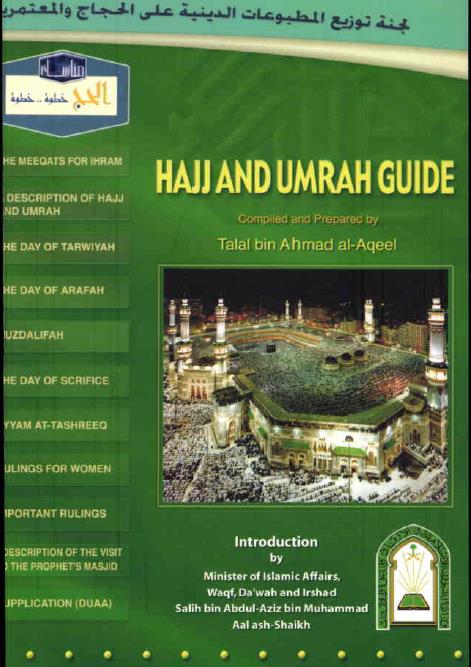
Hajj And Umrah Guide – Compiled by Talal Ahmad al-Aqeel [PDF] [81 Pages]
Introduction by Sheikh Salih Ibn Abdul Aziz Ali Sheikh
This book has illustrative pictures related to the Rites of Hajj and Umrah for easy comprehending of the things
Chapter 11: Shaving the Head
Lessons of Creed Acquired From The Hajj
By Shaykh AbdurRazzaq bin ‘Abdul-Muhsin
Translated by Abbas Abu Yahya
The actions of the day of an-Nahr, the tenth day of the month of Dhul-Hijjah, are indeed four well-known actions which are the stoning, the slaughter, shaving the head and then the Tawaaf. The discussion here will be about shaving the head or shortening the hair as worship for Allaah in obedience to Him and seeking closeness to Him on this great day.
Shaving is completely removing the hair of the head while shortening is lessening the hair of the head all over. Shaving or shortening the hair is one of the obligations of Hajj and Umrah, it is not permissible to leave it, and the evidence is the saying of Allaah Ta’ala:
<< Certainly, you shall enter masjid al-Haram; if Allaah wills, secure, (some) having your heads shaved, and (some) having your head hair cut short, having no fear>> [Fath : 27]
Ibn Qadaamah –Rahimullaah- said:
‘If it was not from the rites of Hajj, Allaah would not have described them this way.’ [1]
It is narrated by Bukhari and Muslim from the hadeeth of Ibn Abbas –RadhiAllaahu anhu- who said:
‘When the Prophet -sallAllaahu alayhi wa sallam- came to Makkah he ordered his Companions to make Tawaaf of the House and of Safa and Marwa, then to come out of Ihraam and shave or shorten their hair.’ [2]
Hence, it is one of the obligations of Hajj and Umrah. So whoever does not shave or shorten their hair, then it is necessary to atone for this by slaughtering a sacrificial animal. It (i.e. shaving/shortening) is a sign that the time period for Ihraam has ended and it imitates the actions of the Messenger – alayhi as-sallat wa sallam- where he shaved his head and ordered his Companions to shave their heads, casting aside their impurities and removing dishevelled hair. Shaving the head is the act of humbly placing the forehead in front of its Lord, due to His greatness, and in submission due to His Honour and it is from the most intense forms of Uboodiyah (worship) for Allaah Azza Wa Jal.
So when the Muslims performs this great act of obedience and important worship in reverence of Allaah and in imitation of the Messenger of Allaah – sallAllaahu alayhi wa sallam- it is obligatory upon him to know that shaving the head or shortening the hair is done to worship and seek closeness to Allaah and that it is not permissible to perform it for anyone other than Allaah –subhanahu wa Ta’ala.
The great Imaam, Shaykh-ul-Islaam ibn Taymeeyah -Rahimullaah– was asked about a people who shave their heads at the command of their shaykhs at such graves as they glorify while regarding it as a means seeking closeness to Allaah and worship: is all of this a Sunnah or a Bida? Is shaving the head, generally, a Sunnah or Bida?
He –Rahimullaah- replied: ‘Shaving the head is of four types:
One of them is shaving the head in Hajj and Umrah and this is from what Allaah and His Messenger -sallAllaahu alayhi wa sallam- have ordered. It is legislated and ordered in the Book, the Sunnah and the consensus of the Ummah.
Allaah Ta’ala said:
<< Certainly, you shall enter masjid al-Haram; if Allaah wills, secure, (some) having your heads shaved, and (some) having your head hair cut short, having no fear>> [Fath : 27]
There are multiple narrations on the authority of the Prophet -sallAllaahu alayhi wa sallamthat he shaved his head in his Hajj and Umrah as did his Companions. From them were those who shaved their heads and some who shortened their hair. Shaving is better than shortening because the Prophet said: ‘O Allaah forgive those who shave their heads.’ The people said, ‘O Messenger of Allaah -sallAllaahu alayhi wa sallam- and those who shorten their hair?’ He said ‘O Allaah forgive those who shave their heads.’ The people said, ‘O Messenger of Allaah -sallAllaahu alayhi wa sallam- and those who shorten their hair?’ He said ‘O Allaah forgive those who shave their heads.’ The people said, ‘O Messenger of Allaah -sallAllaahu alayhi wa sallam- and those who shorten their hair?’ He said: ‘And those who shorten their hair.’ [3]
In the farewell Hajj he -sallAllaahu alayhi wa sallam- commanded the Companions who had brought a sacrificial animal with them to shorten their hair if they had performed Tawaaf of the House and had walked between Safa and Marwa for Umrah and then to shave their heads once they had completed the Hajj. So (in this way) he combined for them, firstly, shortening their hair and, secondly, shaving their heads.
The second type of shaving the head is for a need, such as shaving the head for treatment. This is also permissible according to the Book, the Sunnah and the consensus of the scholars. Indeed Allaah has permitted the Muhrim (pilgrim), for whom it is not usually allowed to have his head shaved until completion of the Hajj rites, to shave his head if he is suffering as Allaah Ta’ala mentions:
<<and do not shave your heads until the Hady (sacrificial animal) reaches the place of sacrifice. And whosoever of you is ill or has an ailment in his scalp (necessitating shaving), he must pay a Fidyah (ransom) of either observing Saum (fasts) (three days) or giving Sadaqah (charity – feeding six poor persons) or offering sacrifice (one sheep) >> [Baqarah :196]
What has been established by agreement of the Muslims is the hadeeth of Ka’b bin Ujraah that when the Prophet -sallAllaahu alayhi wa sallam- passed by him in the Umrah of Al-Hudaybiyah lice were falling from his head, so the Prophet said to him: ‘Are your lice harming you?’ K’ab replied: ‘Yes.’ So the Prophet said: ‘Shave your head and sacrifice a sheep, or fast three days or feed a group of six needy people.’[4]
The authenticity of this Hadeeth is agreed upon and has been received with acceptance by all the Muslims.
The third type of shaving the head is that which is done for worship, religion and Zuhd (abstention from loving worldly things) in other than Hajj or Umrah.
For example, some of the people command the one who repents, once he has repented to shave his head. Similar is the one who shaves the head as a sign of being from the people of rituals and religion or as a sign of the perfection of Zuhd and worship or as a sign that the one who shaves is better, more religious or has more Zuhd than the one who does not.
Then there are those who adhere to certain shaykhs such that if they repent, they shave their heads or they cut some of his hair. So the shaykh specifies who should have the scissors and prayer rug so he can pray on that rug (and not with the Muslims). His cutting hair from the heads of the people is from the complete authority befitting him and someone who is imitated in order to make the people repent.
So all of this is Bida’ which has neither been commanded by Allaah, nor by His Messenger -sallAllaahu alayhi wa sallam. It is not obligatory nor has it been recommended by any one scholar of the Deen. Not one of the Companions did this, nor did any of those who followed the companions in goodness, neither the scholars of the Muslims who were well known for Zuhd and worship nor the Companions, the successors or those who came after them.
There were those who accepted Islam at the time of the Prophet -sallAllaahu alayhi wa sallam- but he never used to order them to shave their heads if they entered Islaam nor did he cut anyone’s hair. He didn’t pray on a rug but, rather, he used to pray as an Imaam with all the Muslims. He used to pray on what they used to pray, sit where they used to sit and he never used to make himself distinct from them by sitting on something special, whether a prayer rug or anything else.
Whoever takes this Bida’ -which is not obligatory or even recommended- as a means of seeking closeness and obedience or as a path to Allaah making it a completion of the Deen or orders the repentant to do it, both the Zahid (the one who abstains from loving worldly things) and the worshipper, then he is a misguided person outside the path of ar-Rahmaan (Allaah the Most Merciful), following the footsteps of the Shayateen.’
Then Shaykh ul-Islaam –Rahimullaah- mentioned the fourth type of shaving the head which is shaving the head as other than a ritual or for other than a need, neither seeking closeness to Allaah nor seeking to be religious. He mentions that the people of knowledge have two opinions regarding this, which are two narrations attributed to Imaam Ahmad.
The first is that it is disliked and this is the Madhab of Maalik and others. The second is that it is permissible and this is well known amongst the companions of Abu Haneefa and ash-Shafi’ee.
Then Imaam Ahmad mentions the evidence that the scholars use for each of these sayings. [5]
Imaam Ibn al-Qayyim mentions a similar division to what has preceded in his book ‘Zaad al-Ma’ad’. He mentions that from the different types of shaving the head there is one that is Shirk and one that is Bida’. Shirk being the one shaving his head for other than Allaah –Subhaanhu- such as those who follow shaykhs and who shave their heads for their shaykhs.
One of them will say:
‘I have shaved my head for so-and-so and you have shaved your head for soand-so.’ This is the same as saying: ‘I have done Sadjah (prostration) for so- and-so,’ because shaving the head is done with humility, in worship and with submissiveness and it is done for the completion of Hajj.
Then he mentions that the misguided shaykhs deceive their followers by causing them to shave their heads for them, just as they mislead them into prostrating to them. [6]
All of this is clear Shirk and a great lie, we ask Allaah for security.
Footnotes:
[1] Al-Mughni (5/305)
[2] Saheeh al-Bukharee
[3] Saheeh al-Bukharee & Saheeh Muslim
[4] Saheeh al-Bukharee & Saheeh Muslim
[5] Majmoo’al-Fatwa (21/116-119)
[6] Za’d al-Ma’ad (4/159-160)


 AbdurRahman.Org
You must be logged in to post a comment.